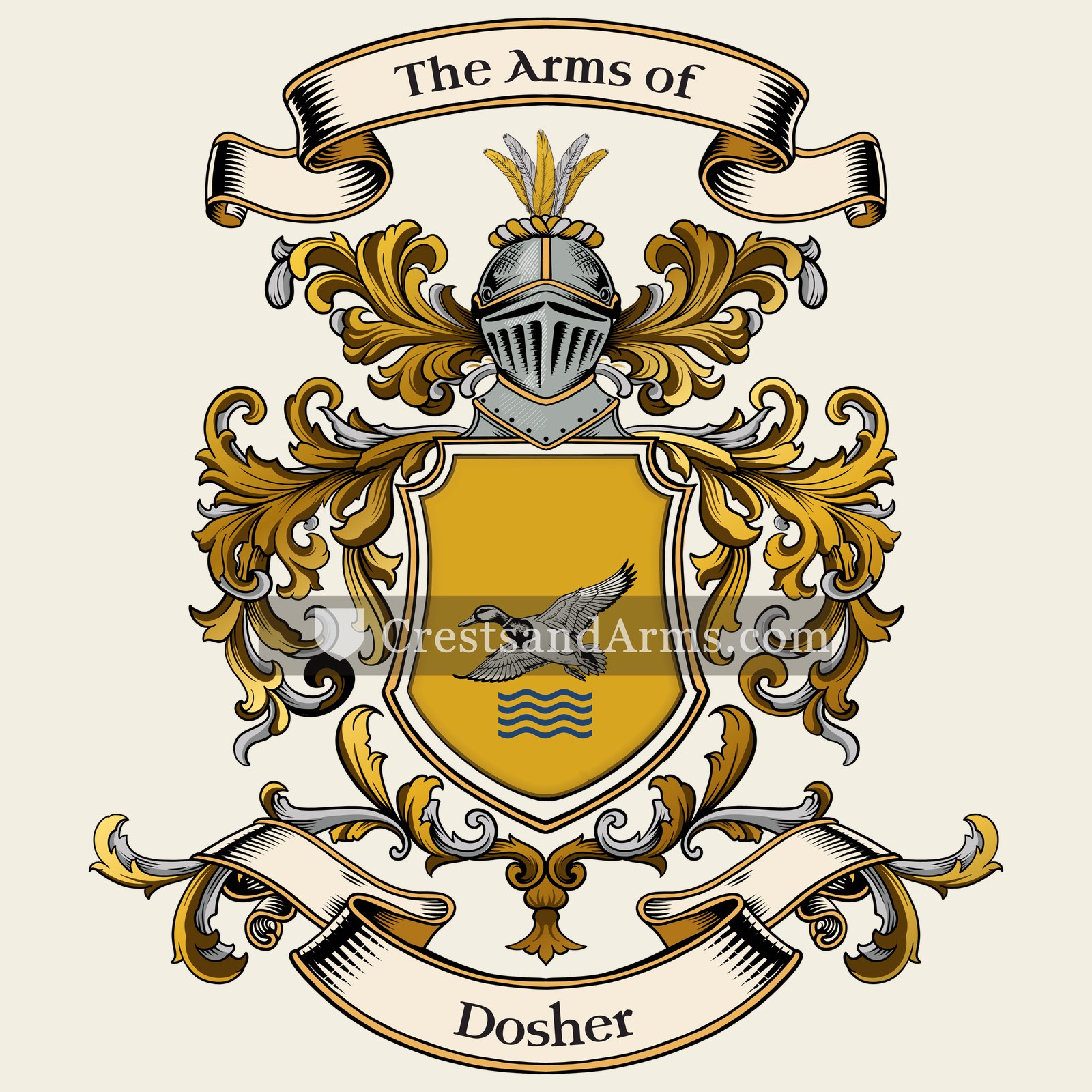
A record of documented arms, meaning and origin, researched for the Dosher family of Germany.
Reg. 1347 · German, D–F
Coat of Arms & Family Crest Details
Symbols on this shield
duckResourcefulness on land and water
riverThe bounds of a land, and life carried through it
Colours
Gold (Or)Means: Generosity
Silver (Argent)Means: Peace and sincerity
Blue (Azure)Means: Loyalty and truth
Historical info
Source
J. B. Rietstap, Armorial Général, Gouda: G. B. van Goor Zonen, 1884–87
Blazon (the actual original written record)
“D'or à une canette d'arg., nageante dans une eau d'azur en p. C.: un coeur de gu., enflammé du même, percé de deux flèches d'arg., empennées d'azur, passées en saut. L. d'or et d'azur.”
GermanyNuremberg, c. 1765
Digital archive packCoat of arms PNG, gold border print PDF, vector SVG and the certificate of authenticity. Sent to your email in minutes.
Map of Germany showing where the Dosher arms are recorded
The Dosher arms were recorded in Nuremberg, c. 1765.
This is where the arms were entered in the register. Families often moved to other parts of the country, so the same name can turn up in more than one region.
The body that granted and recorded arms in Germany in this period.
Francis I, Holy Roman Emperor
Sovereign of the period
Francis I, Holy Roman Emperor
1745–1765
Reigning in Germany when the Dosher arms are first recorded.
How Arms Worked in Germany
In the Holy Roman Empire, coats of arms were often granted to individuals by the Emperor or his representatives. These arms were then passed down through the generations to all legitimate descendants of the original holder. Younger branches of a family usually kept the same shield design without needing to change it, as the arms belonged to the entire lineage.
Granting authority
The Holy Roman Emperor held the sole power to grant new coats of arms throughout his vast imperial territories.
How they got arms
Families typically obtained their coats of arms through a formal imperial grant or by proving their noble status to the authorities.
Where arms were recorded
These grants were officially recorded in the Imperial Chancery registers, which began keeping formal records of such honors during the Middle Ages.
The family's standing
Recorded among the armigerous families of Germany.
Origin & History of the Dosher Family in Germany
The family name Dosher traces its roots to the vibrant city of Nuremberg, where members of the family were firmly established by the year 1765. During this period, Nuremberg served as a major center for trade and skilled craftsmanship in the Holy Roman Empire. Families living in the city at that time were often deeply involved in the guilds that defined the local economy. The name likely evolved from regional dialects spoken in the Franconian area of Germany, where naming conventions often reflected a person’s occupation or their specific place of origin. As the family grew, they participated in the social and economic life of the city, contributing to the industrious reputation that Nuremberg held throughout the eighteenth century. By remaining in such a significant urban hub, the early members of the Dosher family were positioned at the intersection of European commerce and cultural development.
Dosher Meaning & Related Branches
Root word
Tascher
A maker or seller of pouches, bags, or purses.
This name
DosherAn occupational surname for a craftsman who produced leather bags or pouches.
also spelled
Dauchere
Daucherr
Dosher
Documented Sources
J. B. Rietstap, Armorial Général, Gouda: G. B. van Goor Zonen, 1884–87
Stadtarchiv Nürnberg, Bürgerbücher der Stadt Nürnberg (1765)
Endres, Rudolf, Nürnberg im 18. Jahrhundert (1970)
Schultheiß, Werner, Die reichsstädtische Gesellschaft Nürnbergs (1956)
Digital archive packCoat of arms PNG, gold border print PDF, vector SVG and the certificate of authenticity. Sent to your email in minutes.


 duckResourcefulness on land and water
 riverThe bounds of a land, and life carried through it
 duckResourcefulness on land and water
 riverThe bounds of a land, and life carried through it