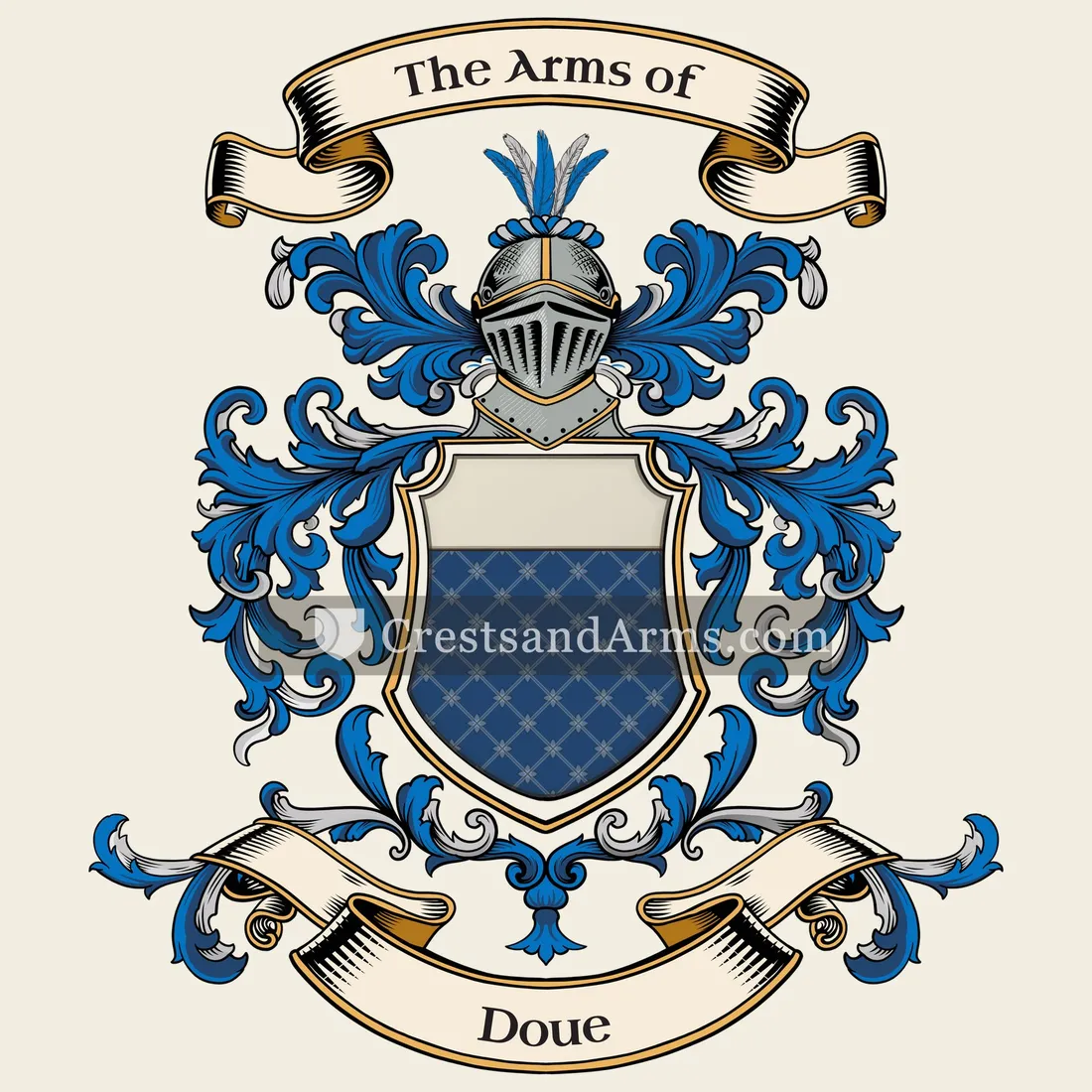
A record of documented arms, meaning and origin, researched for the Doue family lines. Documented in 3 countries.
Reg. 6901 · Danish, D–F
Meaning of the Doue family crest colors & symbols
Colours
Red (Gules)Means: Military strength
Gold (Or)Means: Generosity
Historical info
Source
J. B. Rietstap, Armorial Général, Gouda: G. B. van Goor Zonen, 1884–87
Blazon (the actual original written record)
“Ec. de gu. et d'or. C.: deux prob., coupées alt. d'or et de gu. - 2° D'arg. à une aigle sans pattes, de sa. - 3° D'arg. à trois oiseaux au nat. C.: un oiseau au nat., les ailes étendues. - 4° (An., 30 déc. 1641.) D'azur à trois colombes d'arg. C.: une colombe d'arg. - 5° D'arg. à un oiseau perché sur un tronc d'arbre d'or, le tout soutenu d'une terrasse de gu. C.: l'oiseau perché sur les créneaux d'une tour sans porte ni fenêtres de gu.”
Denmarkc. 1722
Digital archive packCoat of arms PNG, gold border print PDF, vector SVG and the certificate of authenticity. Sent to your email in minutes.
Map of Denmark showing where the Doue arms are recorded
The Doue arms were recorded in Denmark, c. 1722.
Arms such as these were typically recorded in Sjaælland.
Zealand held the Danish court, the crown's offices and Copenhagen itself. Families who served the king kept estates within reach of it, and royal service was the ordinary route to a coat of arms.
This is where the arms were entered in the register. Families often moved to other parts of the country, so the same name can turn up in more than one region.
The body that granted and recorded arms in Denmark in this period.
Frederik IV of Denmark
Sovereign of the period
Frederik IV of Denmark
1699–1730
Reigning in Denmark when the Doue arms are first recorded.
How Arms Worked in Denmark
Danish heraldry during this period was closely tied to noble status and royal favor rather than being open to all citizens. Arms were typically granted by the monarch to individuals, and these symbols were then shared by all members of the noble house. If a family line died out, the right to use those specific arms ended with them.
Granting authority
The Danish royal chancery held the power to issue and regulate official coats of arms for the kingdom.
How they got arms
Families usually received their arms through a formal royal grant that confirmed their noble status and rights.
Where arms were recorded
These grants were officially recorded in the Danish Royal Chancery records starting in the sixteenth century.
The family's standing
Recorded among the armigerous families of Denmark.
Origin & History of the Doue Family in Denmark
The history of the Doue family in Denmark begins with documented records appearing on the island of Sjælland in 1722. During this period, the name was closely associated with the social and professional structures of the Danish state, often appearing in administrative and military registers. Families with this surname were typically integrated into the local community through service to the crown or through land management roles. Because Sjælland served as the political and economic heart of the country, the presence of the Doue family there suggests they were part of the growing middle class that helped maintain the stability of the Danish kingdom during the eighteenth century. Over time, the family established roots in the region, adapting to the shifting cultural landscape of Denmark while maintaining their distinct identity through generations of local residency.
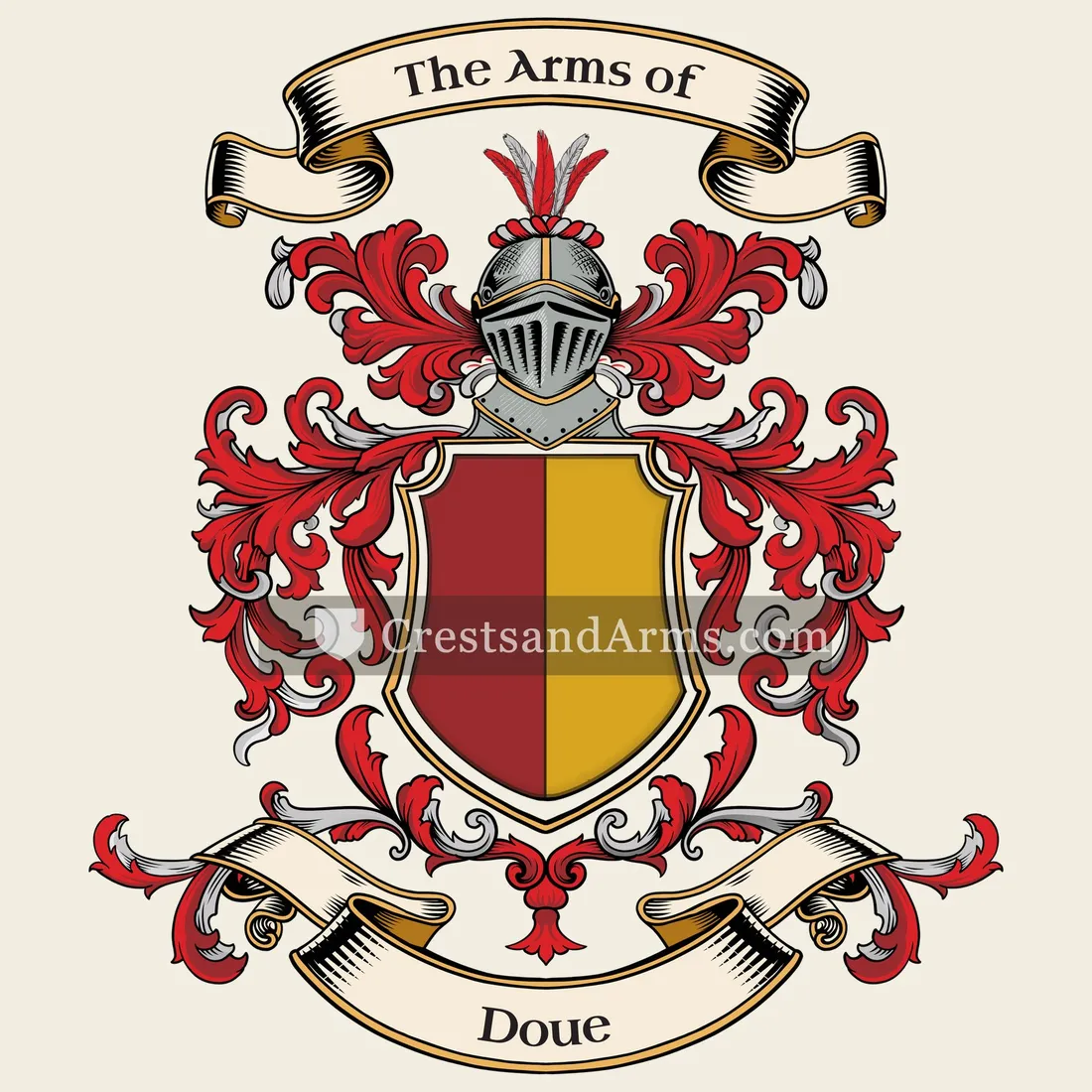
Meaning of the Doue family crest colors & symbols
Symbols on this shield
mountThe ground held, and steadfastness upon it
treeLife, endurance and deep roots
Colours
Gold (Or)Means: Generosity
Black (Sable)Means: Constancy
Historical info
Source
J. B. Rietstap, Armorial Général, Gouda: G. B. van Goor Zonen, 1884–87
Blazon (the actual original written record)
“D'or à un tronc d'arbre de sa., poussant de chaque côté une feuille de sin. et posé sur une terrasse de même. C.: trois plumes de paon au nat., entre deux chicots de sa., poussant chacun à l'ext. une feuille de sin.”
LivoniaLivonia, c. 1772
Digital archive packCoat of arms PNG, gold border print PDF, vector SVG and the certificate of authenticity. Sent to your email in minutes.
Map of Poland showing where the Doue arms are recorded
The Doue arms were recorded in Livonia, c. 1772.
Livonia was Baltic country held by a small number of landed families who kept their estates for centuries. Land there passed down whole rather than being divided, and long unbroken tenure is what fills a register.
This is where the arms were entered in the register. Families often moved to other parts of the country, so the same name can turn up in more than one region.
Region
Livonia
First recorded
1772
Granting Authority for the Doue Arms
Ennoblement by the Sejm
Author: Olek Remesz · CC BY-SA 3.0
The body that granted and recorded arms in Poland in this period.
Stanisław August Poniatowski
Sovereign of the period
Stanisław August Poniatowski
1764–1795
Reigning in Denmark when the Doue arms are first recorded.
How Arms Worked in Poland
Polish noble families shared a single coat of arms across many different surnames, creating large clans rather than individual designs. These symbols were held collectively by all members of the clan regardless of their specific family name. When a new family joined the nobility, they were adopted into an existing clan and began using that group's established shield.
Granting authority
The Sejm, which was the Polish parliament, held the power to grant noble status and the right to bear arms.
How they got arms
Families typically received their coat of arms through a formal act of ennoblement granted by the Sejm for distinguished service.
Where arms were recorded
These grants were officially recorded in the Crown Metrica, which served as the central archive for state documents starting in the sixteenth century.
The family's standing
Recorded among the armigerous families of Livonia.
Origin & History of the Doue Family in Poland
The history of the Doue family in the region of Livonia begins during a period of significant political transition in the late eighteenth century. By 1772, when the First Partition of Poland brought parts of Livonia under the influence of the Russian Empire, members of the family were already established within the local social structure. The name likely reflects the diverse linguistic landscape of the Baltic provinces, where German, Polish, and Baltic influences often merged in official records. During this era, families like the Doues were often involved in the management of land or the administration of local estates. As the borders of the Polish-Lithuanian Commonwealth shifted, the family navigated the complex requirements of regional authorities to maintain their status. Their presence in the area suggests they were part of a mobile class of people who moved across borders to serve in administrative or agricultural roles. This early period set the foundation for the family to adapt to the changing governance of the region throughout the following century.
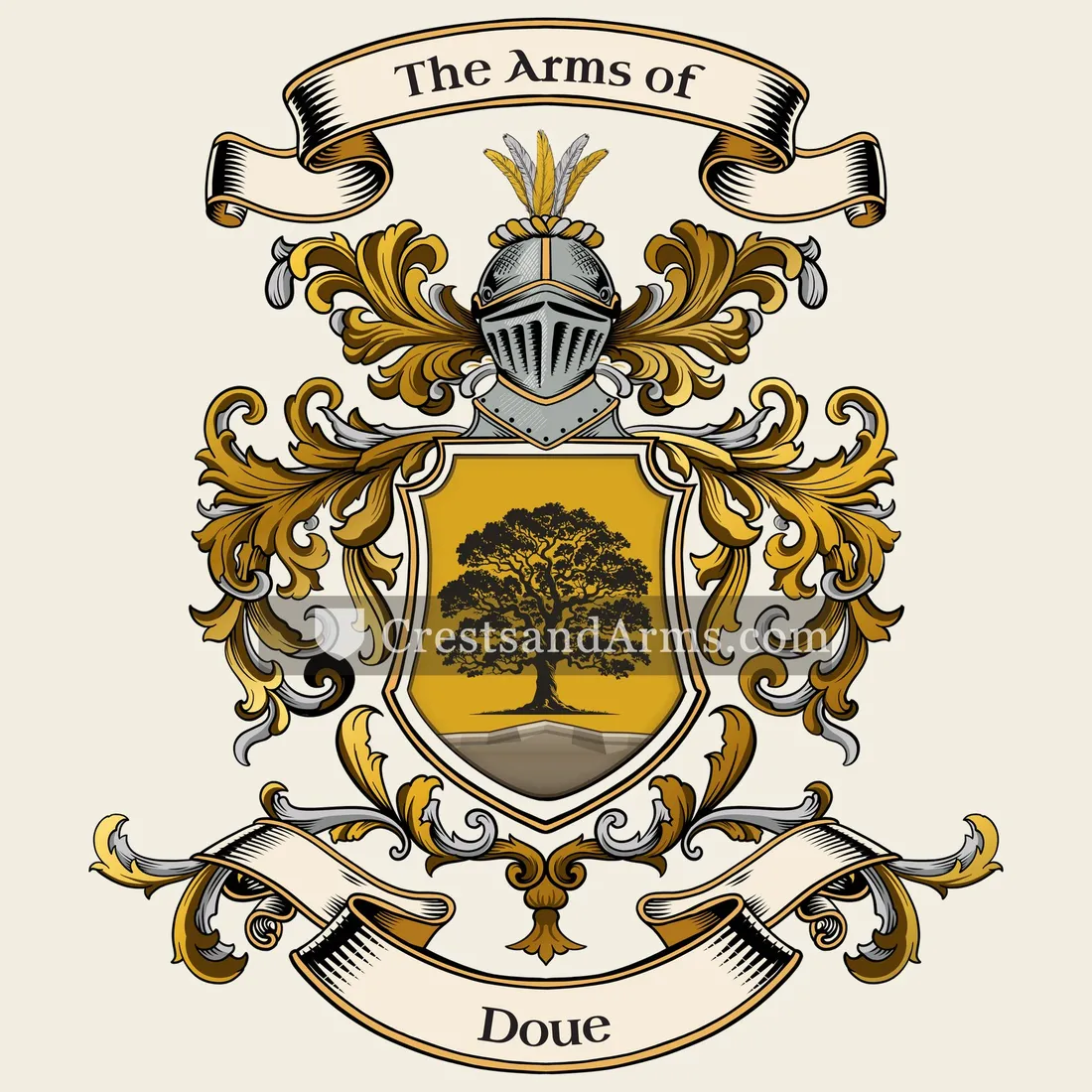
Meaning of the Doue family crest colors & symbols
Symbols on this shield
chiefAuthority, wisdom and dominion
Colours
Blue (Azure)Means: Loyalty and truth
Silver (Argent)Means: Peace and sincerity
Historical info
Source
Sir Bernard Burke, The General Armory of England, Scotland, Ireland and Wales, London: Harrison & Sons, 1884
Blazon (the actual original written record)
“Az. a chief indented ar”
Englandc. 1620
Digital archive packCoat of arms PNG, gold border print PDF, vector SVG and the certificate of authenticity. Sent to your email in minutes.
Map of England showing where the Doue arms are recorded
The Doue arms were recorded in England, c. 1620.
Arms such as these were typically recorded in York.
Yorkshire is the largest of the English counties, and it held more gentry families than any other. Land there was split among a great many households rather than a few, so a great many of them carried arms.
This is where the arms were entered in the register. Families often moved to other parts of the country, so the same name can turn up in more than one region.
The body that granted and recorded arms in England in this period.
James VI and I
Sovereign of the period
James VI and I
1603–1625
Reigning in Denmark when the Doue arms are first recorded.
How Arms Worked in England
English heraldry allowed arms to be shared by all legitimate descendants of the original owner. These symbols were treated as personal property that moved through the generations to all children. While the eldest son kept the original design, other family members could use the same shield without needing to change it or register their own unique versions.
Granting authority
The College of Arms in London has regulated the use of coats of arms throughout England and Wales since 1484.
How they got arms
Families typically obtained their coats of arms through a formal grant from the Crown or by proving their ancient right to them.
Where arms were recorded
All official coats of arms are recorded in the registers kept at the College of Arms, which date back to the fifteenth century.
The family's standing
Recorded among the armigerous families of England.
Origin & History of the Doue Family in England
The family name Doue carries a history that stretches back to the early seventeenth century in the historic city of York. By 1620, records indicate that members of the family were already established residents within this northern English hub. During this period, York was a center of trade and religious transition, and families like the Doues were likely involved in the local merchant guilds or the skilled trades that defined the city’s economy. The name itself is thought to have roots in Old French or Norman traditions, suggesting that the family’s ancestors may have arrived in England centuries before they appeared in the York parish registers. As the family settled into the social fabric of the city, they became part of the growing urban population that navigated the political and religious shifts of the Stuart era. Their presence in 1620 marks them as part of a long-standing lineage that helped shape the local community during a time of significant change in Northern England.
Doue Meaning & Related Branches
Root word
Duo
Latin term meaning two or a pair.
This name
DoueA topographical or habitational name likely referring to a person living near a dual landmark.
also spelled
Duet
Duée
Du
Doo
Dewe
Documented Sources
J. B. Rietstap, Armorial Général, Gouda: G. B. van Goor Zonen, 1884–87
Rigsarkivet (Danish National Archives), Kirkebøger for Sjællands Stift (Parish registers for the Diocese of Sjælland), 1722
Rigsarkivet (Danish National Archives), Danske Kancelli: Supplikprotokoller (Danish Chancery: Petition protocols), 1722
Digital archive packCoat of arms PNG, gold border print PDF, vector SVG and the certificate of authenticity. Sent to your email in minutes.




 mountThe ground held, and steadfastness upon it
 treeLife, endurance and deep roots


 chiefAuthority, wisdom and dominion