A record of documented arms, meaning and origin, researched for the Douglass family lines. Documented in 3 countries.
Reg. 3063 · Britain, D–F
Coat of Arms & Family Crest Details
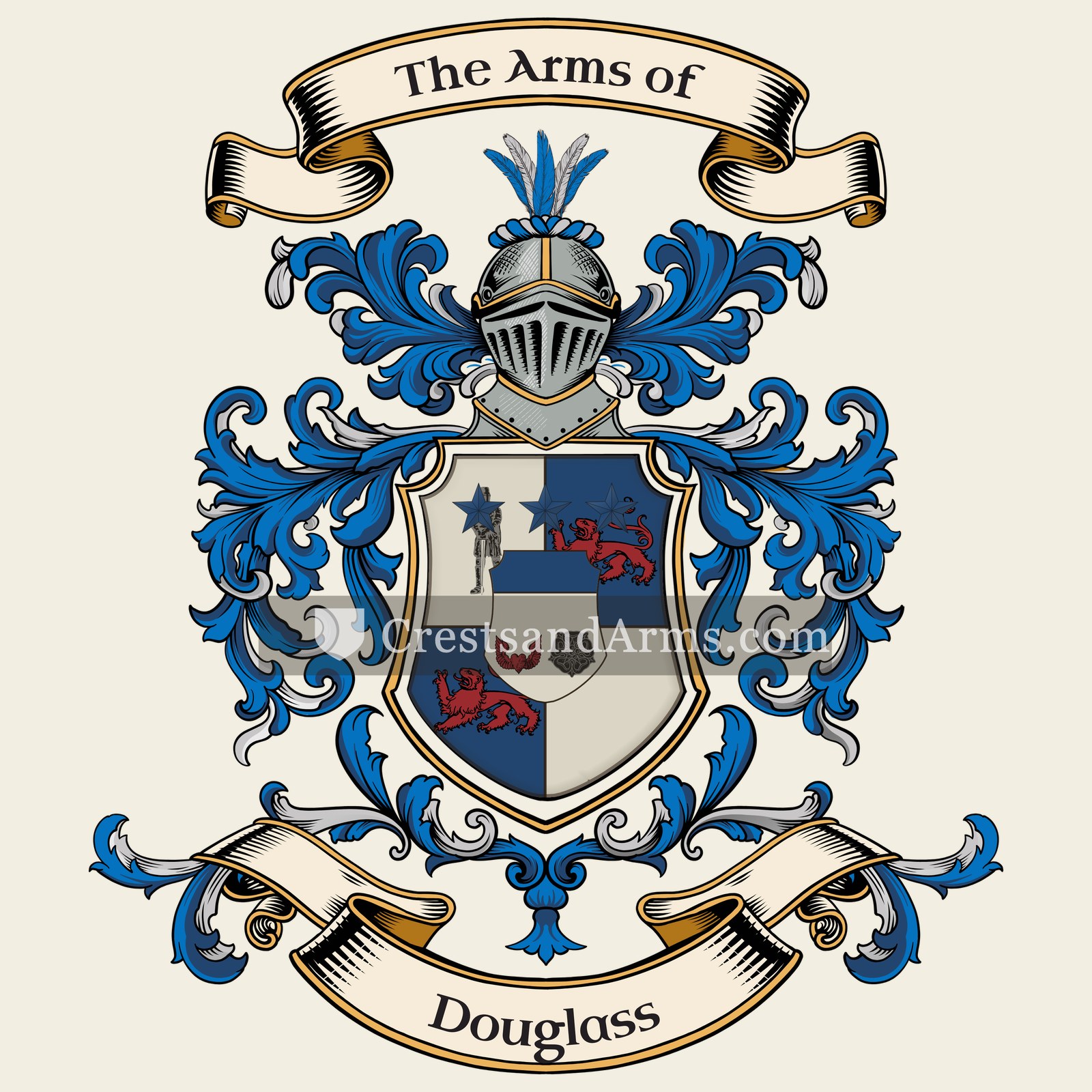
Symbols on this shield
chiefAuthority, wisdom and dominion
heartSincerity, charity and true affection
mulletThe third son, and a divine quality from above
Colours
Silver (Argent)Means: Peace and sincerity
Blue (Azure)Means: Loyalty and truth
Red (Gules)Means: Military strength
Historical info
Source
J. B. Rietstap, Armorial Général, Gouda: G. B. van Goor Zonen, 1884–87
Blazon (the actual original written record)
“D'arg. à un coeur de gu., surm. d'une couronne royale d'or; au chef d'azur, ch. de trois étoiles du champ. C.: une salamandre entourée de flammes, au nat.”
Britainc. 1700
Digital archive packCoat of arms PNG, gold border print PDF, vector SVG and the certificate of authenticity. Sent to your email in minutes.
Map of Britain showing where the Douglass arms are recorded
The Douglass arms were recorded in Britain, c. 1700.
Arms such as these were typically recorded in Kent.
Kent sits between London and the short crossing to Europe, and the trade passing through made it wealthy. Merchant families bought land with that money, and it was landowners who took coats of arms.
This is where the arms were entered in the register. Families often moved to other parts of the country, so the same name can turn up in more than one region.
The body that granted and recorded arms in Britain in this period.
William III of England
Sovereign of the period
William III of England
1694–1702
Reigning in Britain when the Douglass arms are first recorded.
How Arms Worked in Britain
English heraldry allowed arms to be shared by all legitimate descendants of the original owner. These symbols were treated as personal property that moved through the generations to all children. While the eldest son kept the original design, other family members could use the same shield without needing to change it or register their own unique versions.
Granting authority
The College of Arms in London has regulated the use of coats of arms throughout England and Wales since 1484.
How they got arms
Families typically obtained their coats of arms through a formal grant from the Crown or by proving their ancient right to them.
Where arms were recorded
All official coats of arms are recorded in the registers kept at the College of Arms, which date back to the fifteenth century.
The family's standing
Recorded among the armigerous families of Britain.
Origin & History of the Douglass Family in Britain
The surname Douglass is a variation of the Scottish name Douglas, which originates from the Gaelic words meaning dark water. While the name is famously associated with the powerful clans of the Scottish Lowlands, branches of the family moved south into England over several centuries. By the year 1700, records confirm that members of the family had established themselves in the county of Kent. During this period, Kent was a bustling region shaped by trade and its proximity to London, making it a common destination for families seeking new opportunities. These early residents were likely part of a broader movement of people traveling between the northern borders and the southern English countryside. As they settled into their new communities, they integrated into the local social and economic life of the region, carrying their ancestral name into a new geographic landscape.
Coat of Arms & Family Crest Details
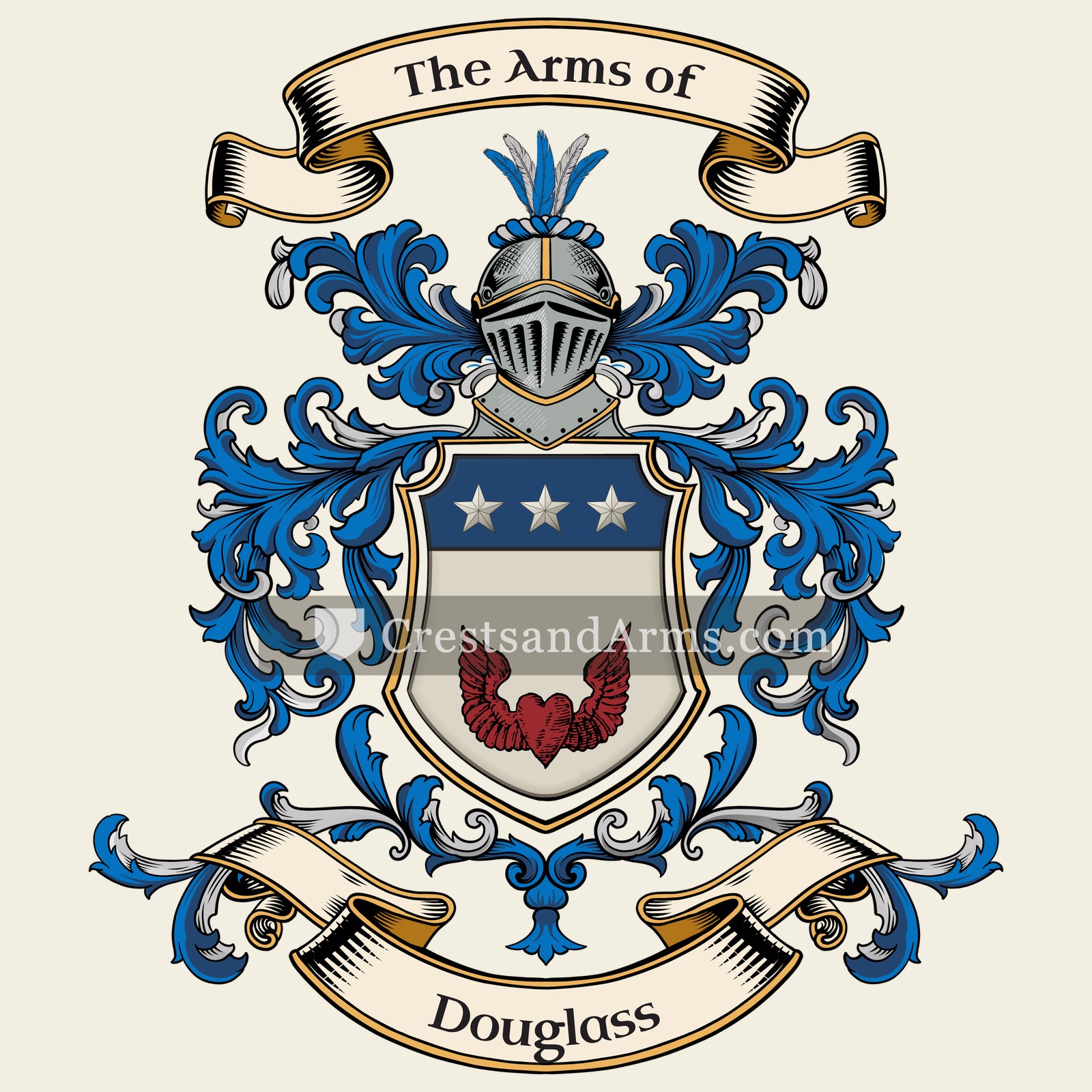
Symbols on this shield
chiefAuthority, wisdom and dominion
bordureA difference between branches of one family
heartSincerity, charity and true affection
mulletThe third son, and a divine quality from above
Colours
Silver (Argent)Means: Peace and sincerity
Blue (Azure)Means: Loyalty and truth
Red (Gules)Means: Military strength
Historical info
Source
J. B. Rietstap, Armorial Général, Gouda: G. B. van Goor Zonen, 1884–87
Blazon (the actual original written record)
“D'arg. à un coeur de gu., surm. d'une couronne royale d'or; au chef d'azur, ch. de trois étoiles du champ; l'écu entouré d'une bordure entée d'azur. C.: un bras de carn., tenant une lance brisée au nat., surm. de la Légende: DO OR DIE.”
Netherlandsc. 1815
Digital archive packCoat of arms PNG, gold border print PDF, vector SVG and the certificate of authenticity. Sent to your email in minutes.
Map of Netherlands showing where the Douglass arms are recorded
The Douglass arms were recorded in Netherlands, c. 1815.
Arms such as these were typically recorded in Friesland.
Friesland was low, wet country on the northern coast of the Netherlands, farmed by families who had held the same land for centuries. Free landholders were unusually common there, and a free landholder could carry arms.
This is where the arms were entered in the register. Families often moved to other parts of the country, so the same name can turn up in more than one region.
Region
Friesland
First recorded
1815
Granting Authority for the Douglass Arms
Hoge Raad van Adel
Photograph made by me · CC BY-SA 3.0
The body that granted and recorded arms in Netherlands in this period.
William I of the Netherlands
Sovereign of the period
William I of the Netherlands
1815–1840
Reigning in Britain when the Douglass arms are first recorded.
How Arms Worked in Netherlands
In the Netherlands, coats of arms were often used by noble families and those who held specific public offices. These arms were passed down through the generations to legitimate descendants. Younger branches of a family usually kept the original design without needing to add special marks. This system ensured that the family identity remained clear and consistent over many years.
Granting authority
The Hoge Raad van Adel is the official body that regulates and manages noble titles and coats of arms in the Netherlands.
How they got arms
Families typically obtained their coats of arms through official royal grants or by proving their long-standing historical use of the symbols.
Where arms were recorded
Coats of arms are officially recorded in the registers held by the Hoge Raad van Adel, which began its work in 1814.
The family's standing
Recorded among the armigerous families of Netherlands.
Origin & History of the Douglass Family in Netherlands
The history of the Douglass name in the Netherlands is deeply connected to the movement of people across the North Sea during the early nineteenth century. While the name is traditionally associated with Scottish roots, records confirm that family members were established in the province of Friesland by 1815. During this period, the Netherlands was undergoing significant political changes following the Napoleonic Wars, and the government began requiring citizens to register their surnames formally. Families like the Douglasses who settled in the Frisian region often integrated into local maritime and agricultural communities. They adapted to the Dutch language and legal systems while maintaining their ancestral identity. This transition highlights how international families became part of the Dutch social fabric during a time of national reconstruction.
Coat of Arms & Family Crest Details
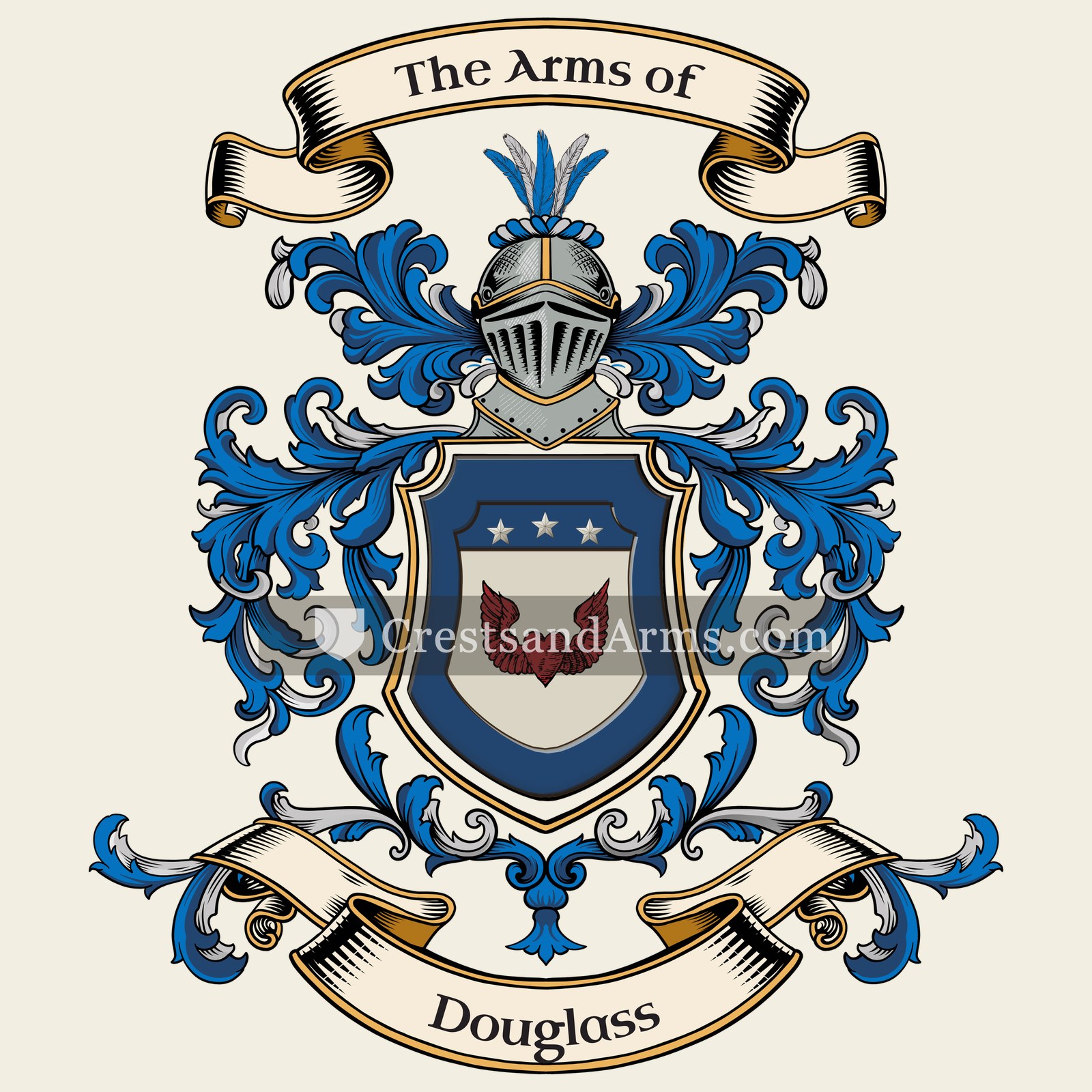
Symbols on this shield
chiefAuthority, wisdom and dominion
mulletThe third son, and a divine quality from above
knightChivalry and service in arms
lionCourage, strength and royalty
heartSincerity, charity and true affection
roseThe seventh son, and beauty with grace
Colours
Silver (Argent)Means: Peace and sincerity
Blue (Azure)Means: Loyalty and truth
Red (Gules)Means: Military strength
Black (Sable)Means: Constancy
Historical info
Source
J. B. Rietstap, Armorial Général, Gouda: G. B. van Goor Zonen, 1884–87
Blazon (the actual original written record)
“Ec.: au 1 d'arg. à un cavalier, arm. de toutes pièces d'arg., tenant un bâton de commandement, monté sur un cheval de sa. houssé de gu., soutenu de sin.; aux 2 et 3 d'azur au lion de gu., tenant de sa patte dextre une palme d'arg. et de sa sen. un caillou du même; au 4 d'arg. à un fantassin, la tunique, la culotte et le chapeau de gu., le panache et l'écharpe d'arg., les bottes de sa.; appuyant sa main dextre sur un mousquet, la crosse en bas. Sur le tout un écusson d'arg., cour. d'or, ch. d'un coeur de gu., surm. d'une couronne royale d'or, le tout br. sur une rose à cinq feuilles de sa.; au chef d'azur, soutenu de gu. et ch. de trois étoiles d'arg. Trois cq. cour. C.: 1º un lion iss. de gu., tenant de sa patte dextre une palme de sin. et de sa sen. une épée d'arg., mouv. d'une tour du même; 2º une salamandre au nat., entourée de flammes de gu.; 3º le cavalier du 1. L.: à dextre d'arg. et de gu., à sen. d'or et d'azur. S.: deux licornes d'arg.”
SwedenBade, c. 1654
Digital archive packCoat of arms PNG, gold border print PDF, vector SVG and the certificate of authenticity. Sent to your email in minutes.
Map of Sweden showing where the Douglass arms are recorded
The Douglass arms were recorded in Bade, c. 1654.
Arms such as these were typically recorded in Stockholm.
Stockholm held the Swedish court and the House of Nobility, where every noble family's arms were entered and kept. Families ennobled for service registered there, which is why so many are recorded around the city.
This is where the arms were entered in the register. Families often moved to other parts of the country, so the same name can turn up in more than one region.
The body that granted and recorded arms in Sweden in this period.
Christina of Sweden
Sovereign of the period
Christina of Sweden
1632–1654
Reigning in Britain when the Douglass arms are first recorded.
How Arms Worked in Sweden
In Sweden, a coat of arms belonged to a noble family as a whole rather than just one individual. These arms were passed down through the generations to all legitimate descendants. Younger branches of the family used the same shield without needing to change it. This system ensured that the entire lineage shared the same identity and status under the law.
Granting authority
The Riddarhuset, or House of Nobility, regulated all noble coats of arms in Sweden under royal authority.
How they got arms
Families received their coats of arms through royal grants of nobility which were then officially registered with the House.
Where arms were recorded
Coats of arms were officially recorded in the Swedish House of Nobility register starting in the year 1626.
The family's standing
Recorded among the armigerous families of Sweden.
Origin & History of the Douglass Family in Sweden
The Douglass family name arrived in Sweden during a time of significant political and military expansion in the seventeenth century. Robert Douglas, a Scottish soldier of fortune, settled in the country and became a prominent figure in the Swedish military hierarchy. By 1654, members of the family were well-established in Stockholm, where they integrated into the upper levels of Swedish society. The name itself underwent a linguistic shift as it adapted to the local phonetic patterns of the Swedish language. Over time, the family transitioned from being seen as foreign mercenaries to becoming deeply rooted members of the Swedish nobility. Their presence in the capital city allowed them to influence court life and participate in the complex administrative affairs of the Swedish Empire. This transition highlights how a Scottish surname became a permanent fixture within the Scandinavian historical landscape.
Douglass Meaning & Related Branches
Root word
dubh glas
Gaelic words meaning dark or black and stream or water.
This name
DouglassDerived from a Scottish river name signifying a dark, black stream or water.
also spelled
Douglass
Douglis
Duglas
Douglasse
Documented Sources
J. B. Rietstap, Armorial Général, Gouda: G. B. van Goor Zonen, 1884–87
Black, George Fraser, The Surnames of Scotland: Their Origin, Meaning, and History, 1946
Reaney, Percy Hide, A Dictionary of British Surnames, 1958
The National Archives, Parish registers for the county of Kent, 1700
Digital archive packCoat of arms PNG, gold border print PDF, vector SVG and the certificate of authenticity. Sent to your email in minutes.


 chiefAuthority, wisdom and dominion
 heartSincerity, charity and true affection
 mulletThe third son, and a divine quality from above
 chiefAuthority, wisdom and dominion
 heartSincerity, charity and true affection
 mulletThe third son, and a divine quality from above


 bordureA difference between branches of one family


 knightChivalry and service in arms
 lionCourage, strength and royalty
 roseThe seventh son, and beauty with grace