Map of France showing where the Dour arms are recorded
The Dour arms were recorded in Picardie, c. 1663.
Picardie lay on the northern road into France and saw armies pass through it repeatedly. Its landowners were soldiers as often as farmers, and a soldier needed a shield he could be recognised by.
This is where the arms were entered in the register. Families often moved to other parts of the country, so the same name can turn up in more than one region.
The body that granted and recorded arms in France in this period.
Louis XIV of France
Sovereign of the period
Louis XIV of France
1643–1715
Reigning in France when the Dour arms are first recorded.
How Arms Worked in France
In France, a coat of arms was a mark of honor that passed down through the male line to all legitimate descendants. Families often used the same shield without changes to show their shared heritage. If a branch wanted to stand out, they could add a small mark to their shield to show their specific place in the family tree.
Granting authority
The Juge d'armes de France acted as the official authority that regulated and verified coats of arms across the country.
How they got arms
Families typically inherited their arms from ancestors, though they could also receive them through royal grants or by proving their noble status.
Where arms were recorded
Coats of arms were officially recorded in the Armorial Général de France, which began its main collection in the year 1696.
The family's standing
Recorded among the armigerous families of Picardie.
Origin & History of the Dour Family in France
The family name Dour traces its roots back to the northern regions of France, with firm historical evidence placing the family in the province of Picardie by the year 1663. During this period, Picardie served as a vital agricultural and strategic region, often shaped by the shifting borders between the French kingdom and the neighboring territories of the Spanish Netherlands. Families living in this area were frequently tied to the land and local parish communities, where records of births, marriages, and deaths were meticulously kept by the church. The name likely evolved from local geographic markers or descriptive nicknames common to the people of the Picardy plains. As the family established itself in this rural landscape, they became part of the intricate social fabric of northern France, living through an era defined by agricultural development and the centralized growth of the French state under King Louis XIV.
Coat of Arms & Family Crest Details
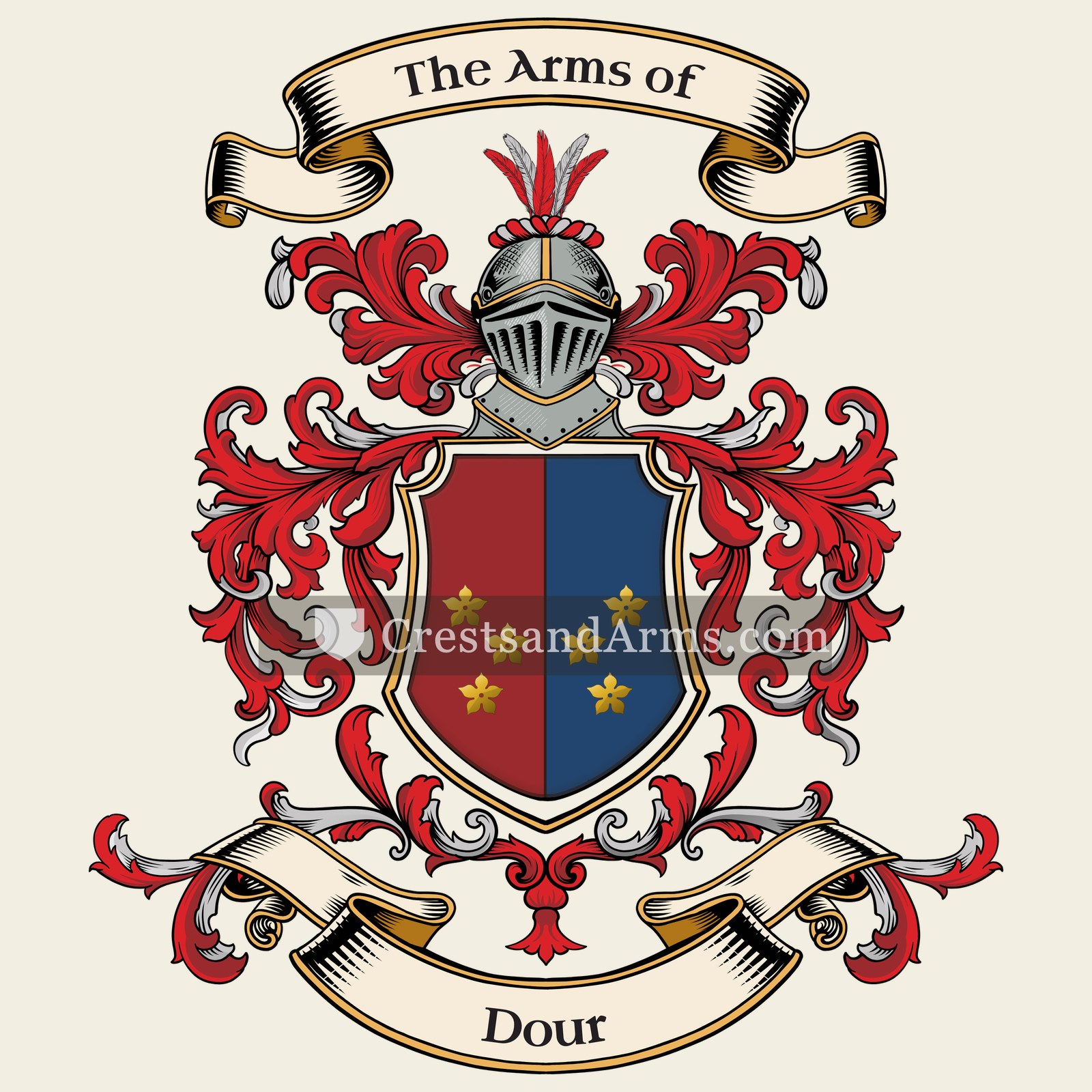
Symbols on this shield
cinquefoilHope and joy
Colours
Red (Gules)Means: Military strength
Blue (Azure)Means: Loyalty and truth
Gold (Or)Means: Generosity
Historical info
Source
Sir Bernard Burke, The General Armory of England, Scotland, Ireland and Wales, London: Harrison & Sons, 1884
Blazon (the actual original written record)
“Per pale gu. and az. three cinquefoils or”
WorcesterWorcester, c. 1620
Digital archive packCoat of arms PNG, gold border print PDF, vector SVG and the certificate of authenticity. Sent to your email in minutes.
Map of England showing where the Dour arms are recorded
The Dour arms were recorded in Worcester, c. 1620.
Worcestershire was orchard and farming country with a scattering of old manors. Its gentry were middling rather than great, but a manor was a manor, and holding one was what brought arms.
This is where the arms were entered in the register. Families often moved to other parts of the country, so the same name can turn up in more than one region.
The body that granted and recorded arms in England in this period.
James VI and I
Sovereign of the period
James VI and I
1603–1625
Reigning in France when the Dour arms are first recorded.
How Arms Worked in England
English heraldry allowed arms to be shared by all legitimate descendants of the original owner. These symbols were treated as personal property that moved through the generations to all children. While the eldest son kept the original design, other family members could use the same shield without needing to change it or register their own unique versions.
Granting authority
The College of Arms in London has regulated the use of coats of arms throughout England and Wales since 1484.
How they got arms
Families typically obtained their coats of arms through a formal grant from the Crown or by proving their ancient right to them.
Where arms were recorded
All official coats of arms are recorded in the registers kept at the College of Arms, which date back to the fifteenth century.
The family's standing
Recorded among the armigerous families of Worcester.
Origin & History of the Dour Family in England
The family name Dour has roots that trace back to the historic city of Worcester, where members of the family were documented as residents by 1620. During this period, Worcester was a bustling center of trade and religious activity located along the River Severn. Families living in this region often identified themselves by their proximity to local landmarks or their specific trade skills. The name Dour likely emerged from these local linguistic patterns, reflecting the unique dialect spoken in the West Midlands at the time. As the family established their lives in Worcester, they became part of the social fabric of a city defined by its medieval architecture and its role in the shifting political landscape of seventeenth-century England. By settling in such a prominent urban hub, the early Dour family members were positioned to participate in the growing economy and the daily civic life of a city that was essential to the history of the region.
Dour Meaning & Related Branches
Root word
durus
Latin term meaning hard, harsh, or enduring.
This name
DourA topographic name for someone living near a hard or stony place.
also spelled
Dourse
Dour
Door
Documented Sources
J. B. Rietstap, Armorial Général, Gouda: G. B. van Goor Zonen, 1884–87
Archives départementales de la Somme, Série E: État civil et registres paroissiaux
Boulanger, Jean-François, Histoire de la Picardie, 2005
Goubert, Pierre, Beauvais et le Beauvaisis de 1600 à 1730, 1960
Digital archive packCoat of arms PNG, gold border print PDF, vector SVG and the certificate of authenticity. Sent to your email in minutes.


 chiefAuthority, wisdom and dominion
 lionCourage, strength and royalty
 chiefAuthority, wisdom and dominion
 lionCourage, strength and royalty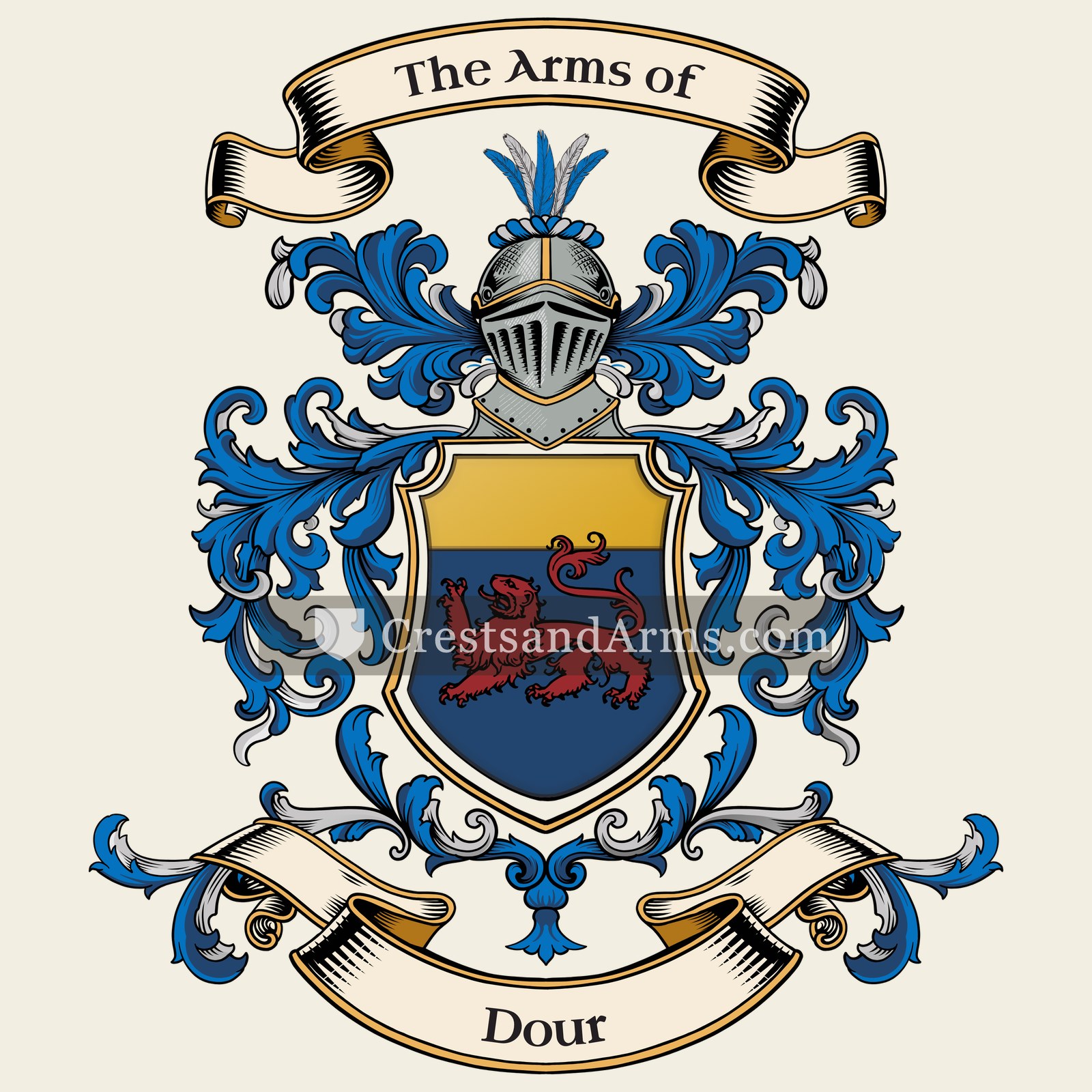


 cinquefoilHope and joy