Map of Britain showing where the Doyel arms are recorded
The Doyel arms were recorded in Britain, c. 1828.
Arms such as these were typically recorded in Kent.
Kent sits between London and the short crossing to Europe, and the trade passing through made it wealthy. Merchant families bought land with that money, and it was landowners who took coats of arms.
This is where the arms were entered in the register. Families often moved to other parts of the country, so the same name can turn up in more than one region.
The body that granted and recorded arms in Britain in this period.
George IV of the United Kingdom
Sovereign of the period
George IV of the United Kingdom
1820–1830
Reigning in Britain when the Doyel arms are first recorded.
How Arms Worked in Britain
English heraldry allowed arms to be shared by all legitimate descendants of the original owner. These symbols were treated as personal property that moved through the generations to all children. While the eldest son kept the original design, other family members could use the same shield without needing to change it or register their own unique versions.
Granting authority
The College of Arms in London has regulated the use of coats of arms throughout England and Wales since 1484.
How they got arms
Families typically obtained their coats of arms through a formal grant from the Crown or by proving their ancient right to them.
Where arms were recorded
All official coats of arms are recorded in the registers kept at the College of Arms, which date back to the fifteenth century.
The family's standing
Recorded among the armigerous families of Britain.
Origin & History of the Doyel Family in Britain
The family name Doyel is a variant of the name Doyle, which traces its linguistic roots back to the Irish Gaelic term *Ó Dubhghaill*. This name translates to descendant of the dark stranger, a descriptor historically used to identify people of Norse or Viking ancestry who settled in Ireland. By the early 19th century, families carrying this name had migrated across the Irish Sea to England. Records confirm that members of the Doyel family were established in the county of Kent by 1828. During this period, Kent was a hub of agricultural and industrial change, and families moving into the region often sought work in the expanding dockyards or the local farming sector. This migration pattern reflects the broader movement of people from Ireland to Britain during the industrial era, as families looked for new opportunities in growing English communities.
Doyel Meaning & Related Branches
Root word
Doyle
Derived from the Gaelic term for a dark-haired foreigner or stranger.
This name
DoyelA surname of Irish origin referring to a person with dark features or a dark complexion.
also spelled
Doyel
Doylle
Doyll
Doyley
Documented Sources
J. B. Rietstap, Armorial Général, Gouda: G. B. van Goor Zonen, 1884–87
Hanks, Patrick and Hodges, Flavia, A Dictionary of Surnames, 1988
MacLysaght, Edward, The Surnames of Ireland, 1985
The National Archives, Census Returns of England and Wales, 1841, HO 107
Kent History and Library Centre, Parish Registers of Kent, P200/1/A1
Digital archive packCoat of arms PNG, gold border print PDF, vector SVG and the certificate of authenticity. Sent to your email in minutes.


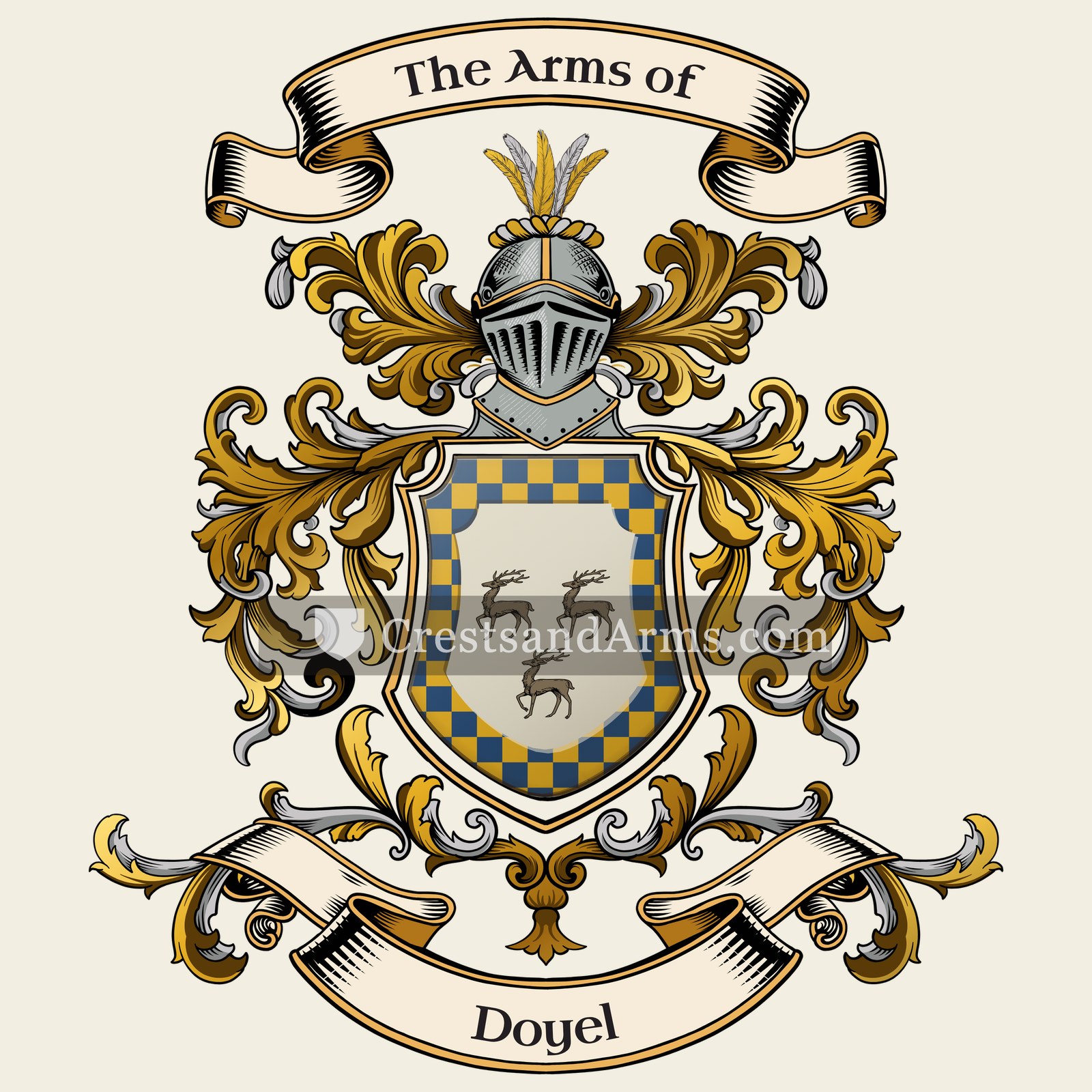
 chequyConstancy, and the counting-board
 stagPeace and harmony, and one who will not fight unprovoked
 chequyConstancy, and the counting-board
 stagPeace and harmony, and one who will not fight unprovoked