Map of Denmark showing where the Drage arms are recorded
The Drage arms were recorded in Denmark, c. 1722.
Arms such as these were typically recorded in Sjaælland.
Zealand held the Danish court, the crown's offices and Copenhagen itself. Families who served the king kept estates within reach of it, and royal service was the ordinary route to a coat of arms.
This is where the arms were entered in the register. Families often moved to other parts of the country, so the same name can turn up in more than one region.
The body that granted and recorded arms in Denmark in this period.
Frederik IV of Denmark
Sovereign of the period
Frederik IV of Denmark
1699–1730
Reigning in Denmark when the Drage arms are first recorded.
How Arms Worked in Denmark
Danish heraldry during this period was closely tied to noble status and royal favor rather than being open to all citizens. Arms were typically granted by the monarch to individuals, and these symbols were then shared by all members of the noble house. If a family line died out, the right to use those specific arms ended with them.
Granting authority
The Danish royal chancery held the power to issue and regulate official coats of arms for the kingdom.
How they got arms
Families usually received their arms through a formal royal grant that confirmed their noble status and rights.
Where arms were recorded
These grants were officially recorded in the Danish Royal Chancery records starting in the sixteenth century.
The family's standing
Recorded among the armigerous families of Denmark.
Origin & History of the Drage Family in Denmark
The family name Drage has deep roots in the island of Sjælland, where records confirm members of the family were living as early as 1722. During this period, the name was closely tied to the rural landscape and the social structures of the Danish countryside. Many families in this region were connected to the land through farming or local trades, and names often reflected the specific geography or the roles individuals played within their village communities. As the family established itself in Sjælland, they became part of the local parish systems that tracked births, marriages, and deaths. These early records provide a clear window into how the family integrated into the social fabric of Denmark during the eighteenth century. By maintaining their presence in the region, the Drage family contributed to the long history of families that helped shape the local culture and development of the Danish islands.
Coat of Arms & Family Crest Details
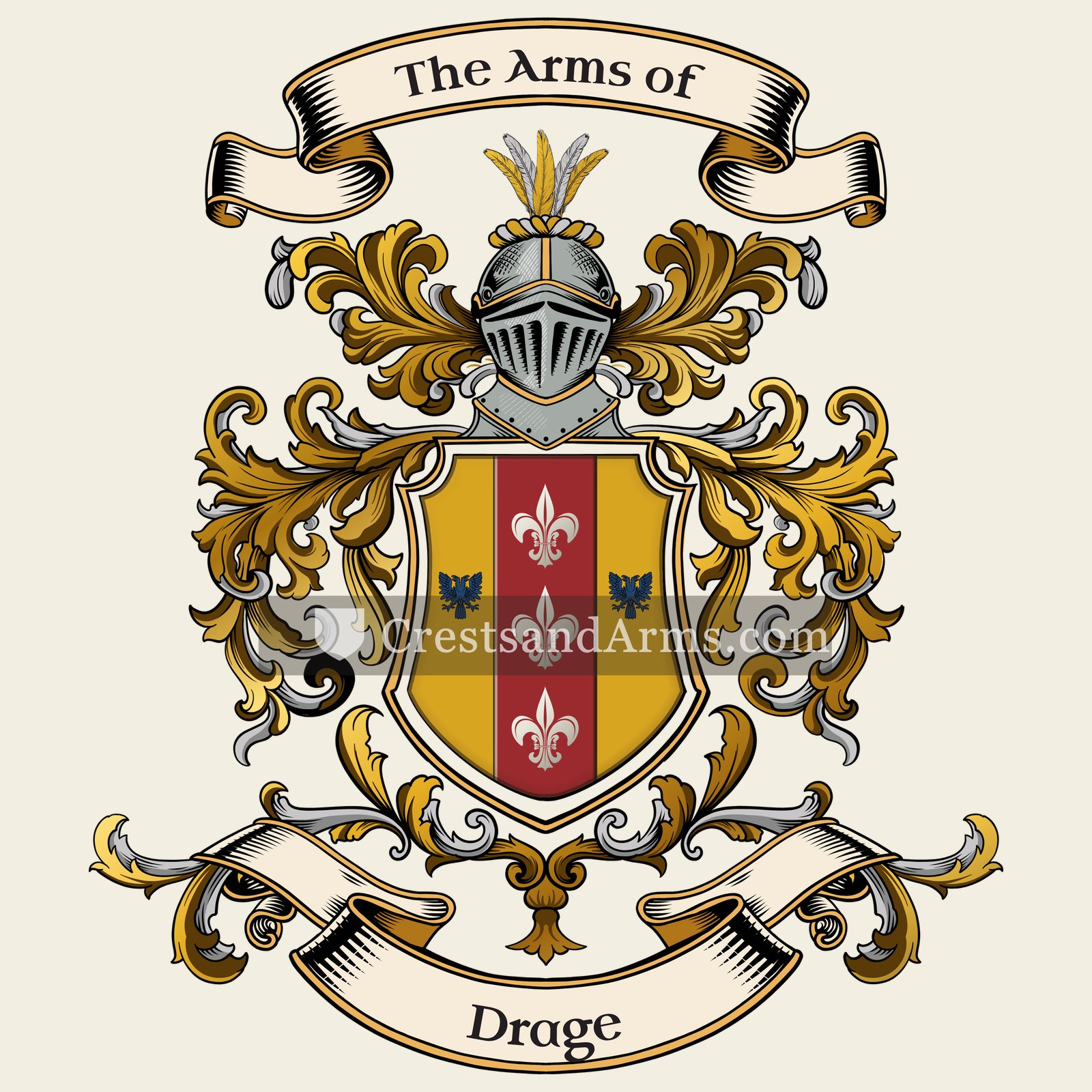
Symbols on this shield
paleMilitary strength, and a fortified defence
eagleNobility, strength and a keen mind
fleur de lisPurity, light, and the sixth son
Colours
Gold (Or)Means: Generosity
Red (Gules)Means: Military strength
Blue (Azure)Means: Loyalty and truth
Silver (Argent)Means: Peace and sincerity
Historical info
Source
Sir Bernard Burke, The General Armory of England, Scotland, Ireland and Wales, London: Harrison & Sons, 1884
Blazon (the actual original written record)
“Or, on a pale gu. betw. two eagles displ. az. three fleurs-de-lis ar”
EnglandCity, c. 1757
Digital archive packCoat of arms PNG, gold border print PDF, vector SVG and the certificate of authenticity. Sent to your email in minutes.
Map of England showing where the Drage arms are recorded
The Drage arms were recorded in City, c. 1757.
This is where the arms were entered in the register. Families often moved to other parts of the country, so the same name can turn up in more than one region.
The body that granted and recorded arms in England in this period.
George II of Great Britain
Sovereign of the period
George II of Great Britain
1727–1760
Reigning in Denmark when the Drage arms are first recorded.
How Arms Worked in England
English heraldry allowed arms to be shared by all legitimate descendants of the original owner. These symbols were treated as personal property that moved through the generations to all children. While the eldest son kept the original design, other family members could use the same shield without needing to change it or register their own unique versions.
Granting authority
The College of Arms in London has regulated the use of coats of arms throughout England and Wales since 1484.
How they got arms
Families typically obtained their coats of arms through a formal grant from the Crown or by proving their ancient right to them.
Where arms were recorded
All official coats of arms are recorded in the registers kept at the College of Arms, which date back to the fifteenth century.
The family's standing
Recorded among the armigerous families of England.
Origin & History of the Drage Family in England
The surname Drage is rooted in the linguistic history of medieval England, where it likely originated as a descriptive nickname or a reference to a specific trade. Etymologists often link the name to the Middle English word "drag," which could refer to a person who operated a heavy cart or a net used for fishing. By the time members of the family were firmly established in the city by 1757, the name had already been present in various English counties for several centuries. Early records suggest that families bearing this name were often involved in local agriculture or small-scale commerce, living as commoners who helped shape the development of their local parishes. As the family became more settled in urban environments during the eighteenth century, they transitioned from rural life into the growing professional and trade sectors that defined the era. This shift reflects the broader movement of English families who moved away from traditional farming roots to participate in the expanding economy of the mid-1700s.
Drage Meaning & Related Branches
Root word
Drage
Old Norse word for a dragon or mythical serpent.
This name
DrageA topographic or habitational name referring to someone who lived near a dragon-shaped landmark or sign.
also spelled
Drages
Dragg
Draj
Draggue
Related arms
Allenrecorded with Drage, same area
Berringtonrecorded with Drage, same area
Edwardsrecorded with Drage, same area
Pagerecorded with Drage, same area
Documented Sources
J. B. Rietstap, Armorial Général, Gouda: G. B. van Goor Zonen, 1884–87
Rigsarkivet, Kirkebøger fra Sjællands Stift (1722)
Trap, J.P., Statistisk-topographisk Beskrivelse af Kongeriget Danmark (1858)
Digital archive packCoat of arms PNG, gold border print PDF, vector SVG and the certificate of authenticity. Sent to your email in minutes.


 dragonA most valiant defender of treasure
 dragonA most valiant defender of treasure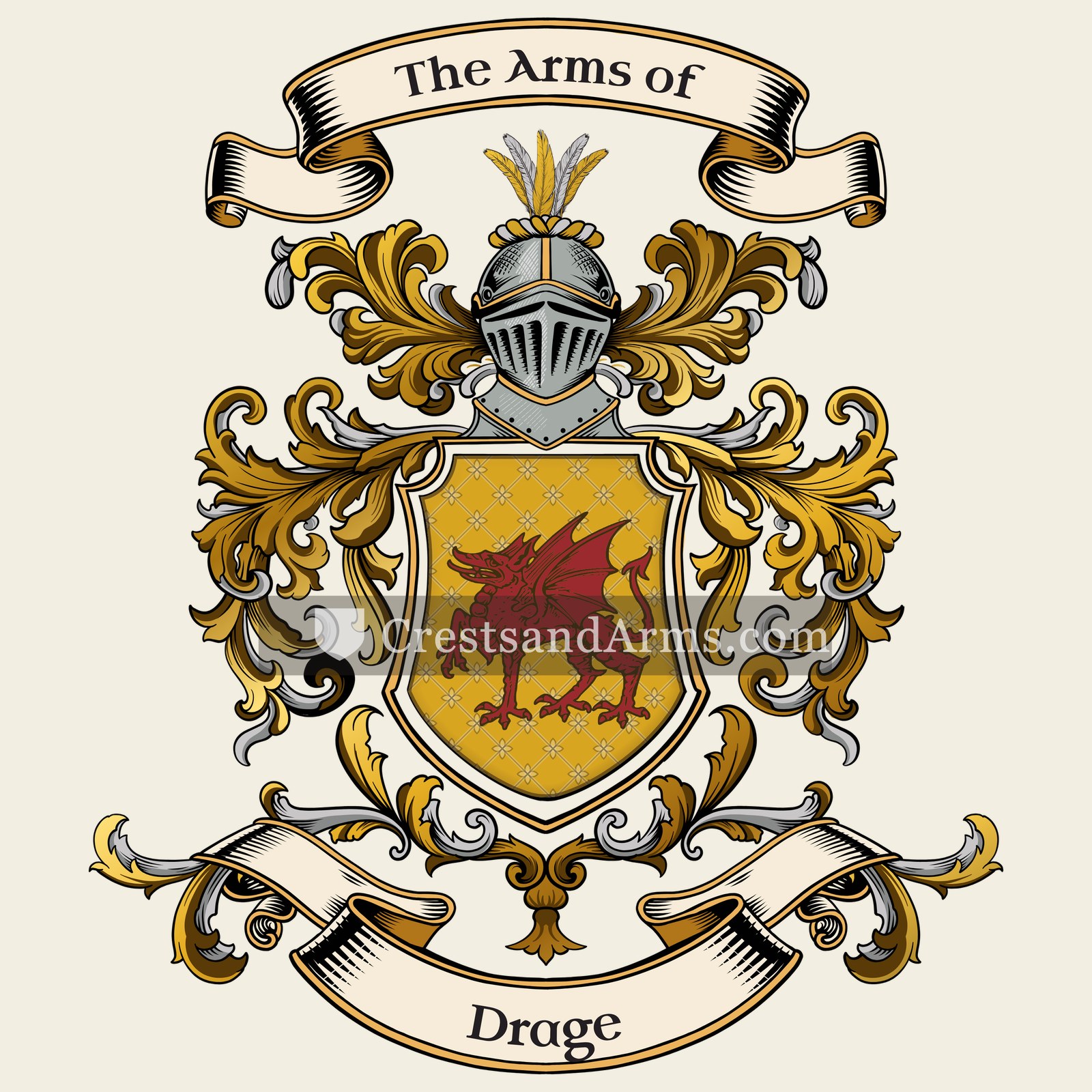


 paleMilitary strength, and a fortified defence
 eagleNobility, strength and a keen mind
 fleur de lisPurity, light, and the sixth son