A record of documented arms, meaning and origin, researched for the Drake family lines. Documented in 2 countries.
Reg. 7495 · Britain, D–F
Coat of Arms & Family Crest Details
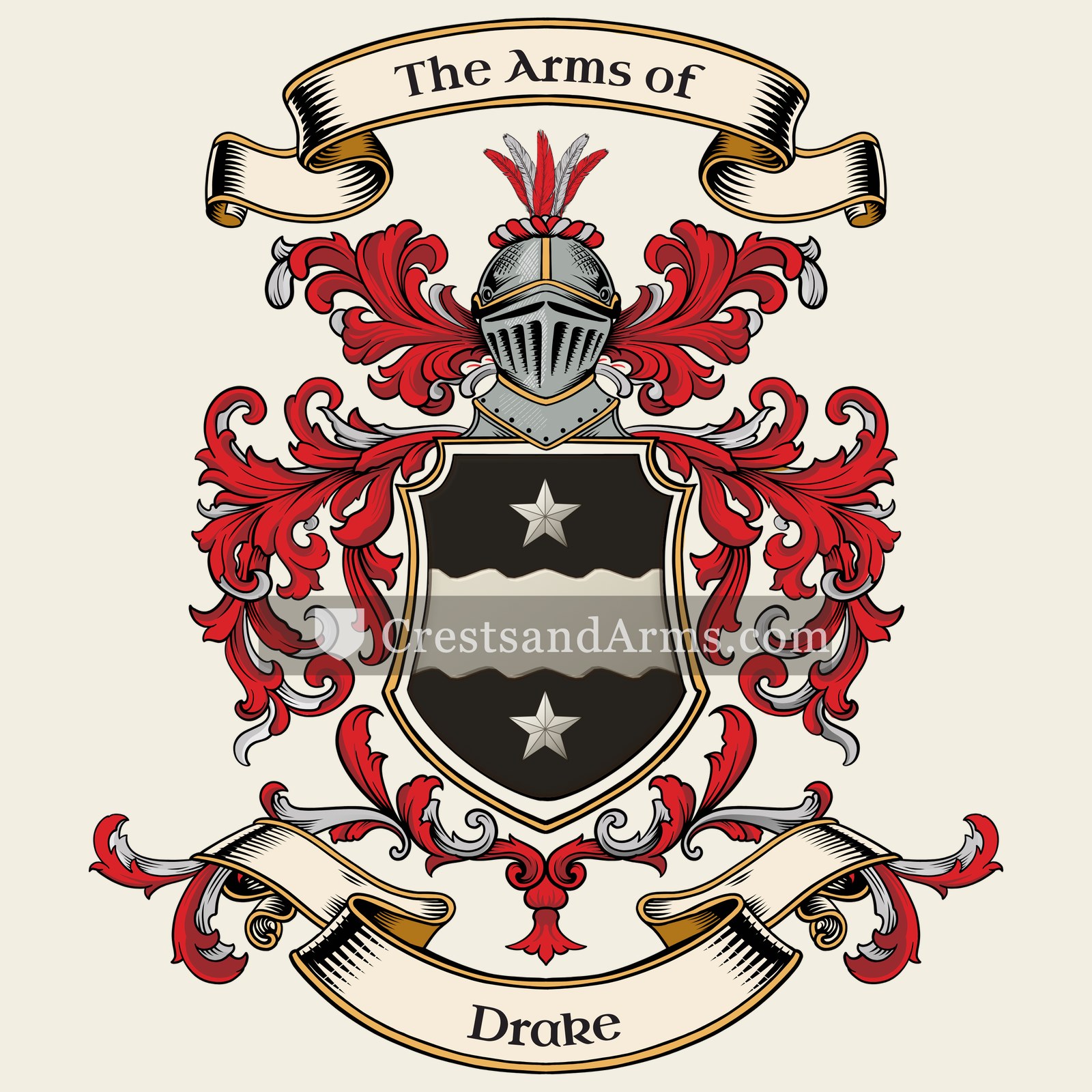
Symbols on this shield
fessThe military belt, and readiness to serve
mulletThe third son, and a divine quality from above
Colours
Black (Sable)Means: Constancy
Silver (Argent)Means: Peace and sincerity
Historical info
Source
J. B. Rietstap, Armorial Général, Gouda: G. B. van Goor Zonen, 1884–87
Blazon (the actual original written record)
“De sa. à la fasce ondée d'arg., acc. de deux étoiles rayonnantes du même, 1 en chef et 1 en p. C.: un globe terrestre, soutenant un vaisseau tiré autour du globe au moyen d'une corde. Au-dessus du cimier la légende: AUXILIO DIVINO. D.: SIC PARVIS MAGNA [Branche éteinte de la famille, fondée par le célèbre navigateur, sir Francis Drake.]”
DevonshireDevonshire, c. 1782
Digital archive packCoat of arms PNG, gold border print PDF, vector SVG and the certificate of authenticity. Sent to your email in minutes.
Map of Britain showing where the Drake arms are recorded
The Drake arms were recorded in Devonshire, c. 1782.
This is where the arms were entered in the register. Families often moved to other parts of the country, so the same name can turn up in more than one region.
The body that granted and recorded arms in Britain in this period.
George III of Great Britain
Sovereign of the period
George III of Great Britain
1760–1801
Reigning in Britain when the Drake arms are first recorded.
How Arms Worked in Britain
English heraldry allowed arms to be shared by all legitimate descendants of the original owner. These symbols were treated as personal property that moved through the generations to all children. While the eldest son kept the original design, other family members could use the same shield without needing to change it or register their own unique versions.
Granting authority
The College of Arms in London has regulated the use of coats of arms throughout England and Wales since 1484.
How they got arms
Families typically obtained their coats of arms through a formal grant from the Crown or by proving their ancient right to them.
Where arms were recorded
All official coats of arms are recorded in the registers kept at the College of Arms, which date back to the fifteenth century.
The family's standing
Recorded among the armigerous families of Devonshire.
Origin & History of the Drake Family in Britain
The surname Drake has deep roots in the English landscape, particularly within the southwestern county of Devonshire. The name likely originated as a nickname derived from the Old English word "draca," meaning dragon, or the Old Norse "draki," which referred to a person with a fierce or bold personality. By the time records place the family firmly in Devonshire during the late eighteenth century, the name had already been established in the region for generations. Many families bearing this name were deeply connected to the maritime culture of the English coast, often living in small parishes where they worked as farmers or tradespeople. Because the name was relatively common in the West Country, it became a fixture of local village life, appearing frequently in parish registers that tracked baptisms, marriages, and burials. Over time, the family name became synonymous with the rugged identity of Devon, reflecting a long history of settlement in the rolling hills and coastal towns of the region.
Coat of Arms & Family Crest Details
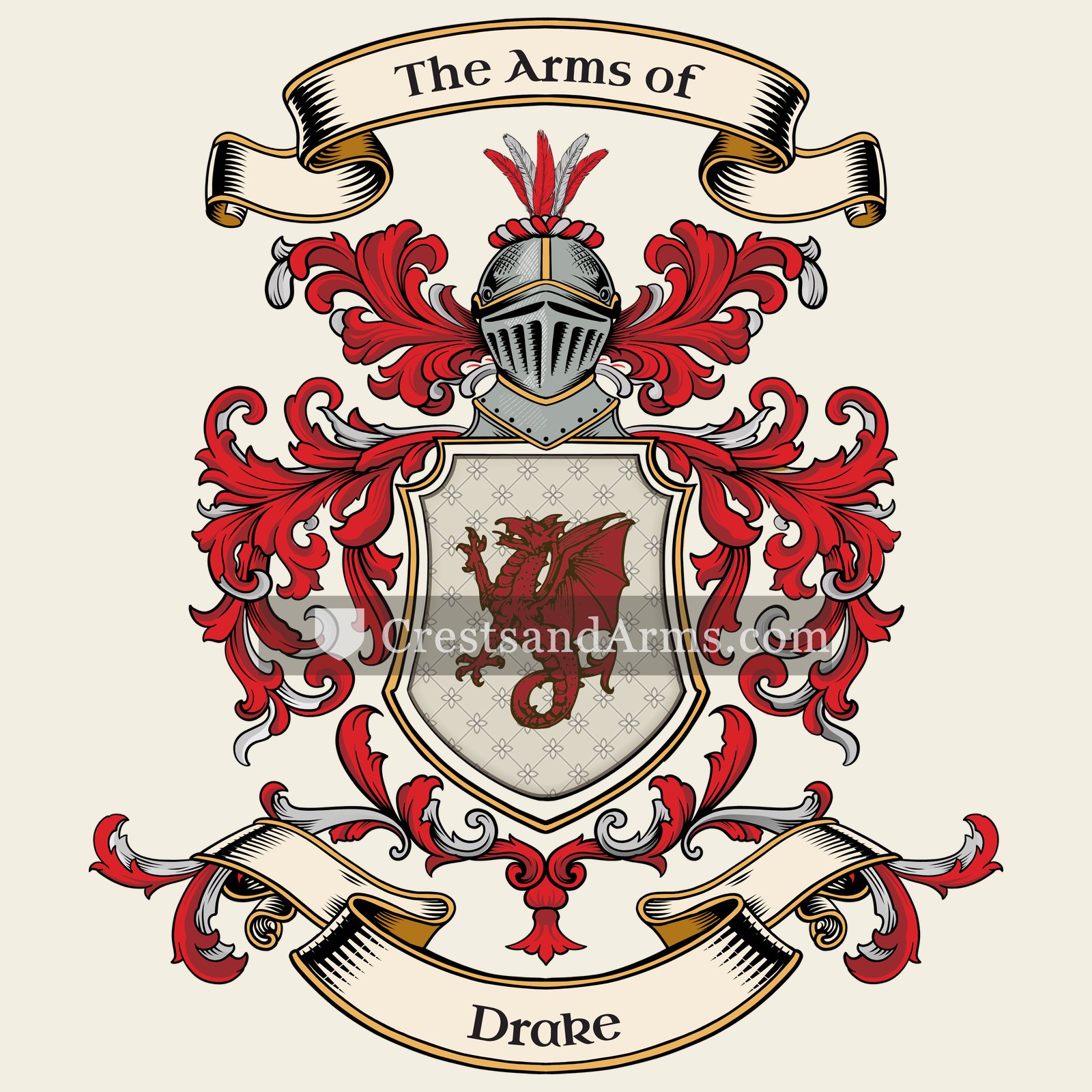
Symbols on this shield
wyvernValour and protection, and victory over the plague
Colours
Silver (Argent)Means: Peace and sincerity
Red (Gules)Means: Military strength
Historical info
Source
Sir Bernard Burke, The General Armory of England, Scotland, Ireland and Wales, London: Harrison & Sons, 1884
Blazon (the actual original written record)
“Ar. a wyvern wings displ. and tail nowed gu”
DevonOtterton · Devon, c. 1303
Digital archive packCoat of arms PNG, gold border print PDF, vector SVG and the certificate of authenticity. Sent to your email in minutes.
Map of England showing where the Drake arms are recorded
The Drake arms were recorded in Devon, c. 1303.
Devon was a county of small manors and seafaring families. Its gentry were spread thickly across the countryside, and money made at sea often bought an estate, which in turn brought a coat of arms.
This is where the arms were entered in the register. Families often moved to other parts of the country, so the same name can turn up in more than one region.
The body that granted and recorded arms in England in this period.
Edward I of England
Sovereign of the period
Edward I of England
1272–1307
Reigning in Britain when the Drake arms are first recorded.
How Arms Worked in England
English heraldry allowed arms to be shared by all legitimate descendants of the original owner. These symbols were treated as personal property that moved through the generations to all children. While the eldest son kept the original design, other family members could use the same shield without needing to change it or register their own unique versions.
Granting authority
The College of Arms in London has regulated the use of coats of arms throughout England and Wales since 1484.
How they got arms
Families typically obtained their coats of arms through a formal grant from the Crown or by proving their ancient right to them.
Where arms were recorded
All official coats of arms are recorded in the registers kept at the College of Arms, which date back to the fifteenth century.
The family's standing
Recorded among the armigerous families of Devon.
Origin & History of the Drake Family in England
The surname Drake has deep roots in the English county of Devon, where records confirm the family held land as early as 1303. The name itself likely originated as a nickname, derived from the Old English word "draca," meaning dragon. In medieval times, such names were often given to individuals who displayed a fierce or bold personality. By the fourteenth century, the family had established a strong presence in the West Country, particularly around the town of Tavistock. Over the following generations, the Drakes became influential landowners and local leaders. Their history is closely tied to the maritime culture of the region, as many members of the family played significant roles in the development of English trade and naval exploration. This connection to the sea helped the family name spread from its rural Devon origins to become a well-known name across England.
Drake Meaning & Related Branches
Root word
draco
A Latin term meaning dragon or serpent.
This name
DrakeDerived from a nickname for a fierce person or one who bore a dragon emblem.
also spelled
Draake
Drak
Draque
Related arms
Ap-Enionrecorded with Drake, same area
Beaumontrecorded with Drake, same area
Beletrecorded with Drake, same area
Boclandrecorded with Drake, same area
Documented Sources
J. B. Rietstap, Armorial Général, Gouda: G. B. van Goor Zonen, 1884–87
Reaney, P.H., A Dictionary of English Surnames, 1958
Hanks, Patrick and Hodges, Flavia, A Dictionary of Surnames, 1988
The National Archives, Parish registers of Devon, 1782
Devon Archives and Local Studies Service, Quarter Sessions Records, 1782
Digital archive packCoat of arms PNG, gold border print PDF, vector SVG and the certificate of authenticity. Sent to your email in minutes.


 fessThe military belt, and readiness to serve
 mulletThe third son, and a divine quality from above
 fessThe military belt, and readiness to serve
 mulletThe third son, and a divine quality from above


 wyvernValour and protection, and victory over the plague