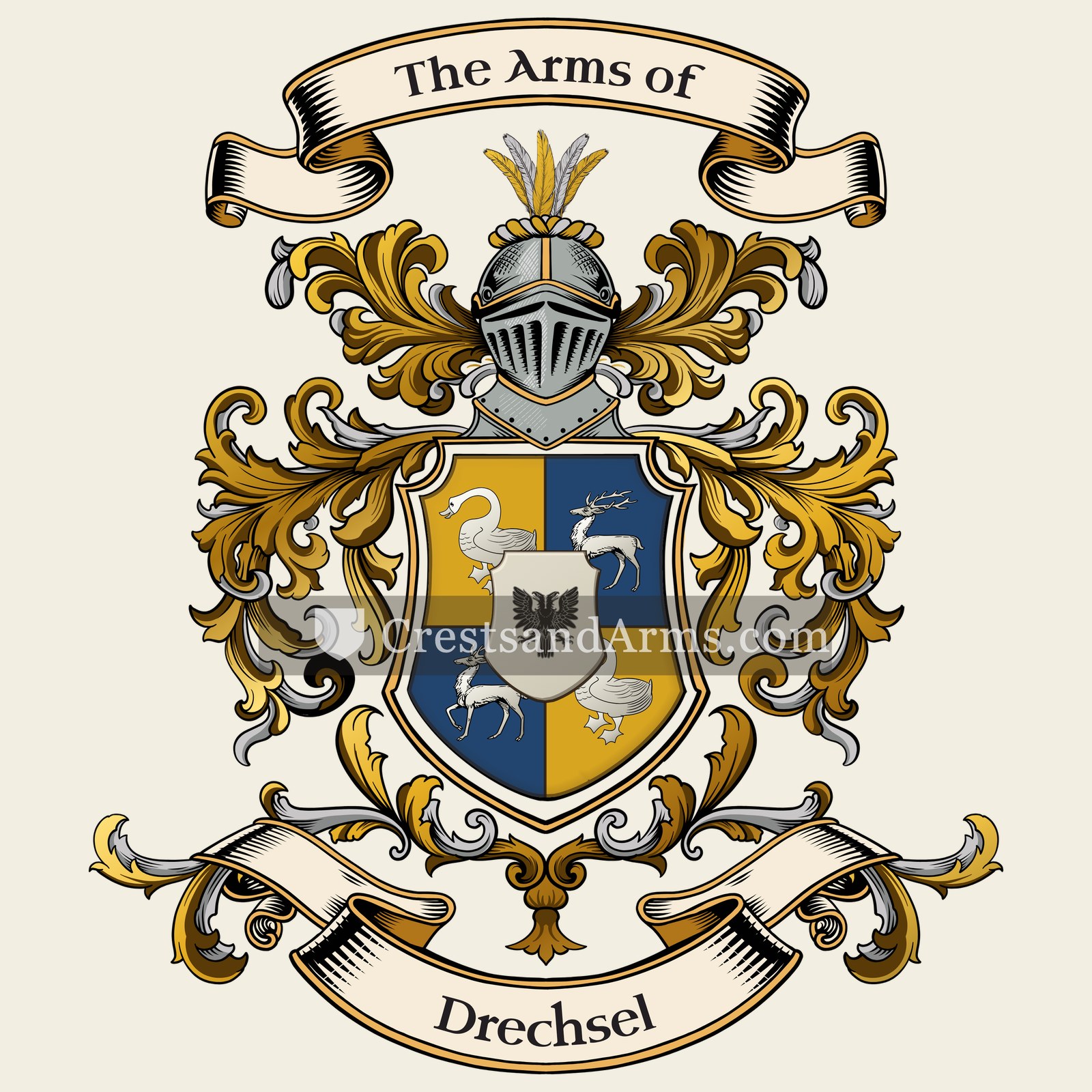
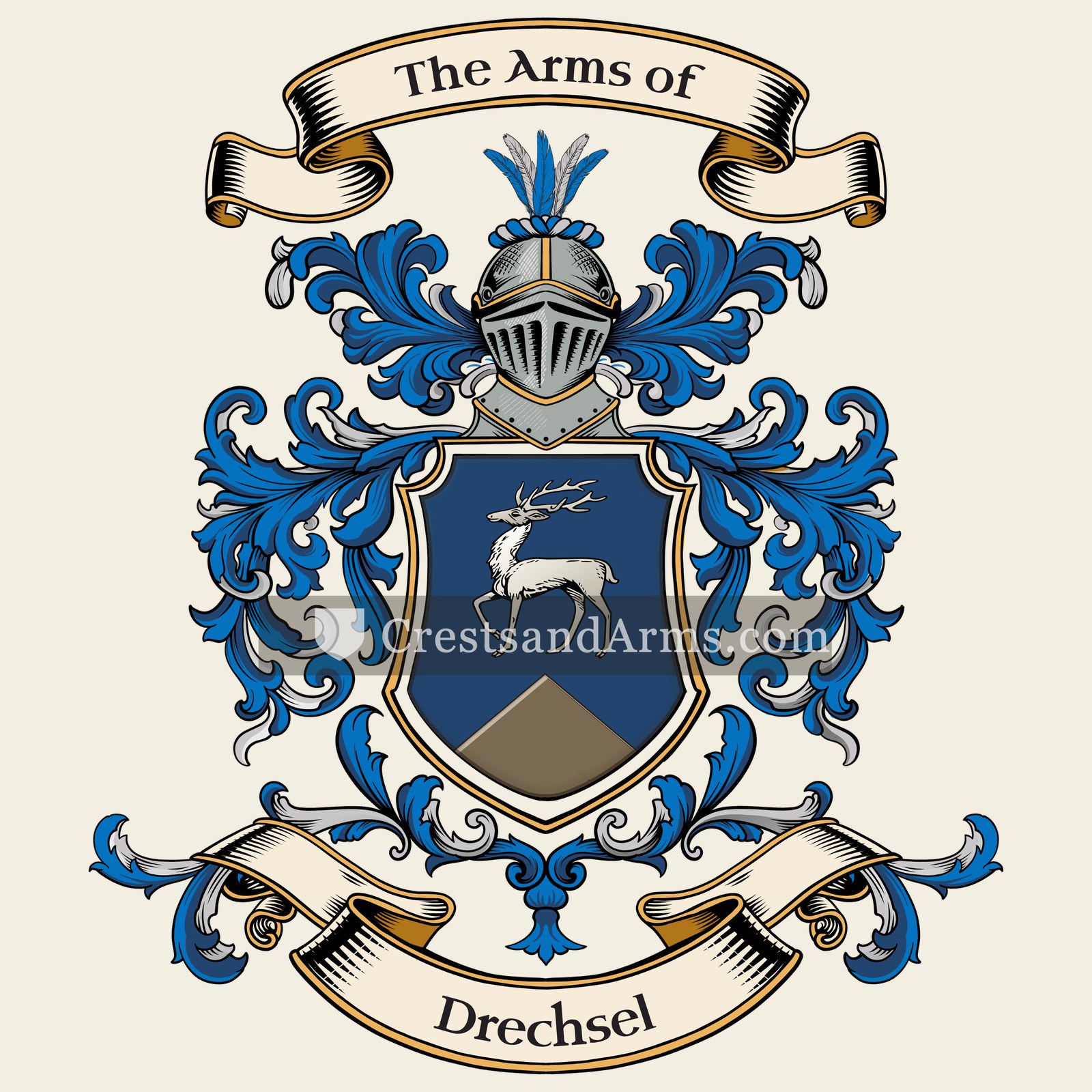
A record of documented arms, meaning and origin, researched for the Drechsel family lines. Documented in 2 countries.
Reg. 6406 · Austrian, D–F
Coat of Arms & Family Crest Details
Symbols on this shield
eagleNobility, strength and a keen mind
swanGrace, light and the poet's art
stagPeace and harmony, and one who will not fight unprovoked
Colours
Gold (Or)Means: Generosity
Blue (Azure)Means: Loyalty and truth
Silver (Argent)Means: Peace and sincerity
Black (Sable)Means: Constancy
Historical info
Source
J. B. Rietstap, Armorial Général, Gouda: G. B. van Goor Zonen, 1884–87
Blazon (the actual original written record)
“Ec. : aux 1 et 4 d'or à un cygne d'arg., celui du 1 cont.; aux 2 et 3 d'azur à un cerf au nat., mouv. de la p., celui du 3 cont. Sur le tout un écusson parti d'arg. et de gu., à une aigle ép. de sa., bq. et m. d'or, br. sur le parti; ledit surtout timbré d'une couronne à sept perles. Trois cq. cour. C. : 1º l'aigle du surtout; 2º un ange iss., posé de front, hab. de gu., ailé d'azur et d'or, tenant de chaque main un poisson d'arg.; entre deux prob. de gu.; 3º le cerf du 2, iss. L. d'or et d'azur.”
Austriac. 1556
Digital archive packCoat of arms PNG, gold border print PDF, vector SVG and the certificate of authenticity. Sent to your email in minutes.
Map of Austria showing where the Drechsel arms are recorded
The Drechsel arms were recorded in Austria, c. 1556.
Arms such as these were typically recorded in Tyrol.
Tyrol was mountain country in western Austria, where the valleys were held by families who had been there a very long time. Old tenure counted for more than money, and old families carried arms.
This is where the arms were entered in the register. Families often moved to other parts of the country, so the same name can turn up in more than one region.
Region
Tyrol
First recorded
1556
Granting Authority for the Drechsel Arms
Imperial and Royal chancery
Sodacan · CC BY-SA 3.0
The body that granted and recorded arms in Austria in this period.
Charles V
Sovereign of the period
Charles V
1519–1556
Reigning in Austria when the Drechsel arms are first recorded.
How Arms Worked in Austria
Austrian coats of arms were often linked directly to noble titles granted by the Emperor. These symbols belonged to the entire family line rather than just one individual. When a family grew, new branches kept the original design without needing to change it. This system allowed all members of a noble house to share the same identity across many generations.
Granting authority
The Imperial and Royal chancery managed all heraldic matters and controlled the official granting of arms throughout the Austrian lands.
How they got arms
Families typically received their arms through a formal imperial decree that often accompanied the elevation of a person to noble status.
Where arms were recorded
Official records of these grants were kept in the Imperial Register of Nobility which began its formal documentation process in 1453.
The family's standing
Recorded among the armigerous families of Austria.
Origin & History of the Drechsel Family in Austria
The surname Drechsel finds its roots in the medieval German language, specifically originating from the word *drechsler*, which describes a skilled woodturner or someone who worked with a lathe. By the middle of the sixteenth century, the family had established a notable presence in the rugged landscape of Tyrol, a region in western Austria known for its deep forests and mountainous terrain. During this era, the craft of woodturning was essential for creating household tools, furniture, and architectural details, making the Drechsel family integral to the local economy and village life. As these early ancestors settled into the alpine valleys, they became part of the growing class of specialized artisans who helped shape the infrastructure of the region. Their presence in Tyrol by 1556 suggests that the family was well-integrated into the social fabric of the Austrian territories, moving beyond simple farming to provide the technical expertise required for building and domestic life in a challenging environment.
Coat of Arms & Family Crest Details
Symbols on this shield
stagPeace and harmony, and one who will not fight unprovoked
Colours
Blue (Azure)Means: Loyalty and truth
Historical info
Source
J. B. Rietstap, Armorial Général, Gouda: G. B. van Goor Zonen, 1884–87
Blazon (the actual original written record)
“D'azur à un cerf au nat., mouv. de la p. Cq. cour. C. : le cerf iss., entre un vol d'arg., chaque aile ch. d'une fasce d'azur, surch. d'un cor d'or, environné de rubans d'arg. et d'azur, le cor de sen. cont. L. d'or et d'azur.”
BavariaBavaria, c. 1579
Digital archive packCoat of arms PNG, gold border print PDF, vector SVG and the certificate of authenticity. Sent to your email in minutes.
Map of Germany showing where the Drechsel arms are recorded
The Drechsel arms were recorded in Bavaria, c. 1579.
Bavaria was a country of old landed families and walled market towns. Estates passed down the same line for centuries, and both the landowners and the leading townsmen kept arms, which is why so many Bavarian names sit in the registers.
This is where the arms were entered in the register. Families often moved to other parts of the country, so the same name can turn up in more than one region.
The body that granted and recorded arms in Germany in this period.
Emperor Rudolf II
Sovereign of the period
Emperor Rudolf II
1576–1612
Reigning in Austria when the Drechsel arms are first recorded.
How Arms Worked in Germany
In the Holy Roman Empire, coats of arms were often granted to individuals by the Emperor or his representatives. These arms were then passed down through the generations to all legitimate descendants of the original holder. Younger branches of a family usually kept the same shield design without needing to change it, as the arms belonged to the entire lineage.
Granting authority
The Holy Roman Emperor held the sole power to grant new coats of arms throughout his vast imperial territories.
How they got arms
Families typically obtained their coats of arms through a formal imperial grant or by proving their noble status to the authorities.
Where arms were recorded
These grants were officially recorded in the Imperial Chancery registers, which began keeping formal records of such honors during the Middle Ages.
The family's standing
Recorded among the armigerous families of Bavaria.
Origin & History of the Drechsel Family in Germany
The family name Drechsel originated in the German-speaking regions as a professional surname, specifically identifying ancestors who worked as turners or woodworkers. The name comes from the Middle High German word *drehsel*, which describes a craftsman who used a lathe to shape wood into bowls, furniture parts, or tools. By the time historical records confirm the family presence in Bavaria in 1579, the name had already become a fixed identifier for families who passed this skilled trade down through generations. Living in the southern German states, these early family members were likely part of the active guild system that defined medieval and Renaissance labor. Because wood turning was an essential service for both rural farming communities and growing urban centers, the Drechsel name spread across the region as these craftsmen moved to follow new work opportunities. This transition from a simple job description to a permanent family name reflects the way many German surnames were formed during the late Middle Ages as local populations became more settled and organized.
Drechsel Meaning & Related Branches
Root word
drechseln
To turn wood on a lathe.
This name
DrechselAn occupational surname for a woodturner or a craftsman who works with a lathe.
also spelled
Drechsel
Deufstetten
Documented Sources
J. B. Rietstap, Armorial Général, Gouda: G. B. van Goor Zonen, 1884–87
Heintze, Albert. Die deutschen Familiennamen: geschichtlich, geographisch, sprachlich. 1903
Tyrol State Archives (Tiroler Landesarchiv), Tiroler Steuerkataster
Digital archive packCoat of arms PNG, gold border print PDF, vector SVG and the certificate of authenticity. Sent to your email in minutes.


 eagleNobility, strength and a keen mind
 swanGrace, light and the poet's art
 stagPeace and harmony, and one who will not fight unprovoked
 eagleNobility, strength and a keen mind
 swanGrace, light and the poet's art
 stagPeace and harmony, and one who will not fight unprovoked