A record of documented arms, meaning and origin, researched for the Dresler family lines. Documented in 2 countries.
Reg. 6980 · Austrian, D–F
Coat of Arms & Family Crest Details
Symbols on this shield
mountThe ground held, and steadfastness upon it
paleMilitary strength, and a fortified defence
womanGrace, and the founding of a house
feathersWilling obedience and serenity
Colours
Silver (Argent)Means: Peace and sincerity
Gold (Or)Means: Generosity
Green (Vert)Means: Hope
Red (Gules)Means: Military strength
Black (Sable)Means: Constancy
Historical info
Source
J. B. Rietstap, Armorial Général, Gouda: G. B. van Goor Zonen, 1884–87
Blazon (the actual original written record)
“Coupé: au 1 d'arg. à une femme iss. de gu., mouv. d'un tertre d'arg., les cheveux épars de sa., cour. d'or, sommée de quatre pl. d'aut. alt. d'arg. et de gu.; au 2 d'or à quatre pals de sa. C.: la femme, iss. L.: à dextre d'arg. et de sa., à sen. d'or et de gu.”
Austriac. 1772
Digital archive packCoat of arms PNG, gold border print PDF, vector SVG and the certificate of authenticity. Sent to your email in minutes.
Map of Austria showing where the Dresler arms are recorded
The Dresler arms were recorded in Austria, c. 1772.
Arms such as these were typically recorded in Tyrol.
Tyrol was mountain country in western Austria, where the valleys were held by families who had been there a very long time. Old tenure counted for more than money, and old families carried arms.
This is where the arms were entered in the register. Families often moved to other parts of the country, so the same name can turn up in more than one region.
Region
Tyrol
First recorded
1772
Granting Authority for the Dresler Arms
Imperial and Royal chancery
Sodacan · CC BY-SA 3.0
The body that granted and recorded arms in Austria in this period.
Joseph II, Holy Roman Emperor
Sovereign of the period
Joseph II, Holy Roman Emperor
1765–1790
Reigning in Austria when the Dresler arms are first recorded.
How Arms Worked in Austria
Austrian coats of arms were often linked directly to noble titles granted by the Emperor. These symbols belonged to the entire family line rather than just one individual. When a family grew, new branches kept the original design without needing to change it. This system allowed all members of a noble house to share the same identity across many generations.
Granting authority
The Imperial and Royal chancery managed all heraldic matters and controlled the official granting of arms throughout the Austrian lands.
How they got arms
Families typically received their arms through a formal imperial decree that often accompanied the elevation of a person to noble status.
Where arms were recorded
Official records of these grants were kept in the Imperial Register of Nobility which began its formal documentation process in 1453.
The family's standing
Recorded among the armigerous families of Austria.
Origin & History of the Dresler Family in Austria
The surname Dresler is rooted in the occupational history of the German-speaking regions, specifically evolving from the Middle High German word "drescher," which refers to a person who threshed grain. By the time the family was firmly established in the mountainous region of Tyrol in 1772, the name served as a marker of their role within the local agricultural economy. In the rugged landscape of the Austrian Alps, families often settled in specific valleys where they maintained small-scale farms or worked as seasonal laborers during the harvest. The presence of the Dresler name in these historical records suggests that early ancestors were likely integral to the rural community structure of the time. As the family moved and grew throughout the eighteenth century, the name transitioned from a simple job description into a permanent identifier that linked them to their ancestral home in the Tyrol province.
Coat of Arms & Family Crest Details
Symbols on this shield
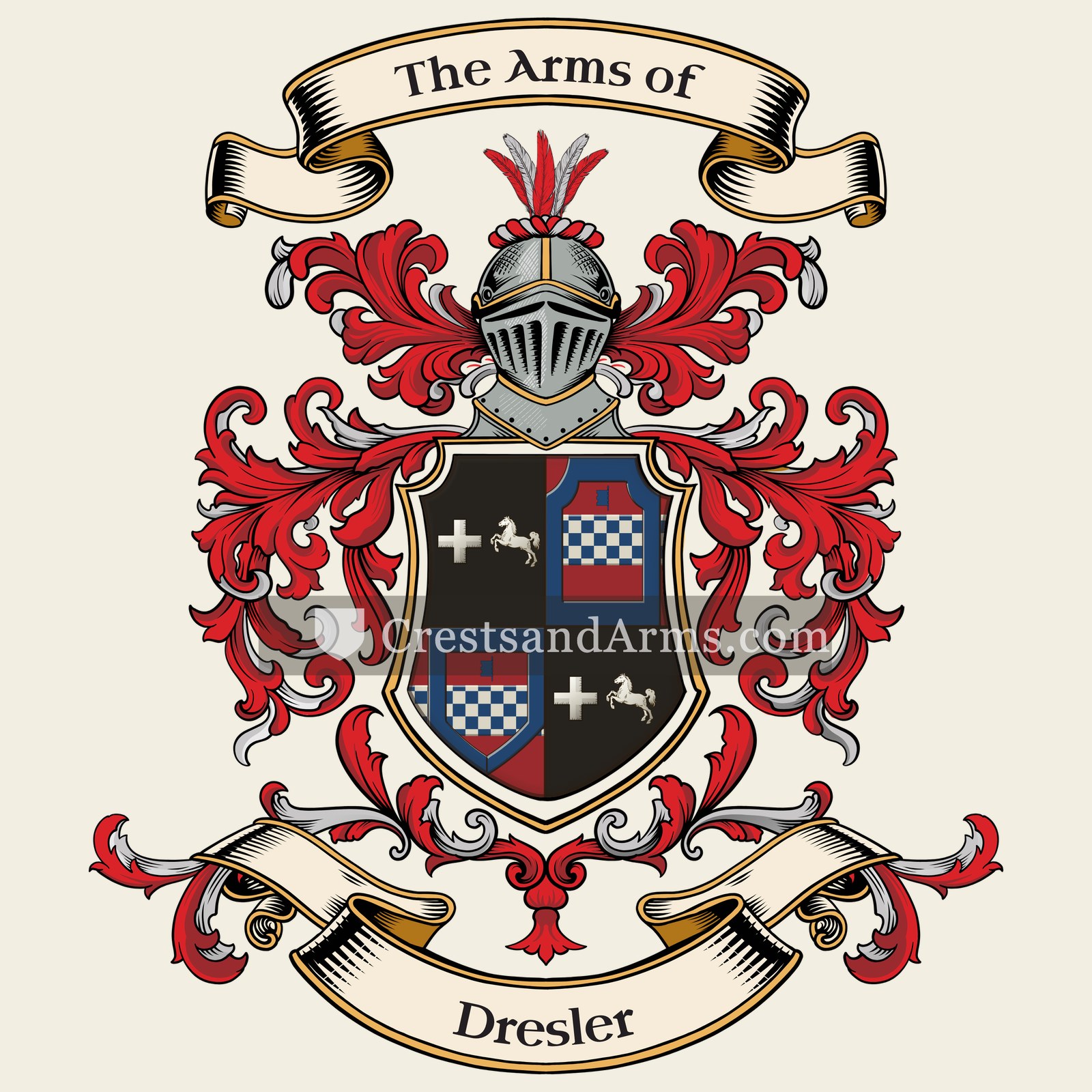
cross symbolChristian faith and service
fessThe military belt, and readiness to serve
chequyConstancy, and the counting-board
horseReadiness to serve king and country
flag / pennantA command held, and a following kept
Colours
Black (Sable)Means: Constancy
Red (Gules)Means: Military strength
Blue (Azure)Means: Loyalty and truth
Silver (Argent)Means: Peace and sincerity
Historical info
Source
J. B. Rietstap, Armorial Général, Gouda: G. B. van Goor Zonen, 1884–87
Blazon (the actual original written record)
“Ec.: aux 1 et 4 coupé, de sa. à une croix de Malte d'arg., sur arg. à une tête et col de cheval de sa.; à la fasce échiq. de sin. et d'arg., br. sur le coupé; aux 2 et 3 de gu. à une bannière d'azur frangée d'or, ch. d'une aigle de sa., la trabe d'arg. posée en bande. L'écu bordé d'azur, surch. d'une filière d'arg. Cq. cour. C.: une tête de cheval de sa., entre deux bannières adossées, pareilles à celles des 2 et 3, sauf que le champ de la bannière sen. est de pourpre. L. d'arg et de sa.”
Germanyc. 1766
Digital archive packCoat of arms PNG, gold border print PDF, vector SVG and the certificate of authenticity. Sent to your email in minutes.
Map of Germany showing where the Dresler arms are recorded
The Dresler arms were recorded in Germany, c. 1766.
Arms such as these were typically recorded in Bavaria.
Bavaria was a country of old landed families and walled market towns. Estates passed down the same line for centuries, and both the landowners and the leading townsmen kept arms, which is why so many Bavarian names sit in the registers.
This is where the arms were entered in the register. Families often moved to other parts of the country, so the same name can turn up in more than one region.
The body that granted and recorded arms in Germany in this period.
Joseph II, Holy Roman Emperor
Sovereign of the period
Joseph II, Holy Roman Emperor
1765–1790
Reigning in Austria when the Dresler arms are first recorded.
How Arms Worked in Germany
In the Holy Roman Empire, coats of arms were often granted to individuals by the Emperor or his representatives. These arms were then passed down through the generations to all legitimate descendants of the original holder. Younger branches of a family usually kept the same shield design without needing to change it, as the arms belonged to the entire lineage.
Granting authority
The Holy Roman Emperor held the sole power to grant new coats of arms throughout his vast imperial territories.
How they got arms
Families typically obtained their coats of arms through a formal imperial grant or by proving their noble status to the authorities.
Where arms were recorded
These grants were officially recorded in the Imperial Chancery registers, which began keeping formal records of such honors during the Middle Ages.
The family's standing
Recorded among the armigerous families of Germany.
Origin & History of the Dresler Family in Germany
The surname Dresler is an occupational name that emerged from the medieval German language, specifically derived from the word "drescher," which refers to a person who threshed grain. In the agricultural society of early Germany, this name identified individuals who worked with flails to separate seeds from stalks during the harvest. By the mid-eighteenth century, records confirm that families bearing this name were well-established in the region of Bavaria. During this era, Bavaria was a collection of rural territories where such trade-based surnames became permanent family markers as local officials began tracking residents more closely for tax and census purposes. The presence of the Dresler family in 1766 suggests they were likely part of the hardworking agrarian class that formed the backbone of the Bavarian economy, living in small village communities where their family name served as a direct link to their daily labor and contributions to the local food supply.
Dresler Meaning & Related Branches
Root word
Drechsler
An occupational term derived from the Middle High German word for turner.
This name
DreslerRefers to a craftsman who shaped wood or metal on a lathe.
also spelled
Dresler
Dresseler
Documented Sources
J. B. Rietstap, Armorial Général, Gouda: G. B. van Goor Zonen, 1884–87
Kranzmayer, Eberhard. Ortsnamenbuch von Kärnten. 1956
Zoder, Rudolf. Familiennamen in Ostösterreich. 1971


 mountThe ground held, and steadfastness upon it
 paleMilitary strength, and a fortified defence
 womanGrace, and the founding of a house
 feathersWilling obedience and serenity
 mountThe ground held, and steadfastness upon it
 paleMilitary strength, and a fortified defence
 womanGrace, and the founding of a house
 feathersWilling obedience and serenity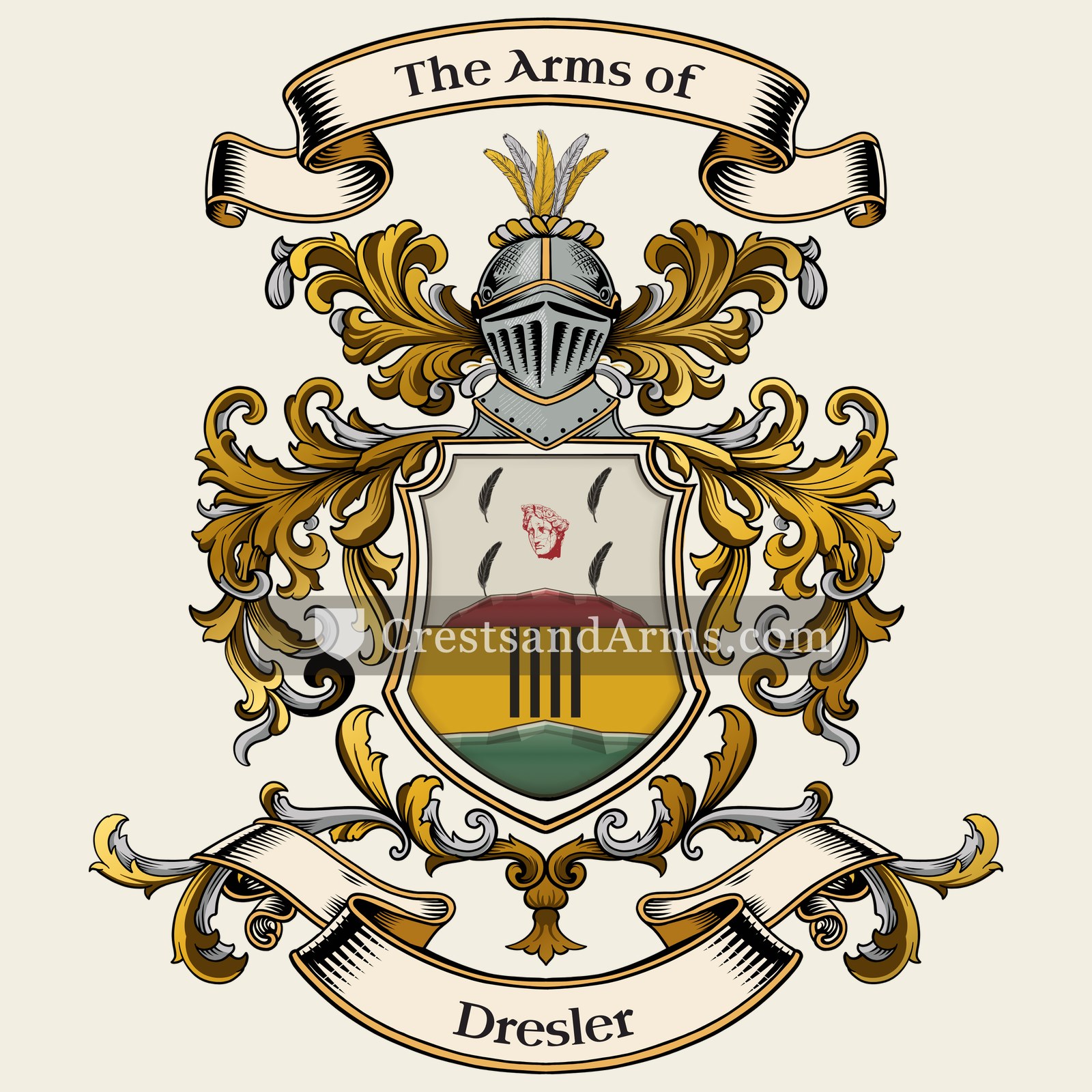


 cross symbolChristian faith and service
 fessThe military belt, and readiness to serve
 chequyConstancy, and the counting-board
 horseReadiness to serve king and country
 flag / pennantA command held, and a following kept