Map of Scotland showing where the Drever arms are recorded
The Drever arms were recorded in Orkney, c. 1809.
Orkney was Norse country until it came to Scotland in 1468, and its landholders kept Norse customs after. Families held their own ground outright, and outright holding brought arms.
This is where the arms were entered in the register. Families often moved to other parts of the country, so the same name can turn up in more than one region.
The body that granted and recorded arms in Scotland in this period.
George III of Great Britain
Sovereign of the period
George III of Great Britain
1801–1820
Reigning in Scotland when the Drever arms are first recorded.
How Arms Worked in Scotland
Scottish heraldry is unique because it treats a coat of arms as a piece of personal property protected by law. Only one person can own a specific design at any given time. When a family grows, the head keeps the original shield while other relatives must apply for their own distinct version with slight changes to prove their specific identity.
Granting authority
The Court of the Lord Lyon acts as the official body that regulates and controls all heraldic matters throughout Scotland.
How they got arms
Individuals obtain a legal right to their arms through a formal petition process that confirms their identity and family connection.
Where arms were recorded
All valid coats of arms are officially entered into the Public Register of All Arms and Bearings starting from 1672.
The family's standing
Recorded among the armigerous families of Orkney.
Origin & History of the Drever Family in Scotland
The surname Drever is deeply rooted in the history of the Orkney Islands, a remote archipelago off the northern coast of Scotland. While the name appears in various records during the early 19th century, such as the 1809 parish registers, its origins likely trace back much further to the influence of Old Norse. The name is often associated with the Old Norse word *dref*, which refers to a drove or a herd of animals. This suggests that the earliest ancestors of the Drever family were likely farmers or drovers who moved livestock across the rugged landscape of the islands. Because Orkney was under Norse rule for centuries before becoming part of Scotland, many local families adopted names that reflected their connection to the land and their daily work. By the time formal records became more consistent in the early 1800s, the Drever family had already established a strong presence in the Orkney community, where they remained closely tied to the maritime and agricultural traditions of the region.
Drever Meaning & Related Branches
Root word
Drefar
Old Norse term for a driver or one who drives cattle.
This name
DreverAn occupational surname for a person who drove livestock or worked as a drover.
also spelled
Drevir
Drevier
Related arms
Edmondssimilar arms
Documented Sources
Sir Bernard Burke, The General Armory of England, Scotland, Ireland and Wales, London: Harrison & Sons, 1884
Clouston, J. Storer, A History of Orkney, 1932
National Records of Scotland, Orkney Parochial Registers, 1809
Wickham-Jones, Caroline, Orkney: A Historical Guide, 1998
Digital archive packCoat of arms PNG, gold border print PDF, vector SVG and the certificate of authenticity. Sent to your email in minutes.


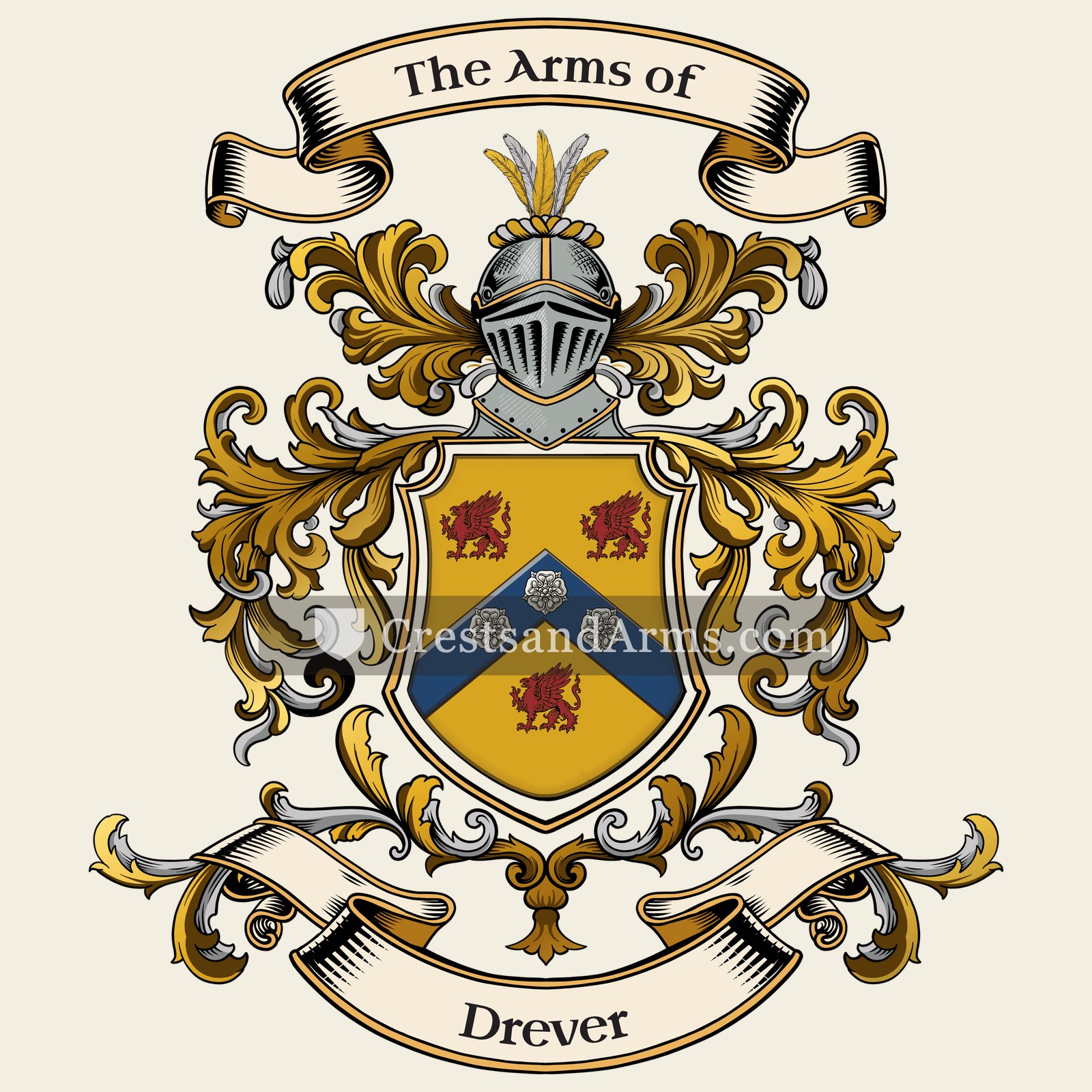
 chevronProtection, and faithful service completed
 griffinValour and vigilance, guarding great treasure
 roseThe seventh son, and beauty with grace
 chevronProtection, and faithful service completed
 griffinValour and vigilance, guarding great treasure
 roseThe seventh son, and beauty with grace