A record of documented arms, meaning and origin, researched for the Drexler family lines. Documented in 2 countries.
Reg. 9441 · Austrian, D–F
Meaning of the Drexler family crest colors & symbols
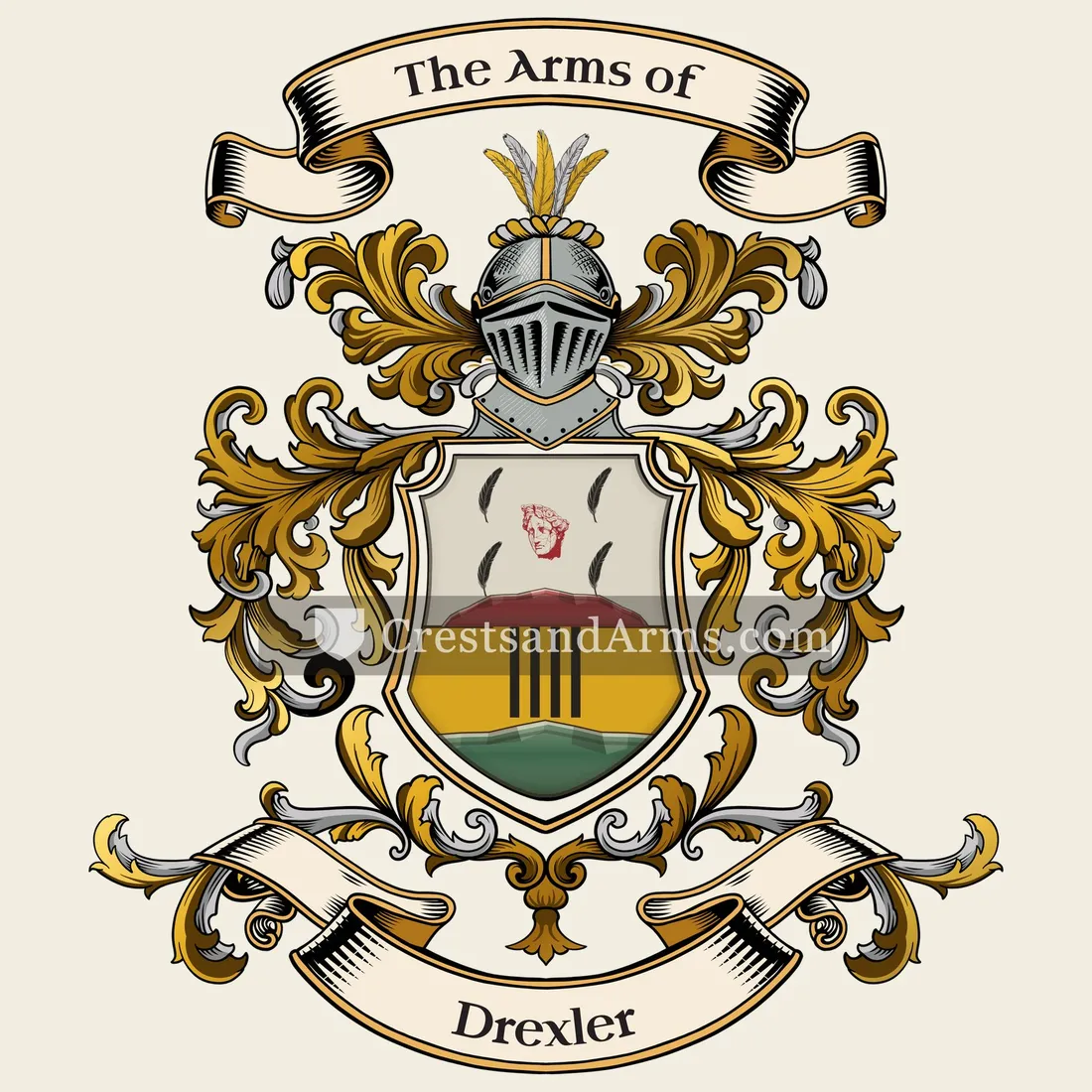
Symbols on this shield
mountThe ground held, and steadfastness upon it
paleMilitary strength, and a fortified defence
womanGrace, and the founding of a house
feathersWilling obedience and serenity
Colours
Silver (Argent)Means: Peace and sincerity
Gold (Or)Means: Generosity
Green (Vert)Means: Hope
Red (Gules)Means: Military strength
Black (Sable)Means: Constancy
Historical info
Source
J. B. Rietstap, Armorial Général, Gouda: G. B. van Goor Zonen, 1884–87
Blazon (the actual original written record)
“Coupé: au 1 d'arg. à une femme iss. de gu., mouv. d'un tertre d'arg., les cheveux épars de sa., cour. d'or, sommée de quatre pl. d'aut. alt. d'arg. et de gu.; au 2 d'or à quatre pals de sa. C.: la femme, iss. L.: à dextre d'arg. et de sa., à sen. d'or et de gu.”
Austriac. 1772
Digital archive packCoat of arms PNG, gold border print PDF, vector SVG and the certificate of authenticity. Sent to your email in minutes.
Map of Austria showing where the Drexler arms are recorded
The Drexler arms were recorded in Austria, c. 1772.
Arms such as these were typically recorded in Tyrol.
Tyrol was mountain country in western Austria, where the valleys were held by families who had been there a very long time. Old tenure counted for more than money, and old families carried arms.
This is where the arms were entered in the register. Families often moved to other parts of the country, so the same name can turn up in more than one region.
Region
Tyrol
First recorded
1772
Granting Authority for the Drexler Arms
Imperial and Royal chancery
Sodacan · CC BY-SA 3.0
The body that granted and recorded arms in Austria in this period.
Joseph II, Holy Roman Emperor
Sovereign of the period
Joseph II, Holy Roman Emperor
1765–1790
Reigning in Austria when the Drexler arms are first recorded.
How Arms Worked in Austria
Austrian coats of arms were often linked directly to noble titles granted by the Emperor. These symbols belonged to the entire family line rather than just one individual. When a family grew, new branches kept the original design without needing to change it. This system allowed all members of a noble house to share the same identity across many generations.
Granting authority
The Imperial and Royal chancery managed all heraldic matters and controlled the official granting of arms throughout the Austrian lands.
How they got arms
Families typically received their arms through a formal imperial decree that often accompanied the elevation of a person to noble status.
Where arms were recorded
Official records of these grants were kept in the Imperial Register of Nobility which began its formal documentation process in 1453.
The family's standing
Recorded among the armigerous families of Austria.
Origin & History of the Drexler Family in Austria
The surname Drexler is an occupational name that originated from the Middle High German word *drechsler*, which refers to a woodturner or someone who worked with a lathe. In the mountainous region of Tyrol, families carrying this name were often skilled craftsmen who played a vital role in the local economy by shaping wood into tools, bowls, and furniture. By the time records confirm the presence of the Drexler family in Tyrol in 1772, the name had become well-established among the alpine population. These early ancestors likely lived in small, tight-knit communities where their trade was passed down from one generation to the next. Because the geography of Tyrol made travel difficult, these families remained deeply rooted in their specific valleys for centuries. Their history is defined by the practical necessity of their craft and their adaptation to the rugged lifestyle of the Austrian Alps.
Meaning of the Drexler family crest colors & symbols
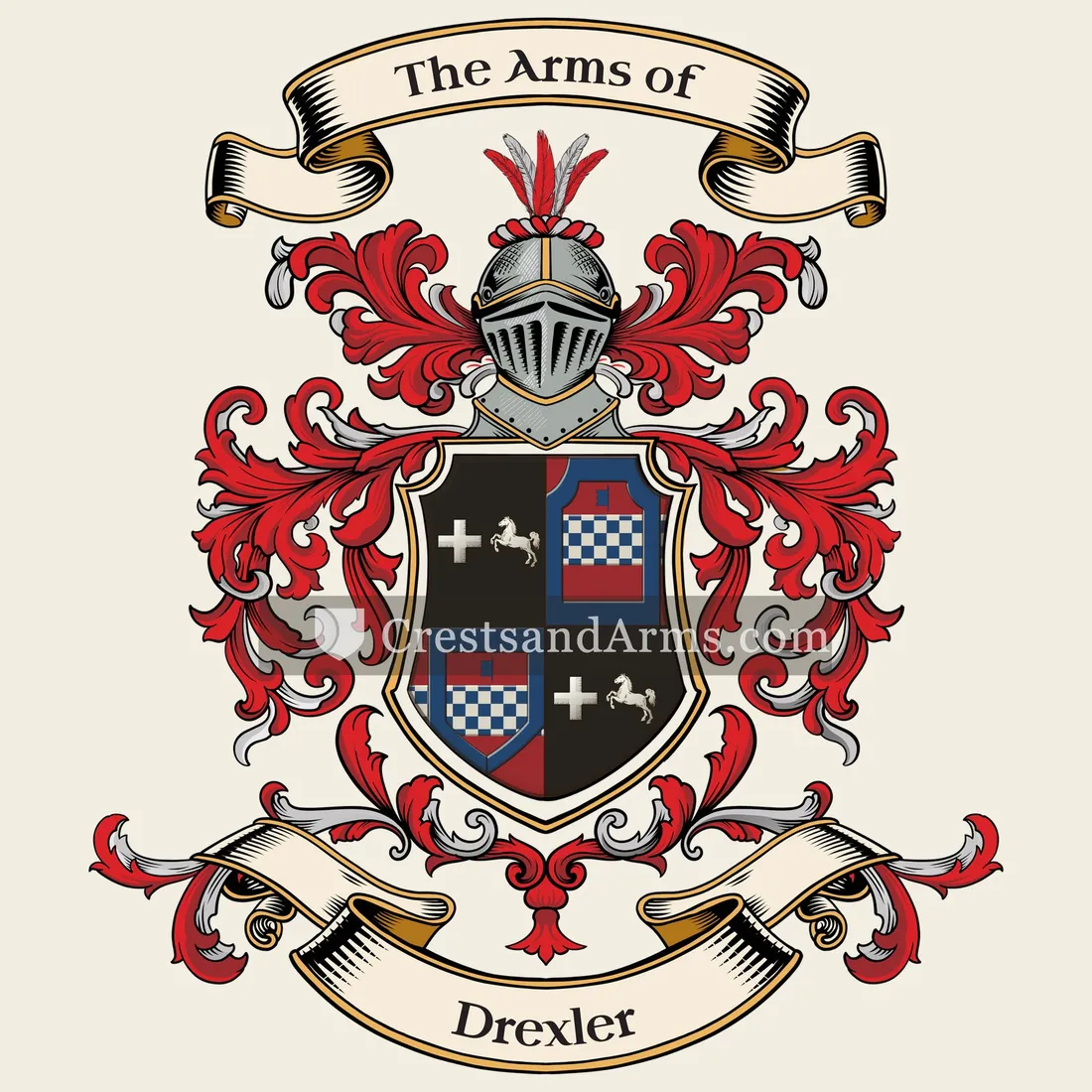
Symbols on this shield
cross symbolChristian faith and service
fessThe military belt, and readiness to serve
chequyConstancy, and the counting-board
horseReadiness to serve king and country
flag / pennantA command held, and a following kept
Colours
Black (Sable)Means: Constancy
Red (Gules)Means: Military strength
Blue (Azure)Means: Loyalty and truth
Silver (Argent)Means: Peace and sincerity
Historical info
Source
J. B. Rietstap, Armorial Général, Gouda: G. B. van Goor Zonen, 1884–87
Blazon (the actual original written record)
“Ec.: aux 1 et 4 coupé, de sa. à une croix de Malte d'arg., sur arg. à une tête et col de cheval de sa.; à la fasce échiq. de sin. et d'arg., br. sur le coupé; aux 2 et 3 de gu. à une bannière d'azur frangée d'or, ch. d'une aigle de sa., la trabe d'arg. posée en bande. L'écu bordé d'azur, surch. d'une filière d'arg. Cq. cour. C.: une tête de cheval de sa., entre deux bannières adossées, pareilles à celles des 2 et 3, sauf que le champ de la bannière sen. est de pourpre. L. d'arg et de sa.”
Germanyc. 1766
Digital archive packCoat of arms PNG, gold border print PDF, vector SVG and the certificate of authenticity. Sent to your email in minutes.
Map of Germany showing where the Drexler arms are recorded
The Drexler arms were recorded in Germany, c. 1766.
Arms such as these were typically recorded in Bavaria.
Bavaria was a country of old landed families and walled market towns. Estates passed down the same line for centuries, and both the landowners and the leading townsmen kept arms, which is why so many Bavarian names sit in the registers.
This is where the arms were entered in the register. Families often moved to other parts of the country, so the same name can turn up in more than one region.
The body that granted and recorded arms in Germany in this period.
Joseph II, Holy Roman Emperor
Sovereign of the period
Joseph II, Holy Roman Emperor
1765–1790
Reigning in Austria when the Drexler arms are first recorded.
How Arms Worked in Germany
In the Holy Roman Empire, coats of arms were often granted to individuals by the Emperor or his representatives. These arms were then passed down through the generations to all legitimate descendants of the original holder. Younger branches of a family usually kept the same shield design without needing to change it, as the arms belonged to the entire lineage.
Granting authority
The Holy Roman Emperor held the sole power to grant new coats of arms throughout his vast imperial territories.
How they got arms
Families typically obtained their coats of arms through a formal imperial grant or by proving their noble status to the authorities.
Where arms were recorded
These grants were officially recorded in the Imperial Chancery registers, which began keeping formal records of such honors during the Middle Ages.
The family's standing
Recorded among the armigerous families of Germany.
Origin & History of the Drexler Family in Germany
The surname Drexler originates from the Middle High German word "drechsler," which describes a person who worked as a wood turner. During the medieval period, this was a skilled trade that involved shaping wood on a lathe to create bowls, furniture parts, and tools. As surnames became common in Germany, families often adopted names based on their specific craft or occupation. By the time records confirm the presence of the Drexler family in Bavaria in 1766, the name had been established for generations as a marker of artisan heritage. These early family members lived in a region known for its strong guilds and woodcraft traditions, which likely provided steady work for those skilled in turning. The name serves as a direct link to the daily life and labor of ancestors who helped build the local economy through their mastery of woodworking tools.
Drexler Meaning & Related Branches
Root word
Drechsler
A person who works with a lathe to shape wood.
This name
DrexlerAn occupational surname for a wood turner or someone who operated a lathe.
also spelled
Dresler
Dresseler
Documented Sources
J. B. Rietstap, Armorial Général, Gouda: G. B. van Goor Zonen, 1884–87
Kranzmayer, Eberhard. Ortsnamenbuch von Kärnten. 1956


 mountThe ground held, and steadfastness upon it
 paleMilitary strength, and a fortified defence
 womanGrace, and the founding of a house
 feathersWilling obedience and serenity
 mountThe ground held, and steadfastness upon it
 paleMilitary strength, and a fortified defence
 womanGrace, and the founding of a house
 feathersWilling obedience and serenity


 cross symbolChristian faith and service
 fessThe military belt, and readiness to serve
 chequyConstancy, and the counting-board
 horseReadiness to serve king and country
 flag / pennantA command held, and a following kept