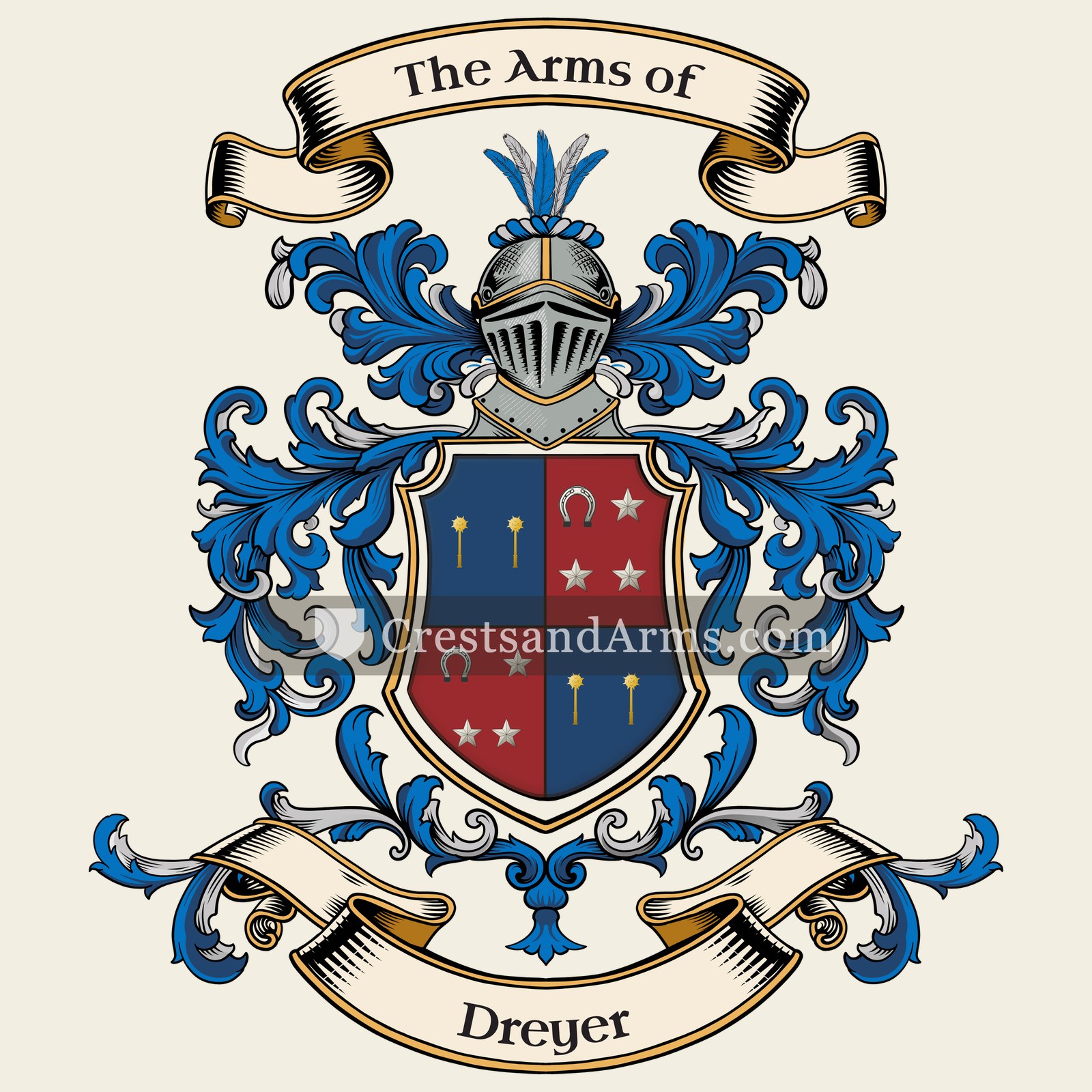
A record of documented arms, meaning and origin, researched for the Dreyer family of Netherlands.
Reg. 9065 · Dutch, D–F
Coat of Arms & Family Crest Details
Symbols on this shield
saltireResolution, and St Andrew's cross
maceAuthority, and the officer who bears it
horseshoeGood fortune and protection from harm
mulletThe third son, and a divine quality from above
Colours
Blue (Azure)Means: Loyalty and truth
Red (Gules)Means: Military strength
Gold (Or)Means: Generosity
Silver (Argent)Means: Peace and sincerity
Historical info
Source
J. B. Rietstap, Armorial Général, Gouda: G. B. van Goor Zonen, 1884–87
Blazon (the actual original written record)
“Ec.: aux 1 et 4 d'azur à deux masses à picotons d'or, passées en saut.; aux 2 et 3 de gu. a un fer-à-cheval d'arg., les bouts en bas, et entre ses branches trois étoiles mal-ordonnées d'arg.”
NetherlandsAmsterdam, c. 1815
Where the Dreyer Arms Were Recorded
Amsterdam
Map of Netherlands showing where the Dreyer arms are recorded
The Dreyer arms were recorded in Amsterdam, c. 1815.
This is where the arms were entered in the register. Families often moved to other parts of the country, so the same name can turn up in more than one region.
Region
Amsterdam
Town
Amsterdam
First recorded
1815
Granting Authority for the Dreyer Arms
Hoge Raad van Adel
Photograph made by me · CC BY-SA 3.0
The body that granted and recorded arms in Netherlands in this period.
William I of the Netherlands
Sovereign of the period
William I of the Netherlands
1815–1840
Reigning in Netherlands when the Dreyer arms are first recorded.
How Arms Worked in Netherlands
In the Netherlands, coats of arms were often used by noble families and those who held specific public offices. These arms were passed down through the generations to legitimate descendants. Younger branches of a family usually kept the original design without needing to add special marks. This system ensured that the family identity remained clear and consistent over many years.
Granting authority
The Hoge Raad van Adel is the official body that regulates and manages noble titles and coats of arms in the Netherlands.
How they got arms
Families typically obtained their coats of arms through official royal grants or by proving their long-standing historical use of the symbols.
Where arms were recorded
Coats of arms are officially recorded in the registers held by the Hoge Raad van Adel, which began its work in 1814.
The family's standing
Recorded among the armigerous families of Netherlands.
Origin & History of the Dreyer Family in Netherlands
The surname Dreyer originates from the Middle Low German word *dreier*, which historically referred to a person who worked at a lathe or operated a turning machine. This occupation was essential for crafting wooden tools, furniture, and household items, making the name a common occupational descriptor across Northern Europe. By the early nineteenth century, the family had established a presence in Amsterdam, a city that served as a major hub for trade and craftsmanship during the post-Napoleonic era. As the family settled into the urban landscape of 1815 Amsterdam, they likely integrated into the city’s vibrant guild systems or merchant networks. This transition from a trade-based identity to a settled urban family reflects the broader social shifts occurring in the Netherlands as the country rebuilt its economy and administrative structures following the French occupation.
Related Branches & Arms
Root word
Draaier
A person who turns or rotates objects on a lathe.
This name
DreyerAn occupational surname for a turner or woodworker who shaped items on a lathe.
also spelled
Dreier
Dreyar
Dryer
Documented Sources
J. B. Rietstap, Armorial Général, Gouda: G. B. van Goor Zonen, 1884–87
Bahlow, Hans. Deutsches Namenlexikon: Familien- und Vornamen nach Ursprung und Sinn erklärt. 1967


 saltireResolution, and St Andrew's cross
 maceAuthority, and the officer who bears it
 horseshoeGood fortune and protection from harm
 mulletThe third son, and a divine quality from above
 saltireResolution, and St Andrew's cross
 maceAuthority, and the officer who bears it
 horseshoeGood fortune and protection from harm
 mulletThe third son, and a divine quality from above