Map of Belgium showing where the Droege arms are recorded
The Droege arms were recorded in Flandre, c. 1663.
Flandre grew rich on cloth, and its towns were among the busiest in Europe. Merchant families bought land with their profits and took arms to go with it, so trade put as many names in the registers here as land did.
This is where the arms were entered in the register. Families often moved to other parts of the country, so the same name can turn up in more than one region.
The body that granted and recorded arms in Belgium in this period.
Philip IV of Spain
Sovereign of the period
Philip IV of Spain
1621–1665
Reigning in Belgium when the Droege arms are first recorded.
How Arms Worked in Belgium
In Belgium, a coat of arms is considered personal property that is passed down through the male line to legitimate descendants. Families often use the same shield design across generations to show their shared heritage. If a branch of the family wants to change the design, they must apply for an official update to their specific version of the arms.
Granting authority
The Conseil héraldique is the official body that regulates and approves all coats of arms in Belgium.
How they got arms
Families obtain their coats of arms through formal royal grants or by confirming their historical right to use existing designs.
Where arms were recorded
All approved coats of arms are officially recorded in the public registers of the Conseil héraldique since 1844.
The family's standing
Recorded among the armigerous families of Flandre.
Origin & History of the Droege Family in Belgium
The family name Droege traces its roots back to the Low Countries, with documented evidence placing family members in the region of Flandre by 1663. The name itself is derived from the Middle Low German and Middle Dutch word "droge," which translates to dry. In the context of early naming customs, this term was often used as a descriptive nickname for someone who lived on dry or elevated land, distinguishing them from those who resided in the marshy or low-lying areas common to the Flemish landscape. As families began to adopt permanent surnames during this period, this descriptor became a fixed identity passed down through generations. The presence of the Droege family in Flandre during the mid-seventeenth century suggests they were part of a stable, land-holding population that played a role in the agricultural and social development of the region.
Droege Meaning & Related Branches
Root word
Droge
Middle Low German term meaning dry or arid land.
This name
DroegeA topographic name for someone who lived on dry, sandy, or uncultivated ground.
also spelled
Drooghe
Droga
Droog
Documented Sources
J. B. Rietstap, Armorial Général, Gouda: G. B. van Goor Zonen, 1884–87
Debrabandere, Frans. Woordenboek van de familienamen in België en Noord-Frankrijk. 1993
State Archives in Belgium (Rijksarchief te Gent), Parochieregisters van de provincie Oost-Vlaanderen. 1663
Digital archive packCoat of arms PNG, gold border print PDF, vector SVG and the certificate of authenticity. Sent to your email in minutes.


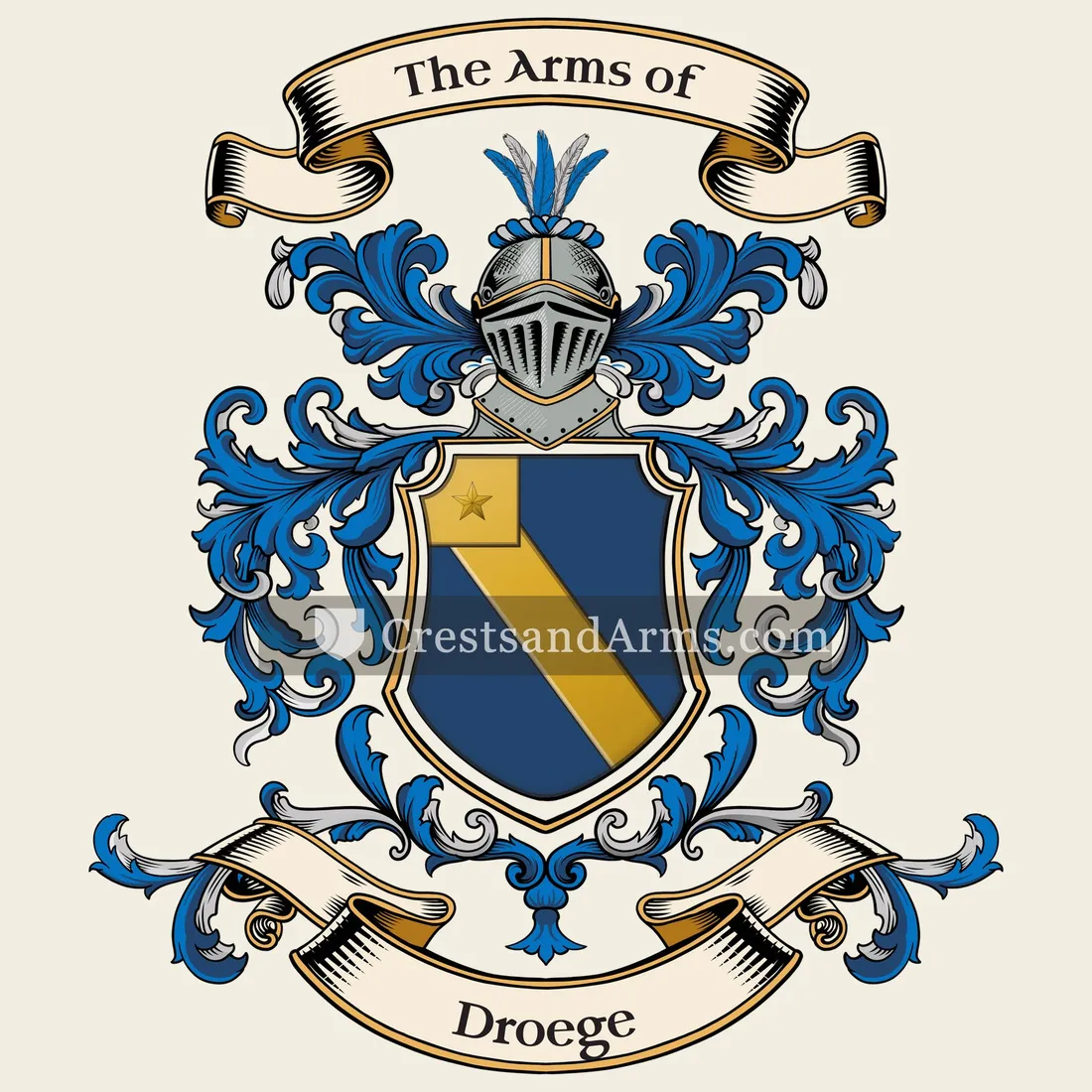
 bendDefence, and the scarf of a commander
 cantonA mark of honour granted by the sovereign
 mulletThe third son, and a divine quality from above
 bendDefence, and the scarf of a commander
 cantonA mark of honour granted by the sovereign
 mulletThe third son, and a divine quality from above