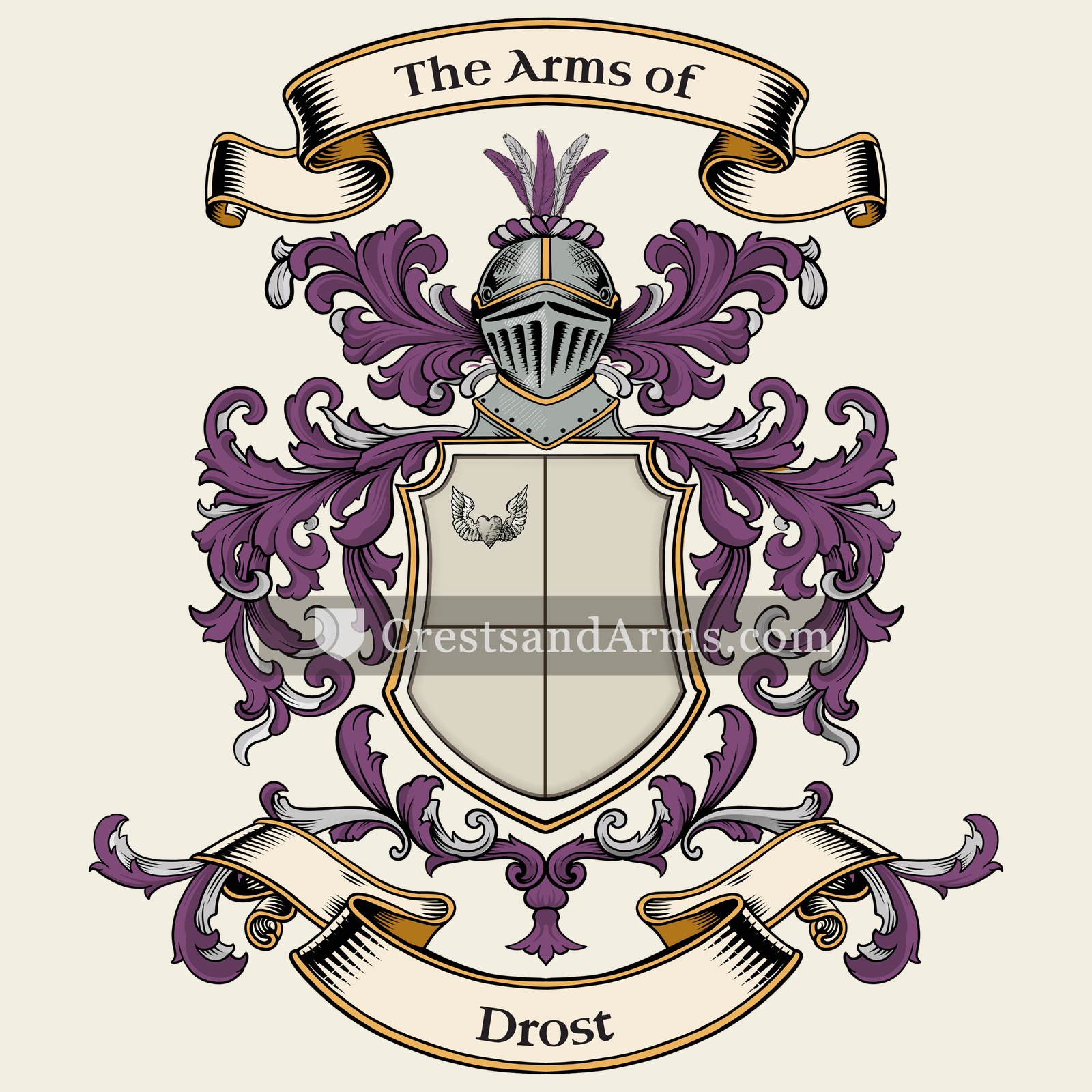
A record of documented arms, meaning and origin, researched for the Drost family lines. Documented in 2 countries.
Reg. 6448 · Dutch, D–F
Coat of Arms & Family Crest Details
Symbols on this shield
fessThe military belt, and readiness to serve
cockCourage, vigilance and readiness for battle
Colours
Red (Gules)Means: Military strength
Silver (Argent)Means: Peace and sincerity
Gold (Or)Means: Generosity
Historical info
Source
J. B. Rietstap, Armorial Général, Gouda: G. B. van Goor Zonen, 1884–87
Blazon (the actual original written record)
“Ec.: aux 1 et 4 de gu. à un sablier d'arg., bordé d'or, ailé du sec.; aux 2 et 3 d'arg. à deux fasces brét. et c.-brét. de gu., la première supp. deux coqs affr. du même. C.: le sablier.”
NetherlandsAmsterdam, c. 1815
Digital archive packCoat of arms PNG, gold border print PDF, vector SVG and the certificate of authenticity. Sent to your email in minutes.
Map of Netherlands showing where the Drost arms are recorded
The Drost arms were recorded in Amsterdam, c. 1815.
This is where the arms were entered in the register. Families often moved to other parts of the country, so the same name can turn up in more than one region.
Region
Amsterdam
Town
Amsterdam
First recorded
1815
Granting Authority for the Drost Arms
Hoge Raad van Adel
Photograph made by me · CC BY-SA 3.0
The body that granted and recorded arms in Netherlands in this period.
William I of the Netherlands
Sovereign of the period
William I of the Netherlands
1815–1840
Reigning in Netherlands when the Drost arms are first recorded.
How Arms Worked in Netherlands
In the Netherlands, coats of arms were often used by noble families and those who held specific public offices. These arms were passed down through the generations to legitimate descendants. Younger branches of a family usually kept the original design without needing to add special marks. This system ensured that the family identity remained clear and consistent over many years.
Granting authority
The Hoge Raad van Adel is the official body that regulates and manages noble titles and coats of arms in the Netherlands.
How they got arms
Families typically obtained their coats of arms through official royal grants or by proving their long-standing historical use of the symbols.
Where arms were recorded
Coats of arms are officially recorded in the registers held by the Hoge Raad van Adel, which began its work in 1814.
The family's standing
Recorded among the armigerous families of Netherlands.
Origin & History of the Drost Family in Netherlands
The surname Drost originates from a historical administrative title rather than a specific family line. In the medieval Netherlands, a *drost* was a high-ranking official who served as a local governor or a representative of a nobleman. Because these officials held significant authority, the title often became a descriptive nickname for the person who held the office. By the time the name appears in Amsterdam records around 1815, it had transitioned from a formal job title into a hereditary family name. This shift occurred as families began to adopt permanent surnames to satisfy government requirements for civil registration. Members of the Drost family in early nineteenth-century Amsterdam were part of a growing urban population that was navigating the transition from traditional naming customs to the modern system of fixed family names.
Coat of Arms & Family Crest Details
Symbols on this shield
heartSincerity, charity and true affection
Colours
Purple (Purpure)Means: Royal majesty
Silver (Argent)Means: Peace and sincerity
Historical info
Source
J. B. Rietstap, Armorial Général, Gouda: G. B. van Goor Zonen, 1884–87
Blazon (the actual original written record)
“Ec.: aux 1 et 4 tiercé en pal de pourpre, de sa. et d'or, le sa. ch. d'une pique de gu., arm. d'arg., en pal; aux 2 et 3 coupé d'arg. sur azur; à une rose à six feuilles d'or, bout. de sin., br. sur le coupé. Sur le tout de pourpre à un coeur d'arg. Deux cq. cour. C.: 1° un homme iss. et cont., posé de profil, hab. de sin., ceint d'or, coiffé d'un chapeau de sa., tenant de sa main dextre un drapeau de sin. à la croix d'arg., frangé d'arg., attaché à une hampe de sa., arm. d'arg.; l'homme placé entre un vol fascé d'arg. et de sa., chaque aile ch. d'un écusson aux armes du 2; 2° trois pl. d'aut.: de pourpre, de sin. et d'or. L.: d'arg. et d'azur.”
Germanyc. 1765
Digital archive packCoat of arms PNG, gold border print PDF, vector SVG and the certificate of authenticity. Sent to your email in minutes.
Map of Germany showing where the Drost arms are recorded
The Drost arms were recorded in Germany, c. 1765.
Arms such as these were typically recorded in Bavaria.
Bavaria was a country of old landed families and walled market towns. Estates passed down the same line for centuries, and both the landowners and the leading townsmen kept arms, which is why so many Bavarian names sit in the registers.
This is where the arms were entered in the register. Families often moved to other parts of the country, so the same name can turn up in more than one region.
The body that granted and recorded arms in Germany in this period.
Francis I, Holy Roman Emperor
Sovereign of the period
Francis I, Holy Roman Emperor
1745–1765
Reigning in Netherlands when the Drost arms are first recorded.
How Arms Worked in Germany
In the Holy Roman Empire, coats of arms were often granted to individuals by the Emperor or his representatives. These arms were then passed down through the generations to all legitimate descendants of the original holder. Younger branches of a family usually kept the same shield design without needing to change it, as the arms belonged to the entire lineage.
Granting authority
The Holy Roman Emperor held the sole power to grant new coats of arms throughout his vast imperial territories.
How they got arms
Families typically obtained their coats of arms through a formal imperial grant or by proving their noble status to the authorities.
Where arms were recorded
These grants were officially recorded in the Imperial Chancery registers, which began keeping formal records of such honors during the Middle Ages.
The family's standing
Recorded among the armigerous families of Germany.
Origin & History of the Drost Family in Germany
The surname Drost originated as a professional title in medieval Germany, derived from the Low German word *drost*, which referred to a high-ranking official or a steward who managed a nobleman’s estate. Over time, this occupational title transitioned into a hereditary surname as families became associated with the administrative roles they performed for local lords. By the mid-eighteenth century, the name had spread across various German regions, including Bavaria, where records confirm the presence of the Drost family by 1765. During this era, families with this name were often integrated into the local social structure as skilled managers or land overseers. This transition from a job description to a permanent family name reflects the way German society organized itself during the transition from the feudal period to the early modern age.
Drost Meaning & Related Branches
Root word
drost
A high-ranking official or administrator appointed by a sovereign.
This name
DrostAn occupational surname for a bailiff, steward, or local magistrate.
also spelled
Droste
Drostt
Drosth
Documented Sources
J. B. Rietstap, Armorial Général, Gouda: G. B. van Goor Zonen, 1884–87
Meertens, P.J., De betekenis van Nederlandse familienamen, 1970


 fessThe military belt, and readiness to serve
 cockCourage, vigilance and readiness for battle
 fessThe military belt, and readiness to serve
 cockCourage, vigilance and readiness for battle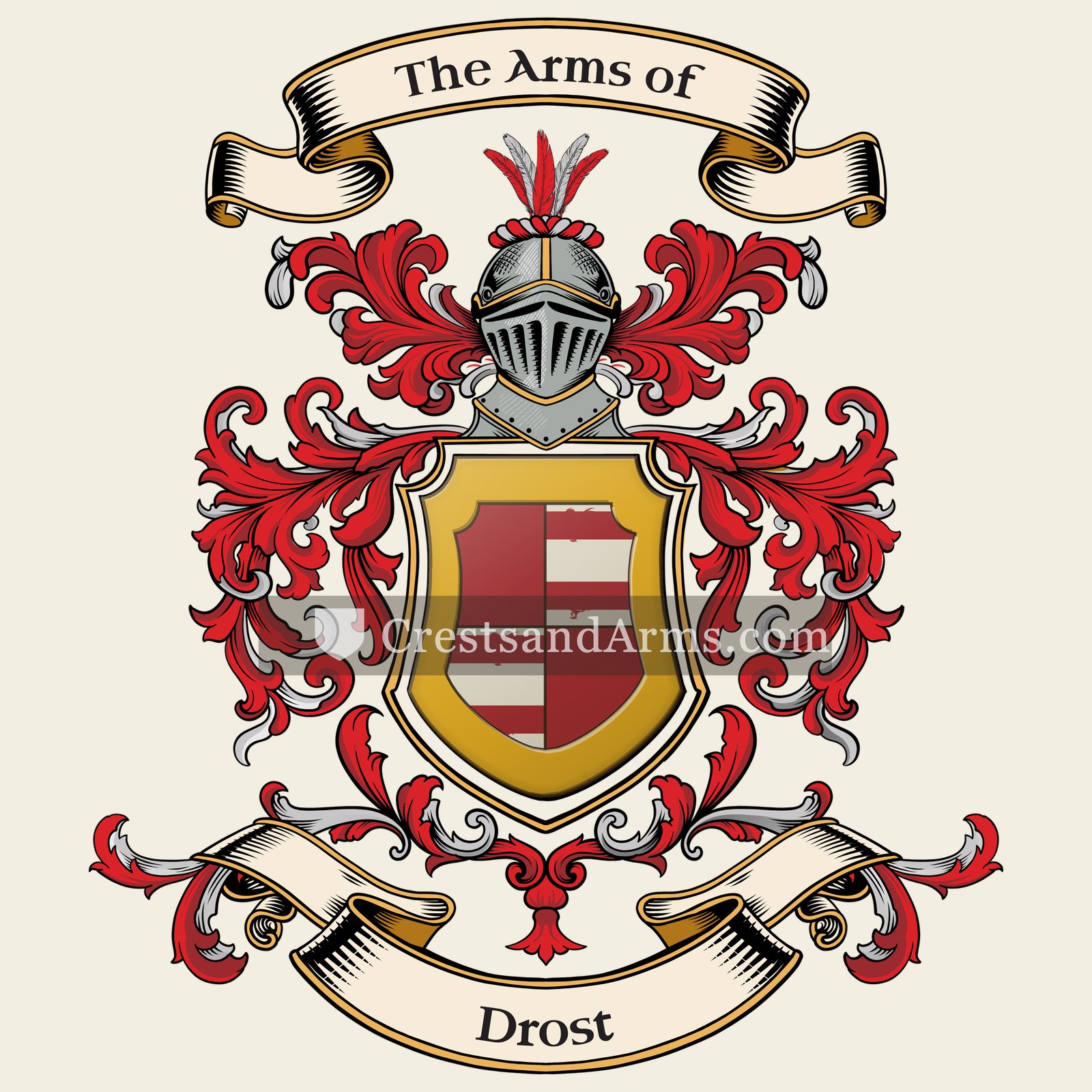


 heartSincerity, charity and true affection