A record of documented arms, meaning and origin, researched for the Drouin family lines. Documented in 2 countries.
Reg. 5307 · French, D–F
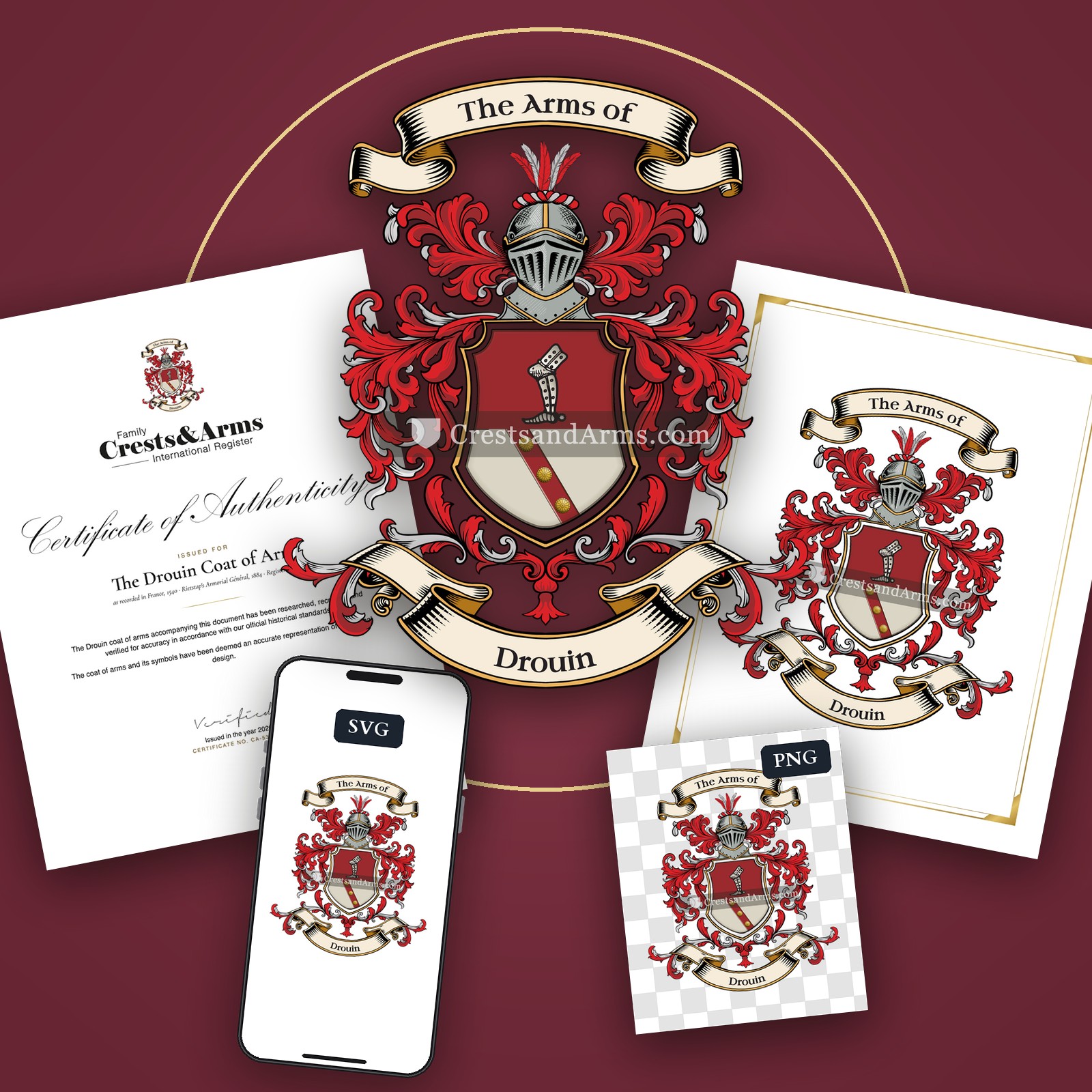
Coat of Arms & Family Crest Details
Symbols on this shield
bendDefence, and the scarf of a commander
legStrength and swiftness
roundelA coin, and one who has been to the crusades
Colours
Red (Gules)Means: Military strength
Silver (Argent)Means: Peace and sincerity
Gold (Or)Means: Generosity
Historical info
Source
J. B. Rietstap, Armorial Général, Gouda: G. B. van Goor Zonen, 1884–87
Blazon (the actual original written record)
“Coupé, de gu. à une jambe d'arg., sur arg. à la bande de gu., ch. de trois bes. d'or; à la fasce d'arg., br. sur le coupé et ch. d'une fasce vivrée d'azur.”
LorraineLorraine, c. 1540
Digital archive packCoat of arms PNG, gold border print PDF, vector SVG and the certificate of authenticity. Sent to your email in minutes.
Map of France showing where the Drouin arms are recorded
The Drouin arms were recorded in Lorraine, c. 1540.
Lorraine sat on the border between France and the German lands, and border country bred soldiers. Families here held small estates and served in arms, and a fighting man was exactly the sort who carried a shield of his own.
This is where the arms were entered in the register. Families often moved to other parts of the country, so the same name can turn up in more than one region.
The body that granted and recorded arms in France in this period.
Francis I of France
Sovereign of the period
Francis I of France
1515–1547
Reigning in France when the Drouin arms are first recorded.
How Arms Worked in France
In France, a coat of arms was a mark of honor that passed down through the male line to all legitimate descendants. Families often used the same shield without changes to show their shared heritage. If a branch wanted to stand out, they could add a small mark to their shield to show their specific place in the family tree.
Granting authority
The Juge d'armes de France acted as the official authority that regulated and verified coats of arms across the country.
How they got arms
Families typically inherited their arms from ancestors, though they could also receive them through royal grants or by proving their noble status.
Where arms were recorded
Coats of arms were officially recorded in the Armorial Général de France, which began its main collection in the year 1696.
The family's standing
Recorded among the armigerous families of Lorraine.
Origin & History of the Drouin Family in France
The family name Drouin has deep roots in the historical region of Lorraine, where records confirm members of the family were established by 1540. The name is considered a variation of the ancient given name Druon, which was common in northern and eastern France during the Middle Ages. This name likely evolved from Germanic origins that were popularized through local oral traditions and naming customs. As the family grew, they became part of the social fabric of the Lorraine countryside, often working as skilled laborers or small landowners. Because the region served as a crossroads for trade and cultural exchange between France and the Germanic territories, the Drouin family lived through a period of significant political change. Their presence in the area during the sixteenth century reflects the broader movement of families who settled in rural villages to build lasting legacies through agriculture and local craftsmanship.
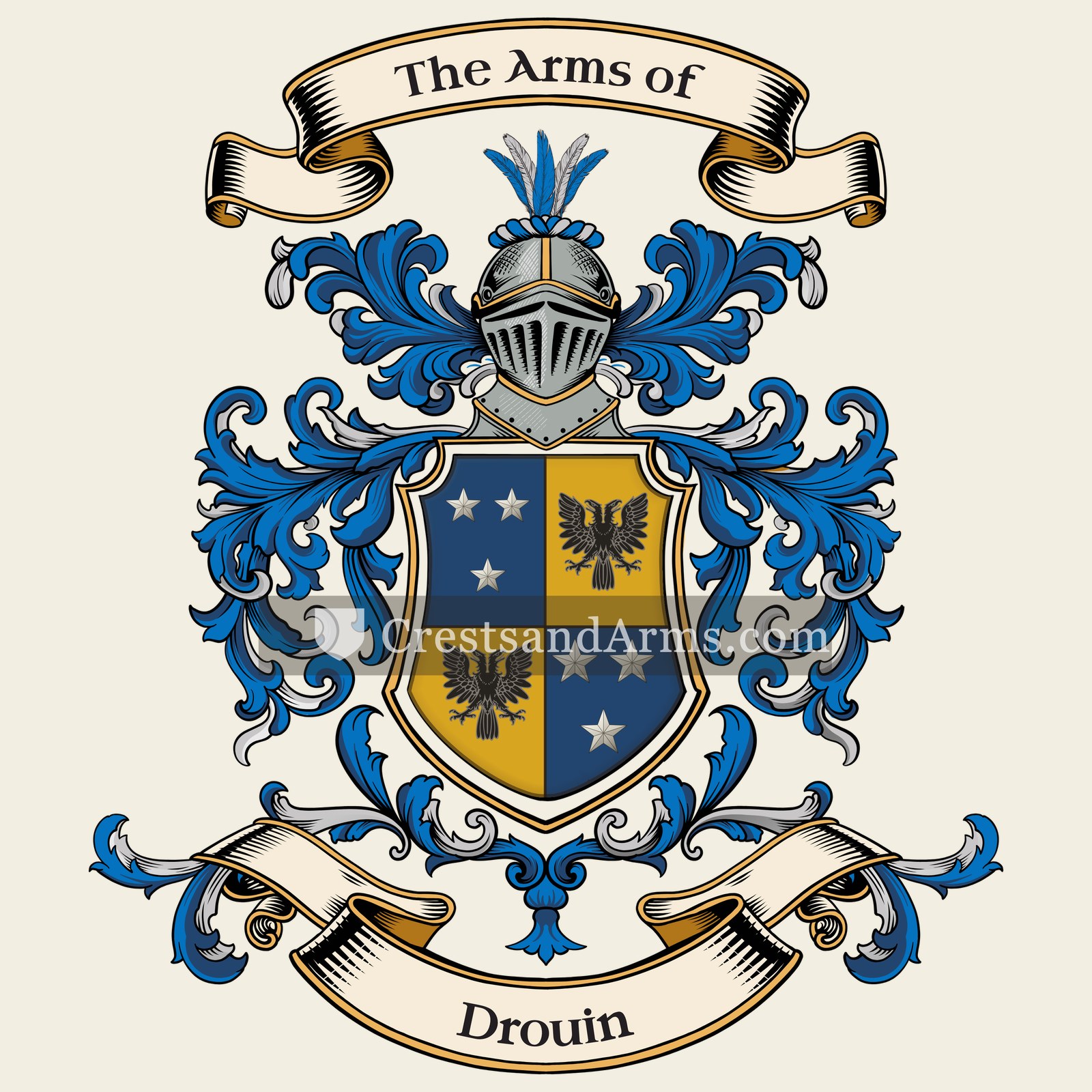
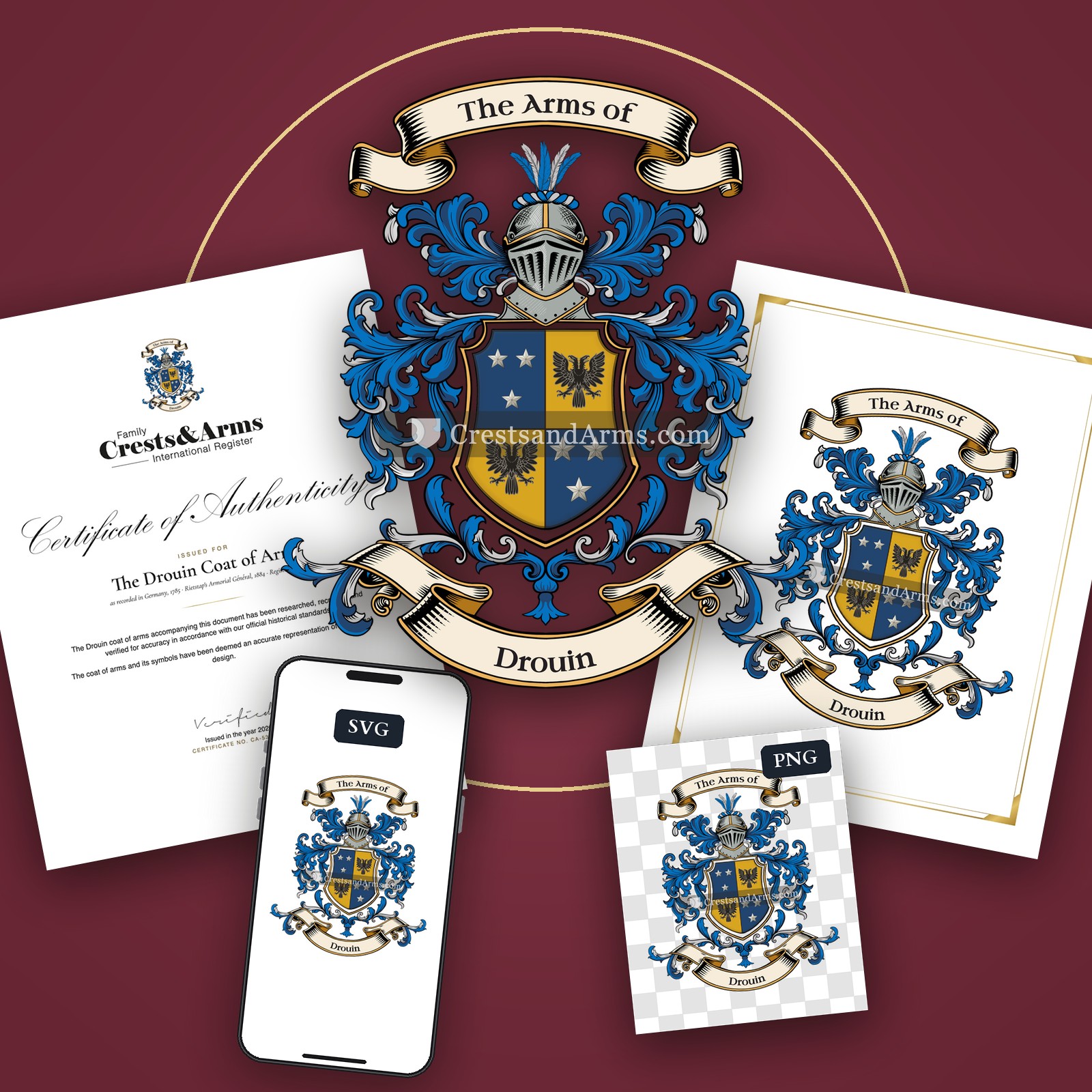
Coat of Arms & Family Crest Details
Symbols on this shield
mulletThe third son, and a divine quality from above
eagleNobility, strength and a keen mind
Colours
Blue (Azure)Means: Loyalty and truth
Gold (Or)Means: Generosity
Silver (Argent)Means: Peace and sincerity
Black (Sable)Means: Constancy
Historical info
Source
J. B. Rietstap, Armorial Général, Gouda: G. B. van Goor Zonen, 1884–87
Blazon (the actual original written record)
“Ec.: aux 1 et 4 d'azur à trois étoiles d'arg.; aux 2 et 3 d'or à la demi-aigle de sa., cour. du champ et mouv. du parti. Deux cq. cour. C.: 1º une aigle iss. de sa., cour. d'or, la tête cont.; 1. d'arg. et d'azur; 2º une étoile d'arg., entre deux cornes de boeuf coupées alt. d'arg. et d'azur; l. d'or et de sa.”
Germanyc. 1785
Digital archive packCoat of arms PNG, gold border print PDF, vector SVG and the certificate of authenticity. Sent to your email in minutes.
Map of Germany showing where the Drouin arms are recorded
The Drouin arms were recorded in Germany, c. 1785.
Arms such as these were typically recorded in Bavaria.
Bavaria was a country of old landed families and walled market towns. Estates passed down the same line for centuries, and both the landowners and the leading townsmen kept arms, which is why so many Bavarian names sit in the registers.
This is where the arms were entered in the register. Families often moved to other parts of the country, so the same name can turn up in more than one region.
The body that granted and recorded arms in Germany in this period.
Joseph II, Holy Roman Emperor
Sovereign of the period
Joseph II, Holy Roman Emperor
1765–1790
Reigning in France when the Drouin arms are first recorded.
How Arms Worked in Germany
In the Holy Roman Empire, coats of arms were often granted to individuals by the Emperor or his representatives. These arms were then passed down through the generations to all legitimate descendants of the original holder. Younger branches of a family usually kept the same shield design without needing to change it, as the arms belonged to the entire lineage.
Granting authority
The Holy Roman Emperor held the sole power to grant new coats of arms throughout his vast imperial territories.
How they got arms
Families typically obtained their coats of arms through a formal imperial grant or by proving their noble status to the authorities.
Where arms were recorded
These grants were officially recorded in the Imperial Chancery registers, which began keeping formal records of such honors during the Middle Ages.
The family's standing
Recorded among the armigerous families of Germany.
Origin & History of the Drouin Family in Germany
The Drouin family name carries a history deeply rooted in the cultural landscape of Southern Germany, particularly within the region of Bavaria. By the year 1785, records confirm that members of the family were already established residents in this area. During this period, Bavaria was undergoing significant social and economic shifts as it transitioned under the rule of the Electorate. Families like the Drouins often lived in tight-knit rural or semi-urban communities where they contributed to the local agricultural and trade systems that defined the Bavarian economy. Because the name appears in regional documentation during the late eighteenth century, it suggests that the family was well-integrated into the local administrative structures of the time. This era was marked by a strong focus on record-keeping by local parishes and government offices, which helped preserve the presence of families like the Drouins as they navigated the complexities of life in the Holy Roman Empire.
Drouin Meaning & Related Branches
Root word
Dru
Old French term for a lover, friend, or trusted companion.
This name
DrouinA diminutive form referring to a beloved person or a close friend.
also spelled
Drouine
Drouinn
Drouyn
Drooan
Related arms
Drouynvariant spelling
Documented Sources
J. B. Rietstap, Armorial Général, Gouda: G. B. van Goor Zonen, 1884–87
Dauzat, Albert, Dictionnaire étymologique des noms et prénoms de France, 1951
Morlet, Marie-Thérèse, Dictionnaire étymologique des noms de famille, 1991
Archives départementales de Meurthe-et-Moselle, Série B: Cours et juridictions
Digital archive packCoat of arms PNG, gold border print PDF, vector SVG and the certificate of authenticity. Sent to your email in minutes.


 bendDefence, and the scarf of a commander
 legStrength and swiftness
 roundelA coin, and one who has been to the crusades
 bendDefence, and the scarf of a commander
 legStrength and swiftness
 roundelA coin, and one who has been to the crusades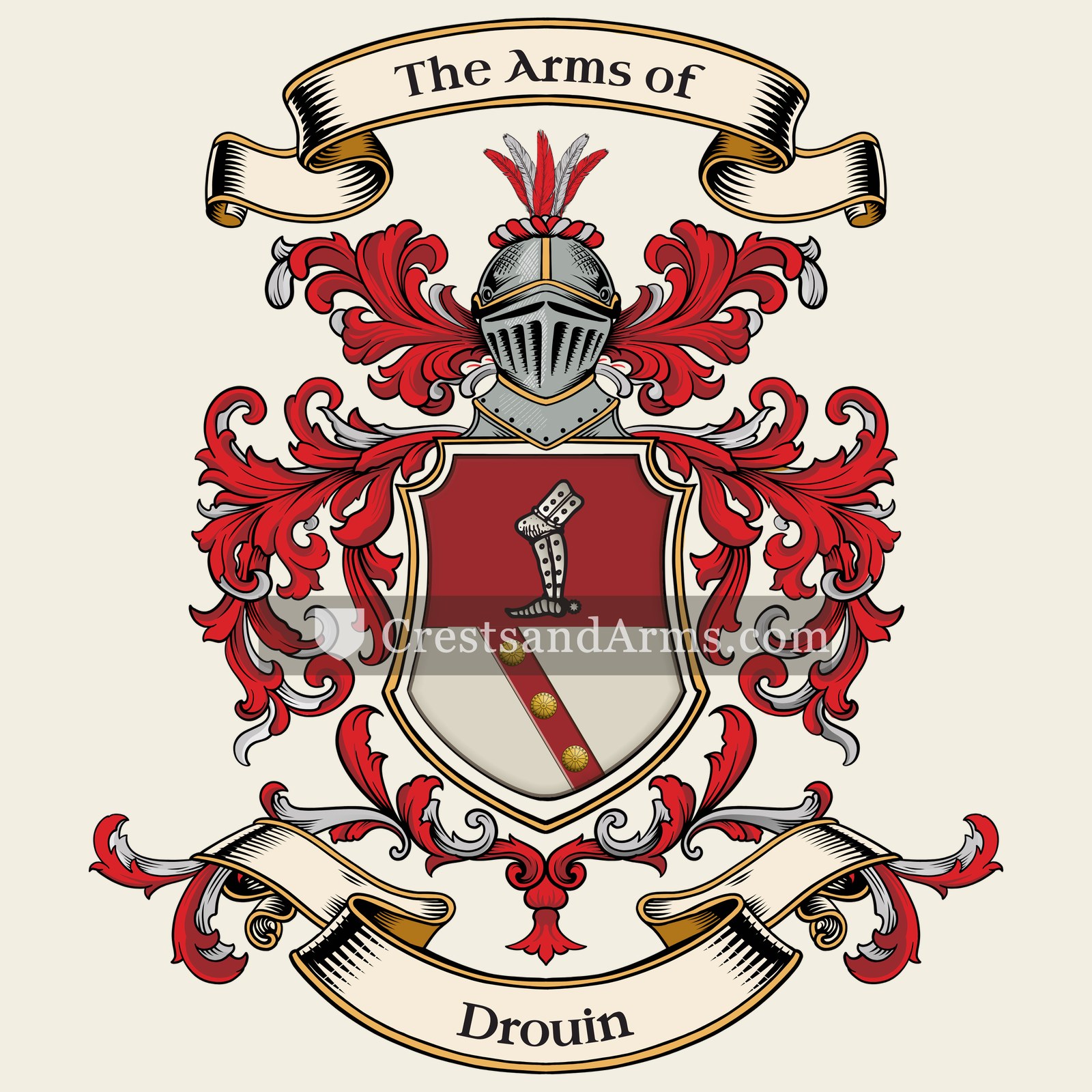


 mulletThe third son, and a divine quality from above
 eagleNobility, strength and a keen mind