Map of France showing where the Drouot arms are recorded
The Drouot arms were recorded in Lorraine, c. 1486.
Lorraine sat on the border between France and the German lands, and border country bred soldiers. Families here held small estates and served in arms, and a fighting man was exactly the sort who carried a shield of his own.
This is where the arms were entered in the register. Families often moved to other parts of the country, so the same name can turn up in more than one region.
The body that granted and recorded arms in France in this period.
Charles VIII of France
Sovereign of the period
Charles VIII of France
1483–1498
Reigning in France when the Drouot arms are first recorded.
How Arms Worked in France
In France, a coat of arms was a mark of honor that passed down through the male line to all legitimate descendants. Families often used the same shield without changes to show their shared heritage. If a branch wanted to stand out, they could add a small mark to their shield to show their specific place in the family tree.
Granting authority
The Juge d'armes de France acted as the official authority that regulated and verified coats of arms across the country.
How they got arms
Families typically inherited their arms from ancestors, though they could also receive them through royal grants or by proving their noble status.
Where arms were recorded
Coats of arms were officially recorded in the Armorial Général de France, which began its main collection in the year 1696.
The family's standing
Recorded among the armigerous families of Lorraine.
Origin & History of the Drouot Family in France
The family name Drouot traces its roots to the historical region of Lorraine in northeastern France, where records confirm the presence of family members as early as 1486. During this period, the name was closely tied to the rural landscape and the social structures of the duchy. The Drouot family lived in an area that served as a cultural bridge between the French kingdom and the Holy Roman Empire. Because of this location, the family likely navigated the complex political shifts and regional conflicts that defined life in Lorraine during the late Middle Ages. Over time, the name became established among local landholders and administrative figures who helped manage the resources of the region. By remaining rooted in this specific area for centuries, the family became a part of the long-standing traditions and economic development that shaped the identity of the Lorraine people.
Coat of Arms & Family Crest Details
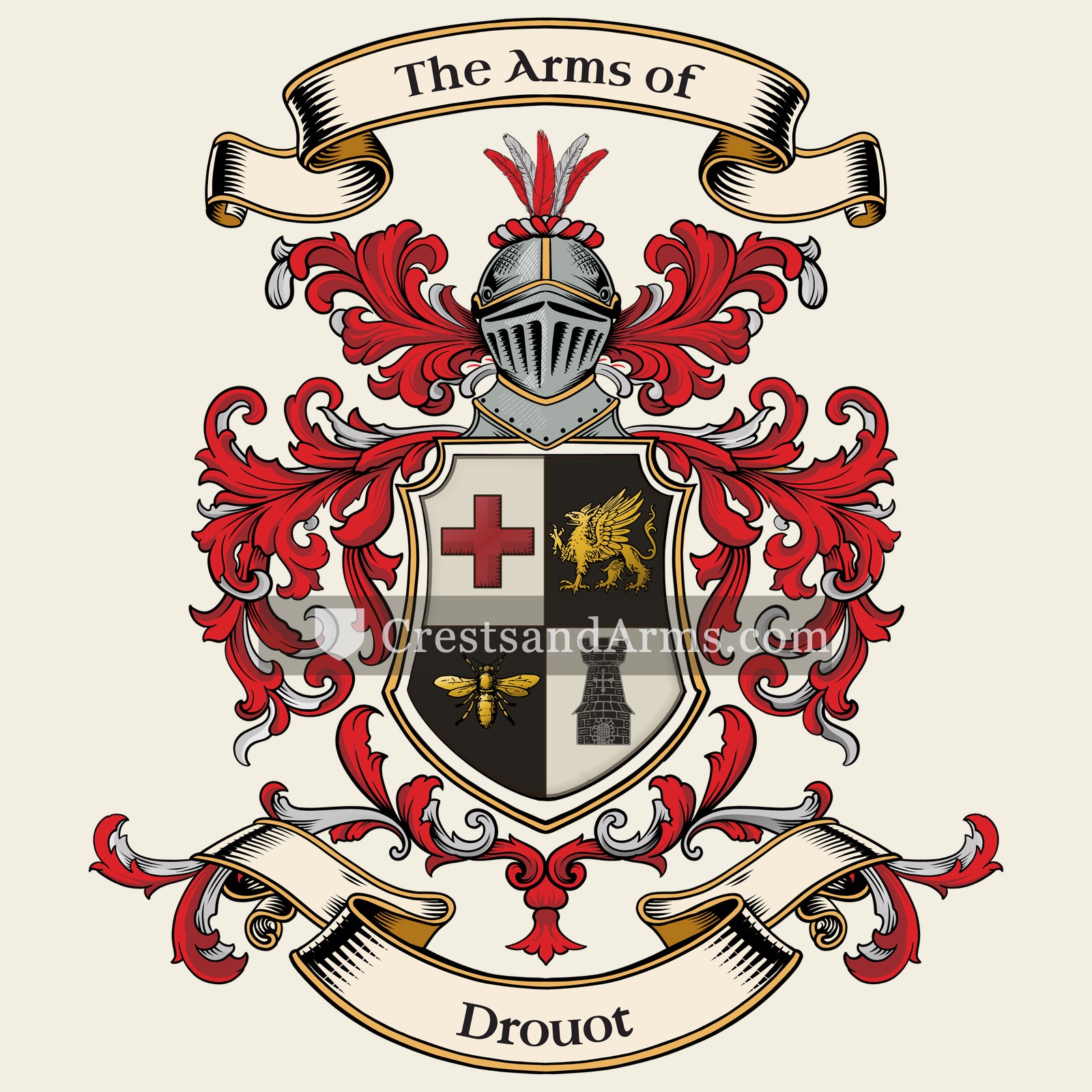
Symbols on this shield
cross symbolChristian faith and service
griffinValour and vigilance, guarding great treasure
beeIndustry, order and tireless work
towerGrandeur and solidity, and a stronghold defended
Colours
Silver (Argent)Means: Peace and sincerity
Black (Sable)Means: Constancy
Red (Gules)Means: Military strength
Gold (Or)Means: Generosity
Historical info
Source
J. B. Rietstap, Armorial Général, Gouda: G. B. van Goor Zonen, 1884–87
Blazon (the actual original written record)
“Ec.: au 1 d'arg. à la croix alésée de gu.; au 2 de sa. à un griffon d'or, tenant de chaque patte un tampon d'imprimeur du même, les tampons appliqués l'un sur l'autre; au 3 de sa. à une abeille d'or; au 4 de gu. à une eau sur le devant, avec un pont d'or conduisant à un château d'arg. dans le fond, flanqué de deux tours couvertes de toits pointus girouettés, ledit château ouvert de sa. avec des battants de porte d'or, la herse levée du mê-me, et deux avant-murs dextre et sen., touchant les flancs. Deux cq. cour. C.: 1° un vol cont., les ailes tranchées alt. d'arg. et de gu.; 1. d'arg. et de gu.; 2° un vol à l'antique, les ailes taillées alt. de sa. et d'or; 1. d'or et de sa.”
Austriac. 1881
Digital archive packCoat of arms PNG, gold border print PDF, vector SVG and the certificate of authenticity. Sent to your email in minutes.
Map of Austria showing where the Drouot arms are recorded
The Drouot arms were recorded in Austria, c. 1881.
Arms such as these were typically recorded in Tyrol.
Tyrol was mountain country in western Austria, where the valleys were held by families who had been there a very long time. Old tenure counted for more than money, and old families carried arms.
This is where the arms were entered in the register. Families often moved to other parts of the country, so the same name can turn up in more than one region.
Region
Tyrol
First recorded
1881
Granting Authority for the Drouot Arms
Imperial and Royal chancery
Sodacan · CC BY-SA 3.0
The body that granted and recorded arms in Austria in this period.
Franz Joseph I of Austria
Sovereign of the period
Franz Joseph I of Austria
1848–1916
Reigning in France when the Drouot arms are first recorded.
How Arms Worked in Austria
Austrian coats of arms were often linked directly to noble titles granted by the Emperor. These symbols belonged to the entire family line rather than just one individual. When a family grew, new branches kept the original design without needing to change it. This system allowed all members of a noble house to share the same identity across many generations.
Granting authority
The Imperial and Royal chancery managed all heraldic matters and controlled the official granting of arms throughout the Austrian lands.
How they got arms
Families typically received their arms through a formal imperial decree that often accompanied the elevation of a person to noble status.
Where arms were recorded
Official records of these grants were kept in the Imperial Register of Nobility which began its formal documentation process in 1453.
The family's standing
Recorded among the armigerous families of Austria.
Origin & History of the Drouot Family in Austria
The Drouot family name carries a distinct history that traces back to the mountainous regions of Tyrol by the late nineteenth century. While the name is often associated with French origins, its presence in the Austrian Alps by 1881 suggests a migration pattern linked to the movement of skilled laborers and merchants across Central Europe. During this period, Tyrol served as a vital crossroads for trade and cultural exchange between the Austrian Empire and its neighbors. Families like the Drouots likely settled in these high-altitude communities to participate in the local timber or mining industries that defined the regional economy. By establishing themselves in this rugged landscape, these early family members integrated into the local social fabric, adapting their traditions to the unique customs of the Tyrolean people. This transition reflects a broader trend of families moving across borders to find new opportunities in the rapidly changing industrial environment of the late 1800s.
Drouot Meaning & Related Branches
Root word
drou
A diminutive form of the Old French name Dru meaning beloved.
This name
DrouotA patronymic surname indicating a descendant of someone named Dru or beloved.
also spelled
Drouott
Drouote
Drouo
Drooho
Documented Sources
J. B. Rietstap, Armorial Général, Gouda: G. B. van Goor Zonen, 1884–87
Lepage, Henri. Les communes de la Meurthe: journal historique des villes, bourgs, villages, hameaux et censes de ce département. 1853
Digital archive packCoat of arms PNG, gold border print PDF, vector SVG and the certificate of authenticity. Sent to your email in minutes.


 acornAntiquity and strength from small beginnings
 acornAntiquity and strength from small beginnings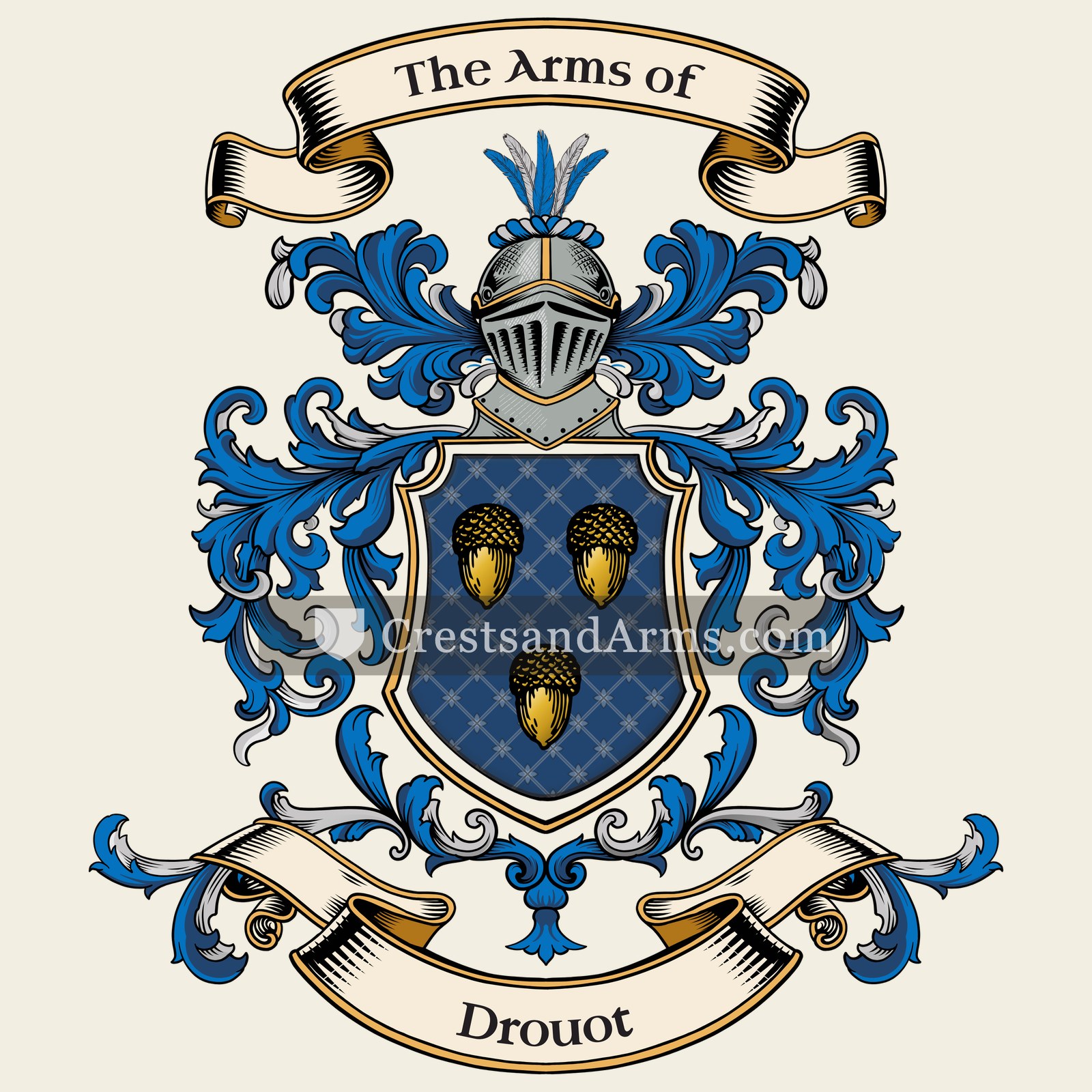


 cross symbolChristian faith and service
 griffinValour and vigilance, guarding great treasure
 beeIndustry, order and tireless work
 towerGrandeur and solidity, and a stronghold defended