Map of France showing where the Drumond arms are recorded
The Drumond arms were recorded in France, c. 1725.
Arms such as these were typically recorded in Bretagne.
More families held coats of arms in Bretagne than anywhere else in France. The land was divided into many small estates rather than a few large ones, so far more households counted as gentry, and each needed a shield of its own to be told apart.
This is where the arms were entered in the register. Families often moved to other parts of the country, so the same name can turn up in more than one region.
The body that granted and recorded arms in France in this period.
Louis XV of France
Sovereign of the period
Louis XV of France
1715–1774
Reigning in France when the Drumond arms are first recorded.
How Arms Worked in France
In France, a coat of arms was a mark of honor that passed down through the male line to all legitimate descendants. Families often used the same shield without changes to show their shared heritage. If a branch wanted to stand out, they could add a small mark to their shield to show their specific place in the family tree.
Granting authority
The Juge d'armes de France acted as the official authority that regulated and verified coats of arms across the country.
How they got arms
Families typically inherited their arms from ancestors, though they could also receive them through royal grants or by proving their noble status.
Where arms were recorded
Coats of arms were officially recorded in the Armorial Général de France, which began its main collection in the year 1696.
The family's standing
Recorded among the armigerous families of France.
Origin & History of the Drumond Family in France
The family name Drummond, often spelled Drumond in French records, carries a history deeply rooted in the rugged landscapes of Scotland before spreading across Europe. The name is locative, meaning it originated from a specific place, specifically the lands of Drymen in Stirlingshire. By the early 18th century, members of the family had migrated to the coastal region of Bretagne in France. This movement was likely driven by the close political and military ties between Scotland and France, a relationship historically known as the Auld Alliance. Settling in Bretagne by 1725, these early ancestors integrated into local society while maintaining their distinct heritage. Their presence in French parish registers from this period highlights how families moved across borders to pursue new opportunities in trade, military service, or agriculture during the Enlightenment era.
Drumond Meaning & Related Branches
Root word
drom
A ridge or a high piece of ground.
This name
DrumondDerived from a place name in Scotland referring to a ridge or high ground.
also spelled
Drumond
Drummound
Drummunde
Drumund
Documented Sources
J. B. Rietstap, Armorial Général, Gouda: G. B. van Goor Zonen, 1884–87
Black, George Fraser. The Surnames of Scotland: Their Origin, Meaning, and History. 1946
Digital archive packCoat of arms PNG, gold border print PDF, vector SVG and the certificate of authenticity. Sent to your email in minutes.


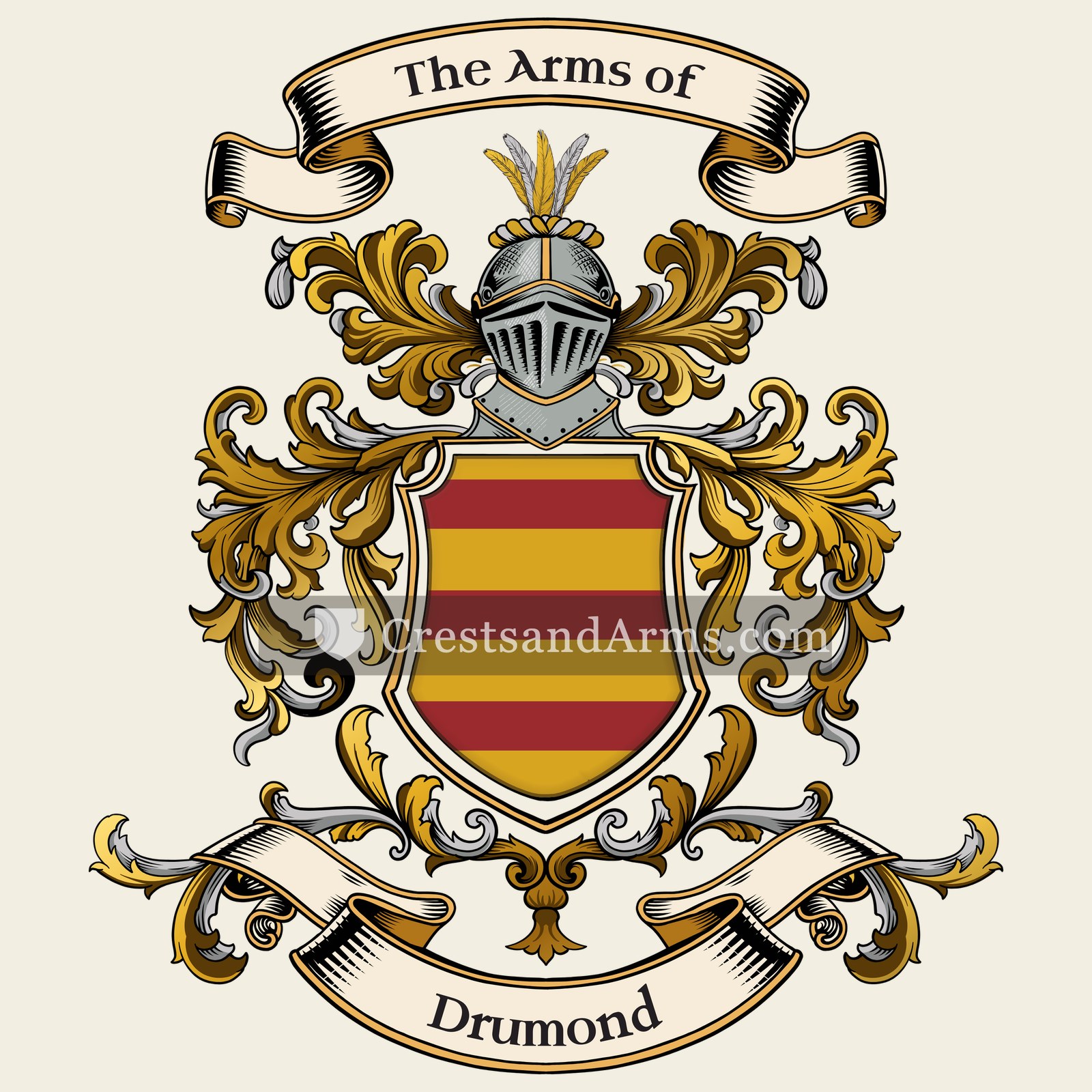
 fessThe military belt, and readiness to serve
 fessThe military belt, and readiness to serve