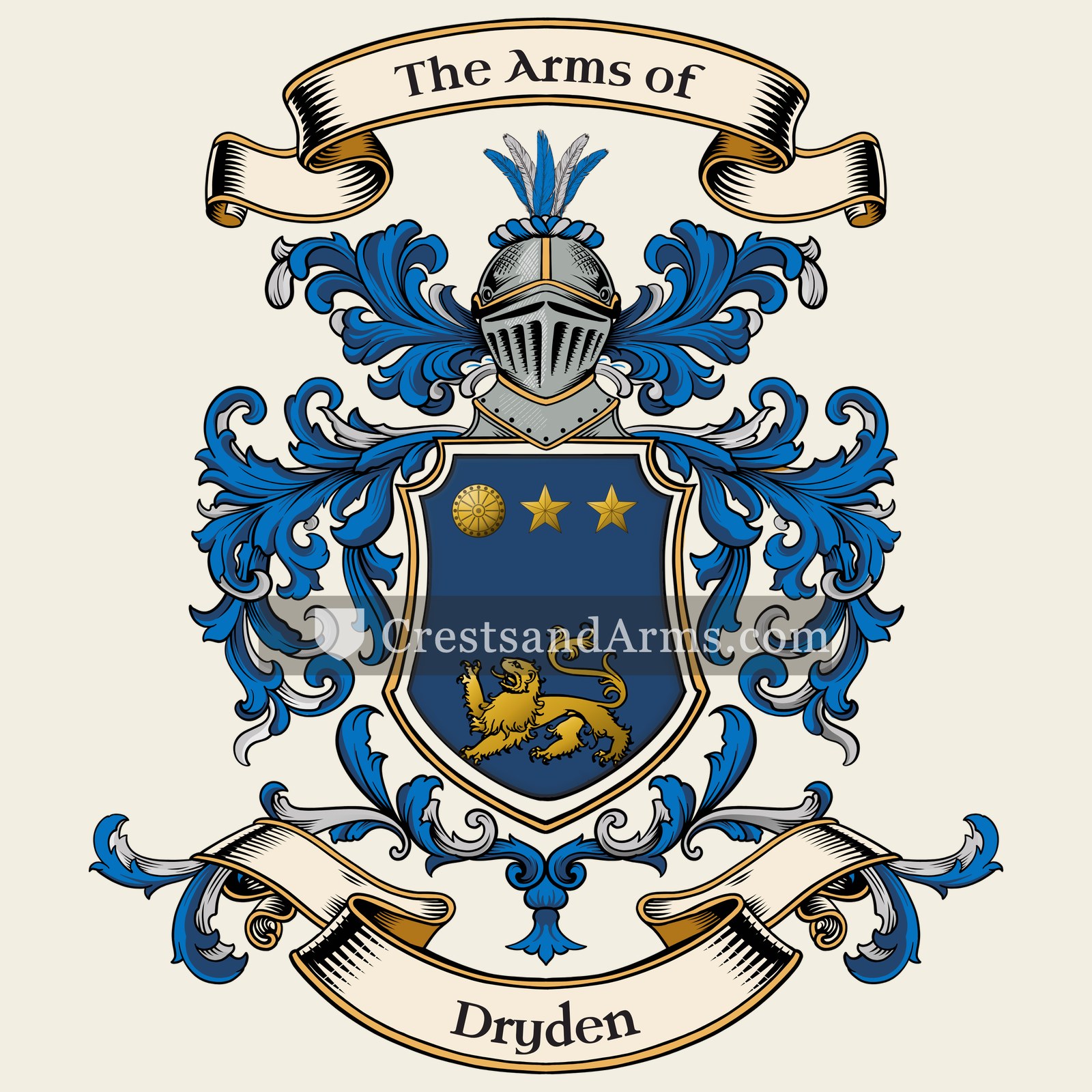
A record of documented arms, meaning and origin, researched for the Dryden family of France.
Reg. 2181 · French, D–F
Coat of Arms & Family Crest Details
Symbols on this shield
lionCourage, strength and royalty
roundelA coin, and one who has been to the crusades
mulletThe third son, and a divine quality from above
Colours
Blue (Azure)Means: Loyalty and truth
Gold (Or)Means: Generosity
Historical info
Source
J. B. Rietstap, Armorial Général, Gouda: G. B. van Goor Zonen, 1884–87
Blazon (the actual original written record)
“D'azur au lion, acc. en chef d'un globe terrestre accosté de deux étoiles rayonnantes, le tout d'or. C.: le lion, iss., supp. de sa patte dextre le globe de l'écu [Le poète John D. portait les mêmes armes.]”
NorthamptonshireNorthamptonshire, c. 1725
Digital archive packCoat of arms PNG, gold border print PDF, vector SVG and the certificate of authenticity. Sent to your email in minutes.
Map of France showing where the Dryden arms are recorded
The Dryden arms were recorded in Northamptonshire, c. 1725.
This is where the arms were entered in the register. Families often moved to other parts of the country, so the same name can turn up in more than one region.
The body that granted and recorded arms in France in this period.
Louis XV of France
Sovereign of the period
Louis XV of France
1715–1774
Reigning in France when the Dryden arms are first recorded.
How Arms Worked in France
In France, a coat of arms was a mark of honor that passed down through the male line to all legitimate descendants. Families often used the same shield without changes to show their shared heritage. If a branch wanted to stand out, they could add a small mark to their shield to show their specific place in the family tree.
Granting authority
The Juge d'armes de France acted as the official authority that regulated and verified coats of arms across the country.
How they got arms
Families typically inherited their arms from ancestors, though they could also receive them through royal grants or by proving their noble status.
Where arms were recorded
Coats of arms were officially recorded in the Armorial Général de France, which began its main collection in the year 1696.
The family's standing
Recorded among the armigerous families of Northamptonshire.
Origin & History of the Dryden Family in France
The surname Dryden is of English origin and is traditionally linked to the landscape of the northern border regions, though the family established a prominent presence in Northamptonshire by the early eighteenth century. The name is locational, meaning it was likely derived from a place name composed of the Old English words "dryge," meaning dry, and "denu," meaning valley. Families bearing this name often settled in areas where the geography matched this description, eventually spreading southward as members sought new opportunities in agriculture and local administration. By 1725, the Dryden family was well-integrated into the social fabric of Northamptonshire, where they were recognized as established residents involved in the local community. This migration from the north to the English Midlands reflects the broader movement of families who sought to secure land and influence during a period of significant economic change in Britain.
Dryden Meaning & Related Branches
Root word
Dryden
Derived from the Old English words for dry and valley.
This name
DrydenA locational surname referring to someone who lived in a dry valley or parched ravine.
also spelled
Drydenn
Drydene
Driden
Documented Sources
J. B. Rietstap, Armorial Général, Gouda: G. B. van Goor Zonen, 1884–87
Reaney, P.H. and Wilson, R.M., A Dictionary of English Surnames, 1991


 lionCourage, strength and royalty
 roundelA coin, and one who has been to the crusades
 mulletThe third son, and a divine quality from above
 lionCourage, strength and royalty
 roundelA coin, and one who has been to the crusades
 mulletThe third son, and a divine quality from above