Map of Belgium showing where the Drye arms are recorded
The Drye arms were recorded in Liege, c. 1737.
Liege was a prosperous town and its surrounding country, living on metalworking and trade. Merchant families grew rich, bought land outside the walls, and took arms as landowners rather than tradesmen.
This is where the arms were entered in the register. Families often moved to other parts of the country, so the same name can turn up in more than one region.
The body that granted and recorded arms in Belgium in this period.
Charles VI, Holy Roman Emperor
Sovereign of the period
Charles VI, Holy Roman Emperor
1711–1740
Reigning in Belgium when the Drye arms are first recorded.
How Arms Worked in Belgium
In Belgium, a coat of arms is considered personal property that is passed down through the male line to legitimate descendants. Families often use the same shield design across generations to show their shared heritage. If a branch of the family wants to change the design, they must apply for an official update to their specific version of the arms.
Granting authority
The Conseil héraldique is the official body that regulates and approves all coats of arms in Belgium.
How they got arms
Families obtain their coats of arms through formal royal grants or by confirming their historical right to use existing designs.
Where arms were recorded
All approved coats of arms are officially recorded in the public registers of the Conseil héraldique since 1844.
The family's standing
Recorded among the armigerous families of Liege.
Origin & History of the Drye Family in Belgium
The history of the Drye family in Belgium is rooted in the industrial and cultural landscape of the Prince-Bishopric of Liège during the eighteenth century. By 1737, records confirm that members of the family were established within this region, which was then a major hub for coal mining, metalworking, and trade. During this era, the Liège area served as a crossroads for European commerce, and families like the Dryes often integrated into the local economy as skilled laborers or artisans. Living in such a dense urban center required families to adapt to shifting political powers and the influence of the Catholic Church, which played a central role in documenting births, marriages, and deaths. The presence of the Drye name in these early parish registers suggests a stable life centered around the community traditions and the growing industrial output of the Meuse River valley. This period of residency helped shape the family identity as they navigated the transition from traditional agrarian society toward the early stages of the modern urban workforce.
Meaning of the Drye family crest colors & symbols
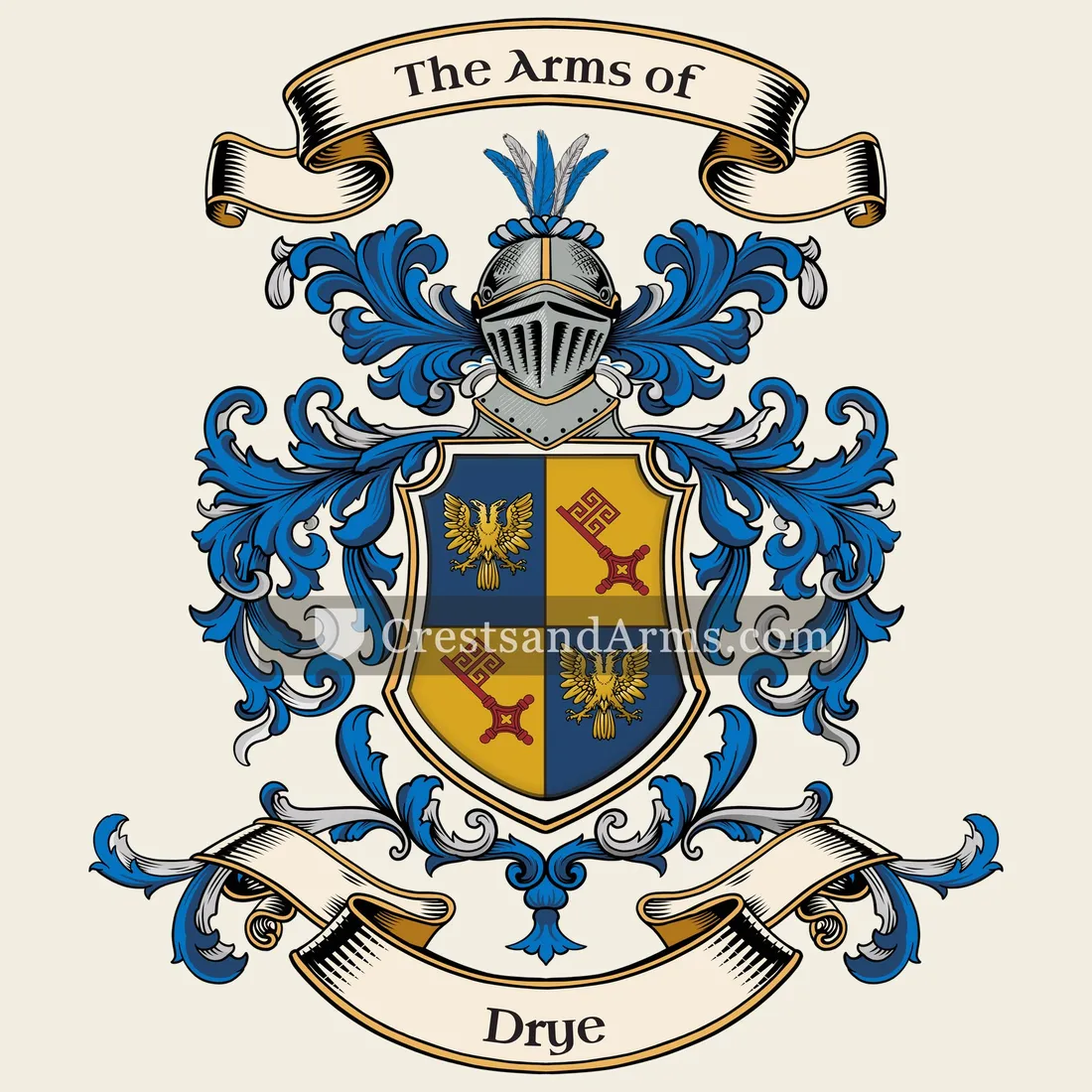
Symbols on this shield
eagleNobility, strength and a keen mind
keyGuardianship, and the office of a steward
Colours
Blue (Azure)Means: Loyalty and truth
Gold (Or)Means: Generosity
Red (Gules)Means: Military strength
Historical info
Source
J. B. Rietstap, Armorial Général, Gouda: G. B. van Goor Zonen, 1884–87
Blazon (the actual original written record)
“Ec.: aux 1 et 4 d'azur à l'aigle d'or (Rye); aux 2 et 3 d'or à une clé de gu., posée en pal (Trichâtel). C.: un vol d'azur. S.: deux lions d'or.”
Franche-ComteFranche-Comte, c. 1663
Digital archive packCoat of arms PNG, gold border print PDF, vector SVG and the certificate of authenticity. Sent to your email in minutes.
Map of France showing where the Drye arms are recorded
The Drye arms were recorded in Franche-Comte, c. 1663.
Franche-Comte sat between France and the Empire and changed hands more than once. Border families held their land under arms and expected to defend it, so a shield was a practical thing rather than an ornament.
This is where the arms were entered in the register. Families often moved to other parts of the country, so the same name can turn up in more than one region.
The body that granted and recorded arms in France in this period.
Louis XIV of France
Sovereign of the period
Louis XIV of France
1643–1715
Reigning in Belgium when the Drye arms are first recorded.
How Arms Worked in France
In France, a coat of arms was a mark of honor that passed down through the male line to all legitimate descendants. Families often used the same shield without changes to show their shared heritage. If a branch wanted to stand out, they could add a small mark to their shield to show their specific place in the family tree.
Granting authority
The Juge d'armes de France acted as the official authority that regulated and verified coats of arms across the country.
How they got arms
Families typically inherited their arms from ancestors, though they could also receive them through royal grants or by proving their noble status.
Where arms were recorded
Coats of arms were officially recorded in the Armorial Général de France, which began its main collection in the year 1696.
The family's standing
Recorded among the armigerous families of Franche-Comte.
Origin & History of the Drye Family in France
The history of the Drye family in France is deeply rooted in the rugged landscape of the Franche-Comté region. By the year 1663, records confirm that members of the family were well-established in this area, which sits between the Jura Mountains and the border of modern-day Switzerland. During the seventeenth century, this region was a complex frontier that transitioned from Spanish rule to French control. Families living in Franche-Comté at this time were often shaped by the unique local customs and the strong influence of the Catholic Church. The name likely evolved as a way to identify individuals based on their specific trade or their connection to the local land. Because the region was frequently affected by regional conflicts and shifting borders, the early Drye ancestors were likely resilient people who relied on farming or local craftsmanship to sustain their households. Their presence in the historical record during this era highlights a long-standing connection to the traditions and social structures of eastern France.
Drye Meaning & Related Branches
Root word
Drie
Middle Dutch word meaning three or a numerical reference.
This name
DryeA topographical or habitational name likely referring to a person living near a third landmark or field.
also spelled
Rye
Ryes
Rie
de Ree
Documented Sources
J. B. Rietstap, Armorial Général, Gouda: G. B. van Goor Zonen, 1884–87
Archives de l'État à Liège, Registres paroissiaux de la ville de Liège
Kupper, Jean-Louis, Liège et l'Église impériale aux XIe-XIIe siècles, 1981
Stiennon, Jacques, Histoire de Liège, 1991
Digital archive packCoat of arms PNG, gold border print PDF, vector SVG and the certificate of authenticity. Sent to your email in minutes.


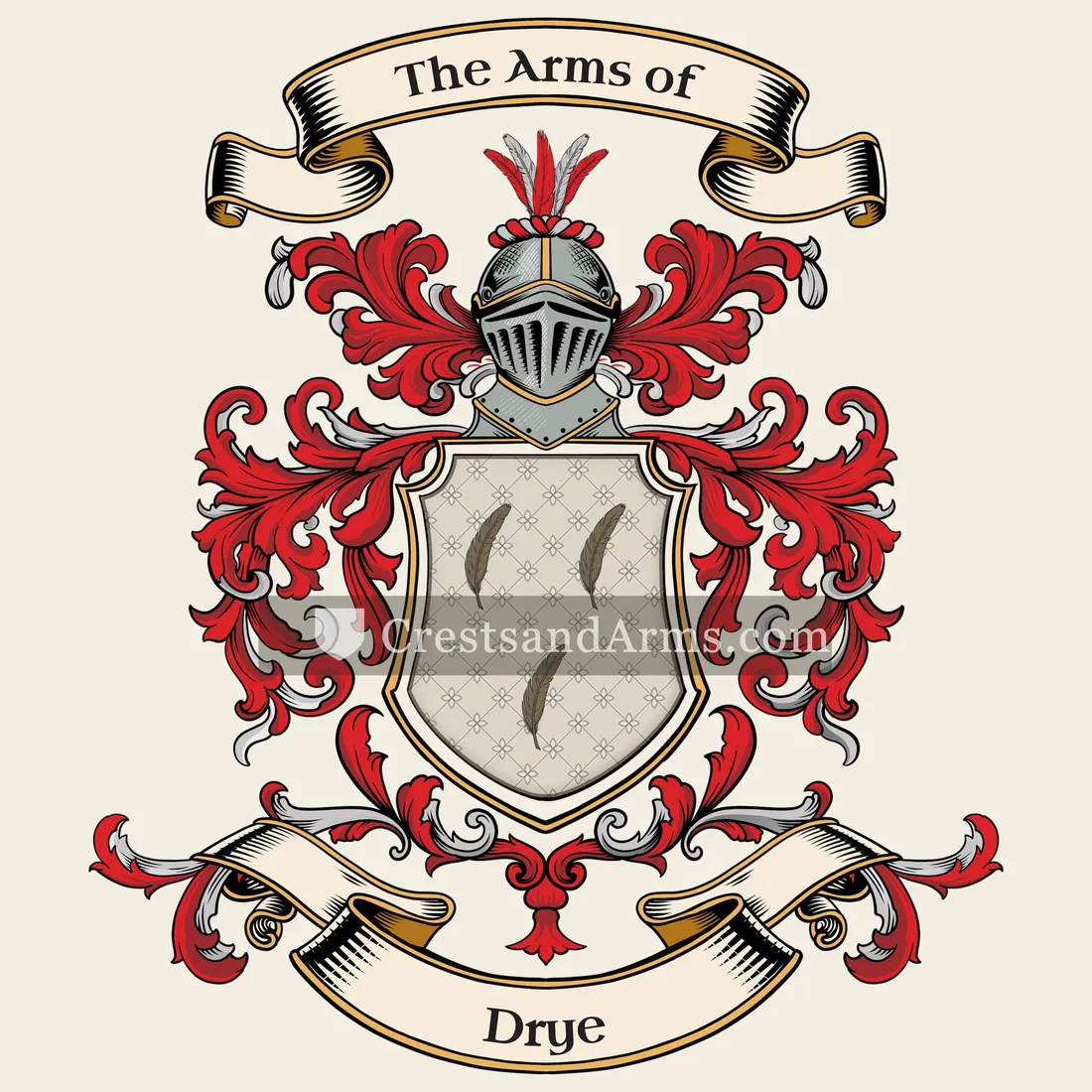
 feathersWilling obedience and serenity
 feathersWilling obedience and serenity


 eagleNobility, strength and a keen mind
 keyGuardianship, and the office of a steward