Map of Belgium showing where the Duce arms are recorded
The Duce arms were recorded in Brabant, c. 1737.
Brabant lay at the heart of the Low Countries, where the trade routes met. Its towns were wealthy and its landowners many, and both kinds of family kept arms, which is why the region is so heavily represented.
This is where the arms were entered in the register. Families often moved to other parts of the country, so the same name can turn up in more than one region.
The body that granted and recorded arms in Belgium in this period.
Charles VI, Holy Roman Emperor
Sovereign of the period
Charles VI, Holy Roman Emperor
1711–1740
Reigning in Belgium when the Duce arms are first recorded.
How Arms Worked in Belgium
In Belgium, a coat of arms is considered personal property that is passed down through the male line to legitimate descendants. Families often use the same shield design across generations to show their shared heritage. If a branch of the family wants to change the design, they must apply for an official update to their specific version of the arms.
Granting authority
The Conseil héraldique is the official body that regulates and approves all coats of arms in Belgium.
How they got arms
Families obtain their coats of arms through formal royal grants or by confirming their historical right to use existing designs.
Where arms were recorded
All approved coats of arms are officially recorded in the public registers of the Conseil héraldique since 1844.
The family's standing
Recorded among the armigerous families of Brabant.
Origin & History of the Duce Family in Belgium
The family name Duce has roots that can be traced back to the historic Duchy of Brabant, a region that now spans parts of modern-day Belgium. By 1737, records confirm that members of the family were established within this territory, which was then a center of trade and agriculture under the rule of the Austrian Habsburgs. During this period, families in Brabant often lived in small, tight-knit rural communities where surnames were tied to local occupations or specific geographic landmarks. The name likely evolved as a way to distinguish these individuals within the local parish registers, which were the primary method for tracking births, marriages, and deaths at the time. As the family grew, they became part of the social fabric of the Brabant landscape, navigating the complex political shifts and economic changes that defined the eighteenth-century Low Countries.
Coat of Arms & Family Crest Details
Symbols on this shield
bendDefence, and the scarf of a commander
swordJustice, and military honour
Colours
Silver (Argent)Means: Peace and sincerity
Red (Gules)Means: Military strength
Historical info
Source
J. B. Rietstap, Armorial Général, Gouda: G. B. van Goor Zonen, 1884–87
Blazon (the actual original written record)
“D'arg. à la bande de gu., ch. d'une épée d'arg., garnie d'or. C.: un bras, arm. au nat., tenant une épée d'arg., garnie d'or.”
FranceValenciennes, c. 1663
Digital archive packCoat of arms PNG, gold border print PDF, vector SVG and the certificate of authenticity. Sent to your email in minutes.
Map of France showing where the Duce arms are recorded
The Duce arms were recorded in Valenciennes, c. 1663.
This is where the arms were entered in the register. Families often moved to other parts of the country, so the same name can turn up in more than one region.
The body that granted and recorded arms in France in this period.
Louis XIV of France
Sovereign of the period
Louis XIV of France
1643–1715
Reigning in Belgium when the Duce arms are first recorded.
How Arms Worked in France
In France, a coat of arms was a mark of honor that passed down through the male line to all legitimate descendants. Families often used the same shield without changes to show their shared heritage. If a branch wanted to stand out, they could add a small mark to their shield to show their specific place in the family tree.
Granting authority
The Juge d'armes de France acted as the official authority that regulated and verified coats of arms across the country.
How they got arms
Families typically inherited their arms from ancestors, though they could also receive them through royal grants or by proving their noble status.
Where arms were recorded
Coats of arms were officially recorded in the Armorial Général de France, which began its main collection in the year 1696.
The family's standing
Recorded among the armigerous families of France.
Origin & History of the Duce Family in France
The family name Duce has deep roots in the northern region of France, specifically within the historic city of Valenciennes. By the year 1663, records confirm that members of the family were already established residents of this area. During the seventeenth century, Valenciennes was a bustling center of trade and craftsmanship located near the border of the Spanish Netherlands. Families living in this region often navigated a complex landscape of shifting political borders and economic change. As the name appears in local records from this period, it suggests that the Duce family was integrated into the local community life of the city. They likely participated in the urban culture and professional guilds that defined life in northern France during the reign of King Louis XIV. This early presence in Valenciennes provides a clear starting point for understanding how the family became part of the social fabric of the region.
Coat of Arms & Family Crest Details
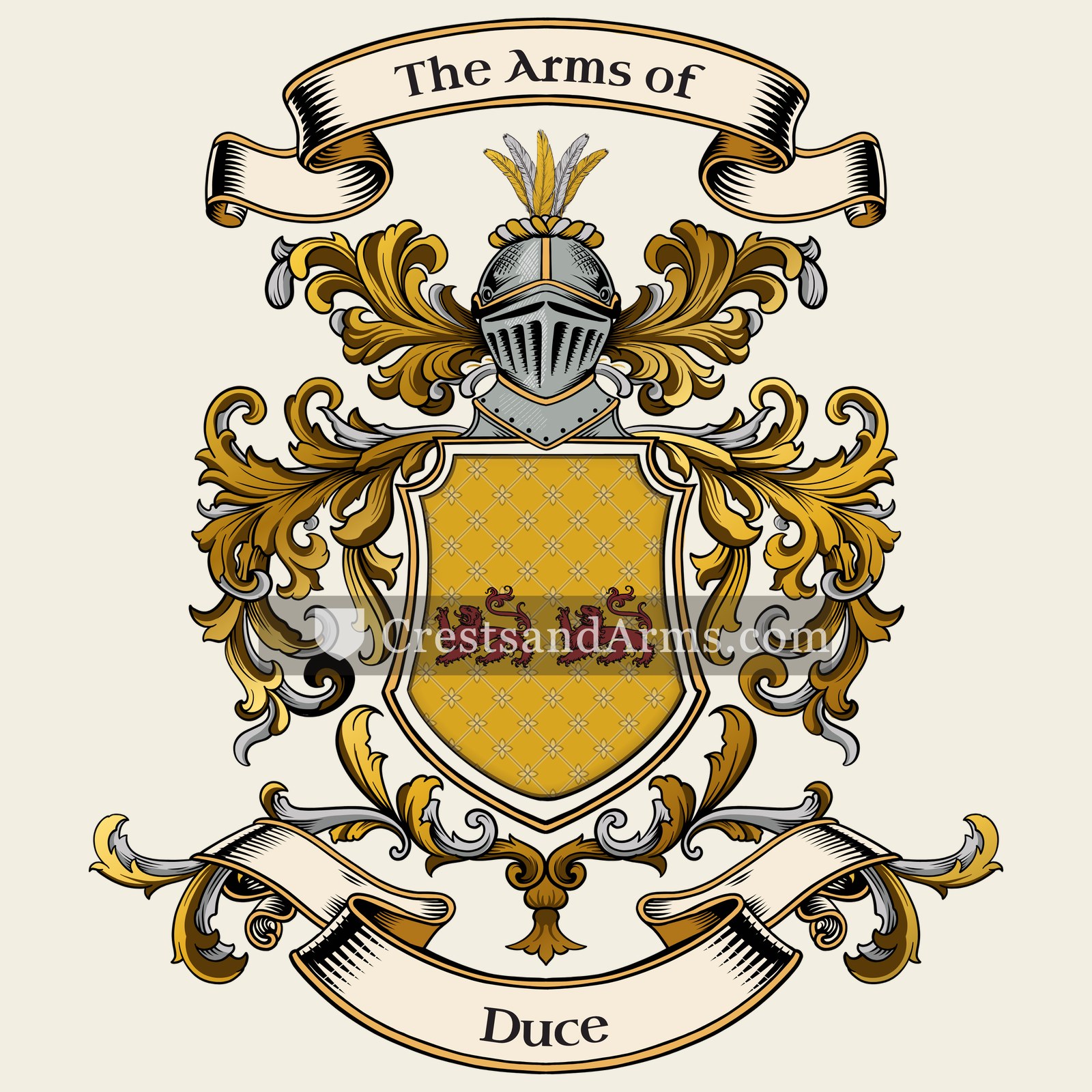
Symbols on this shield
lionCourage, strength and royalty
Colours
Gold (Or)Means: Generosity
Red (Gules)Means: Military strength
Historical info
Source
Sir Bernard Burke, The General Armory of England, Scotland, Ireland and Wales, London: Harrison & Sons, 1884
Blazon (the actual original written record)
“Or, two lions pass. guard. gu”
Englandc. 1620
Digital archive packCoat of arms PNG, gold border print PDF, vector SVG and the certificate of authenticity. Sent to your email in minutes.
Map of England showing where the Duce arms are recorded
The Duce arms were recorded in England, c. 1620.
Arms such as these were typically recorded in York.
Yorkshire is the largest of the English counties, and it held more gentry families than any other. Land there was split among a great many households rather than a few, so a great many of them carried arms.
This is where the arms were entered in the register. Families often moved to other parts of the country, so the same name can turn up in more than one region.
The body that granted and recorded arms in England in this period.
James VI and I
Sovereign of the period
James VI and I
1603–1625
Reigning in Belgium when the Duce arms are first recorded.
How Arms Worked in England
English heraldry allowed arms to be shared by all legitimate descendants of the original owner. These symbols were treated as personal property that moved through the generations to all children. While the eldest son kept the original design, other family members could use the same shield without needing to change it or register their own unique versions.
Granting authority
The College of Arms in London has regulated the use of coats of arms throughout England and Wales since 1484.
How they got arms
Families typically obtained their coats of arms through a formal grant from the Crown or by proving their ancient right to them.
Where arms were recorded
All official coats of arms are recorded in the registers kept at the College of Arms, which date back to the fifteenth century.
The family's standing
Recorded among the armigerous families of England.
Origin & History of the Duce Family in England
The family name Duce has roots that stretch back to the northern regions of England, with documented evidence placing members of the family in the city of York by the year 1620. During the early seventeenth century, York was a bustling center of trade and religious life, and families living there often occupied roles within the local merchant guilds or the skilled trades. The name itself is thought to have evolved from occupational or descriptive origins, potentially linked to the Middle English word "duce," which was a term used to describe a leader or a person of high rank. As the family established itself in the city, they became part of the local social fabric during a time of great political change in England. By settling in a major urban hub like York, the early members of the Duce family were positioned to participate in the growth of the city’s economy and the daily life of a community that served as the administrative heart of the north.
Duce Meaning & Related Branches
Root word
Dux
Latin term for a leader, commander, or military guide.
This name
DuceAn occupational surname for someone who served as a leader or chief.
also spelled
Duc
Duce
Du
Ducc
le Dook
Documented Sources
J. B. Rietstap, Armorial Général, Gouda: G. B. van Goor Zonen, 1884–87
Archives: State Archives in Belgium (Rijksarchief), Parish Registers of the Duchy of Brabant (Parochieregisters van het Hertogdom Brabant)
Book: De Smet, A., Geschiedenis van Brabant van de vroegste tijden tot heden, 1970
Book: Van Uytven, R., De geschiedenis van het Brabantse land, 1991
Digital archive packCoat of arms PNG, gold border print PDF, vector SVG and the certificate of authenticity. Sent to your email in minutes.


 chequyConstancy, and the counting-board
 chequyConstancy, and the counting-board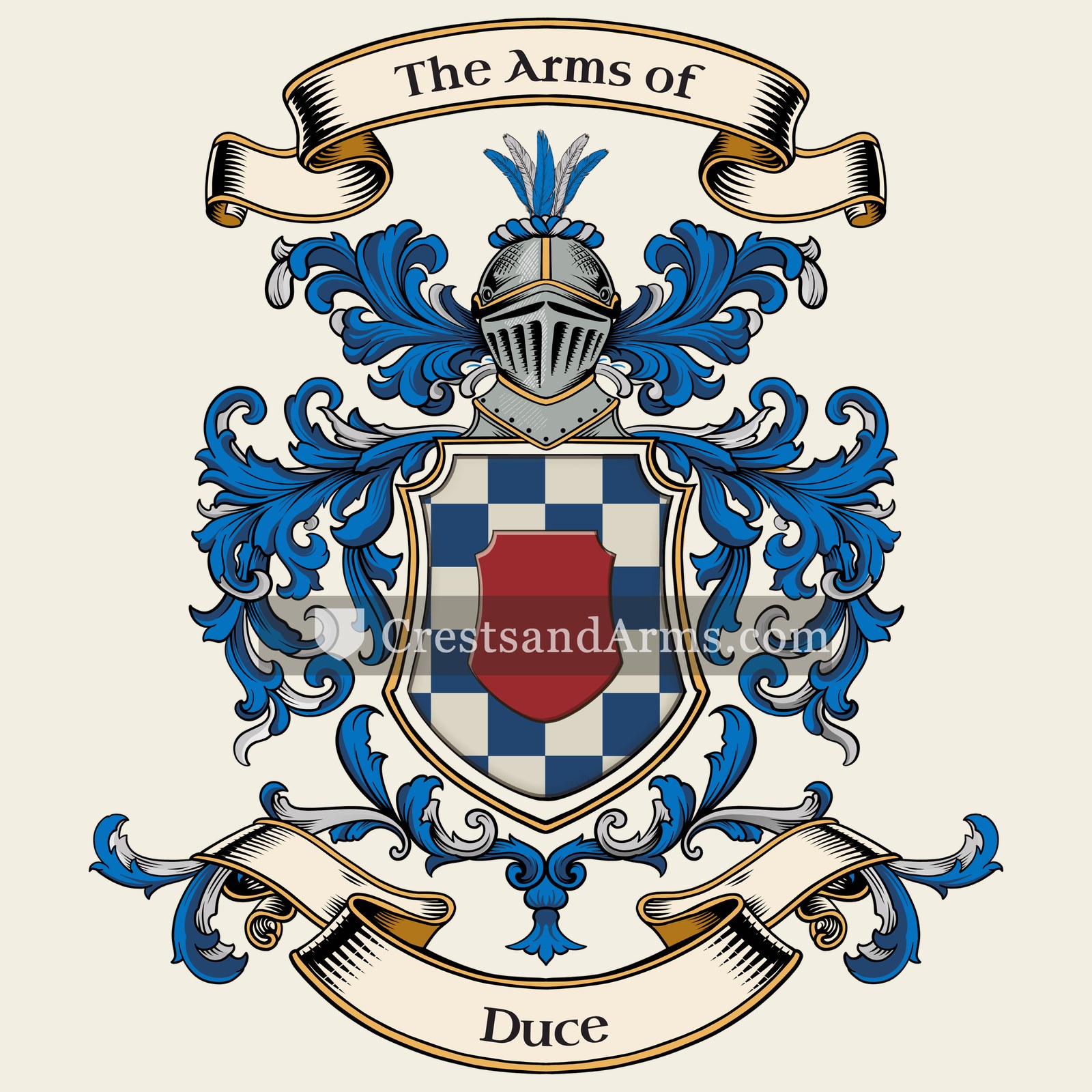


 bendDefence, and the scarf of a commander
 swordJustice, and military honour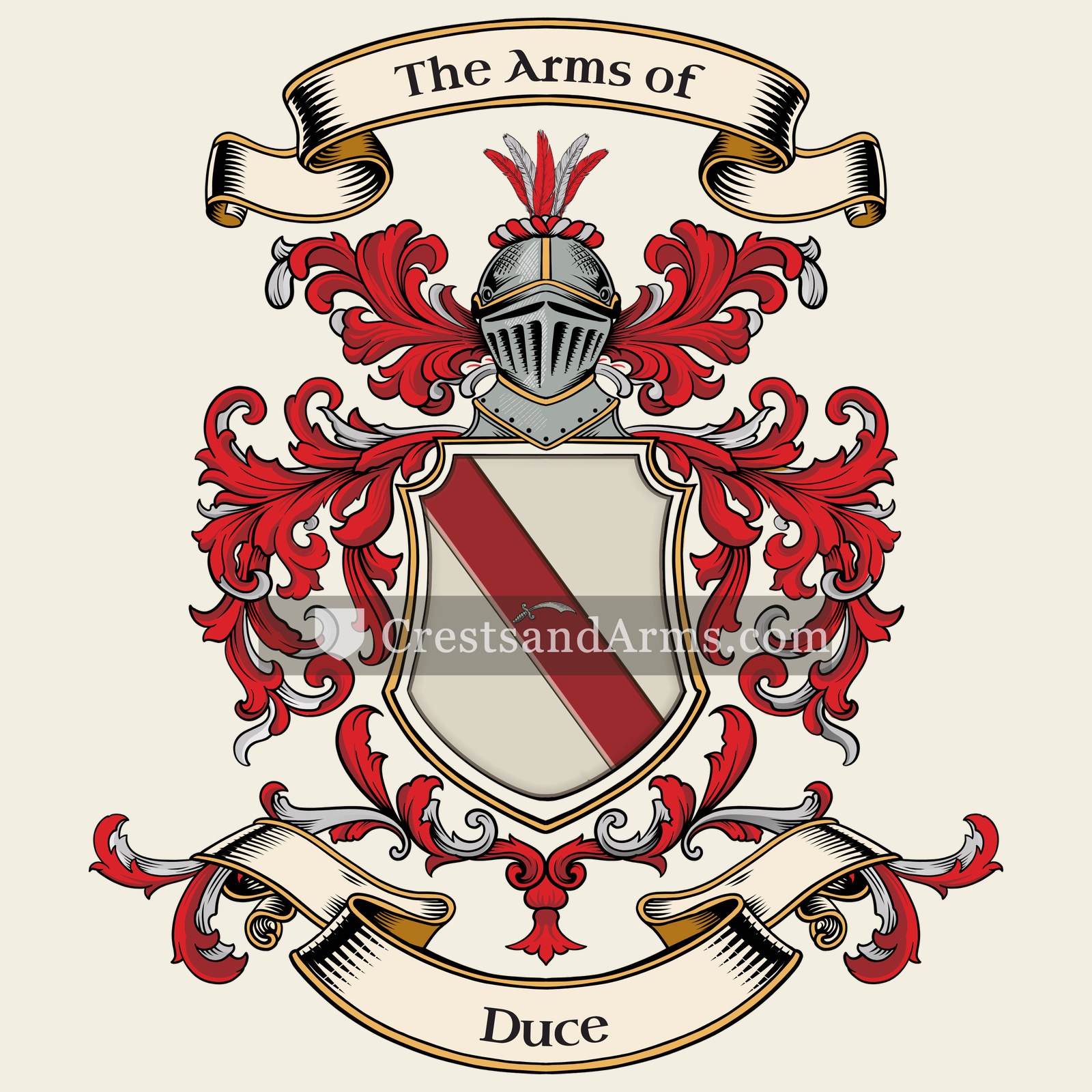


 lionCourage, strength and royalty