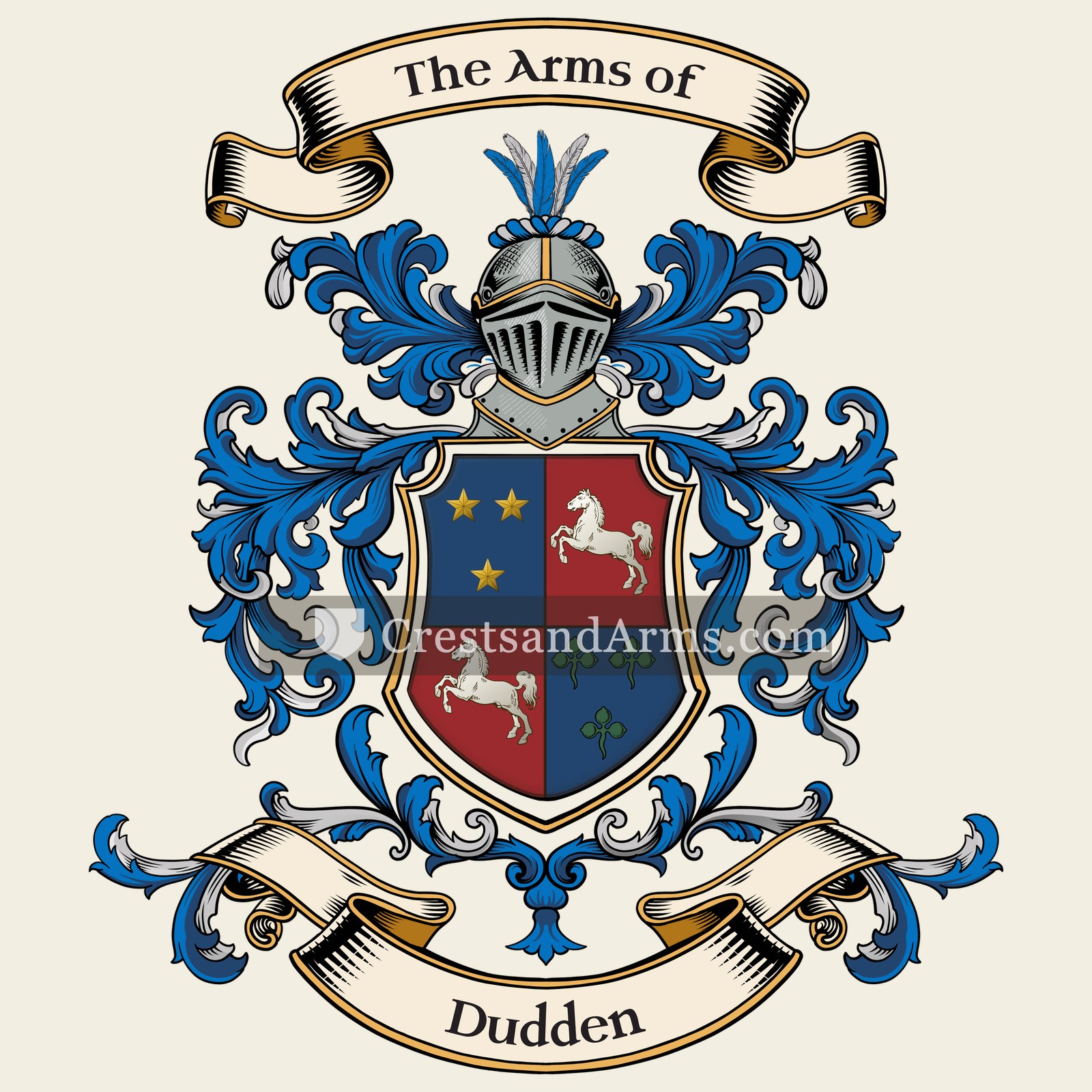
A record of documented arms, meaning and origin, researched for the Dudden family of Germany.
Reg. 5572 · German, D–F
Coat of Arms & Family Crest Details
Symbols on this shield
mulletThe third son, and a divine quality from above
horseReadiness to serve king and country
trefoilPerpetuity, and the Trinity
Colours
Blue (Azure)Means: Loyalty and truth
Red (Gules)Means: Military strength
Gold (Or)Means: Generosity
Silver (Argent)Means: Peace and sincerity
Green (Vert)Means: Hope
Historical info
Source
J. B. Rietstap, Armorial Général, Gouda: G. B. van Goor Zonen, 1884–87
Blazon (the actual original written record)
“Ec.: au 1 d'azur à trois étoiles d'or; au 2 et 3 de gu. à un cheval cabré d'arg.; au 4 d'arg. à trois trèfles de sin. Cq. cour. C.: un lion iss. d'or, lamp. de gu., entre deux prob. coupées, à dextre d'azur sur arg., à sen. de gu. sur arg L.: à dextre d'arg. et de gu., à sen. d'or et d'azur.”
GermanyHan, c. 1652
Digital archive packCoat of arms PNG, gold border print PDF, vector SVG and the certificate of authenticity. Sent to your email in minutes.
Map of Germany showing where the Dudden arms are recorded
The Dudden arms were recorded in Han, c. 1652.
This is where the arms were entered in the register. Families often moved to other parts of the country, so the same name can turn up in more than one region.
The body that granted and recorded arms in Germany in this period.
Ferdinand III, Holy Roman Emperor
Sovereign of the period
Ferdinand III, Holy Roman Emperor
1637–1657
Reigning in Germany when the Dudden arms are first recorded.
How Arms Worked in Germany
In the Holy Roman Empire, coats of arms were often granted to individuals by the Emperor or his representatives. These arms were then passed down through the generations to all legitimate descendants of the original holder. Younger branches of a family usually kept the same shield design without needing to change it, as the arms belonged to the entire lineage.
Granting authority
The Holy Roman Emperor held the sole power to grant new coats of arms throughout his vast imperial territories.
How they got arms
Families typically obtained their coats of arms through a formal imperial grant or by proving their noble status to the authorities.
Where arms were recorded
These grants were officially recorded in the Imperial Chancery registers, which began keeping formal records of such honors during the Middle Ages.
The family's standing
Recorded among the armigerous families of Germany.
Origin & History of the Dudden Family in Germany
The surname Dudden is rooted in the landscape of early modern England, with historical records confirming that members of the family were firmly established in the village of Han by 1652. The name likely originated as a topographical or locational descriptor, which was a common way for people to identify themselves in small rural communities during the seventeenth century. Families living in places like Han often relied on agriculture and local trade, meaning the Duddens were likely integrated into the daily rhythms of village life, such as farming or local craftsmanship. During this period, the spelling of surnames was not standardized, so the name may have appeared in various forms in parish registers and tax documents. By settling in Han, the early Duddens became part of a stable social fabric that defined life in the English countryside before the onset of the Industrial Revolution.
Dudden Meaning & Related Branches
Root word
Dudo
An ancient Germanic personal name derived from the word for warrior.
This name
DuddenA patronymic surname indicating descent from a person named Dudo or a diminutive form of the name.
also spelled
Duden
Related arms
Dudenvariant spelling
Documented Sources
J. B. Rietstap, Armorial Général, Gouda: G. B. van Goor Zonen, 1884–87
Parish Records of Han, Worcestershire Archive and Archaeology Service, Ref: 850 BA 2648/1 (Original title: Parish Register of Hanley Castle)
Dunkin, A. J., The History of the County of Kent, 1855
Digital archive packCoat of arms PNG, gold border print PDF, vector SVG and the certificate of authenticity. Sent to your email in minutes.


 mulletThe third son, and a divine quality from above
 horseReadiness to serve king and country
 trefoilPerpetuity, and the Trinity
 mulletThe third son, and a divine quality from above
 horseReadiness to serve king and country
 trefoilPerpetuity, and the Trinity