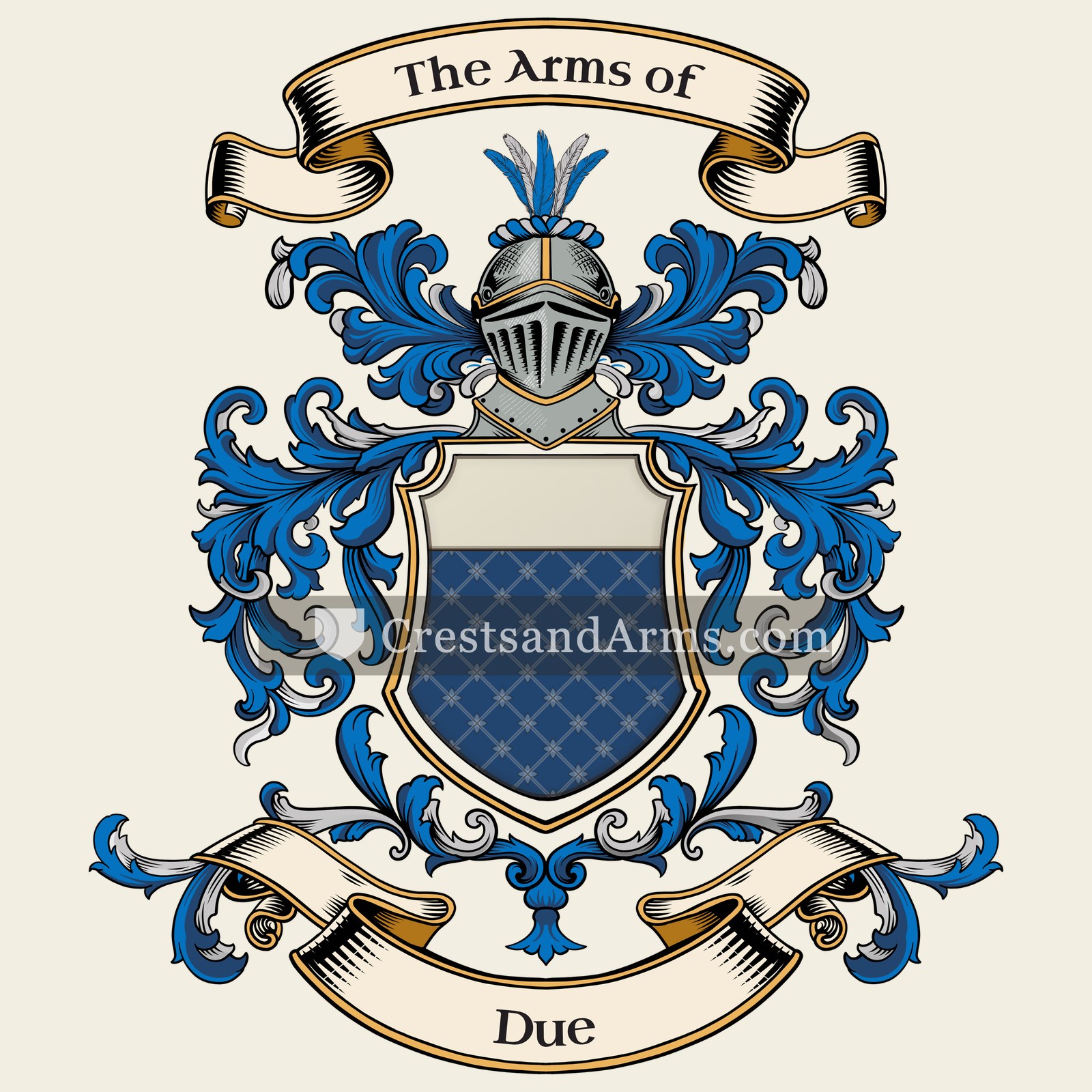
A record of documented arms, meaning and origin, researched for the Due family lines. Documented in 3 countries.
Reg. 8694 · Danish, D–F
Coat of Arms & Family Crest Details
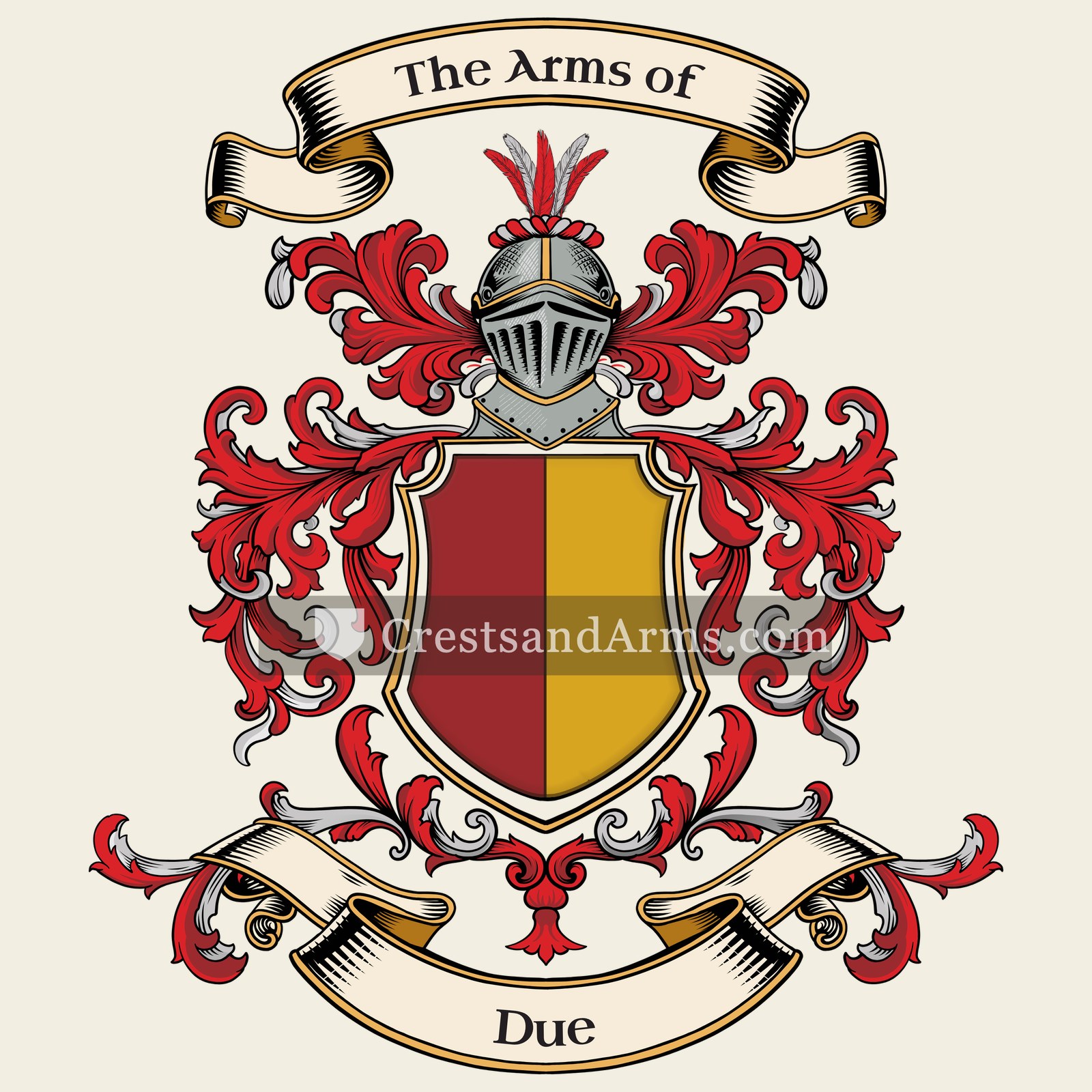
Colours
Red (Gules)Means: Military strength
Gold (Or)Means: Generosity
Historical info
Source
J. B. Rietstap, Armorial Général, Gouda: G. B. van Goor Zonen, 1884–87
Blazon (the actual original written record)
“Ec. de gu. et d'or. C.: deux prob., coupées alt. d'or et de gu. - 2° D'arg. à une aigle sans pattes, de sa. - 3° D'arg. à trois oiseaux au nat. C.: un oiseau au nat., les ailes étendues. - 4° (An., 30 déc. 1641.) D'azur à trois colombes d'arg. C.: une colombe d'arg. - 5° D'arg. à un oiseau perché sur un tronc d'arbre d'or, le tout soutenu d'une terrasse de gu. C.: l'oiseau perché sur les créneaux d'une tour sans porte ni fenêtres de gu.”
Denmarkc. 1722
Digital archive packCoat of arms PNG, gold border print PDF, vector SVG and the certificate of authenticity. Sent to your email in minutes.
Map of Denmark showing where the Due arms are recorded
The Due arms were recorded in Denmark, c. 1722.
Arms such as these were typically recorded in Sjaælland.
Zealand held the Danish court, the crown's offices and Copenhagen itself. Families who served the king kept estates within reach of it, and royal service was the ordinary route to a coat of arms.
This is where the arms were entered in the register. Families often moved to other parts of the country, so the same name can turn up in more than one region.
The body that granted and recorded arms in Denmark in this period.
Frederik IV of Denmark
Sovereign of the period
Frederik IV of Denmark
1699–1730
Reigning in Denmark when the Due arms are first recorded.
How Arms Worked in Denmark
Danish heraldry during this period was closely tied to noble status and royal favor rather than being open to all citizens. Arms were typically granted by the monarch to individuals, and these symbols were then shared by all members of the noble house. If a family line died out, the right to use those specific arms ended with them.
Granting authority
The Danish royal chancery held the power to issue and regulate official coats of arms for the kingdom.
How they got arms
Families usually received their arms through a formal royal grant that confirmed their noble status and rights.
Where arms were recorded
These grants were officially recorded in the Danish Royal Chancery records starting in the sixteenth century.
The family's standing
Recorded among the armigerous families of Denmark.
Origin & History of the Due Family in Denmark
The family name Due, which translates to "dove" in Danish, has roots that reach deep into the rural landscape of Sjælland. By the early 18th century, the name was already established among the local population, with documented records confirming family members living on the island by 1722. During this period, surnames in Denmark were often fluid and descriptive, frequently derived from nature or personal characteristics rather than inherited lineages. As the family navigated life in the Danish countryside, they were likely part of the agrarian society that defined the region, living through a time when the transition from patronymic naming systems to fixed surnames was just beginning to take hold. This early presence in Sjælland suggests that the family was deeply embedded in the local community, participating in the agricultural and social rhythms of 18th-century Denmark long before the formalization of family names became a national standard.
Coat of Arms & Family Crest Details
Symbols on this shield
mountThe ground held, and steadfastness upon it
treeLife, endurance and deep roots
Colours
Gold (Or)Means: Generosity
Black (Sable)Means: Constancy
Historical info
Source
J. B. Rietstap, Armorial Général, Gouda: G. B. van Goor Zonen, 1884–87
Blazon (the actual original written record)
“D'or à un tronc d'arbre de sa., poussant de chaque côté une feuille de sin. et posé sur une terrasse de même. C.: trois plumes de paon au nat., entre deux chicots de sa., poussant chacun à l'ext. une feuille de sin.”
LivoniaLivonia, c. 1772
Digital archive packCoat of arms PNG, gold border print PDF, vector SVG and the certificate of authenticity. Sent to your email in minutes.
Map of Poland showing where the Due arms are recorded
The Due arms were recorded in Livonia, c. 1772.
Livonia was Baltic country held by a small number of landed families who kept their estates for centuries. Land there passed down whole rather than being divided, and long unbroken tenure is what fills a register.
This is where the arms were entered in the register. Families often moved to other parts of the country, so the same name can turn up in more than one region.
Region
Livonia
First recorded
1772
Granting Authority for the Due Arms
Ennoblement by the Sejm
Author: Olek Remesz · CC BY-SA 3.0
The body that granted and recorded arms in Poland in this period.
Stanisław August Poniatowski
Sovereign of the period
Stanisław August Poniatowski
1764–1795
Reigning in Denmark when the Due arms are first recorded.
How Arms Worked in Poland
Polish noble families shared a single coat of arms across many different surnames, creating large clans rather than individual designs. These symbols were held collectively by all members of the clan regardless of their specific family name. When a new family joined the nobility, they were adopted into an existing clan and began using that group's established shield.
Granting authority
The Sejm, which was the Polish parliament, held the power to grant noble status and the right to bear arms.
How they got arms
Families typically received their coat of arms through a formal act of ennoblement granted by the Sejm for distinguished service.
Where arms were recorded
These grants were officially recorded in the Crown Metrica, which served as the central archive for state documents starting in the sixteenth century.
The family's standing
Recorded among the armigerous families of Livonia.
Origin & History of the Due Family in Poland
The history of the Due family in the region of Livonia is deeply connected to the shifting borders and cultural exchanges of the eighteenth century. By 1772, when the First Partition of Poland brought significant changes to the administrative landscape of the Baltic territories, members of the family were already established within this complex social environment. During this era, Livonia served as a crossroads for German, Polish, and Baltic influences, which shaped the lives of families living there. The name Due likely reflects the linguistic blending common in this borderland, where families often navigated multiple administrative systems and cultural identities. As the region transitioned under new political authorities, the family maintained its presence, adapting to the evolving legal and social structures of the time. This period of history highlights how families like the Due line integrated into the local fabric of Livonia while remaining part of the broader historical narrative of the Polish-Lithuanian Commonwealth and its surrounding territories.
Coat of Arms & Family Crest Details
Symbols on this shield
chiefAuthority, wisdom and dominion
Colours
Blue (Azure)Means: Loyalty and truth
Silver (Argent)Means: Peace and sincerity
Historical info
Source
Sir Bernard Burke, The General Armory of England, Scotland, Ireland and Wales, London: Harrison & Sons, 1884
Blazon (the actual original written record)
“Az. a chief indented ar”
Englandc. 1620
Digital archive packCoat of arms PNG, gold border print PDF, vector SVG and the certificate of authenticity. Sent to your email in minutes.
Map of England showing where the Due arms are recorded
The Due arms were recorded in England, c. 1620.
Arms such as these were typically recorded in York.
Yorkshire is the largest of the English counties, and it held more gentry families than any other. Land there was split among a great many households rather than a few, so a great many of them carried arms.
This is where the arms were entered in the register. Families often moved to other parts of the country, so the same name can turn up in more than one region.
The body that granted and recorded arms in England in this period.
James VI and I
Sovereign of the period
James VI and I
1603–1625
Reigning in Denmark when the Due arms are first recorded.
How Arms Worked in England
English heraldry allowed arms to be shared by all legitimate descendants of the original owner. These symbols were treated as personal property that moved through the generations to all children. While the eldest son kept the original design, other family members could use the same shield without needing to change it or register their own unique versions.
Granting authority
The College of Arms in London has regulated the use of coats of arms throughout England and Wales since 1484.
How they got arms
Families typically obtained their coats of arms through a formal grant from the Crown or by proving their ancient right to them.
Where arms were recorded
All official coats of arms are recorded in the registers kept at the College of Arms, which date back to the fifteenth century.
The family's standing
Recorded among the armigerous families of England.
Origin & History of the Due Family in England
The surname Due has deep roots in the historic city of York, where records confirm members of the family were living as early as 1620. During this period, York was a bustling center of trade and religion in Northern England, and families like the Dues were often integrated into the local merchant or artisan classes. The name itself likely evolved from Old English or Old French terms, potentially serving as a descriptive nickname for a person who was owed money or perhaps as a reference to a specific location near a stream or a dew-covered field. As the family established themselves in the shadow of the York Minster, they became part of the social fabric of a city that was transitioning from a medieval stronghold into a modern administrative hub. By settling in such a prominent urban center, early generations of the Due family were well-positioned to participate in the local guilds and civic life that defined seventeenth-century English society.
Due Meaning & Related Branches
Root word
Due
Old Norse word for a dove or pigeon.
This name
DueA topographic or habitational name referring to someone who lived near a place frequented by doves.
also spelled
Duet
Duée
Du
Doo
Dewe
Related arms
le Duvariant spelling
Dewevariant spelling
Documented Sources
J. B. Rietstap, Armorial Général, Gouda: G. B. van Goor Zonen, 1884–87
Dansk Navneleksikon (Danish Name Dictionary), 1978
Rigsarkivet (Danish National Archives), Kirkebøger (Parish Registers), Sjælland Stift
Digital archive packCoat of arms PNG, gold border print PDF, vector SVG and the certificate of authenticity. Sent to your email in minutes.




 mountThe ground held, and steadfastness upon it
 treeLife, endurance and deep roots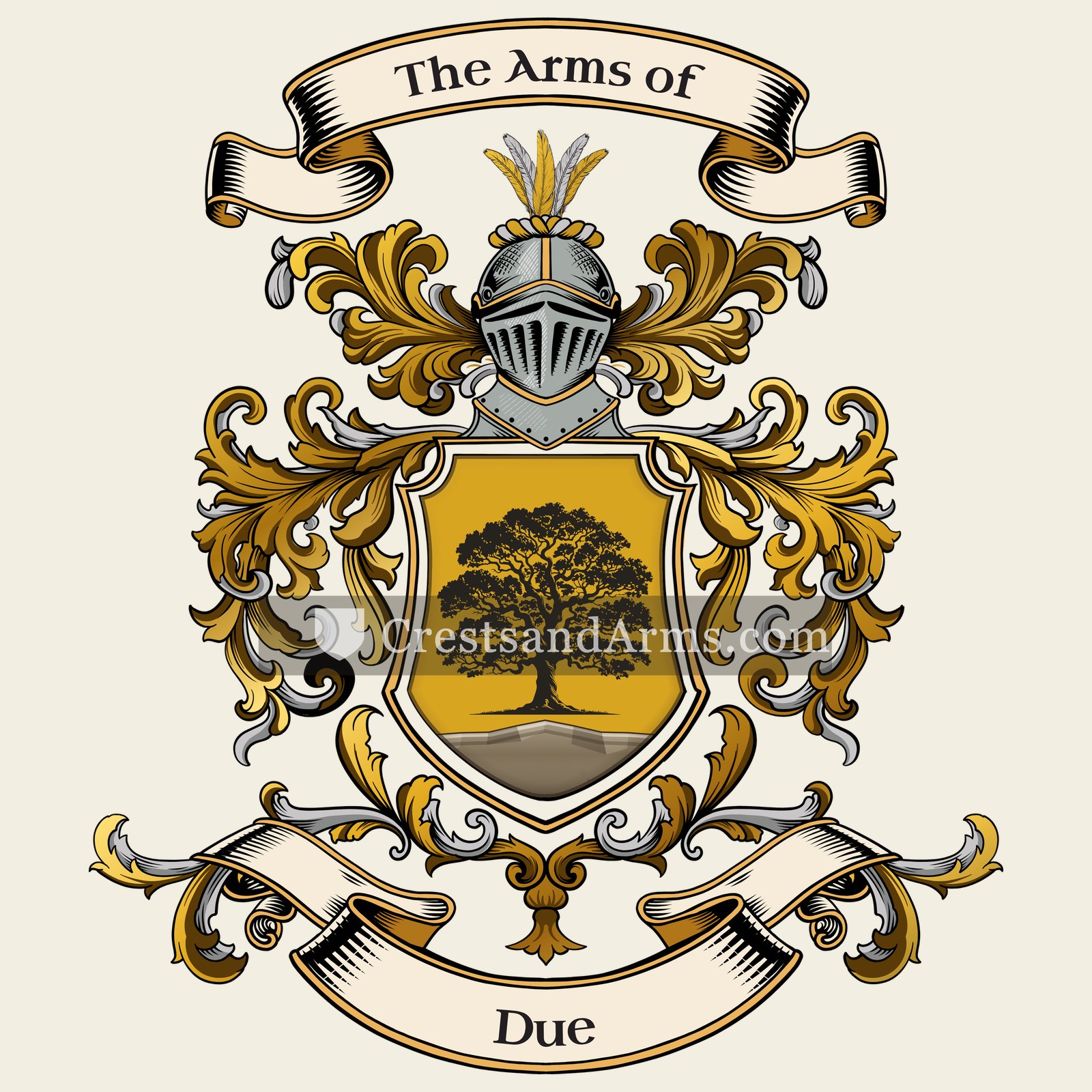


 chiefAuthority, wisdom and dominion