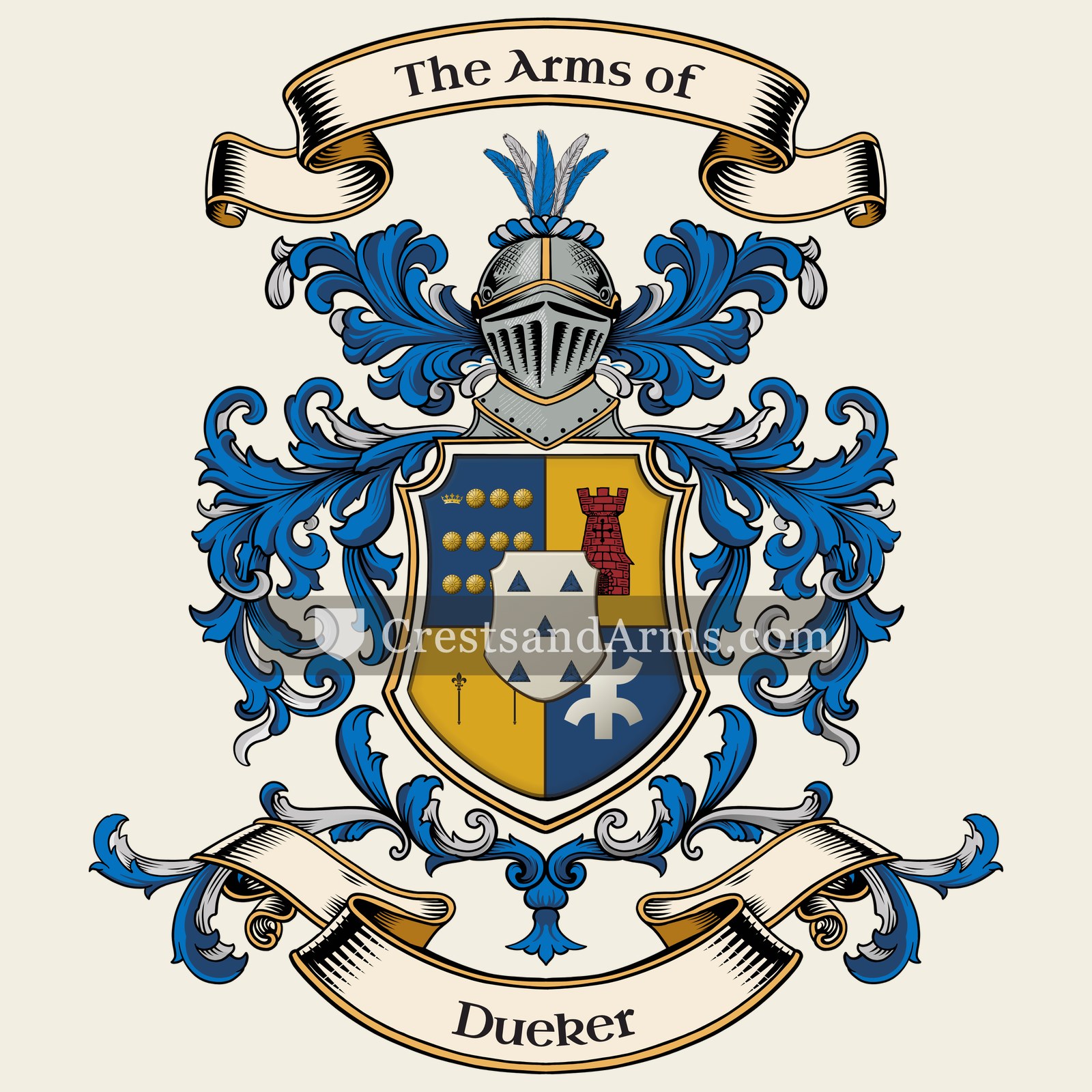
A record of documented arms, meaning and origin, researched for the Dueker family of Sweden.
Reg. 1285 · Swedish, D–F
Coat of Arms & Family Crest Details
Symbols on this shield
triangleThe Trinity, and stability
crownSovereignty, authority and just reward
roundelA coin, and one who has been to the crusades
towerGrandeur and solidity, and a stronghold defended
batonAuthority and office held under the crown
millrind / fer de molineThe mill's iron, and the grinding of grain
Colours
Blue (Azure)Means: Loyalty and truth
Gold (Or)Means: Generosity
Silver (Argent)Means: Peace and sincerity
Red (Gules)Means: Military strength
Historical info
Source
J. B. Rietstap, Armorial Général, Gouda: G. B. van Goor Zonen, 1884–87
Blazon (the actual original written record)
“Parti d'un trait, coupé de deux autres, qui font six quartiers: au 1 d'azur à une couronne d'or, acc. de treize bes. du même, 4, 2, 4 et 3; au 2 d'or à une tour de gu., sominée de deux bannières d'azur; au 3 de gu. à deux bâtons d'or, passés en saut.; au 4 de gu. à une anille antique d'arg.; au 5 coupé: a. d'or au lion naiss. de gu., cour. d'or; b. d'azur à trois étoiles (5) d'arg.; au 6 d'azur à trois fleurs-de-lis d'arg., rangées en fasce, et acc. de sept bes. d'or, 4 en chef et 3 en p. Sur le tout d'arg. à cinq triangles d'azur. Trois cq. cour. C.: 1º une étoile (5) d'arg., entre un vol d'or et d'azur; 2º deux bras, arm. d'arg., passés chacun dans un joug, les mains de carn. supp. ensemble un soleil d'or; 3º six bannières, alt. d'arg., de sa. et d'or, six à dextre et six à sen.”
Swedenc. 1719
Digital archive packCoat of arms PNG, gold border print PDF, vector SVG and the certificate of authenticity. Sent to your email in minutes.
Map of Sweden showing where the Dueker arms are recorded
The Dueker arms were recorded in Sweden, c. 1719.
Arms such as these were typically recorded in Stockholm.
Stockholm held the Swedish court and the House of Nobility, where every noble family's arms were entered and kept. Families ennobled for service registered there, which is why so many are recorded around the city.
This is where the arms were entered in the register. Families often moved to other parts of the country, so the same name can turn up in more than one region.
The body that granted and recorded arms in Sweden in this period.
Ulrika Eleonora I of Sweden
Sovereign of the period
Ulrika Eleonora I of Sweden
1718–1720
Reigning in Sweden when the Dueker arms are first recorded.
How Arms Worked in Sweden
In Sweden, a coat of arms belonged to a noble family as a whole rather than just one individual. These arms were passed down through the generations to all legitimate descendants. Younger branches of the family used the same shield without needing to change it. This system ensured that the entire lineage shared the same identity and status under the law.
Granting authority
The Riddarhuset, or House of Nobility, regulated all noble coats of arms in Sweden under royal authority.
How they got arms
Families received their coats of arms through royal grants of nobility which were then officially registered with the House.
Where arms were recorded
Coats of arms were officially recorded in the Swedish House of Nobility register starting in the year 1626.
The family's standing
Recorded among the armigerous families of Sweden.
Origin & History of the Dueker Family in Sweden
The family name Dueker has deep roots in Northern Europe, with significant historical records placing members of the family in Stockholm as early as 1719. During this period, Sweden was navigating the final years of the Great Northern War, a time when the city served as a vital hub for military officers, civil servants, and merchants. The name itself is thought to be of Low German origin, likely derived from the word "duker," which historically referred to a diver or someone who worked near water. As the family established themselves in the Swedish capital, they became part of the urban professional class that helped shape the country during the eighteenth century. By settling in Stockholm, the early Duekers integrated into a society that valued trade and administrative service, allowing the family name to persist through generations of urban growth and social change.
Dueker Meaning & Related Branches
Root word
Duk
A Middle Low German term referring to a cloth or covering.
This name
DuekerLikely an occupational name for a cloth merchant or a maker of textile coverings.
also spelled
Dueker
Ducker
Documented Sources
J. B. Rietstap, Armorial Général, Gouda: G. B. van Goor Zonen, 1884–87
Elgenstierna, Gustaf. Den introducerade svenska adelns ättartavlor. 1926
Stockholm City Archives (Stockholms stadsarkiv), Mantalslängder för Stockholms stad
Digital archive packCoat of arms PNG, gold border print PDF, vector SVG and the certificate of authenticity. Sent to your email in minutes.


 triangleThe Trinity, and stability
 crownSovereignty, authority and just reward
 roundelA coin, and one who has been to the crusades
 towerGrandeur and solidity, and a stronghold defended
 batonAuthority and office held under the crown
 millrind / fer de molineThe mill's iron, and the grinding of grain