Map of Germany showing where the Duensing arms are recorded
The Duensing arms were recorded in Westphalia, c. 1765.
Westphalia was a land of small estates and fortified farmhouses in western Germany. Its families were numerous and not especially rich, but each held its own ground, and holding ground was what brought arms.
This is where the arms were entered in the register. Families often moved to other parts of the country, so the same name can turn up in more than one region.
The body that granted and recorded arms in Germany in this period.
Francis I, Holy Roman Emperor
Sovereign of the period
Francis I, Holy Roman Emperor
1745–1765
Reigning in Germany when the Duensing arms are first recorded.
How Arms Worked in Germany
In the Holy Roman Empire, coats of arms were often granted to individuals by the Emperor or his representatives. These arms were then passed down through the generations to all legitimate descendants of the original holder. Younger branches of a family usually kept the same shield design without needing to change it, as the arms belonged to the entire lineage.
Granting authority
The Holy Roman Emperor held the sole power to grant new coats of arms throughout his vast imperial territories.
How they got arms
Families typically obtained their coats of arms through a formal imperial grant or by proving their noble status to the authorities.
Where arms were recorded
These grants were officially recorded in the Imperial Chancery registers, which began keeping formal records of such honors during the Middle Ages.
The family's standing
Recorded among the armigerous families of Westphalia.
Origin & History of the Duensing Family in Germany
The family name Duensing originates from the historic region of Westphalia in northwestern Germany. Linguists believe the name is a patronymic, meaning it was originally derived from a given name, likely "Duno" or a similar variation. By adding the suffix "ing," the name signified that the family belonged to the descendants or the household of that specific ancestor. Records confirm that the Duensing family was well-established in this region by 1765, living within the social structure of rural Westphalian farming communities. During this era, families were often tied to the land they cultivated, and their names became permanent identifiers within local church registers and tax documents. These early ancestors lived through a time of significant transition in German history, as the region moved from feudal traditions toward more organized administrative record-keeping.
Duensing Meaning & Related Branches
Root word
Dune
A sandy hill or dune formation in coastal or inland regions.
This name
DuensingA topographic name for someone who lived near a sandy hill or dune.
also spelled
Dinsinge
Dinsingh
Dynsing
Documented Sources
J. B. Rietstap, Armorial Général, Gouda: G. B. van Goor Zonen, 1884–87
Bahlow, Hans, Deutsches Namenlexikon: Familien- und Vornamen nach Ursprung und Sinn erklärt, 1967
Gottschald, Max, Deutsche Namenkunde: Unsere Familiennamen, 1971
Landesarchiv Nordrhein-Westfalen, Kirchenbücher der evangelischen Kirchengemeinden in Westfalen
Digital archive packCoat of arms PNG, gold border print PDF, vector SVG and the certificate of authenticity. Sent to your email in minutes.


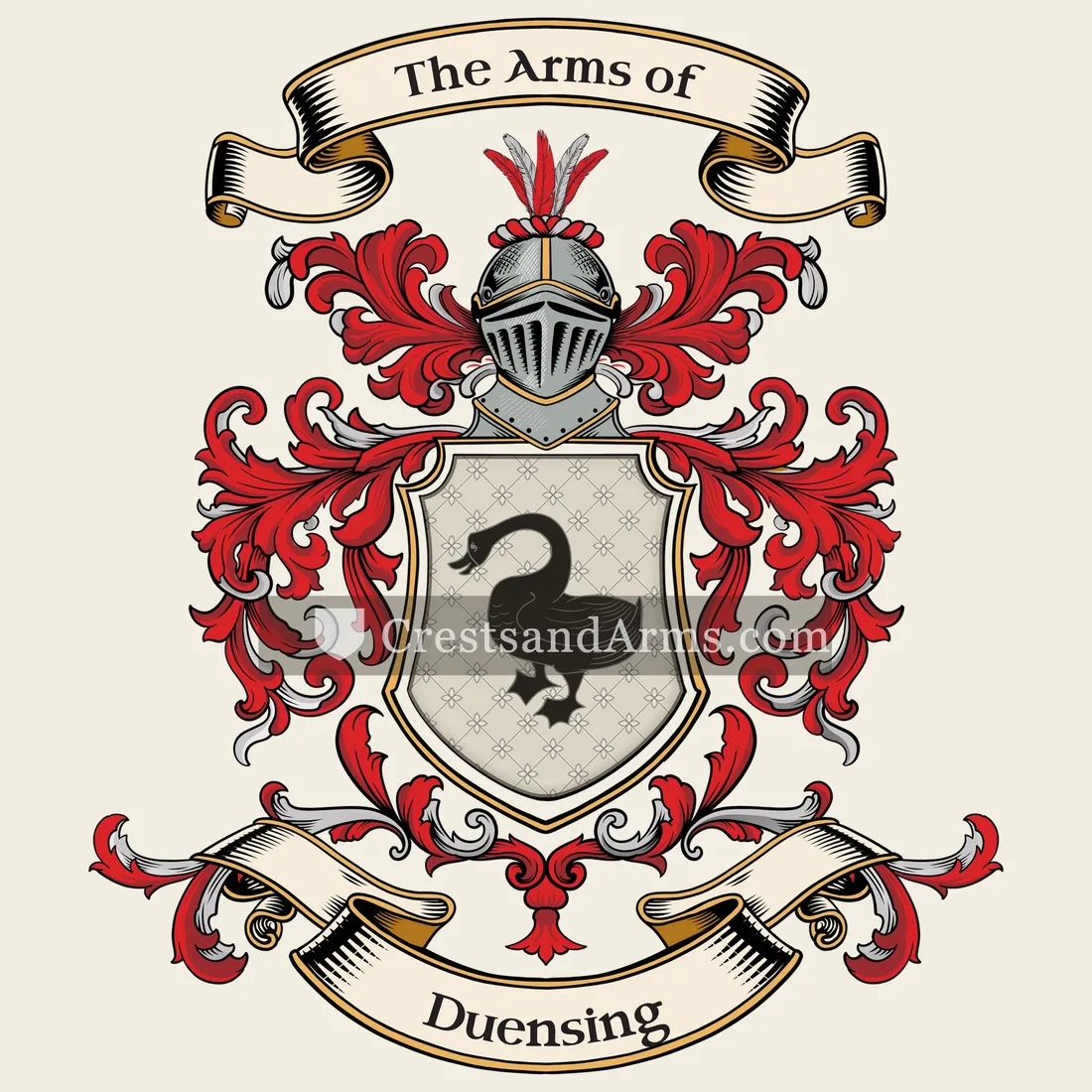
 swanGrace, light and the poet's art
 swanGrace, light and the poet's art