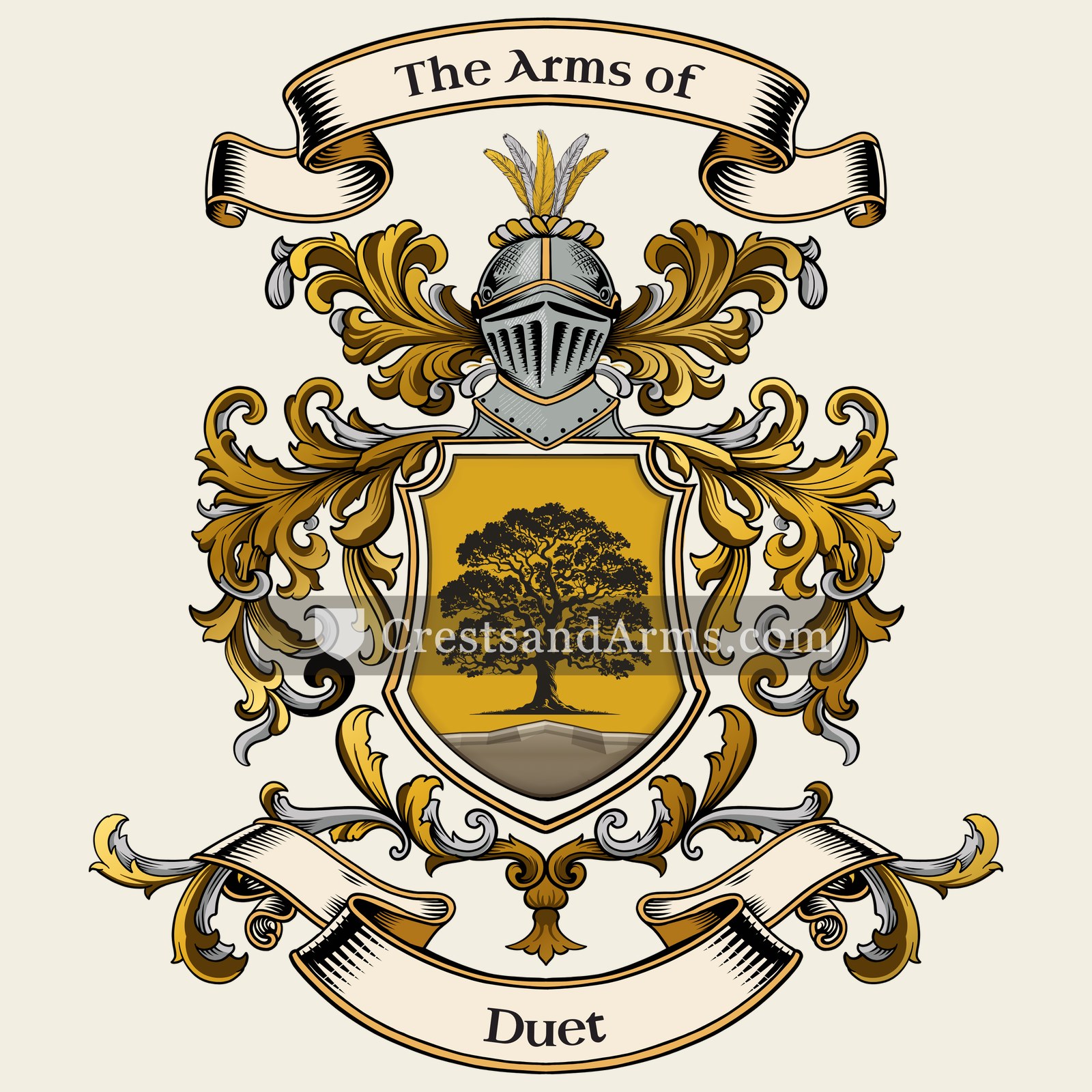
A record of documented arms, meaning and origin, researched for the Duet family lines. Documented in 2 countries.
Reg. 2674 · Danish, D–F
Coat of Arms & Family Crest Details
Colours
Red (Gules)Means: Military strength
Gold (Or)Means: Generosity
Historical info
Source
J. B. Rietstap, Armorial Général, Gouda: G. B. van Goor Zonen, 1884–87
Blazon (the actual original written record)
“Ec. de gu. et d'or. C.: deux prob., coupées alt. d'or et de gu. - 2° D'arg. à une aigle sans pattes, de sa. - 3° D'arg. à trois oiseaux au nat. C.: un oiseau au nat., les ailes étendues. - 4° (An., 30 déc. 1641.) D'azur à trois colombes d'arg. C.: une colombe d'arg. - 5° D'arg. à un oiseau perché sur un tronc d'arbre d'or, le tout soutenu d'une terrasse de gu. C.: l'oiseau perché sur les créneaux d'une tour sans porte ni fenêtres de gu.”
Denmarkc. 1722
Digital archive packCoat of arms PNG, gold border print PDF, vector SVG and the certificate of authenticity. Sent to your email in minutes.
Map of Denmark showing where the Duet arms are recorded
The Duet arms were recorded in Denmark, c. 1722.
Arms such as these were typically recorded in Sjaælland.
Zealand held the Danish court, the crown's offices and Copenhagen itself. Families who served the king kept estates within reach of it, and royal service was the ordinary route to a coat of arms.
This is where the arms were entered in the register. Families often moved to other parts of the country, so the same name can turn up in more than one region.
The body that granted and recorded arms in Denmark in this period.
Frederik IV of Denmark
Sovereign of the period
Frederik IV of Denmark
1699–1730
Reigning in Denmark when the Duet arms are first recorded.
How Arms Worked in Denmark
Danish heraldry during this period was closely tied to noble status and royal favor rather than being open to all citizens. Arms were typically granted by the monarch to individuals, and these symbols were then shared by all members of the noble house. If a family line died out, the right to use those specific arms ended with them.
Granting authority
The Danish royal chancery held the power to issue and regulate official coats of arms for the kingdom.
How they got arms
Families usually received their arms through a formal royal grant that confirmed their noble status and rights.
Where arms were recorded
These grants were officially recorded in the Danish Royal Chancery records starting in the sixteenth century.
The family's standing
Recorded among the armigerous families of Denmark.
Origin & History of the Duet Family in Denmark
The history of the Duet family in Denmark begins with documented records of individuals living on the island of Sjælland as early as 1722. During the early eighteenth century, Denmark was transitioning from a society based on oral traditions to one with more formal record-keeping, particularly through church registers and tax rolls. The name likely arrived in the region during a period of increased movement between Northern Europe and the Danish kingdom, as craftsmen and laborers often migrated to find work in the growing urban centers near Copenhagen. Because the name appears in parish registers from this era, we know that these early family members were integrated into the local community life of Sjælland. They lived through a time of significant agricultural reform and social change in Denmark, which shaped the lives of common families for generations to come. By studying these early parish entries, historians can trace how the family established their roots in the Danish landscape long before the modern era of industrialization.
Coat of Arms & Family Crest Details
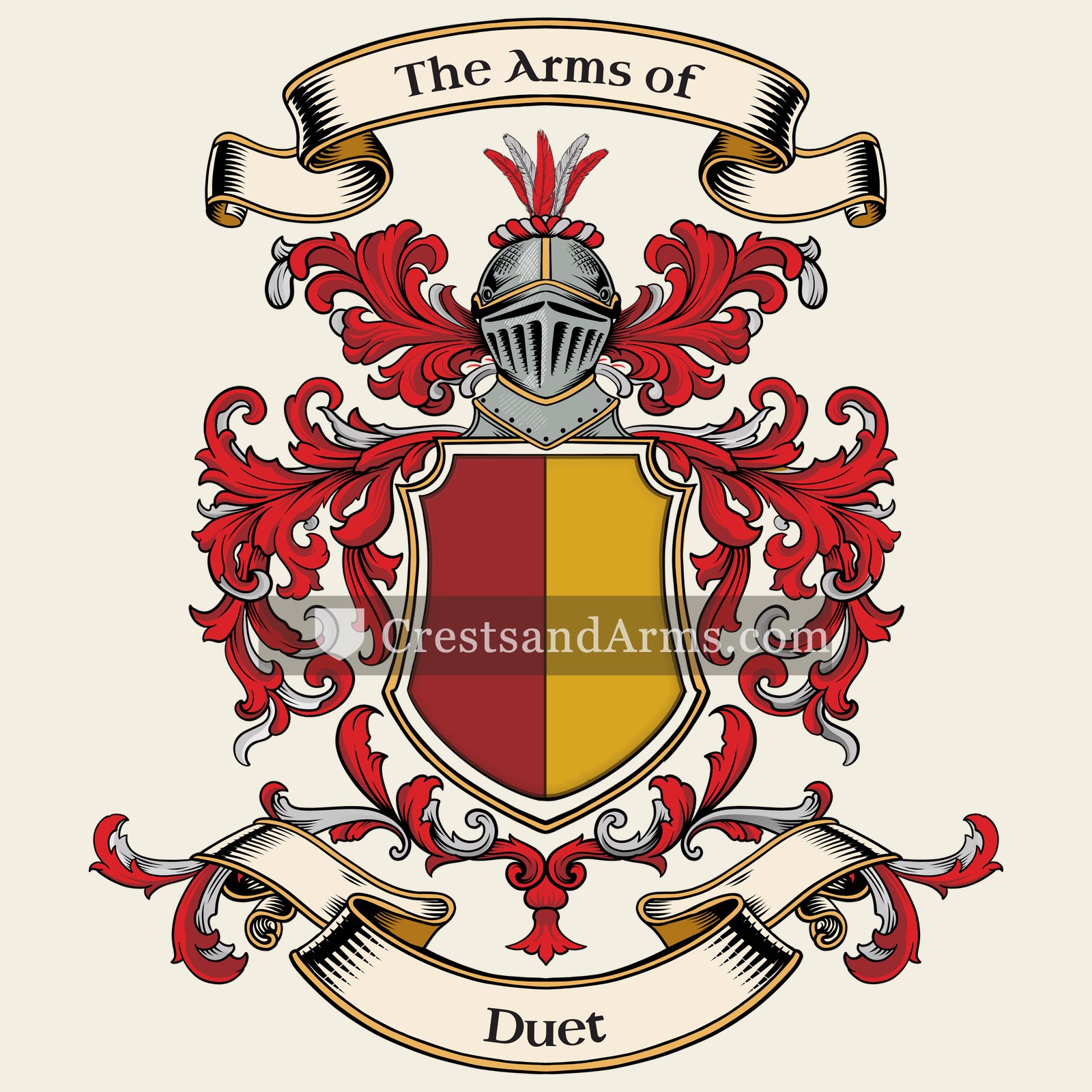
Symbols on this shield
mountThe ground held, and steadfastness upon it
treeLife, endurance and deep roots
Colours
Gold (Or)Means: Generosity
Black (Sable)Means: Constancy
Historical info
Source
J. B. Rietstap, Armorial Général, Gouda: G. B. van Goor Zonen, 1884–87
Blazon (the actual original written record)
“D'or à un tronc d'arbre de sa., poussant de chaque côté une feuille de sin. et posé sur une terrasse de même. C.: trois plumes de paon au nat., entre deux chicots de sa., poussant chacun à l'ext. une feuille de sin.”
LivoniaLivonia, c. 1772
Digital archive packCoat of arms PNG, gold border print PDF, vector SVG and the certificate of authenticity. Sent to your email in minutes.
Map of Poland showing where the Duet arms are recorded
The Duet arms were recorded in Livonia, c. 1772.
Livonia was Baltic country held by a small number of landed families who kept their estates for centuries. Land there passed down whole rather than being divided, and long unbroken tenure is what fills a register.
This is where the arms were entered in the register. Families often moved to other parts of the country, so the same name can turn up in more than one region.
Region
Livonia
First recorded
1772
Granting Authority for the Duet Arms
Ennoblement by the Sejm
Author: Olek Remesz · CC BY-SA 3.0
The body that granted and recorded arms in Poland in this period.
Stanisław August Poniatowski
Sovereign of the period
Stanisław August Poniatowski
1764–1795
Reigning in Denmark when the Duet arms are first recorded.
How Arms Worked in Poland
Polish noble families shared a single coat of arms across many different surnames, creating large clans rather than individual designs. These symbols were held collectively by all members of the clan regardless of their specific family name. When a new family joined the nobility, they were adopted into an existing clan and began using that group's established shield.
Granting authority
The Sejm, which was the Polish parliament, held the power to grant noble status and the right to bear arms.
How they got arms
Families typically received their coat of arms through a formal act of ennoblement granted by the Sejm for distinguished service.
Where arms were recorded
These grants were officially recorded in the Crown Metrica, which served as the central archive for state documents starting in the sixteenth century.
The family's standing
Recorded among the armigerous families of Livonia.
Origin & History of the Duet Family in Poland
The family name Duet traces its historical roots to the borderlands of the Baltic region, with documented evidence placing family members in the territory of Livonia by 1772. During this period, Livonia was a complex cultural crossroads under the influence of the Polish-Lithuanian Commonwealth and the Russian Empire. The name likely emerged within the administrative and social structures of this frontier, where families often moved between urban centers like Riga and the surrounding rural estates. As the geopolitical landscape shifted following the partitions of Poland, the Duet family became part of a mobile class of professionals and landowners who navigated the changing loyalties of the region. Their presence in 1772 suggests they were integrated into the local governance or merchant networks that defined the social fabric of the eastern Baltic provinces during the late eighteenth century.
Duet Meaning & Related Branches
Root word
Dud
A Germanic or Old English term referring to a dull person.
This name
DuetA surname likely derived from a nickname for a slow or sluggish individual.
also spelled
Duet
Duée
Du
Doo
Dewe
Documented Sources
J. B. Rietstap, Armorial Général, Gouda: G. B. van Goor Zonen, 1884–87
Rigsarkivet (The Danish National Archives), Kirkebøger (Parish Registers), Sjælland Stift




 mountThe ground held, and steadfastness upon it
 treeLife, endurance and deep roots