Map of France showing where the Duhamel arms are recorded
The Duhamel arms were recorded in Normandie, c. 1663.
Normandie held a dense crowd of knightly families on some of the best farmland in France. Its men had fought and settled abroad for generations, and a family that sent sons to war needed a shield they could be recognised by.
This is where the arms were entered in the register. Families often moved to other parts of the country, so the same name can turn up in more than one region.
The body that granted and recorded arms in France in this period.
Louis XIV of France
Sovereign of the period
Louis XIV of France
1643–1715
Reigning in France when the Duhamel arms are first recorded.
How Arms Worked in France
In France, a coat of arms was a mark of honor that passed down through the male line to all legitimate descendants. Families often used the same shield without changes to show their shared heritage. If a branch wanted to stand out, they could add a small mark to their shield to show their specific place in the family tree.
Granting authority
The Juge d'armes de France acted as the official authority that regulated and verified coats of arms across the country.
How they got arms
Families typically inherited their arms from ancestors, though they could also receive them through royal grants or by proving their noble status.
Where arms were recorded
Coats of arms were officially recorded in the Armorial Général de France, which began its main collection in the year 1696.
The family's standing
Recorded among the armigerous families of Normandie.
Origin & History of the Duhamel Family in France
The surname Duhamel is deeply rooted in the geography of northern France, specifically within the historic region of Normandy. The name is a descriptive toponymic, meaning it was originally used to identify people who lived near a small hamlet or a cluster of dwellings. In the French language, the prefix "du" indicates "of the," while "hamel" is an old term for a village or a small settlement. By the mid-17th century, the family was well-established in the Norman countryside, as evidenced by records confirming their presence in the region by 1663. During this era, families in Normandy were often tied closely to the land and local parish life. The name reflects a time when a person’s identity was frequently defined by their immediate surroundings and the specific landscape they called home. As the family grew, they became part of the long history of Norman settlers who helped shape the cultural and agricultural identity of the province before many members eventually expanded their reach beyond the borders of France.
Coat of Arms & Family Crest Details
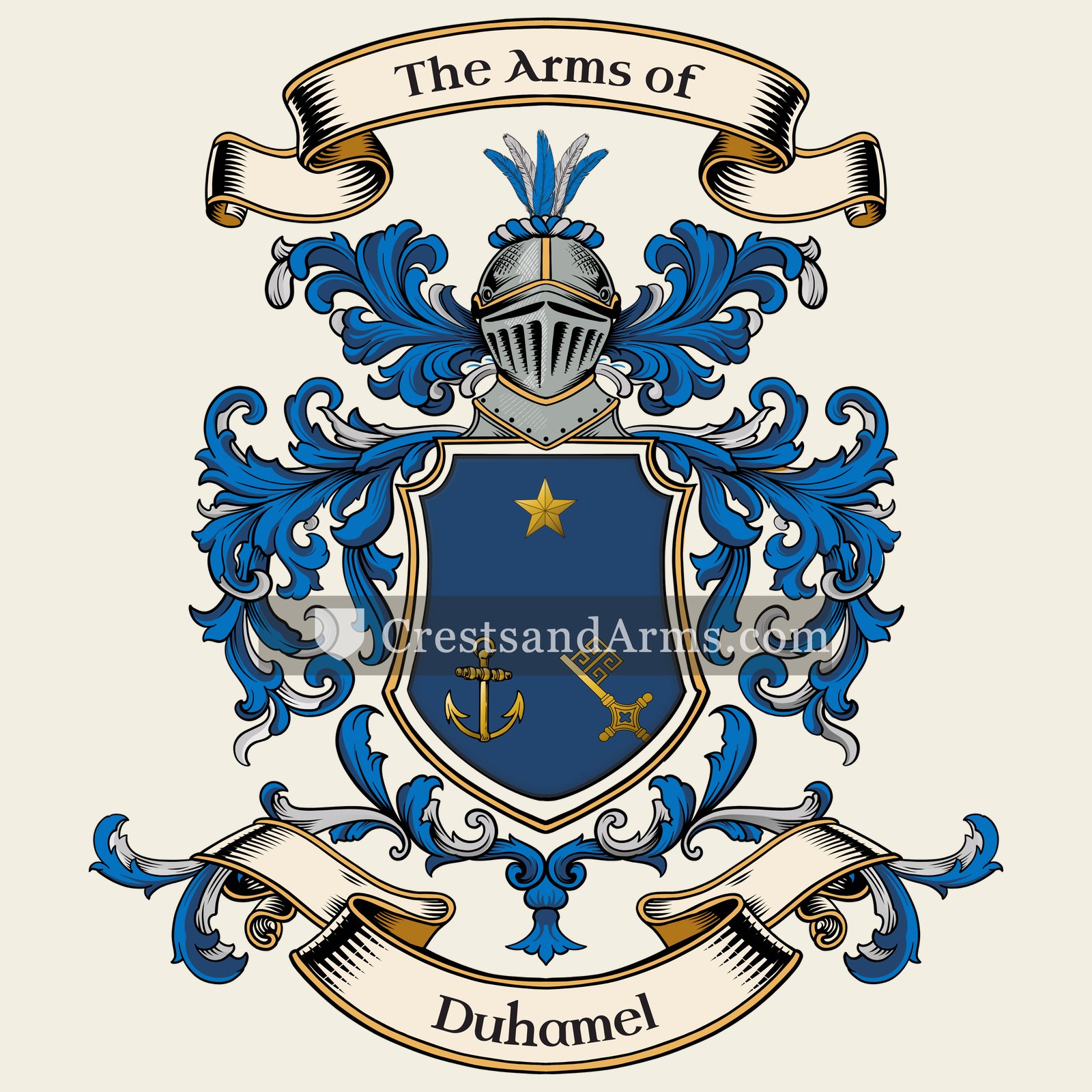
Symbols on this shield
anchorHope, and steadfastness in trouble
keyGuardianship, and the office of a steward
mulletThe third son, and a divine quality from above
Colours
Blue (Azure)Means: Loyalty and truth
Gold (Or)Means: Generosity
Historical info
Source
J. B. Rietstap, Armorial Général, Gouda: G. B. van Goor Zonen, 1884–87
Blazon (the actual original written record)
“D'azur à une ancre posée en barre, et une clé, le panneton en haut et à sen., posée en bande, passées en saut., acc. en chef d'une étoile, le tout d'or. Cq. cour. C.: un bras, arm. d'arg., la main de carn. tenant une clé d'or en barre, le panneton en haut et à dextre.”
CourlandCourland, c. 1772
Digital archive packCoat of arms PNG, gold border print PDF, vector SVG and the certificate of authenticity. Sent to your email in minutes.
Map of Poland showing where the Duhamel arms are recorded
The Duhamel arms were recorded in Courland, c. 1772.
Courland was Baltic coast country held in large estates by a small number of families. They kept their land for generations and served as officers abroad, and both landholding and service brought arms with them.
This is where the arms were entered in the register. Families often moved to other parts of the country, so the same name can turn up in more than one region.
Region
Courland
First recorded
1772
Granting Authority for the Duhamel Arms
Ennoblement by the Sejm
Author: Olek Remesz · CC BY-SA 3.0
The body that granted and recorded arms in Poland in this period.
Stanisław August Poniatowski
Sovereign of the period
Stanisław August Poniatowski
1764–1795
Reigning in France when the Duhamel arms are first recorded.
How Arms Worked in Poland
Polish noble families shared a single coat of arms across many different surnames, creating large clans rather than individual designs. These symbols were held collectively by all members of the clan regardless of their specific family name. When a new family joined the nobility, they were adopted into an existing clan and began using that group's established shield.
Granting authority
The Sejm, which was the Polish parliament, held the power to grant noble status and the right to bear arms.
How they got arms
Families typically received their coat of arms through a formal act of ennoblement granted by the Sejm for distinguished service.
Where arms were recorded
These grants were officially recorded in the Crown Metrica, which served as the central archive for state documents starting in the sixteenth century.
The family's standing
Recorded among the armigerous families of Courland.
Origin & History of the Duhamel Family in Poland
The Duhamel family name traces its roots to the French language, where it describes someone who lived near a small forest or a hedge. While the name originated in France, members of the family migrated eastward over several centuries. By the year 1772, records confirm that the Duhamel family had established a notable presence in the region of Courland. This area was then a duchy under the influence of the Polish-Lithuanian Commonwealth. During this time, the family integrated into the local social structure of the Baltic territories. They often served in administrative or military roles that were common for families of their status within the borders of the Commonwealth. Their movement into this region highlights the broader patterns of European migration where families sought new opportunities in the eastern territories of the eighteenth century.
Duhamel Meaning & Related Branches
Root word
du hamel
derived from the old French word hamel meaning a small village
This name
Duhamelrefers to someone who lived in or near a small hamlet or village
also spelled
Duhamelle
Duhamell
Documented Sources
J. B. Rietstap, Armorial Général, Gouda: G. B. van Goor Zonen, 1884–87
Dauzat, Albert. Dictionnaire étymologique des noms de famille et prénoms de France. 1951
Morlet, Marie-Thérèse. Dictionnaire étymologique des noms de famille. 1991
Archives départementales de la Seine-Maritime, Registres paroissiaux et d'état civil
Digital archive packCoat of arms PNG, gold border print PDF, vector SVG and the certificate of authenticity. Sent to your email in minutes.


 chevronProtection, and faithful service completed
 chevronProtection, and faithful service completed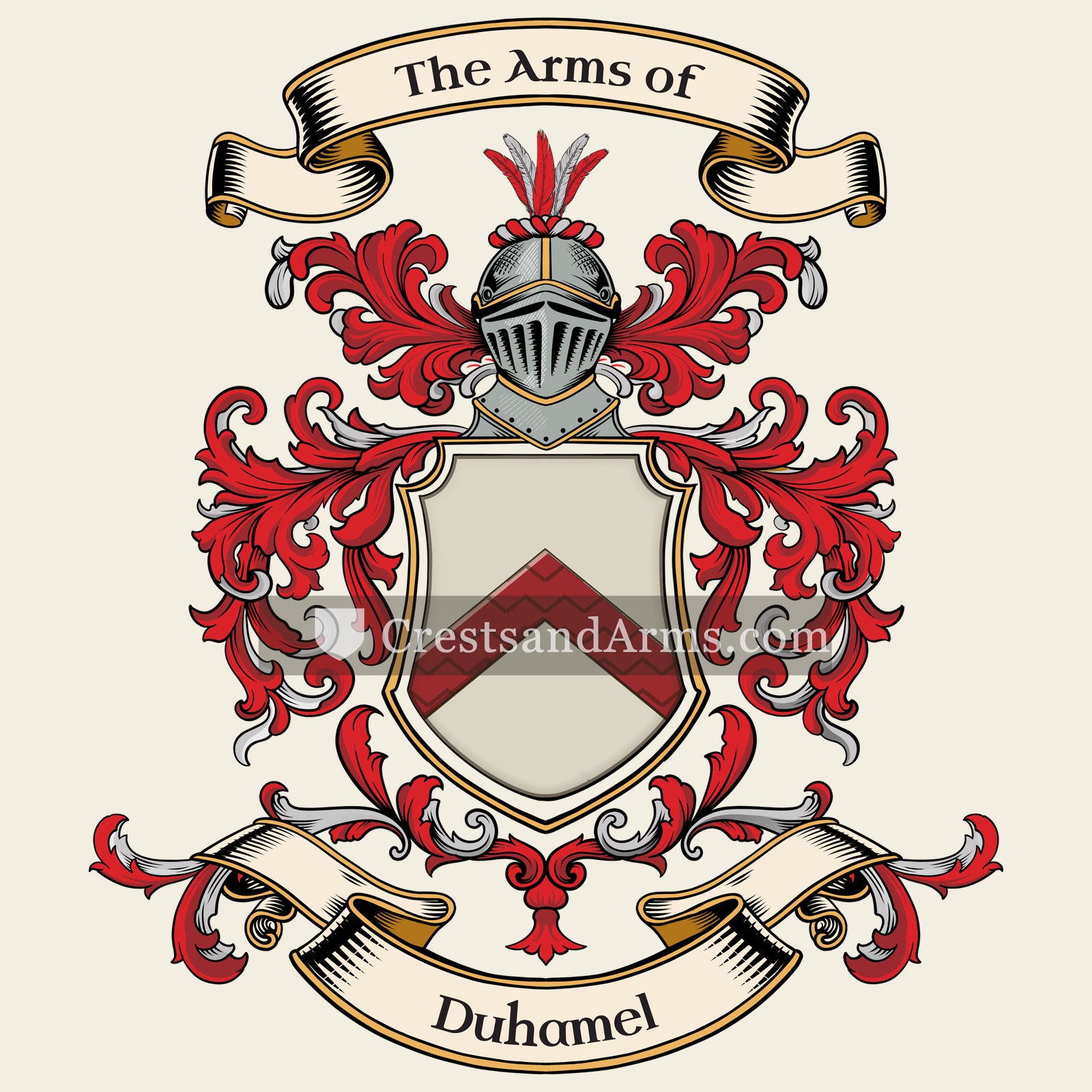


 anchorHope, and steadfastness in trouble
 keyGuardianship, and the office of a steward
 mulletThe third son, and a divine quality from above