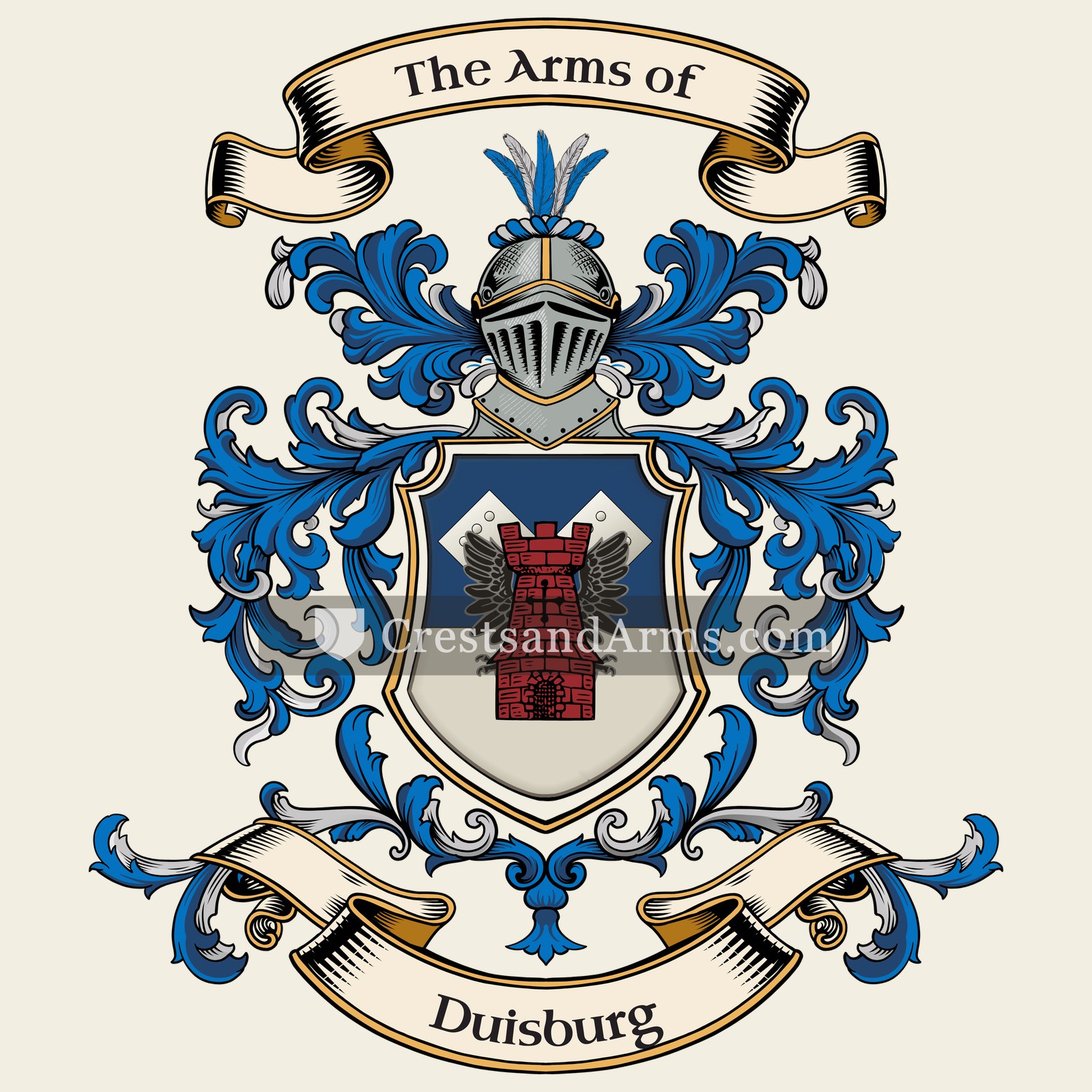
A record of documented arms, meaning and origin, researched for the Duisburg family of Germany.
Reg. 5217 · German, D–F
Coat of Arms & Family Crest Details
Symbols on this shield
eagleNobility, strength and a keen mind
towerGrandeur and solidity, and a stronghold defended
dieFortune met with a steady hand
Colours
Blue (Azure)Means: Loyalty and truth
Silver (Argent)Means: Peace and sincerity
Black (Sable)Means: Constancy
Red (Gules)Means: Military strength
Historical info
Source
J. B. Rietstap, Armorial Général, Gouda: G. B. van Goor Zonen, 1884–87
Blazon (the actual original written record)
“Coupé: au 1 d'azur à deux dés (sans points) d'arg., accostés, posés sur l'un de leurs angles; au 2 parti: a. d'arg. à une aigle de profil de sa., volante; b. d'or à un château de trois tours de gu., celle du milieu crénelée et supp. une bannière aux armes du 1, flottante à dextre, les deux autres tours couvertes de toits pointus de gu. Cq. cour. C.: une tour crén. de gu., sommée d'une bannière aux armes du 1, flottante à dextre; entre deux prob. coupées, à dextre d'azur sur arg., à sen. d'arg. sur sa. L. d'arg. et d'azur.”
GermanyPrusse orientale, c. 1765
Digital archive packCoat of arms PNG, gold border print PDF, vector SVG and the certificate of authenticity. Sent to your email in minutes.
Map of Germany showing where the Duisburg arms are recorded
The Duisburg arms were recorded in Prusse orientale, c. 1765.
Arms such as these were typically recorded in Bavaria.
Bavaria was a country of old landed families and walled market towns. Estates passed down the same line for centuries, and both the landowners and the leading townsmen kept arms, which is why so many Bavarian names sit in the registers.
This is where the arms were entered in the register. Families often moved to other parts of the country, so the same name can turn up in more than one region.
The body that granted and recorded arms in Germany in this period.
Francis I, Holy Roman Emperor
Sovereign of the period
Francis I, Holy Roman Emperor
1745–1765
Reigning in Germany when the Duisburg arms are first recorded.
How Arms Worked in Germany
In the Holy Roman Empire, coats of arms were often granted to individuals by the Emperor or his representatives. These arms were then passed down through the generations to all legitimate descendants of the original holder. Younger branches of a family usually kept the same shield design without needing to change it, as the arms belonged to the entire lineage.
Granting authority
The Holy Roman Emperor held the sole power to grant new coats of arms throughout his vast imperial territories.
How they got arms
Families typically obtained their coats of arms through a formal imperial grant or by proving their noble status to the authorities.
Where arms were recorded
These grants were officially recorded in the Imperial Chancery registers, which began keeping formal records of such honors during the Middle Ages.
The family's standing
Recorded among the armigerous families of Germany.
Origin & History of the Duisburg Family in Germany
The family name Duisburg is primarily a topographic surname, meaning it was originally derived from the location where the first bearers lived. While the name is famously associated with the city of Duisburg in the Rhineland, the presence of the family in Bavaria by 1765 suggests a migration pattern common in the eighteenth century. During this era, many families moved across German territories to seek better farmland or new economic opportunities in the southern regions. Because surnames were often assigned based on a person’s place of origin, a family moving from the north to Bavaria would likely retain their geographic name as a way to identify their ancestral roots. This practice helped maintain a connection to their home region even as they integrated into the local Bavarian society, where they eventually established deep roots in the community.
Duisburg Meaning & Related Branches
Root word
Duis-burg
A combination of a personal name and a fortified settlement.
This name
DuisburgRefers to a fortified town or castle associated with a person named Dius.
also spelled
Duisbourg
Dusburg
Duesburg
Deesburg
Documented Sources
J. B. Rietstap, Armorial Général, Gouda: G. B. van Goor Zonen, 1884–87
Bahlow, Hans, Deutsches Namenlexikon: Familien- und Vornamen nach Ursprung und Sinn erklärt, 1967
Gottschald, Max, Deutsche Namenkunde: Unsere Familiennamen, 1954


 eagleNobility, strength and a keen mind
 towerGrandeur and solidity, and a stronghold defended
 dieFortune met with a steady hand
 eagleNobility, strength and a keen mind
 towerGrandeur and solidity, and a stronghold defended
 dieFortune met with a steady hand