Map of France showing where the Dujardin arms are recorded
The Dujardin arms were recorded in Flandre, c. 1659.
Flandre grew rich on cloth, and its towns were among the busiest in Europe. Merchant families bought land with their profits and took arms to go with it, so trade put as many names in the registers here as land did.
This is where the arms were entered in the register. Families often moved to other parts of the country, so the same name can turn up in more than one region.
The body that granted and recorded arms in France in this period.
Louis XIV of France
Sovereign of the period
Louis XIV of France
1643–1715
Reigning in France when the Dujardin arms are first recorded.
How Arms Worked in France
In France, a coat of arms was a mark of honor that passed down through the male line to all legitimate descendants. Families often used the same shield without changes to show their shared heritage. If a branch wanted to stand out, they could add a small mark to their shield to show their specific place in the family tree.
Granting authority
The Juge d'armes de France acted as the official authority that regulated and verified coats of arms across the country.
How they got arms
Families typically inherited their arms from ancestors, though they could also receive them through royal grants or by proving their noble status.
Where arms were recorded
Coats of arms were officially recorded in the Armorial Général de France, which began its main collection in the year 1696.
The family's standing
Recorded among the armigerous families of Flandre.
Origin & History of the Dujardin Family in France
The surname Dujardin is a classic example of a topographic name, which means it was originally used to identify people based on where they lived. In French, the name translates literally to "of the garden," suggesting that the earliest ancestors were likely gardeners or lived near a prominent enclosed plot of land. By the year 1659, records confirm that families bearing this name were well-established in the region of Flandre. During this period, the area was a complex crossroads of French and Flemish cultures, often shifting between different political powers. Because the name is rooted in a common agricultural term, it emerged independently in several different locations, though the branch in Flandre became particularly notable for its deep ties to the local landscape. These early families were often tied to the land they cultivated, and their name served as a simple way for neighbors and officials to distinguish them from those living in the surrounding forests or open fields.
Coat of Arms & Family Crest Details
Symbols on this shield
eagleNobility, strength and a keen mind
hunting horn stringedOne who delights in the chase
Colours
Gold (Or)Means: Generosity
Black (Sable)Means: Constancy
Historical info
Source
J. B. Rietstap, Armorial Général, Gouda: G. B. van Goor Zonen, 1884–87
Blazon (the actual original written record)
“d'or ch. chacun d'une aigle de sa., équipollés à quatre points de sa. ch. chacun d'un huchet suspendu à deux chaines, mouv. d'un anneau en chef, le tout d'or.”
Spainc. 1722
Digital archive packCoat of arms PNG, gold border print PDF, vector SVG and the certificate of authenticity. Sent to your email in minutes.
Map of Spain showing where the Dujardin arms are recorded
The Dujardin arms were recorded in Spain, c. 1722.
Arms such as these were typically recorded in Castile.
Castile was the heart of Spain and the source of most of its noble families. Land won in the long wars against the Moors was granted out to fighting men, and a man granted land was granted arms along with it.
This is where the arms were entered in the register. Families often moved to other parts of the country, so the same name can turn up in more than one region.
The body that granted and recorded arms in Spain in this period.
Philip V of Spain
Sovereign of the period
Philip V of Spain
1714–1724
Reigning in France when the Dujardin arms are first recorded.
How Arms Worked in Spain
In Spain, a coat of arms was considered a form of property that belonged to the entire family line. These arms were passed down from a father to all his children equally. Younger branches of the family usually kept the original design without needing to add any special marks to distinguish their specific line.
Granting authority
The Cronista Rey de Armas was the official body that regulated and granted coats of arms throughout Spain.
How they got arms
Families often obtained their arms through royal grants or by proving their noble status to the official heraldic authority.
Where arms were recorded
Coats of arms were officially recorded in the registers of the Cronista Rey de Armas starting in 1496.
The family's standing
Recorded among the armigerous families of Spain.
Origin & History of the Dujardin Family in Spain
The family name Dujardin, which translates from French to mean "of the garden," traces its roots in Spain to the early eighteenth century. By 1722, records confirm that members of the family were established within the Kingdom of Castile. During this period, Castile served as a central hub for trade and administration, attracting families from across Europe who sought new opportunities in the Spanish heartland. The Dujardin family likely arrived as part of the broader movement of merchants and skilled professionals who integrated into the local Spanish society. As they settled into their new environment, they adapted to the customs and social structures of the region while maintaining the identity associated with their name. This transition highlights how families moved across borders during the Enlightenment era to build new lives in the service of the Spanish crown and its growing urban centers.
Coat of Arms & Family Crest Details
Symbols on this shield
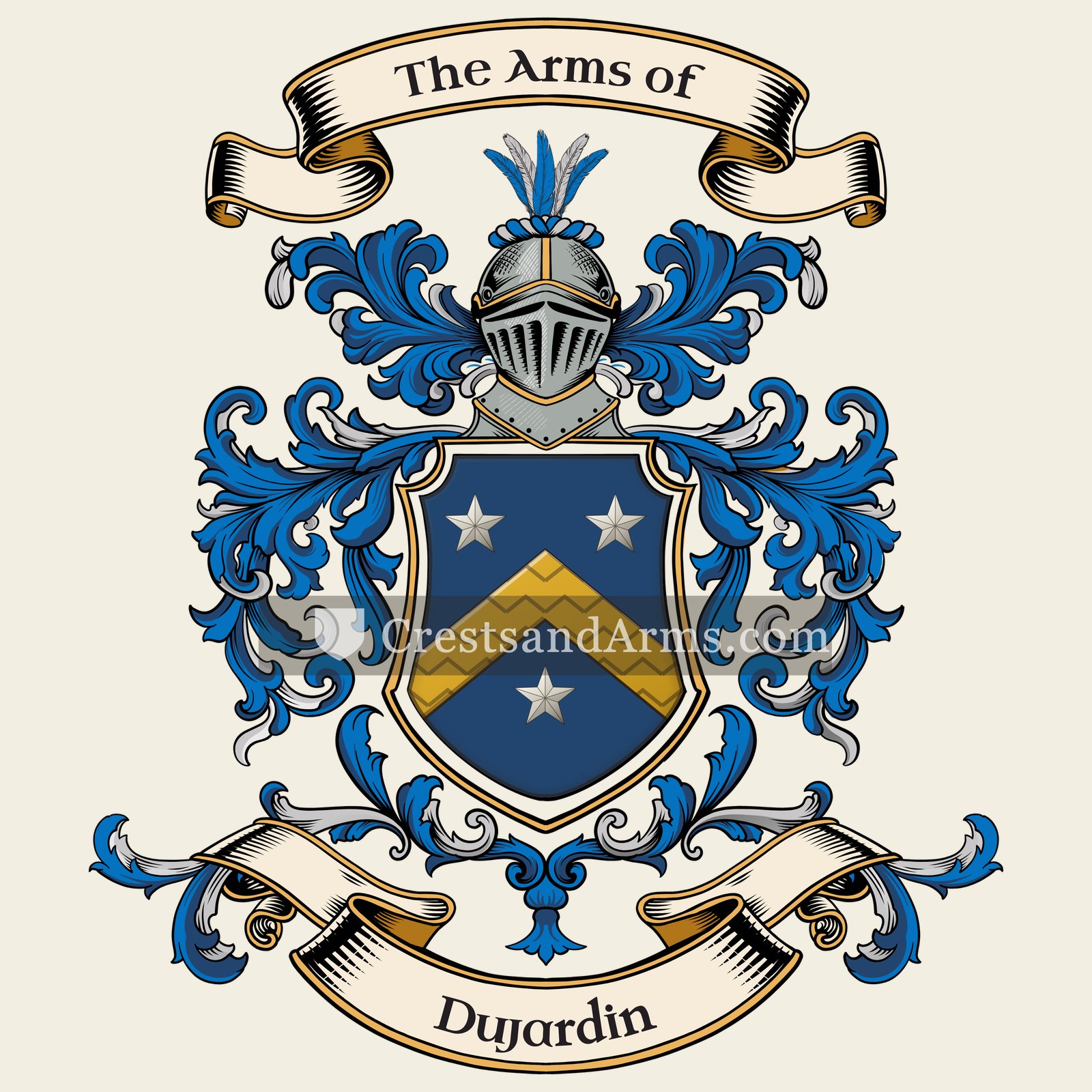
chevronProtection, and faithful service completed
mulletThe third son, and a divine quality from above
Colours
Blue (Azure)Means: Loyalty and truth
Gold (Or)Means: Generosity
Silver (Argent)Means: Peace and sincerity
Historical info
Source
J. B. Rietstap, Armorial Général, Gouda: G. B. van Goor Zonen, 1884–87
Blazon (the actual original written record)
“D'azur au chev. d'or, acc. de trois étoiles d'arg. brl. d'azur et d'or. C.: un cygne d'arg., bq. et m. de gu. S.: deux lions d'or, arm. et lamp. de gu. D.: TOUT D'EN HAUT.”
BelgiumBruxelles, c. 1705
Digital archive packCoat of arms PNG, gold border print PDF, vector SVG and the certificate of authenticity. Sent to your email in minutes.
Map of Belgium showing where the Dujardin arms are recorded
The Dujardin arms were recorded in Bruxelles, c. 1705.
This is where the arms were entered in the register. Families often moved to other parts of the country, so the same name can turn up in more than one region.
The body that granted and recorded arms in Belgium in this period.
Philip V of Spain
Sovereign of the period
Philip V of Spain
1700–1714
Reigning in France when the Dujardin arms are first recorded.
How Arms Worked in Belgium
In Belgium, a coat of arms is considered personal property that is passed down through the male line to legitimate descendants. Families often use the same shield design across generations to show their shared heritage. If a branch of the family wants to change the design, they must apply for an official update to their specific version of the arms.
Granting authority
The Conseil héraldique is the official body that regulates and approves all coats of arms in Belgium.
How they got arms
Families obtain their coats of arms through formal royal grants or by confirming their historical right to use existing designs.
Where arms were recorded
All approved coats of arms are officially recorded in the public registers of the Conseil héraldique since 1844.
The family's standing
Recorded among the armigerous families of Belgium.
Origin & History of the Dujardin Family in Belgium
The family name Dujardin is a classic example of a topographic surname, which means it was originally used to describe where a person lived or worked. In French, the name translates to "of the garden," suggesting that the earliest ancestors were likely gardeners, groundskeepers, or individuals who lived near a prominent orchard or estate. By the year 1705, records confirm that members of the Dujardin family were well-established residents of Brussels. During this period, Brussels was a bustling center of trade and craftsmanship within the Southern Netherlands. Families with this name were often integrated into the urban fabric of the city, likely contributing to the local economy through skilled labor or small-scale commerce. As the city grew, the Dujardin name became a fixture of the local community, reflecting a history rooted in the daily life and development of Belgium’s capital.
Dujardin Meaning & Related Branches
Root word
Jardin
A piece of enclosed land used for cultivation.
This name
DujardinRefers to someone who lived near or worked in a garden.
also spelled
de Jardin
du Jardyn
de Jardyn
Jardin
Related arms
Festeausimilar arms
Documented Sources
J. B. Rietstap, Armorial Général, Gouda: G. B. van Goor Zonen, 1884–87
Dauzat, Albert. Dictionnaire étymologique des noms et prénoms de France. 1951
Morlet, Marie-Thérèse. Dictionnaire étymologique des noms de famille. 1991
Archives départementales du Nord, Registres paroissiaux et d'état civil de la Flandre française
Digital archive packCoat of arms PNG, gold border print PDF, vector SVG and the certificate of authenticity. Sent to your email in minutes.


 mulletThe third son, and a divine quality from above
 mulletThe third son, and a divine quality from above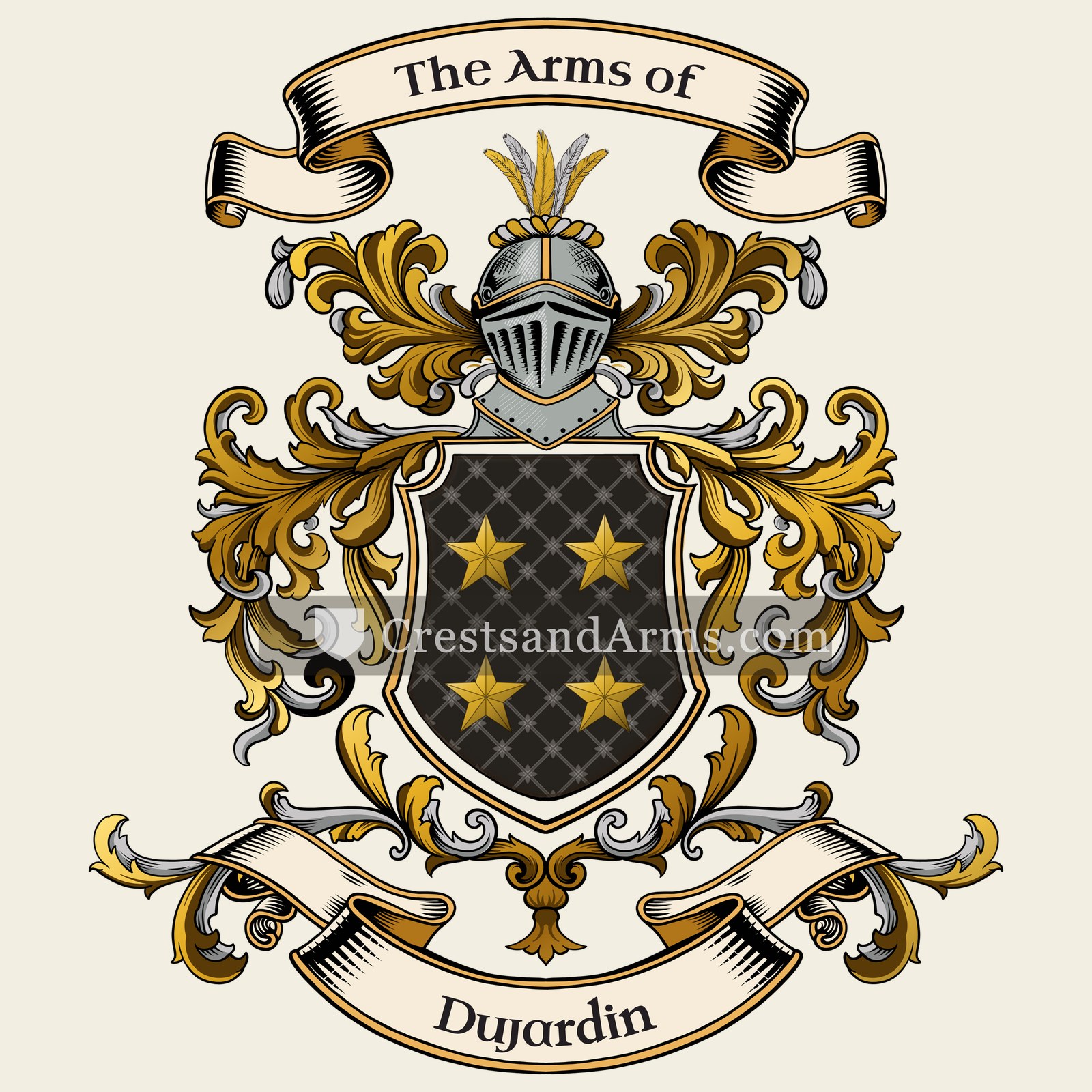


 eagleNobility, strength and a keen mind
 hunting horn stringedOne who delights in the chase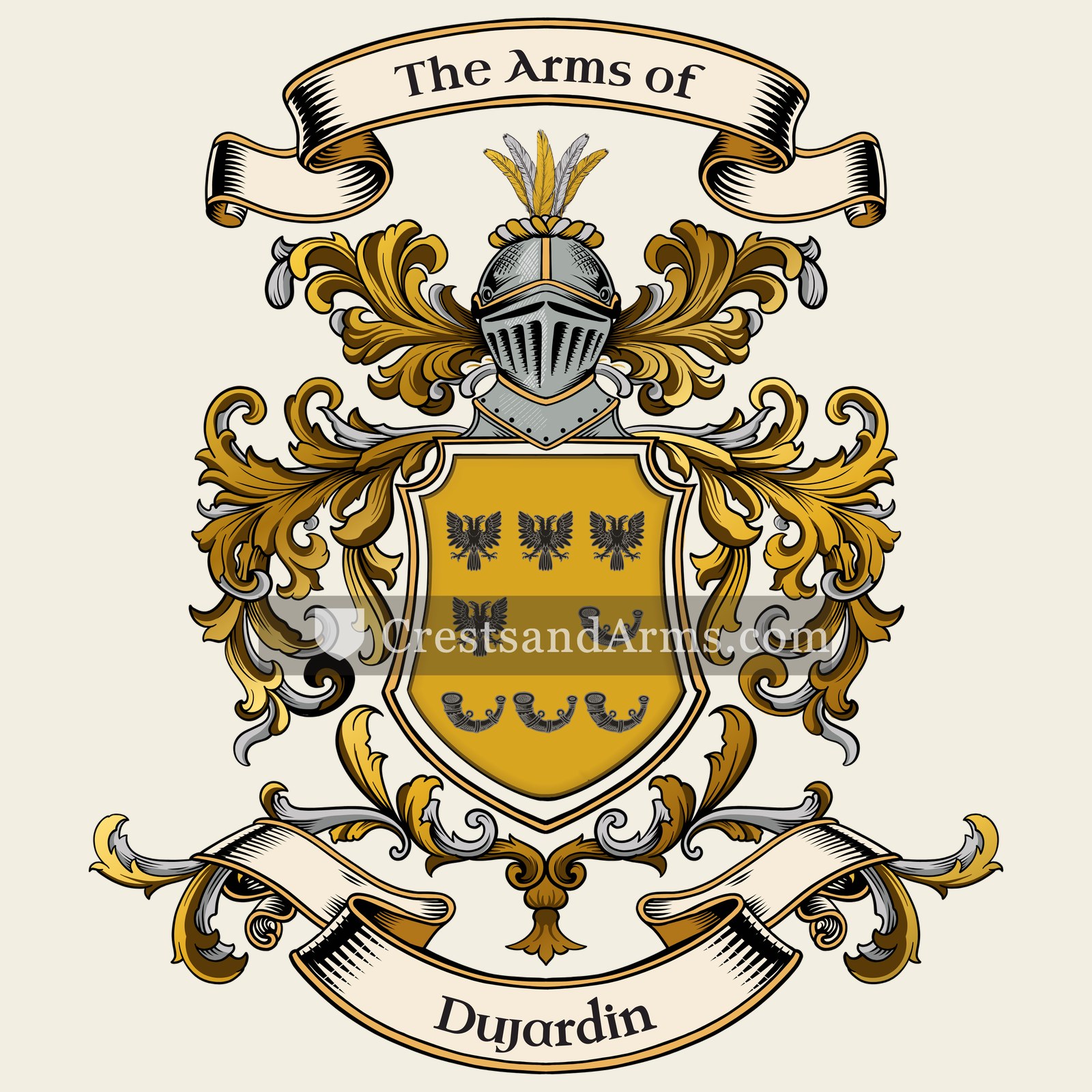


 chevronProtection, and faithful service completed