Map of France showing where the Dulac arms are recorded
The Dulac arms were recorded in Beaujolais, c. 1663.
Beaujolais was wine country in eastern France, small but prosperous. Its landowners were modest and numerous, and even a single vineyard estate was enough to justify a coat of arms.
This is where the arms were entered in the register. Families often moved to other parts of the country, so the same name can turn up in more than one region.
The body that granted and recorded arms in France in this period.
Louis XIV of France
Sovereign of the period
Louis XIV of France
1643–1715
Reigning in France when the Dulac arms are first recorded.
How Arms Worked in France
In France, a coat of arms was a mark of honor that passed down through the male line to all legitimate descendants. Families often used the same shield without changes to show their shared heritage. If a branch wanted to stand out, they could add a small mark to their shield to show their specific place in the family tree.
Granting authority
The Juge d'armes de France acted as the official authority that regulated and verified coats of arms across the country.
How they got arms
Families typically inherited their arms from ancestors, though they could also receive them through royal grants or by proving their noble status.
Where arms were recorded
Coats of arms were officially recorded in the Armorial Général de France, which began its main collection in the year 1696.
The family's standing
Recorded among the armigerous families of Beaujolais.
Origin & History of the Dulac Family in France
The surname Dulac is a classic example of a topographic name, which means it was originally given to people based on the landscape where they lived. In French, the name translates literally to "of the lake," suggesting that the earliest ancestors bearing this title resided near a prominent body of water. By the year 1663, historical records confirm that the family had established a firm presence in the Beaujolais region of east-central France. This area was well known for its rolling hills and agricultural importance, providing a stable environment for families to settle and grow over several generations. As the family became rooted in the local community, the name transitioned from a simple description of their home into a permanent family identifier that was passed down through the centuries.
Coat of Arms & Family Crest Details
Colours
Silver (Argent)Means: Peace and sincerity
Historical info
Source
J. B. Rietstap, Armorial Général, Gouda: G. B. van Goor Zonen, 1884–87
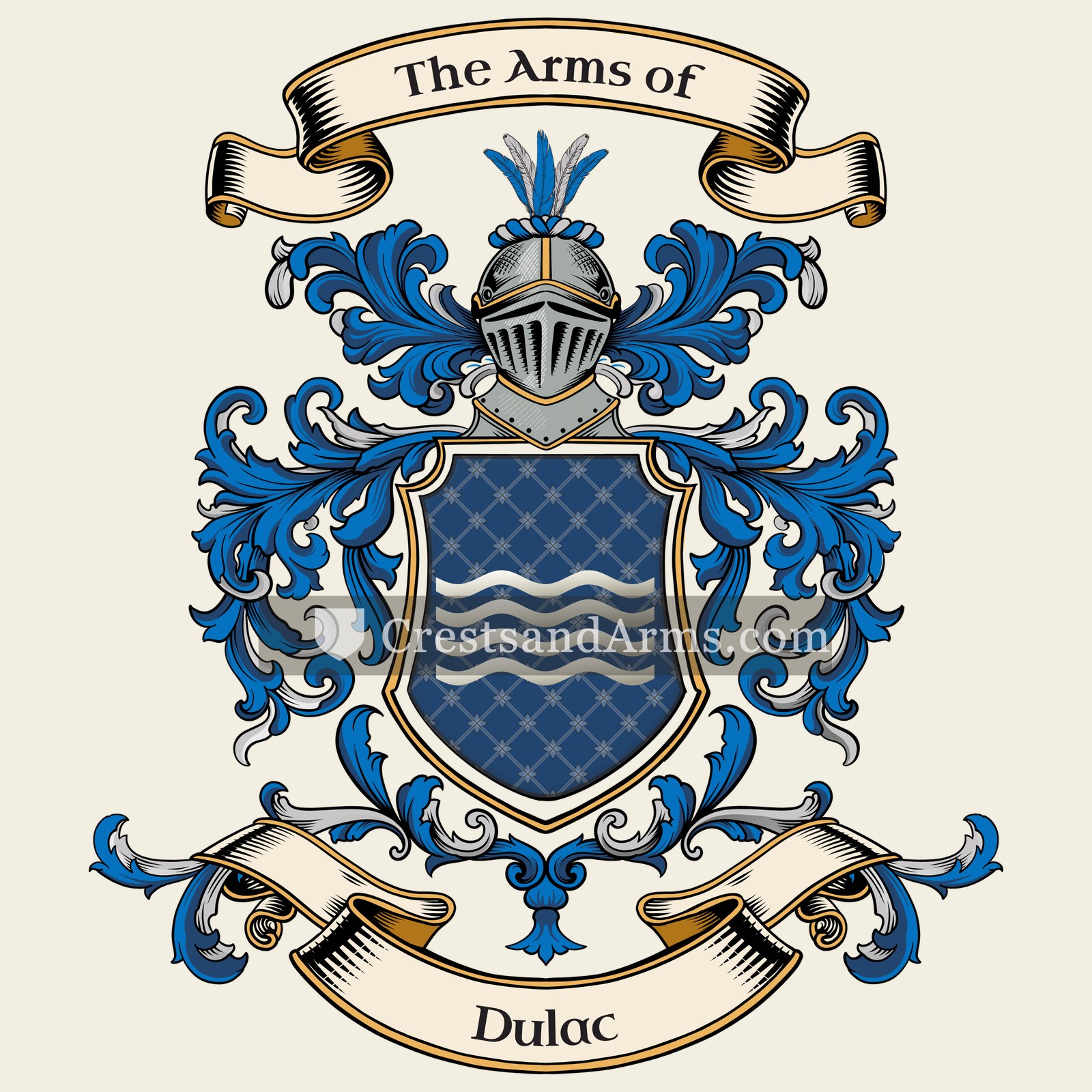
Blazon (the actual original written record)
“D'arg. à trois giroflées de gu., tigées et feuillées de sin. C.: un porc-épic de sa. L. d'arg. et de gu.”
BavariaBavaria, c. 1765
Digital archive packCoat of arms PNG, gold border print PDF, vector SVG and the certificate of authenticity. Sent to your email in minutes.
Map of Germany showing where the Dulac arms are recorded
The Dulac arms were recorded in Bavaria, c. 1765.
Bavaria was a country of old landed families and walled market towns. Estates passed down the same line for centuries, and both the landowners and the leading townsmen kept arms, which is why so many Bavarian names sit in the registers.
This is where the arms were entered in the register. Families often moved to other parts of the country, so the same name can turn up in more than one region.
The body that granted and recorded arms in Germany in this period.
Francis I, Holy Roman Emperor
Sovereign of the period
Francis I, Holy Roman Emperor
1745–1765
Reigning in France when the Dulac arms are first recorded.
How Arms Worked in Germany
In the Holy Roman Empire, coats of arms were often granted to individuals by the Emperor or his representatives. These arms were then passed down through the generations to all legitimate descendants of the original holder. Younger branches of a family usually kept the same shield design without needing to change it, as the arms belonged to the entire lineage.
Granting authority
The Holy Roman Emperor held the sole power to grant new coats of arms throughout his vast imperial territories.
How they got arms
Families typically obtained their coats of arms through a formal imperial grant or by proving their noble status to the authorities.
Where arms were recorded
These grants were officially recorded in the Imperial Chancery registers, which began keeping formal records of such honors during the Middle Ages.
The family's standing
Recorded among the armigerous families of Bavaria.
Origin & History of the Dulac Family in Germany
The surname Dulac is primarily recognized as a French locative name, meaning "of the lake," but its presence in Bavaria by 1765 suggests a fascinating history of migration and cultural integration. During the eighteenth century, the Holy Roman Empire experienced significant movement of people across borders due to trade, religious shifts, and military service. Families bearing this name likely moved eastward from French-speaking regions into the German territories, where they adapted to the local social structures of the Bavarian electorate. By settling in this region, these early ancestors became part of a diverse population that navigated the complex administrative and agricultural life of the era. Their transition into Bavarian society reflects a broader pattern of European families seeking new opportunities in central German lands, where they eventually established roots that lasted for generations.
Dulac Meaning & Related Branches
Root word
lacus
Latin term referring to a lake or pool of water.
This name
DulacA topographic surname denoting someone who lived near a lake or pond.
also spelled
de Lac
du Lack
de Lack
Dulak
Lac
Related arms
Axmasimilar arms
Fatiosimilar arms
Fatio de Duilliersimilar arms
Lentfrincksimilar arms
Documented Sources
J. B. Rietstap, Armorial Général, Gouda: G. B. van Goor Zonen, 1884–87
Dauzat, Albert. Dictionnaire étymologique des noms et prénoms de France, 1951
Archives départementales du Rhône, Registres paroissiaux et d'état civil de la commune de Beaujeu, 1663
Digital archive packCoat of arms PNG, gold border print PDF, vector SVG and the certificate of authenticity. Sent to your email in minutes.


 riverThe bounds of a land, and life carried through it
 riverThe bounds of a land, and life carried through it