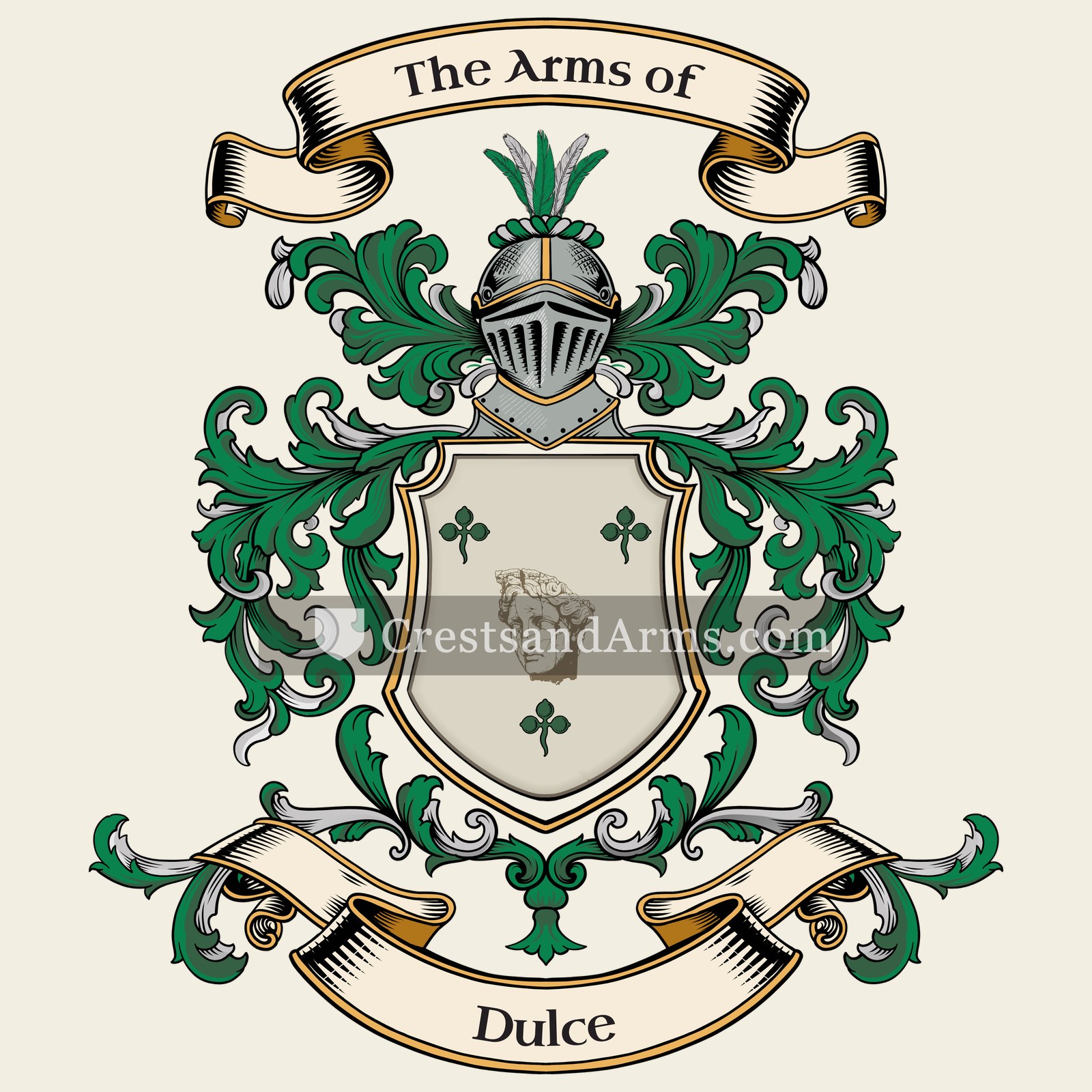
A record of documented arms, meaning and origin, researched for the Dulce family of Germany.
Reg. 6666 · German, D–F
Coat of Arms & Family Crest Details
Symbols on this shield
womanGrace, and the founding of a house
trefoilPerpetuity, and the Trinity
Colours
Silver (Argent)Means: Peace and sincerity
Green (Vert)Means: Hope
Historical info
Source
J. B. Rietstap, Armorial Général, Gouda: G. B. van Goor Zonen, 1884–87
Blazon (the actual original written record)
“D'arg. à une tête et col de femme de carn., tort. d'arg., posée de profil, surm. d'un croiss. tourné d'azur et acc. de trois trèfles de sin. C.: un buste d'homme, posé de profil, hab. d'arg., coiffé d'un bonnet albanais du même et surm. d'un croiss. cont. d'arg; entre deux prob. coupées d'arg. sur sin., ornées chacune dans son embouchure d'un trèfle de sin. L. d'arg. et de sin.”
FranconiaFranconia, c. 1765
Digital archive packCoat of arms PNG, gold border print PDF, vector SVG and the certificate of authenticity. Sent to your email in minutes.
Map of Germany showing where the Dulce arms are recorded
The Dulce arms were recorded in Franconia, c. 1765.
Franconia was a patchwork of small territories in central Germany, full of minor landowners and prosperous market towns. So many separate households held land there that the region produced a great many coats of arms.
This is where the arms were entered in the register. Families often moved to other parts of the country, so the same name can turn up in more than one region.
The body that granted and recorded arms in Germany in this period.
Francis I, Holy Roman Emperor
Sovereign of the period
Francis I, Holy Roman Emperor
1745–1765
Reigning in Germany when the Dulce arms are first recorded.
How Arms Worked in Germany
In the Holy Roman Empire, coats of arms were often granted to individuals by the Emperor or his representatives. These arms were then passed down through the generations to all legitimate descendants of the original holder. Younger branches of a family usually kept the same shield design without needing to change it, as the arms belonged to the entire lineage.
Granting authority
The Holy Roman Emperor held the sole power to grant new coats of arms throughout his vast imperial territories.
How they got arms
Families typically obtained their coats of arms through a formal imperial grant or by proving their noble status to the authorities.
Where arms were recorded
These grants were officially recorded in the Imperial Chancery registers, which began keeping formal records of such honors during the Middle Ages.
The family's standing
Recorded among the armigerous families of Franconia.
Origin & History of the Dulce Family in Germany
The family name Dulce carries a rich history that is deeply rooted in the cultural landscape of central Europe. By 1765, records confirm that members of the family were well-established residents of Franconia, a region known for its complex social and agricultural traditions. During this era, the name likely functioned as a descriptive identifier, reflecting the linguistic influences common to the German-speaking territories of the eighteenth century. Families in this region often lived in tight-knit rural communities where they contributed to the local economy through trade or farming. As the family grew and moved across the changing borders of the Holy Roman Empire, they maintained their identity while adapting to the shifting political and social structures of the time. This early presence in Franconia serves as a foundational chapter for the family, marking their transition from local inhabitants to a lineage with a documented historical footprint.
Related Branches & Arms
Root word
Dulcis
Latin term meaning sweet, pleasant, or delightful.
This name
DulceA descriptive surname denoting a person with a sweet or agreeable temperament.
also spelled
Dulk
Dulcke
Dulke
Documented Sources
J. B. Rietstap, Armorial Général, Gouda: G. B. van Goor Zonen, 1884–87


 womanGrace, and the founding of a house
 trefoilPerpetuity, and the Trinity
 womanGrace, and the founding of a house
 trefoilPerpetuity, and the Trinity