Map of France showing where the Dullea arms are recorded
The Dullea arms were recorded in Berry, c. 1663.
Berry was central French farming country, quiet and long-settled. Its estates were modest and stayed in the same hands for centuries, and steady landholding of that kind is exactly what puts a name into the heraldic records.
This is where the arms were entered in the register. Families often moved to other parts of the country, so the same name can turn up in more than one region.
The body that granted and recorded arms in France in this period.
Louis XIV of France
Sovereign of the period
Louis XIV of France
1643–1715
Reigning in France when the Dullea arms are first recorded.
How Arms Worked in France
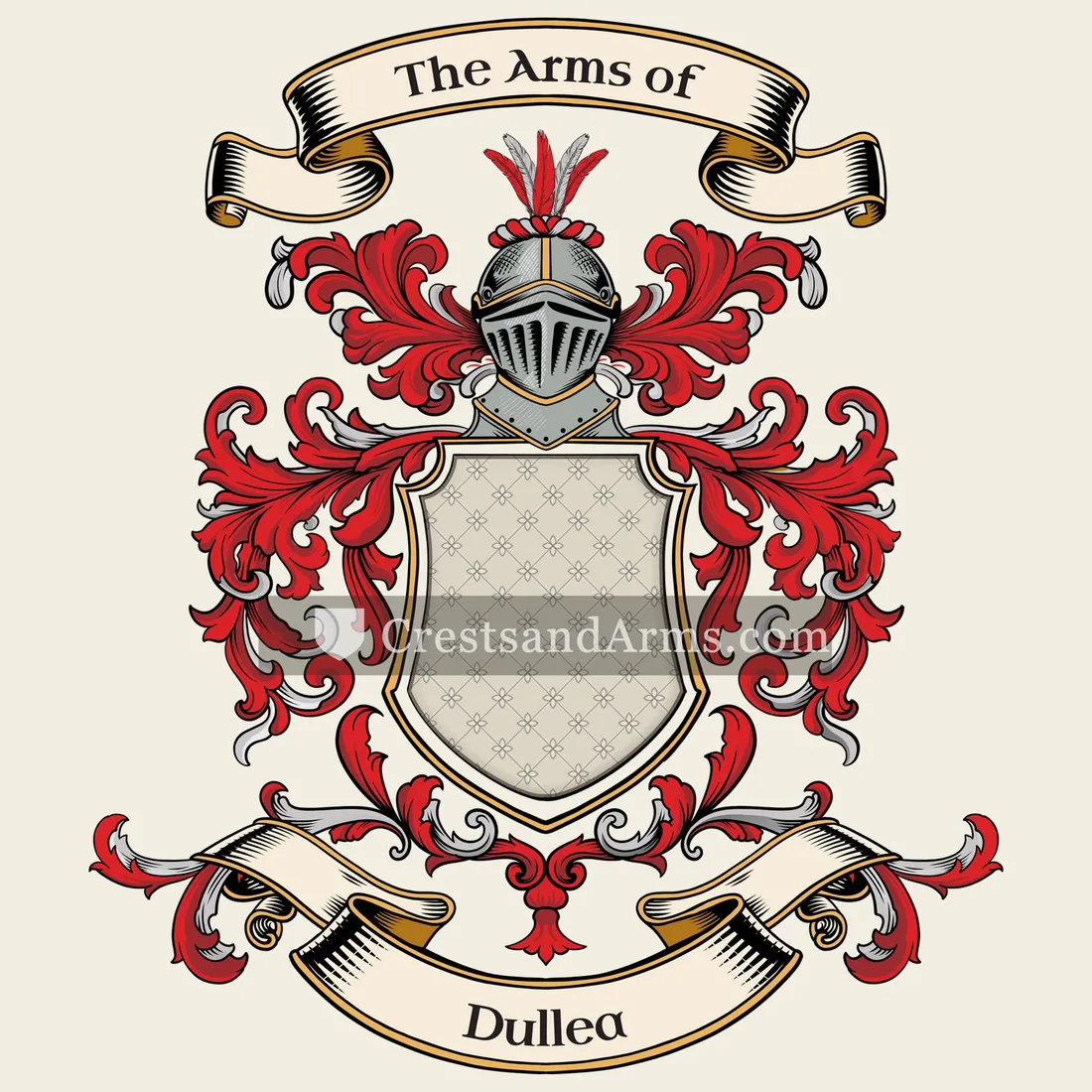
In France, a coat of arms was a mark of honor that passed down through the male line to all legitimate descendants. Families often used the same shield without changes to show their shared heritage. If a branch wanted to stand out, they could add a small mark to their shield to show their specific place in the family tree.
Granting authority
The Juge d'armes de France acted as the official authority that regulated and verified coats of arms across the country.
How they got arms
Families typically inherited their arms from ancestors, though they could also receive them through royal grants or by proving their noble status.
Where arms were recorded
Coats of arms were officially recorded in the Armorial Général de France, which began its main collection in the year 1696.
The family's standing
Recorded among the armigerous families of Berry.
Origin & History of the Dullea Family in France
The family name Dullea has deep roots in the region of County Cork, Ireland, where the name is traditionally associated with the rugged landscape of the Beara Peninsula. While the surname is often linked to the Gaelic phrase for a dark or black-haired person, historical records confirm that members of the family were firmly established in the area of Bere, or Berry, by 1663. During this period, families in the region lived through significant political upheaval and land redistribution, which often forced them to adapt to changing local authorities. Despite these pressures, the Dullea name remained connected to the coastal communities of West Cork for generations. The family likely functioned as part of the local farming or seafaring population, relying on the natural resources of the Atlantic coastline to sustain their households. This early presence in the 17th century serves as a vital anchor point for understanding how the family integrated into the social and economic life of the Irish countryside.
Dullea Meaning & Related Branches
Root word
De l'eau
French phrase meaning of the water.
This name
DulleaA topographic surname for someone who lived near a body of water or a stream.
also spelled
Doule
Doolay
Documented Sources
J. B. Rietstap, Armorial Général, Gouda: G. B. van Goor Zonen, 1884–87
O'Hart, John, Irish Pedigrees; or, The Origin and Stem of the Irish Nation, 1892
National Archives of Ireland, The Hearth Money Rolls, 1663
Ó Murchadha, Diarmuid, The Diocese of Cork: An Archaeological, Historical and Ecclesiastical Survey, 2005
Digital archive packCoat of arms PNG, gold border print PDF, vector SVG and the certificate of authenticity. Sent to your email in minutes.