Map of France showing where the Duma arms are recorded
The Duma arms were recorded in Paris, c. 1663.
This is where the arms were entered in the register. Families often moved to other parts of the country, so the same name can turn up in more than one region.
The body that granted and recorded arms in France in this period.
Louis XIV of France
Sovereign of the period
Louis XIV of France
1643–1715
Reigning in France when the Duma arms are first recorded.
How Arms Worked in France
In France, a coat of arms was a mark of honor that passed down through the male line to all legitimate descendants. Families often used the same shield without changes to show their shared heritage. If a branch wanted to stand out, they could add a small mark to their shield to show their specific place in the family tree.
Granting authority
The Juge d'armes de France acted as the official authority that regulated and verified coats of arms across the country.
How they got arms
Families typically inherited their arms from ancestors, though they could also receive them through royal grants or by proving their noble status.
Where arms were recorded
Coats of arms were officially recorded in the Armorial Général de France, which began its main collection in the year 1696.
The family's standing
Recorded among the armigerous families of France.
Origin & History of the Duma Family in France
The family name Duma carries a distinct history rooted in the social landscape of seventeenth-century France. By the year 1663, records confirm that members of the family were already established in Paris, a city that served as the vibrant center of French culture and administration under King Louis XIV. The name itself is often associated with the French preposition "du" combined with a geographical or descriptive term, suggesting that early ancestors likely identified themselves by their place of residence or their connection to a specific plot of land. During this era, families living in the capital were often part of the growing merchant class or skilled tradespeople who helped sustain the city's expanding economy. As these individuals navigated life in Paris, they contributed to the urban fabric of a nation undergoing significant political and architectural transformation. Their presence in the city during this period highlights a long-standing lineage that predates the major social upheavals of the following century.
Coat of Arms & Family Crest Details
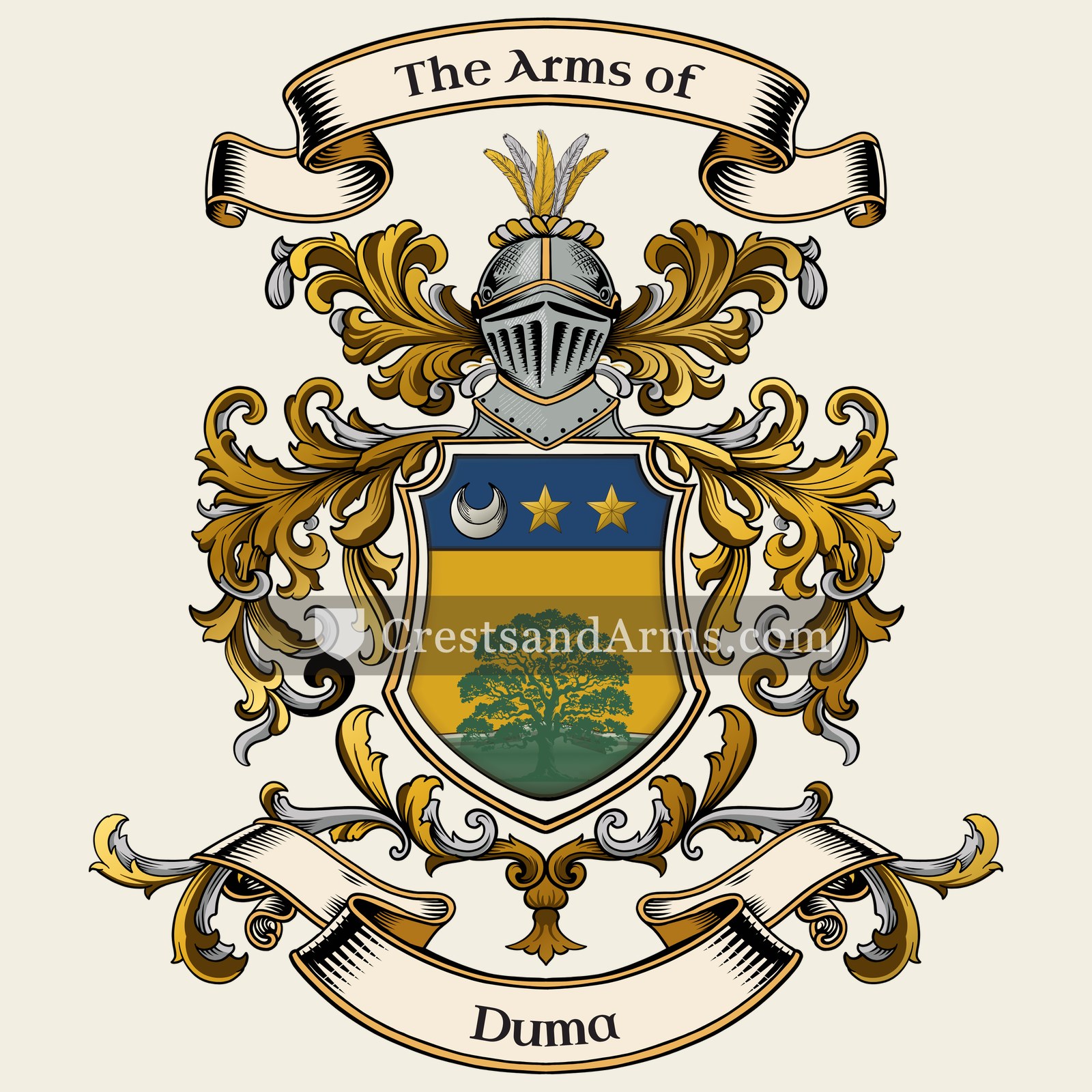
Symbols on this shield
mountThe ground held, and steadfastness upon it
chiefAuthority, wisdom and dominion
treeLife, endurance and deep roots
crescentHonour by the sovereign, and the second son
mulletThe third son, and a divine quality from above
Colours
Gold (Or)Means: Generosity
Blue (Azure)Means: Loyalty and truth
Green (Vert)Means: Hope
Silver (Argent)Means: Peace and sincerity
Historical info
Source
J. B. Rietstap, Armorial Général, Gouda: G. B. van Goor Zonen, 1884–87
Blazon (the actual original written record)
“D'or à un arbre terrassé de sin.; au chef d'azur, ch. d'un croiss. d'arg. entre deux étoiles (5) du champ. Brl. d'azur et d'or. C.: un lion iss., au nat., supp. une étoile d'or. L. d'or et d'azur.”
BavariaBavaria, c. 1736
Digital archive packCoat of arms PNG, gold border print PDF, vector SVG and the certificate of authenticity. Sent to your email in minutes.
Map of Germany showing where the Duma arms are recorded
The Duma arms were recorded in Bavaria, c. 1736.
Bavaria was a country of old landed families and walled market towns. Estates passed down the same line for centuries, and both the landowners and the leading townsmen kept arms, which is why so many Bavarian names sit in the registers.
This is where the arms were entered in the register. Families often moved to other parts of the country, so the same name can turn up in more than one region.
The body that granted and recorded arms in Germany in this period.
Charles VI, Holy Roman Emperor
Sovereign of the period
Charles VI, Holy Roman Emperor
1711–1740
Reigning in France when the Duma arms are first recorded.
How Arms Worked in Germany
In the Holy Roman Empire, coats of arms were often granted to individuals by the Emperor or his representatives. These arms were then passed down through the generations to all legitimate descendants of the original holder. Younger branches of a family usually kept the same shield design without needing to change it, as the arms belonged to the entire lineage.
Granting authority
The Holy Roman Emperor held the sole power to grant new coats of arms throughout his vast imperial territories.
How they got arms
Families typically obtained their coats of arms through a formal imperial grant or by proving their noble status to the authorities.
Where arms were recorded
These grants were officially recorded in the Imperial Chancery registers, which began keeping formal records of such honors during the Middle Ages.
The family's standing
Recorded among the armigerous families of Bavaria.
Origin & History of the Duma Family in Germany
The family name Duma has deep roots in the historical landscape of Bavaria, where records confirm the presence of family members as early as 1736. During this period, the region was part of the Holy Roman Empire, a time when most people lived in small agricultural communities and identified themselves by their local trade or the specific village they called home. The name likely emerged as a descriptive identifier or a localized surname during the transition toward more formal record-keeping in German parish registers. Because Bavaria was a central hub for trade and migration within Central Europe, families like the Dumas were often shaped by the shifting borders and religious changes that defined the eighteenth century. By settling in this region, early ancestors became part of a long tradition of Bavarian craftsmanship and rural life, helping to establish a lineage that persisted through generations of social and political transformation.
Duma Meaning & Related Branches
Root word
dume
Old French term referring to a hill or a mound.
This name
DumaA topographic surname denoting someone who lived near a prominent hill or mound.
also spelled
de Mas
du Mass
de Mass
Du Ma
Mas
Documented Sources
J. B. Rietstap, Armorial Général, Gouda: G. B. van Goor Zonen, 1884–87
Archives Nationales, Minutier central des notaires de Paris, Series ET/LXXIII
Filleau, Henri, Dictionnaire historique et généalogique des familles du Poitou, 1840
Mousnier, Roland, La famille, l'enfant et l'éducation en France au XVIIe siècle, 1975
Digital archive packCoat of arms PNG, gold border print PDF, vector SVG and the certificate of authenticity. Sent to your email in minutes.


 shipEnterprise, and a great voyage undertaken
 shipEnterprise, and a great voyage undertaken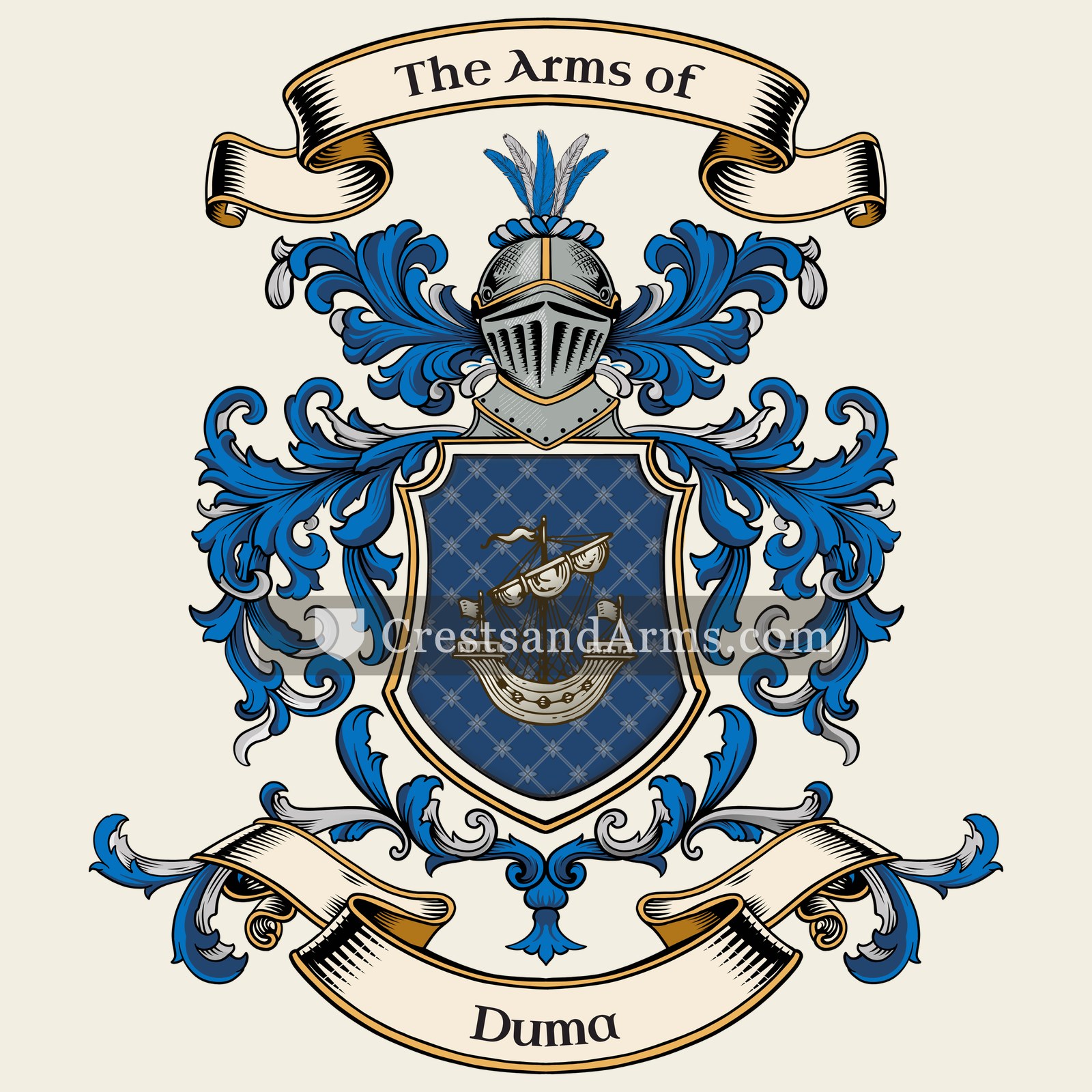


 mountThe ground held, and steadfastness upon it
 chiefAuthority, wisdom and dominion
 treeLife, endurance and deep roots
 crescentHonour by the sovereign, and the second son
 mulletThe third son, and a divine quality from above