Map of France showing where the Dumas arms are recorded
The Dumas arms were recorded in Paris, c. 1663.
This is where the arms were entered in the register. Families often moved to other parts of the country, so the same name can turn up in more than one region.
The body that granted and recorded arms in France in this period.
Louis XIV of France
Sovereign of the period
Louis XIV of France
1643–1715
Reigning in France when the Dumas arms are first recorded.
How Arms Worked in France
In France, a coat of arms was a mark of honor that passed down through the male line to all legitimate descendants. Families often used the same shield without changes to show their shared heritage. If a branch wanted to stand out, they could add a small mark to their shield to show their specific place in the family tree.
Granting authority
The Juge d'armes de France acted as the official authority that regulated and verified coats of arms across the country.
How they got arms
Families typically inherited their arms from ancestors, though they could also receive them through royal grants or by proving their noble status.
Where arms were recorded
Coats of arms were officially recorded in the Armorial Général de France, which began its main collection in the year 1696.
The family's standing
Recorded among the armigerous families of France.
Origin & History of the Dumas Family in France
The family name Dumas is a classic example of a topographic surname, which means it was derived from the natural landscape surrounding a person's home. In French, the name translates to "of the farm" or "from the house," originating from the Old Occitan word "mas," which referred to a rural dwelling or a small agricultural estate. While the name likely began in the southern regions of France where this dialect was common, by 1663, members of the family were firmly established in the bustling urban environment of Paris. This transition from a rural identifier to a city-dwelling surname reflects the broader movement of people toward the capital during the seventeenth century as the French monarchy consolidated power. As the family integrated into Parisian life, the name evolved from a simple description of a country home into a permanent family designation that persisted through generations of social and political change in France.
Coat of Arms & Family Crest Details
Symbols on this shield
mountThe ground held, and steadfastness upon it
chiefAuthority, wisdom and dominion
treeLife, endurance and deep roots
crescentHonour by the sovereign, and the second son
mulletThe third son, and a divine quality from above
Colours
Gold (Or)Means: Generosity
Blue (Azure)Means: Loyalty and truth
Green (Vert)Means: Hope
Silver (Argent)Means: Peace and sincerity
Historical info
Source
J. B. Rietstap, Armorial Général, Gouda: G. B. van Goor Zonen, 1884–87
Blazon (the actual original written record)
“D'or à un arbre terrassé de sin.; au chef d'azur, ch. d'un croiss. d'arg. entre deux étoiles (5) du champ. Brl. d'azur et d'or. C.: un lion iss., au nat., supp. une étoile d'or. L. d'or et d'azur.”
BavariaBavaria, c. 1736
Digital archive packCoat of arms PNG, gold border print PDF, vector SVG and the certificate of authenticity. Sent to your email in minutes.
Map of Germany showing where the Dumas arms are recorded
The Dumas arms were recorded in Bavaria, c. 1736.
Bavaria was a country of old landed families and walled market towns. Estates passed down the same line for centuries, and both the landowners and the leading townsmen kept arms, which is why so many Bavarian names sit in the registers.
This is where the arms were entered in the register. Families often moved to other parts of the country, so the same name can turn up in more than one region.
The body that granted and recorded arms in Germany in this period.
Charles VI, Holy Roman Emperor
Sovereign of the period
Charles VI, Holy Roman Emperor
1711–1740
Reigning in France when the Dumas arms are first recorded.
How Arms Worked in Germany
In the Holy Roman Empire, coats of arms were often granted to individuals by the Emperor or his representatives. These arms were then passed down through the generations to all legitimate descendants of the original holder. Younger branches of a family usually kept the same shield design without needing to change it, as the arms belonged to the entire lineage.
Granting authority
The Holy Roman Emperor held the sole power to grant new coats of arms throughout his vast imperial territories.
How they got arms
Families typically obtained their coats of arms through a formal imperial grant or by proving their noble status to the authorities.
Where arms were recorded
These grants were officially recorded in the Imperial Chancery registers, which began keeping formal records of such honors during the Middle Ages.
The family's standing
Recorded among the armigerous families of Bavaria.
Origin & History of the Dumas Family in Germany
The family name Dumas carries a distinct history that traces back to the southern regions of Germany, specifically within the state of Bavaria. By the year 1736, records confirm that members of the family were already established in this area, living as part of the local community. The name itself is rooted in the French phrase *du mas*, which translates to "of the farmhouse" or "of the smallholding." This suggests that the earliest ancestors were likely farmers or landowners who held a specific plot of land. As families moved across borders during the eighteenth century, the name settled into the Bavarian landscape, blending French linguistic origins with the social structures of southern Germany. Over time, these individuals integrated into the local economy, contributing to the agricultural and social development of their villages while maintaining a name that reflected their connection to the land.
Coat of Arms & Family Crest Details
Symbols on this shield
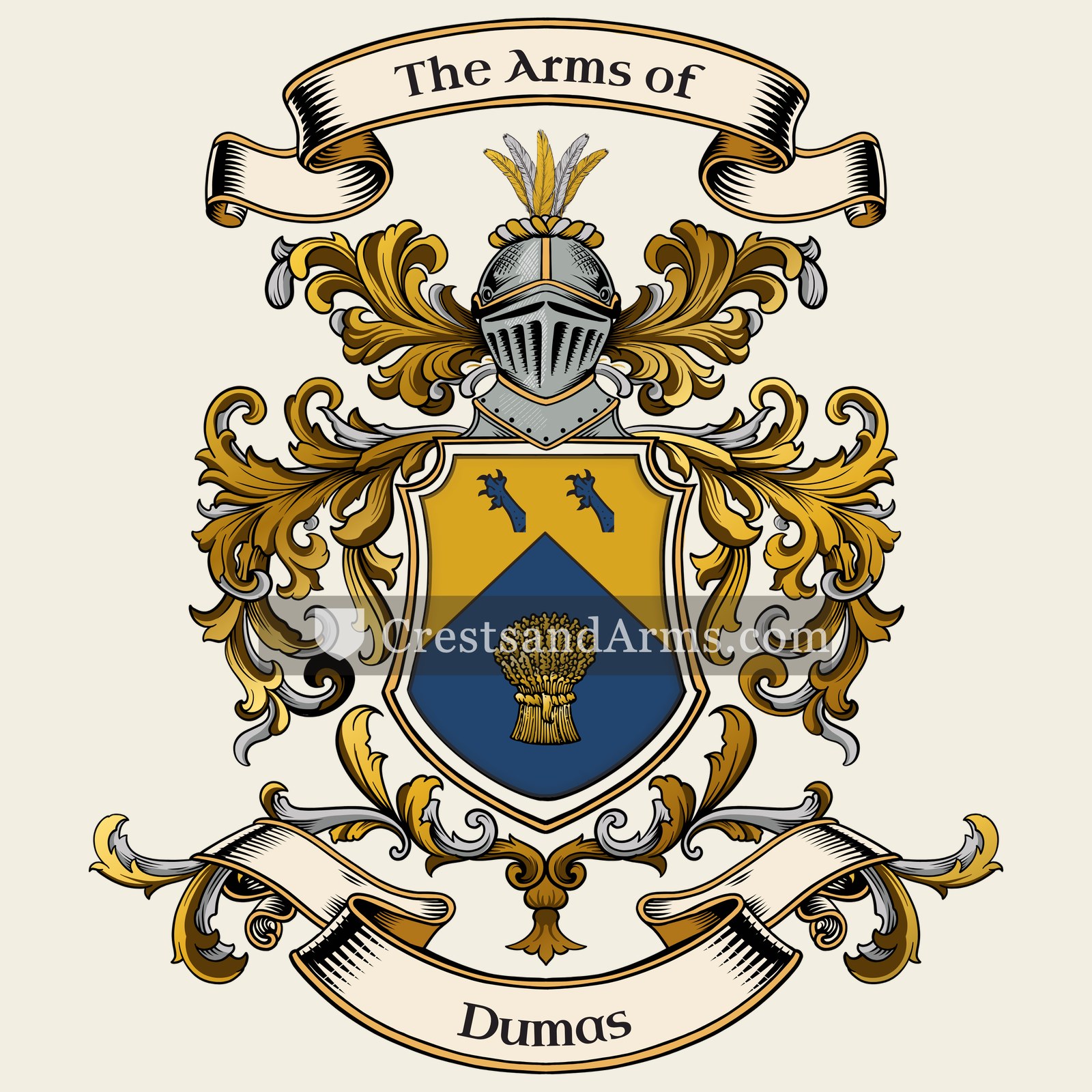
pawStrength held ready, the beast's power in a single limb
wheatsheafPlenty, and the harvest of one's own labour
Colours
Gold (Or)Means: Generosity
Blue (Azure)Means: Loyalty and truth
Historical info
Source
Sir Bernard Burke, The General Armory of England, Scotland, Ireland and Wales, London: Harrison & Sons, 1884
Blazon (the actual original written record)
“Per chev. flory counterflory or and az. in chief two lions' gambs erased and in base a garb counterchanged”
SurreyClapham · Surrey, c. 1620
Digital archive packCoat of arms PNG, gold border print PDF, vector SVG and the certificate of authenticity. Sent to your email in minutes.
Map of England showing where the Dumas arms are recorded
The Dumas arms were recorded in Surrey, c. 1620.
Surrey sat just south of London and filled up with families who had made money in the City. Buying an estate there was the usual next step, and an estate was the usual reason to take arms.
This is where the arms were entered in the register. Families often moved to other parts of the country, so the same name can turn up in more than one region.
The body that granted and recorded arms in England in this period.
James VI and I
Sovereign of the period
James VI and I
1603–1625
Reigning in France when the Dumas arms are first recorded.
How Arms Worked in England
English heraldry allowed arms to be shared by all legitimate descendants of the original owner. These symbols were treated as personal property that moved through the generations to all children. While the eldest son kept the original design, other family members could use the same shield without needing to change it or register their own unique versions.
Granting authority
The College of Arms in London has regulated the use of coats of arms throughout England and Wales since 1484.
How they got arms
Families typically obtained their coats of arms through a formal grant from the Crown or by proving their ancient right to them.
Where arms were recorded
All official coats of arms are recorded in the registers kept at the College of Arms, which date back to the fifteenth century.
The family's standing
Recorded among the armigerous families of Surrey.
Origin & History of the Dumas Family in England
The Dumas family name arrived in England as part of a broader wave of migration that brought French-speaking settlers to the British Isles. By the year 1620, historical records confirm that members of the family had established a presence in the county of Surrey. This region was a common destination for newcomers who sought to integrate into English society while maintaining their cultural identity. The name itself is derived from the French phrase "du mas," which translates to "of the farmhouse" or "of the smallholding." This suggests that the earliest ancestors were likely people who worked the land or managed rural estates. Over the following decades, these families became part of the local fabric in southern England, gradually adapting to the customs and language of their new home while preserving the heritage connected to their original surname.
Dumas Meaning & Related Branches
Root word
dum
A Latin-derived term referring to a hill or an elevation.
This name
DumasA topographic surname for someone who lived near or on a hill.
also spelled
de Mas
du Mass
de Mass
Du Ma
Mas
Related arms
Fauresimilar arms
Bollandrecorded with Dumas, same area
Butterfieldrecorded with Dumas, same area
Crowderrecorded with Dumas, same area
Documented Sources
J. B. Rietstap, Armorial Général, Gouda: G. B. van Goor Zonen, 1884–87
Dauzat, Albert. Les noms de famille de France. 1949
Morlet, Marie-Thérèse. Dictionnaire étymologique des noms de famille. 1991
Archives Nationales de France. Minutier central des notaires de Paris, Series ET/XXIV
Digital archive packCoat of arms PNG, gold border print PDF, vector SVG and the certificate of authenticity. Sent to your email in minutes.


 shipEnterprise, and a great voyage undertaken
 shipEnterprise, and a great voyage undertaken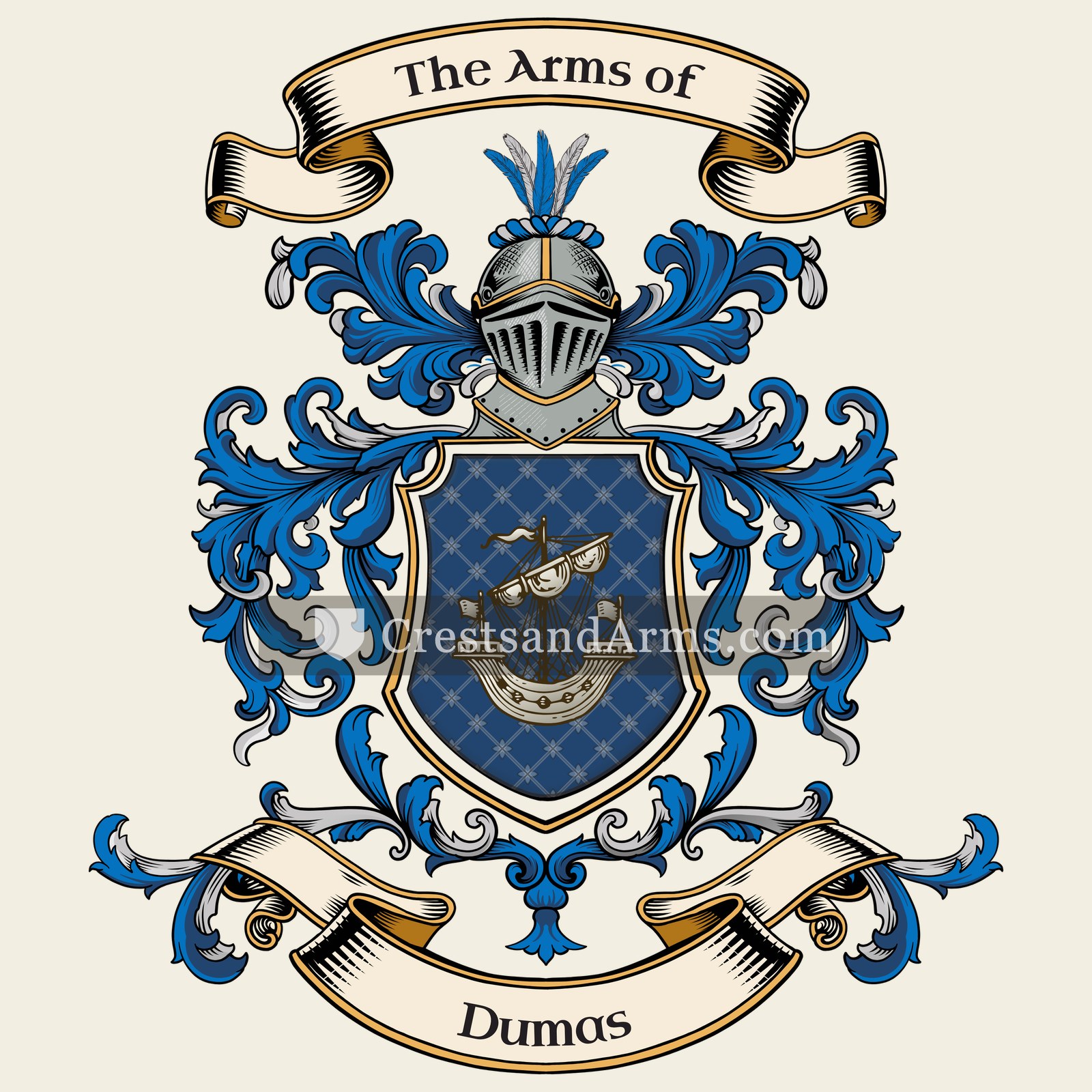


 mountThe ground held, and steadfastness upon it
 chiefAuthority, wisdom and dominion
 treeLife, endurance and deep roots
 crescentHonour by the sovereign, and the second son
 mulletThe third son, and a divine quality from above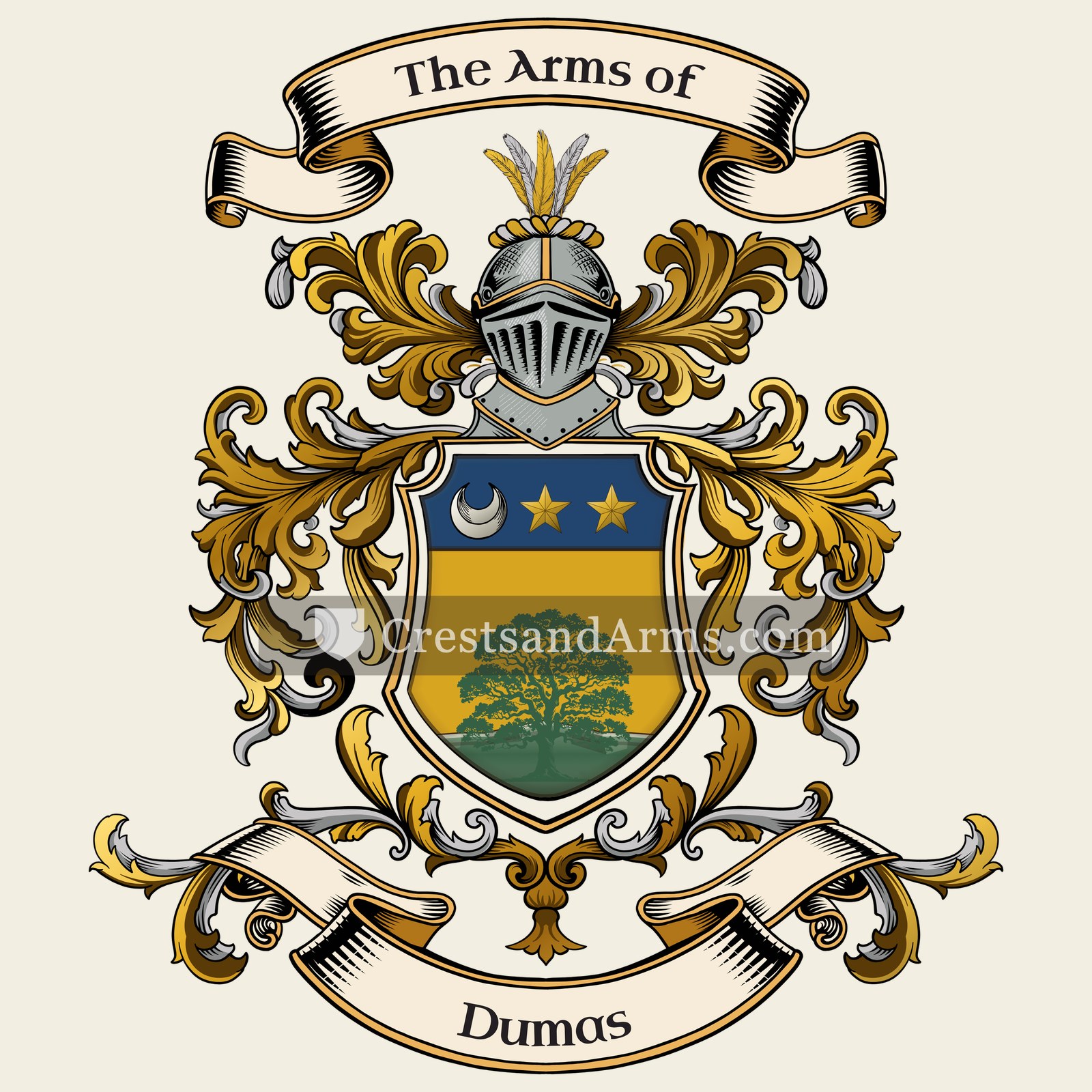


 pawStrength held ready, the beast's power in a single limb
 wheatsheafPlenty, and the harvest of one's own labour