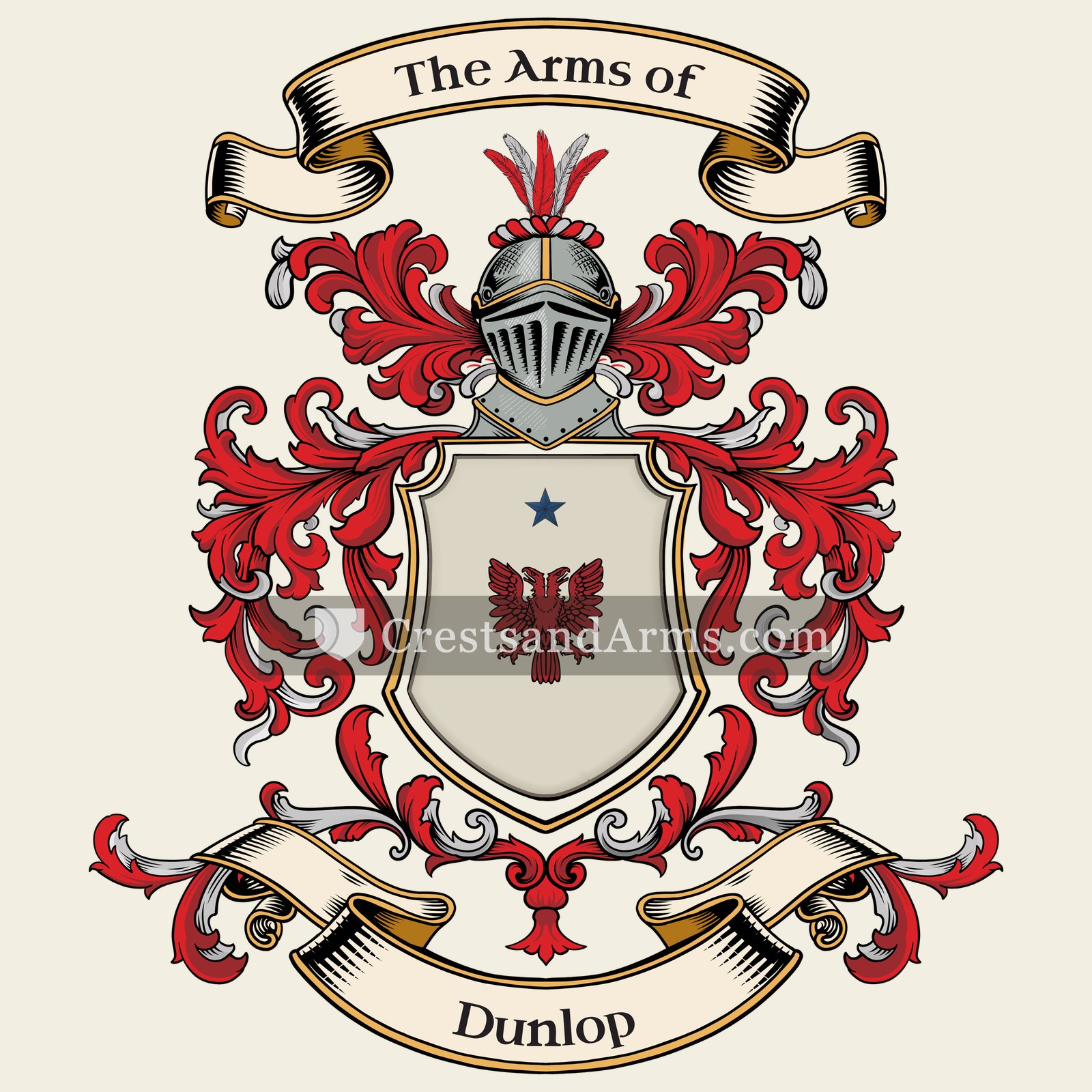
A record of documented arms, meaning and origin, researched for the Dunlop family lines. Documented in 2 countries.
Reg. 8833 · Dutch, D–F
Coat of Arms & Family Crest Details
Colours
Gold (Or)Means: Generosity
Historical info
Source
J. B. Rietstap, Armorial Général, Gouda: G. B. van Goor Zonen, 1884–87
Blazon (the actual original written record)
“d'or. S.: deux lions au nat., cour. à l'antique d'or, coll. chacun d'une couronne de chêne de sin., englantée d'or, portant chacun suspendu au collier un écusson. celui à dextre d'arg. au chef-sautoir de gu., et au canton d'arg. ch. d'un lion de sa. (Bruce), celui à sen. losangé d'arg. et de gu. (Fitzwilliam). D.: ESSAYEZ.”
Netherlandsc. 1815
Digital archive packCoat of arms PNG, gold border print PDF, vector SVG and the certificate of authenticity. Sent to your email in minutes.
Map of Netherlands showing where the Dunlop arms are recorded
The Dunlop arms were recorded in Netherlands, c. 1815.
Arms such as these were typically recorded in Friesland.
Friesland was low, wet country on the northern coast of the Netherlands, farmed by families who had held the same land for centuries. Free landholders were unusually common there, and a free landholder could carry arms.
This is where the arms were entered in the register. Families often moved to other parts of the country, so the same name can turn up in more than one region.
Region
Friesland
First recorded
1815
Granting Authority for the Dunlop Arms
Hoge Raad van Adel
Photograph made by me · CC BY-SA 3.0
The body that granted and recorded arms in Netherlands in this period.
William I of the Netherlands
Sovereign of the period
William I of the Netherlands
1815–1840
Reigning in Netherlands when the Dunlop arms are first recorded.
How Arms Worked in Netherlands
In the Netherlands, coats of arms were often used by noble families and those who held specific public offices. These arms were passed down through the generations to legitimate descendants. Younger branches of a family usually kept the original design without needing to add special marks. This system ensured that the family identity remained clear and consistent over many years.
Granting authority
The Hoge Raad van Adel is the official body that regulates and manages noble titles and coats of arms in the Netherlands.
How they got arms
Families typically obtained their coats of arms through official royal grants or by proving their long-standing historical use of the symbols.
Where arms were recorded
Coats of arms are officially recorded in the registers held by the Hoge Raad van Adel, which began its work in 1814.
The family's standing
Recorded among the armigerous families of Netherlands.
Origin & History of the Dunlop Family in Netherlands
The history of the Dunlop name in the Netherlands begins with the arrival of family members in the province of Friesland around 1815. While the surname is traditionally linked to Scottish origins, its appearance in Dutch records during the early nineteenth century suggests a period of migration often tied to the shifting political landscape of post-Napoleonic Europe. During this era, many individuals moved across borders for military service or trade, leading to the establishment of new family branches in northern regions like Friesland. These early Dutch Dunlops integrated into local society by adopting regional naming customs and participating in the administrative life of their new communities. By settling in this coastal province, the family became part of the local demographic fabric, transitioning from their ancestral roots to a new life within the Dutch state.
Coat of Arms & Family Crest Details
Symbols on this shield
eagleNobility, strength and a keen mind
mulletThe third son, and a divine quality from above
Colours
Silver (Argent)Means: Peace and sincerity
Red (Gules)Means: Military strength
Blue (Azure)Means: Loyalty and truth
Historical info
Source
Sir Bernard Burke, The General Armory of England, Scotland, Ireland and Wales, London: Harrison & Sons, 1884
Blazon (the actual original written record)
“Ar. a two-headed eagle displ. gu. in dexter chief point a mullet az. for diff”
AyrGarnkirk · Ayr, c. 1672
Digital archive packCoat of arms PNG, gold border print PDF, vector SVG and the certificate of authenticity. Sent to your email in minutes.
Map of Scotland showing where the Dunlop arms are recorded
The Dunlop arms were recorded in Ayr, c. 1672.
Ayrshire was farming country along Scotland's south-west coast, held in a great many small estates. Its lairds were numerous rather than rich, and each holding brought its own claim to arms.
This is where the arms were entered in the register. Families often moved to other parts of the country, so the same name can turn up in more than one region.
The body that granted and recorded arms in Scotland in this period.
Charles II of England
Sovereign of the period
Charles II of England
1660–1685
Reigning in Netherlands when the Dunlop arms are first recorded.
How Arms Worked in Scotland
Scottish heraldry is unique because it treats a coat of arms as a piece of personal property protected by law. Only one person can own a specific design at any given time. When a family grows, the head keeps the original shield while other relatives must apply for their own distinct version with slight changes to prove their specific identity.
Granting authority
The Court of the Lord Lyon acts as the official body that regulates and controls all heraldic matters throughout Scotland.
How they got arms
Individuals obtain a legal right to their arms through a formal petition process that confirms their identity and family connection.
Where arms were recorded
All valid coats of arms are officially entered into the Public Register of All Arms and Bearings starting from 1672.
The family's standing
Recorded among the armigerous families of Ayr.
Origin & History of the Dunlop Family in Scotland
The name Dunlop originates from the district of Cunningham in Ayrshire, Scotland, where it is derived from the Gaelic words for a fort and a hill. By the medieval period, the family had established a strong presence in this region, with the name being linked to the lands of Dunlop as early as the thirteenth century. The family grew in influence over the next several hundred years, becoming deeply rooted in the local landscape and community life. By 1672, records confirm that members of the family were well-settled in the town of Ayr, reflecting their long-standing connection to the county. This history illustrates how the family name evolved from a simple description of a local landmark into a recognized identity for those living in the southwest of Scotland.
Dunlop Meaning & Related Branches
Root word
Dun-Lop
Gaelic for fort or hill and a bend or slope.
This name
DunlopRefers to a settlement located on a hill near a winding river bend.
also spelled
Dunlopp
Dunlope
Dunloppe
Related arms
Masonrecorded with Dunlop, same area
Youngrecorded with Dunlop, same area
Documented Sources
J. B. Rietstap, Armorial Général, Gouda: G. B. van Goor Zonen, 1884–87
AlleFriezen, Burgerlijke Stand Geboorte, Huwelijk en Overlijden (1811–1950)
Nationaal Archief, Ministerie van Binnenlandse Zaken: Bevolkingsregisters en vestigingsregisters (1813–1850)
Tresoar, Frysk Histoarysk en Letterkundich Sintrum, Archief van de Burgerlijke Stand van Friesland
Digital archive packCoat of arms PNG, gold border print PDF, vector SVG and the certificate of authenticity. Sent to your email in minutes.




 eagleNobility, strength and a keen mind
 mulletThe third son, and a divine quality from above