Map of France showing where the Dupon arms are recorded
The Dupon arms were recorded in Lorraine, c. 1590.
Lorraine sat on the border between France and the German lands, and border country bred soldiers. Families here held small estates and served in arms, and a fighting man was exactly the sort who carried a shield of his own.
This is where the arms were entered in the register. Families often moved to other parts of the country, so the same name can turn up in more than one region.
The body that granted and recorded arms in France in this period.
Henry IV of France
Sovereign of the period
Henry IV of France
1589–1610
Reigning in France when the Dupon arms are first recorded.
How Arms Worked in France
In France, a coat of arms was a mark of honor that passed down through the male line to all legitimate descendants. Families often used the same shield without changes to show their shared heritage. If a branch wanted to stand out, they could add a small mark to their shield to show their specific place in the family tree.
Granting authority
The Juge d'armes de France acted as the official authority that regulated and verified coats of arms across the country.
How they got arms
Families typically inherited their arms from ancestors, though they could also receive them through royal grants or by proving their noble status.
Where arms were recorded
Coats of arms were officially recorded in the Armorial Général de France, which began its main collection in the year 1696.
The family's standing
Recorded among the armigerous families of Lorraine.
Origin & History of the Dupon Family in France
The surname Dupon is a classic example of a topographic name, which means it was originally used to identify people based on where they lived. In the French language, the prefix "du" means "of the," and "pont" refers to a bridge. Therefore, the name was likely given to families who resided near a prominent bridge or worked as bridge keepers in their local community. By the year 1590, records confirm that members of the Dupon family were well-established in the Lorraine region of northeastern France. During this period, Lorraine was a crossroads of European culture and politics, and families living there often navigated the complex shifts between the influence of the Holy Roman Empire and the French monarchy. As these early ancestors moved through their daily lives in the sixteenth century, their name served as a simple but effective way to mark their connection to the landscape and the infrastructure of their home province.
Coat of Arms & Family Crest Details
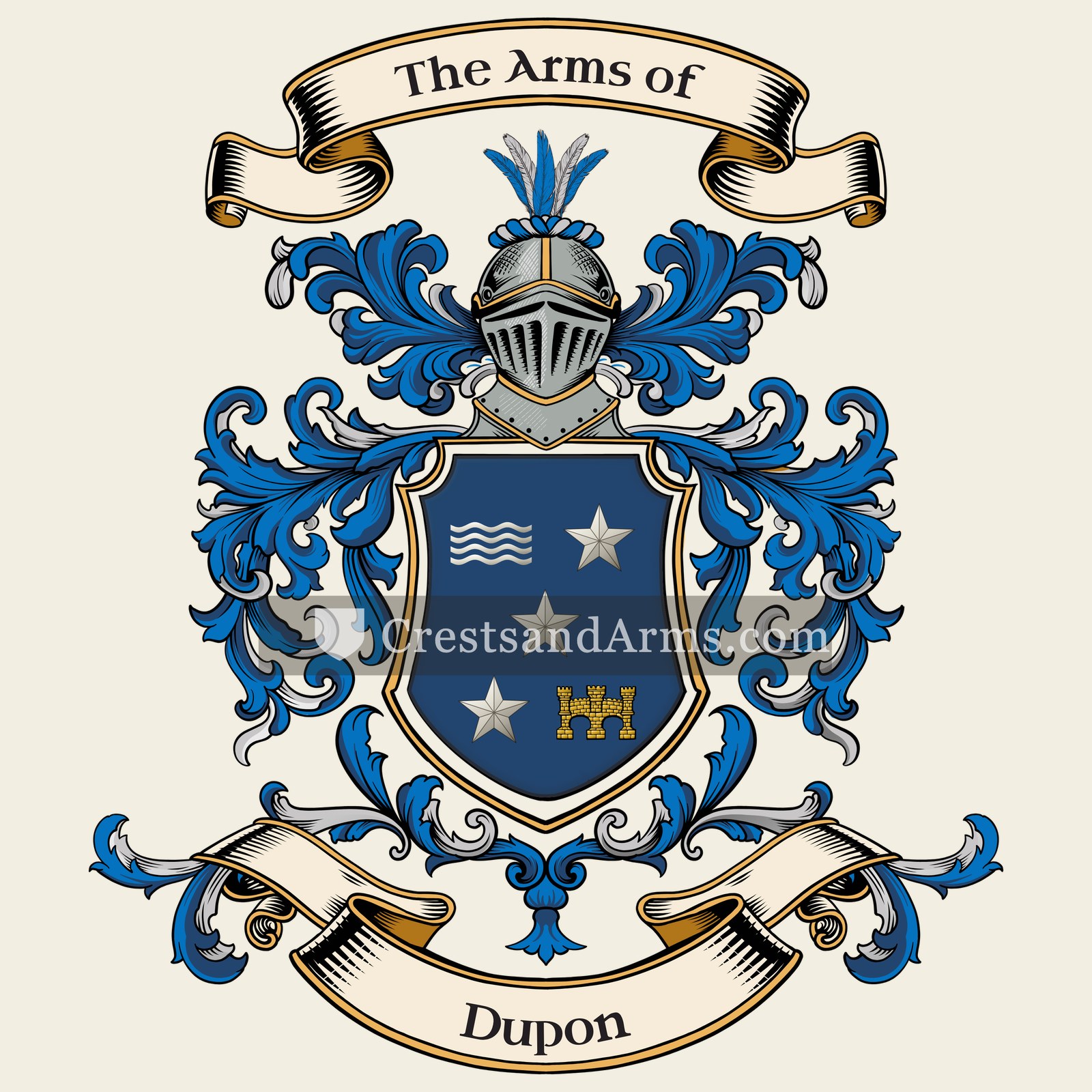
Symbols on this shield
mountThe ground held, and steadfastness upon it
knightChivalry and service in arms
horseReadiness to serve king and country
roundelA coin, and one who has been to the crusades
starThe celestial goddess, and nobility
Colours
Silver (Argent)Means: Peace and sincerity
Green (Vert)Means: Hope
Blue (Azure)Means: Loyalty and truth
Red (Gules)Means: Military strength
Gold (Or)Means: Generosity
Historical info
Source
J. B. Rietstap, Armorial Général, Gouda: G. B. van Goor Zonen, 1884–87
Blazon (the actual original written record)
“Coupé: au 1 parti: a. d'arg. à un monde d'azur, cintré et croisé d'or; b. d'azur à une étoile (8) d'or; au 2 d'arg. à un homme monté sur un cheval d'azur, suivi d'un autre cheval de gu. et d'un troisième cheval bai, le tout soutenu d'une terrasse de sin. Brl. d'azur et d'arg. C.: le monde du 1 a.”
Belgiumc. 1737
Digital archive packCoat of arms PNG, gold border print PDF, vector SVG and the certificate of authenticity. Sent to your email in minutes.
Map of Belgium showing where the Dupon arms are recorded
The Dupon arms were recorded in Belgium, c. 1737.
Arms such as these were typically recorded in Brabant.
Brabant lay at the heart of the Low Countries, where the trade routes met. Its towns were wealthy and its landowners many, and both kinds of family kept arms, which is why the region is so heavily represented.
This is where the arms were entered in the register. Families often moved to other parts of the country, so the same name can turn up in more than one region.
The body that granted and recorded arms in Belgium in this period.
Charles VI, Holy Roman Emperor
Sovereign of the period
Charles VI, Holy Roman Emperor
1711–1740
Reigning in France when the Dupon arms are first recorded.
How Arms Worked in Belgium
In Belgium, a coat of arms is considered personal property that is passed down through the male line to legitimate descendants. Families often use the same shield design across generations to show their shared heritage. If a branch of the family wants to change the design, they must apply for an official update to their specific version of the arms.
Granting authority
The Conseil héraldique is the official body that regulates and approves all coats of arms in Belgium.
How they got arms
Families obtain their coats of arms through formal royal grants or by confirming their historical right to use existing designs.
Where arms were recorded
All approved coats of arms are officially recorded in the public registers of the Conseil héraldique since 1844.
The family's standing
Recorded among the armigerous families of Belgium.
Origin & History of the Dupon Family in Belgium
The family name Dupon is a classic example of a topographic surname, which was historically used to identify people based on their proximity to a specific landmark. In the context of the Low Countries, the name is derived from the French phrase "du pont," meaning "of the bridge." During the eighteenth century, the family established a notable presence in the Duchy of Brabant, a region that served as a vital crossroads for trade and culture in what is now Belgium. By 1737, records indicate that members of the family were already settled within this territory, likely living near a significant bridge or a river crossing that defined their local community. As the region transitioned through various political shifts under Austrian and later French rule, the family name remained tied to these geographic markers. This naming tradition reflects a time when surnames were still evolving, turning simple descriptions of a person's home into a permanent family identity that persisted across generations in the Brabant countryside.
Coat of Arms & Family Crest Details
Symbols on this shield
riverThe bounds of a land, and life carried through it
mulletThe third son, and a divine quality from above
bridgeOne who joins what was divided
Colours
Blue (Azure)Means: Loyalty and truth
Silver (Argent)Means: Peace and sincerity
Gold (Or)Means: Generosity
Historical info
Source
J. B. Rietstap, Armorial Général, Gouda: G. B. van Goor Zonen, 1884–87
Blazon (the actual original written record)
“D'azur à un pont de quatre arches d'or, jeté sur une rivière d'arg., sommé d'un croiss. d'arg. et surm. de trois étoiles (5) mal-ordonnées du même.”
GenevoisGenevois, c. 1745
Digital archive packCoat of arms PNG, gold border print PDF, vector SVG and the certificate of authenticity. Sent to your email in minutes.
Map of Switzerland showing where the Dupon arms are recorded
The Dupon arms were recorded in Genevois, c. 1745.
Genevois was Alpine country south of Geneva, held in small estates by families who stayed put. Land there passed down the same line for centuries, and long tenure counted for more than wealth.
This is where the arms were entered in the register. Families often moved to other parts of the country, so the same name can turn up in more than one region.
The body that granted and recorded arms in Switzerland in this period.
How Arms Worked in Switzerland
In Switzerland, coats of arms were not restricted to the nobility and were often adopted by common citizens and families. These symbols were passed down through generations to show family identity. When branches of a family grew, they often changed small details of the design to distinguish their own line from the original group.
Granting authority
Cantonal and civic authorities managed the use of coats of arms within their specific regions and local jurisdictions.
How they got arms
Families typically assumed their own coats of arms based on local custom rather than receiving them from a central monarch.
Where arms were recorded
Arms were recorded in various cantonal and civic registers starting from the fourteenth century throughout the Swiss region.
The family's standing
Recorded among the armigerous families of Genevois.
Origin & History of the Dupon Family in Switzerland
The family name Dupon, which translates literally to "of the bridge," likely originated as a topographical surname for people living near a prominent crossing point. By 1745, records confirm that members of the family were well-established in the Genevois region, a territory that historically served as a vital crossroads between the Swiss Confederation and the Duchy of Savoy. During this period, the family was deeply integrated into the local social fabric, often participating in the agricultural and artisanal life that defined the rural landscape surrounding Lake Geneva. Because the region was a hub for trade and migration, the Dupon family likely benefited from the constant movement of merchants and travelers passing through these mountain gateways. Their presence in the Genevois during the mid-eighteenth century suggests they were part of a stable, land-holding population that navigated the complex political shifts between Swiss influence and neighboring powers.
Dupon Meaning & Related Branches
Root word
pont
A structure built to span a physical obstacle like a river.
This name
DuponRefers to someone who lived near or worked at a bridge.
also spelled
Dupon
Documented Sources
J. B. Rietstap, Armorial Général, Gouda: G. B. van Goor Zonen, 1884–87
Dauzat, Albert. Dictionnaire étymologique des noms de famille et prénoms de France. 1951
Morlet, Marie-Thérèse. Dictionnaire étymologique des noms de famille. 1991
Digital archive packCoat of arms PNG, gold border print PDF, vector SVG and the certificate of authenticity. Sent to your email in minutes.


 swanGrace, light and the poet's art
 swanGrace, light and the poet's art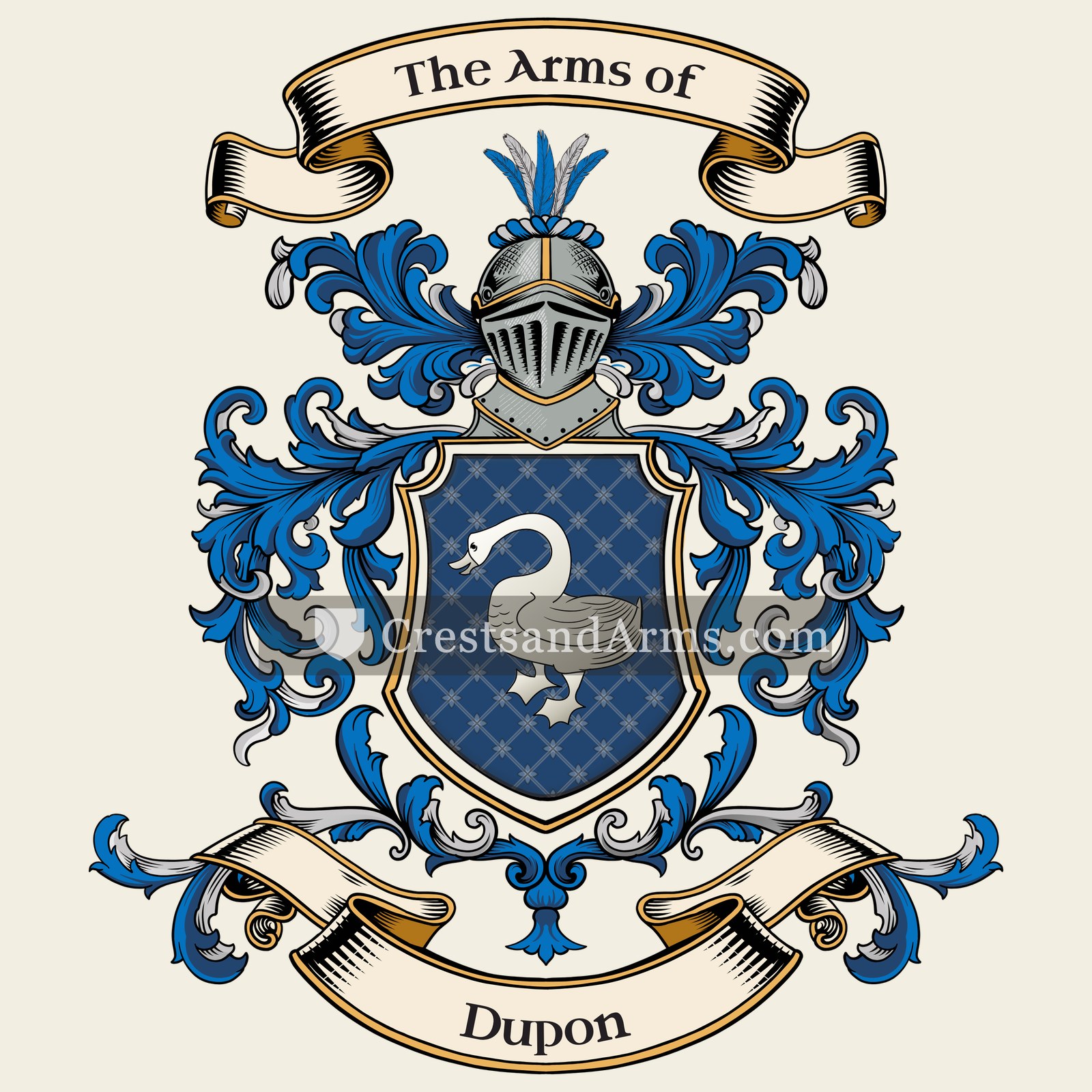


 mountThe ground held, and steadfastness upon it
 knightChivalry and service in arms
 horseReadiness to serve king and country
 roundelA coin, and one who has been to the crusades
 starThe celestial goddess, and nobility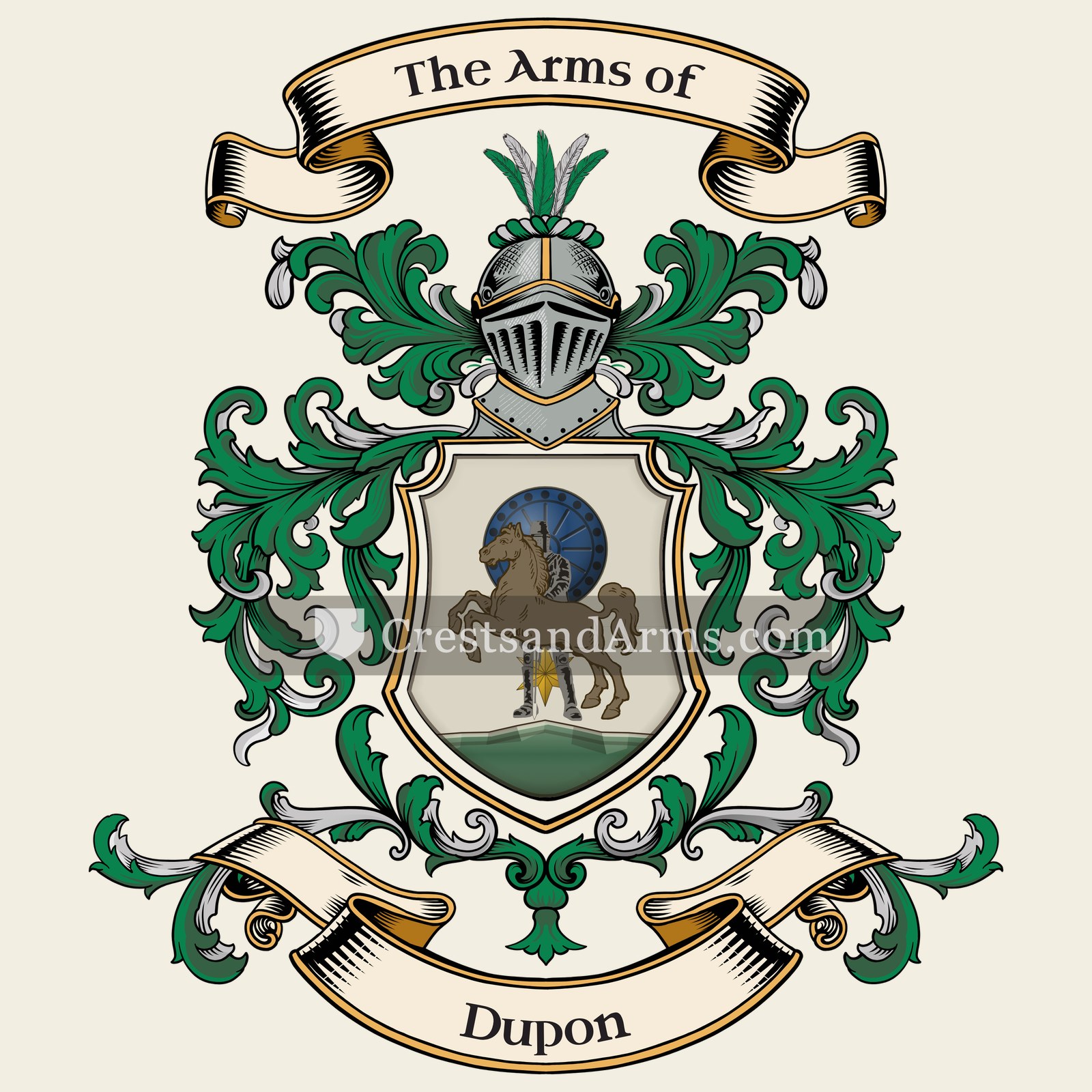


 riverThe bounds of a land, and life carried through it
 mulletThe third son, and a divine quality from above
 bridgeOne who joins what was divided