Map of France showing where the Dupré arms are recorded
The Dupré arms were recorded in Lyonnais, c. 1663.
Lyonnais centred on Lyon, one of the great banking and silk towns of France. Money made in the city bought estates in the countryside around it, and those estates brought arms with them.
This is where the arms were entered in the register. Families often moved to other parts of the country, so the same name can turn up in more than one region.
The body that granted and recorded arms in France in this period.
Louis XIV of France
Sovereign of the period
Louis XIV of France
1643–1715
Reigning in France when the Dupré arms are first recorded.
How Arms Worked in France
In France, a coat of arms was a mark of honor that passed down through the male line to all legitimate descendants. Families often used the same shield without changes to show their shared heritage. If a branch wanted to stand out, they could add a small mark to their shield to show their specific place in the family tree.
Granting authority
The Juge d'armes de France acted as the official authority that regulated and verified coats of arms across the country.
How they got arms
Families typically inherited their arms from ancestors, though they could also receive them through royal grants or by proving their noble status.
Where arms were recorded
Coats of arms were officially recorded in the Armorial Général de France, which began its main collection in the year 1696.
The family's standing
Recorded among the armigerous families of Lyonnais.
Origin & History of the Dupré Family in France
The surname Dupré is a classic example of a topographic name, which means it was originally used to identify people based on the landscape where they lived. In French, the name translates to "of the meadow," suggesting that the earliest ancestors bearing this title likely resided near a prominent pasture or a grassy field. By the year 1663, records confirm that members of the Dupré family were well-established in the Lyonnais region of east-central France. During this period, the Lyonnais was a vital hub for trade and silk production, placing the family at the heart of a bustling economic center. Families in this area often adopted names that reflected their connection to the local geography, helping neighbors distinguish between different households in growing rural and urban communities. Over time, the name became a permanent fixture of the region, marking the family as part of the long-standing social fabric of the French countryside.
Coat of Arms & Family Crest Details
Symbols on this shield
roundelA coin, and one who has been to the crusades
Colours
Blue (Azure)Means: Loyalty and truth
Gold (Or)Means: Generosity
Historical info
Source
J. B. Rietstap, Armorial Général, Gouda: G. B. van Goor Zonen, 1884–87
Blazon (the actual original written record)
“D'azur à un soc de charrue d'arg., la pointe en bas, acc. en chef de trois bes. mal-ordonnés d'or.”
Switzerlandc. 1745
Digital archive packCoat of arms PNG, gold border print PDF, vector SVG and the certificate of authenticity. Sent to your email in minutes.
Map of Switzerland showing where the Dupré arms are recorded
The Dupré arms were recorded in Switzerland, c. 1745.
Arms such as these were typically recorded in Bern.
Bern was the largest of the Swiss cantons and ran itself, with its own council and its own courts. Its governing families held office for generations, and office of that kind carried a shield with it.
This is where the arms were entered in the register. Families often moved to other parts of the country, so the same name can turn up in more than one region.
The body that granted and recorded arms in Switzerland in this period.
How Arms Worked in Switzerland
In Switzerland, coats of arms were not restricted to the nobility and were often adopted by common citizens and families. These symbols were passed down through generations to show family identity. When branches of a family grew, they often changed small details of the design to distinguish their own line from the original group.
Granting authority
Cantonal and civic authorities managed the use of coats of arms within their specific regions and local jurisdictions.
How they got arms
Families typically assumed their own coats of arms based on local custom rather than receiving them from a central monarch.
Where arms were recorded
Arms were recorded in various cantonal and civic registers starting from the fourteenth century throughout the Swiss region.
The family's standing
Recorded among the armigerous families of Switzerland.
Origin & History of the Dupré Family in Switzerland
The surname Dupré is a topographical name of French origin, meaning "from the meadow." While the name is deeply rooted in French-speaking regions, its presence in the city of Bern by 1745 highlights the movement of families across linguistic and regional borders in early modern Europe. During this period, Bern served as a central hub for trade and administration, attracting skilled workers and families from surrounding areas. The Dupré family likely integrated into the local society by adapting to the German-speaking culture of the city while maintaining their distinct heritage. Records from the mid-eighteenth century suggest that these early members were part of a growing urban population that contributed to the social and economic fabric of the Swiss Confederation. Their transition into Bernese life reflects the broader historical trend of families seeking new opportunities in stable, prosperous cities during the eighteenth century.
Coat of Arms & Family Crest Details
Symbols on this shield
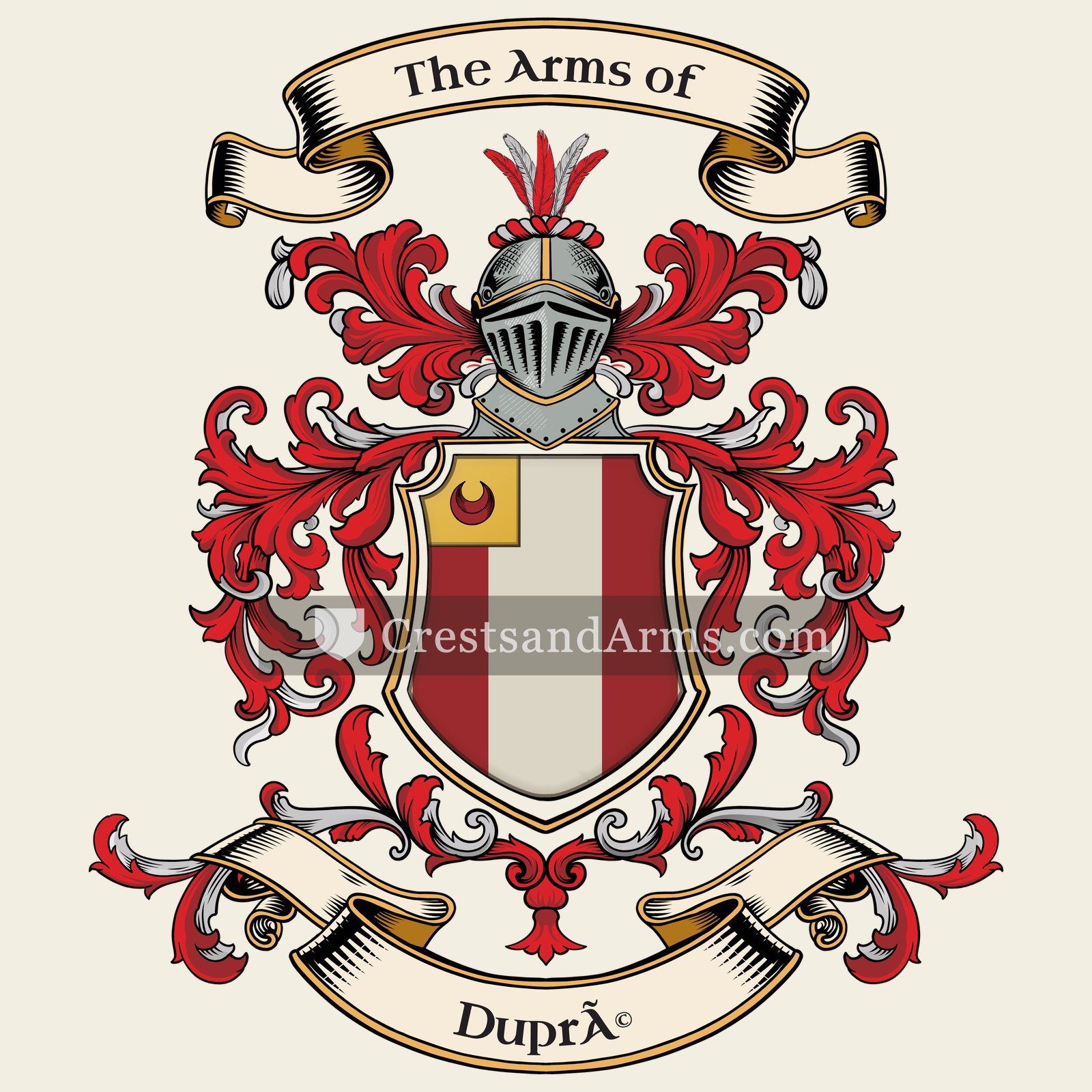
paleMilitary strength, and a fortified defence
crescentHonour by the sovereign, and the second son
Colours
Silver (Argent)Means: Peace and sincerity
Red (Gules)Means: Military strength
Gold (Or)Means: Generosity
Historical info
Source
Sir Bernard Burke, The General Armory of England, Scotland, Ireland and Wales, London: Harrison & Sons, 1884
Blazon (the actual original written record)
“Ar. two palets gu. a quarter or, charged with a crescent of the second”
Englandc. 1620
Digital archive packCoat of arms PNG, gold border print PDF, vector SVG and the certificate of authenticity. Sent to your email in minutes.
Map of England showing where the Dupré arms are recorded
The Dupré arms were recorded in England, c. 1620.
Arms such as these were typically recorded in York.
Yorkshire is the largest of the English counties, and it held more gentry families than any other. Land there was split among a great many households rather than a few, so a great many of them carried arms.
This is where the arms were entered in the register. Families often moved to other parts of the country, so the same name can turn up in more than one region.
The body that granted and recorded arms in England in this period.
James VI and I
Sovereign of the period
James VI and I
1603–1625
Reigning in France when the Dupré arms are first recorded.
How Arms Worked in England
English heraldry allowed arms to be shared by all legitimate descendants of the original owner. These symbols were treated as personal property that moved through the generations to all children. While the eldest son kept the original design, other family members could use the same shield without needing to change it or register their own unique versions.
Granting authority
The College of Arms in London has regulated the use of coats of arms throughout England and Wales since 1484.
How they got arms
Families typically obtained their coats of arms through a formal grant from the Crown or by proving their ancient right to them.
Where arms were recorded
All official coats of arms are recorded in the registers kept at the College of Arms, which date back to the fifteenth century.
The family's standing
Recorded among the armigerous families of England.
Origin & History of the Dupré Family in England
The name Dupré originates from France and translates to "of the meadow," describing someone who lived near a grassy field or pasture. While the name is deeply rooted in French history, members of the family established a presence in England by the early 17th century. Records confirm that individuals bearing this name were living in the city of York by 1620. During this period, York was a bustling northern hub, and families like the Duprés often moved across the English Channel for trade, religious freedom, or new professional opportunities. Once in England, the name gradually adapted to the local language and customs while maintaining its connection to the family's agricultural origins. By settling in a historic city like York, these early ancestors became part of the diverse social fabric that defined England during the Stuart era.
Dupré Meaning & Related Branches
Root word
pratum
A Latin term referring to a meadow or field.
This name
DupréDerived from the French phrase meaning of the meadow, denoting someone who lived near a pasture.
also spelled
Dupray
Dupree
Related arms
Pré (du) - Artvariant spelling
Pré (du) - Dauphinévariant spelling
Pré (du) de Prévariant spelling
Pré (du) de St.-Maurvariant spelling
Documented Sources
J. B. Rietstap, Armorial Général, Gouda: G. B. van Goor Zonen, 1884–87
Dauzat, Albert. Dictionnaire étymologique des noms de famille et prénoms de France. 1951
Archives départementales du Rhône, Registres paroissiaux et d'état civil du Lyonnais
Digital archive packCoat of arms PNG, gold border print PDF, vector SVG and the certificate of authenticity. Sent to your email in minutes.


 bendDefence, and the scarf of a commander
 hunting horn stringedOne who delights in the chase
 bendDefence, and the scarf of a commander
 hunting horn stringedOne who delights in the chase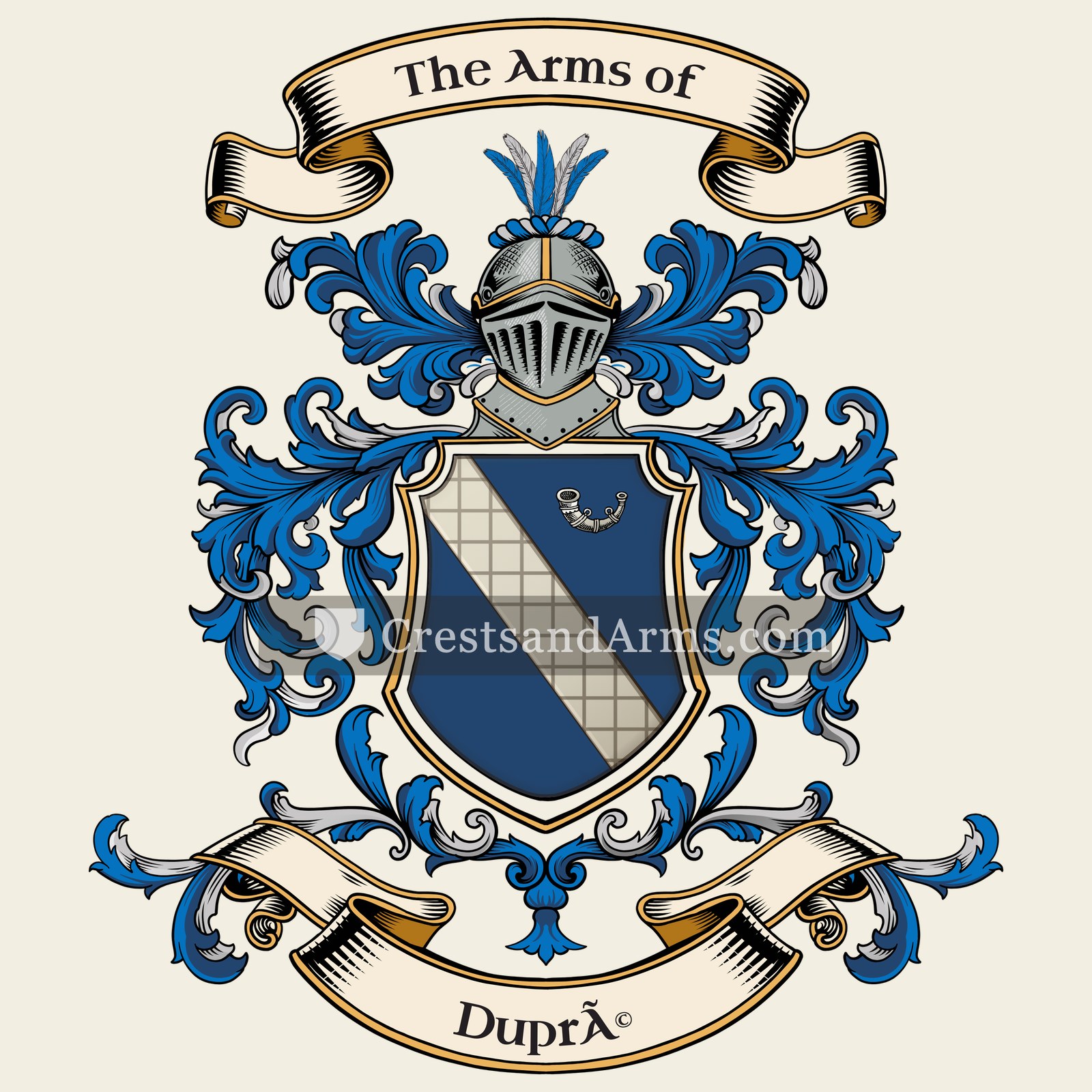


 roundelA coin, and one who has been to the crusades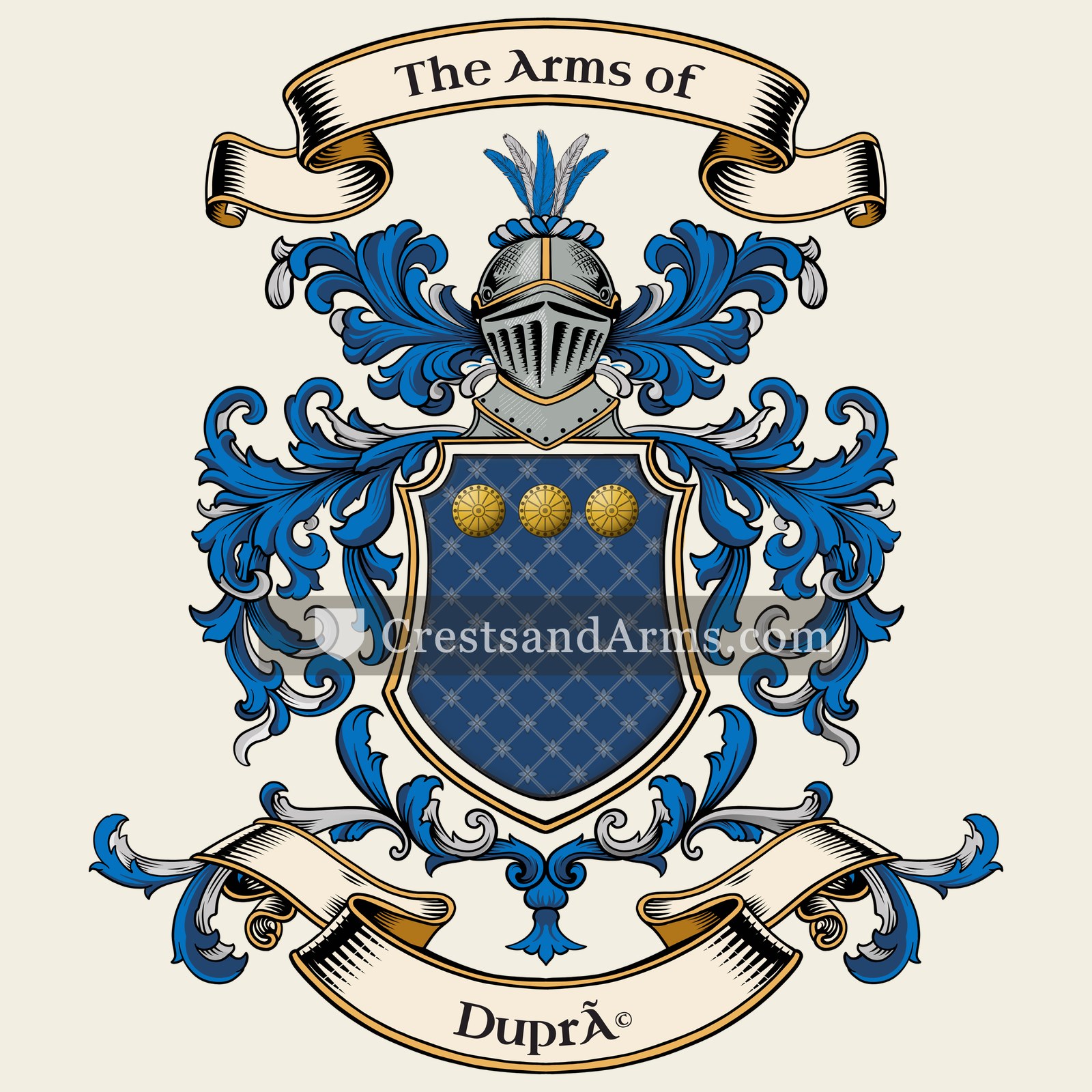

 paleMilitary strength, and a fortified defence
 crescentHonour by the sovereign, and the second son