A record of documented arms, meaning and origin, researched for the Dupuis family lines. Documented in 3 countries.
Reg. 9648 · French, D–F
Coat of Arms & Family Crest Details
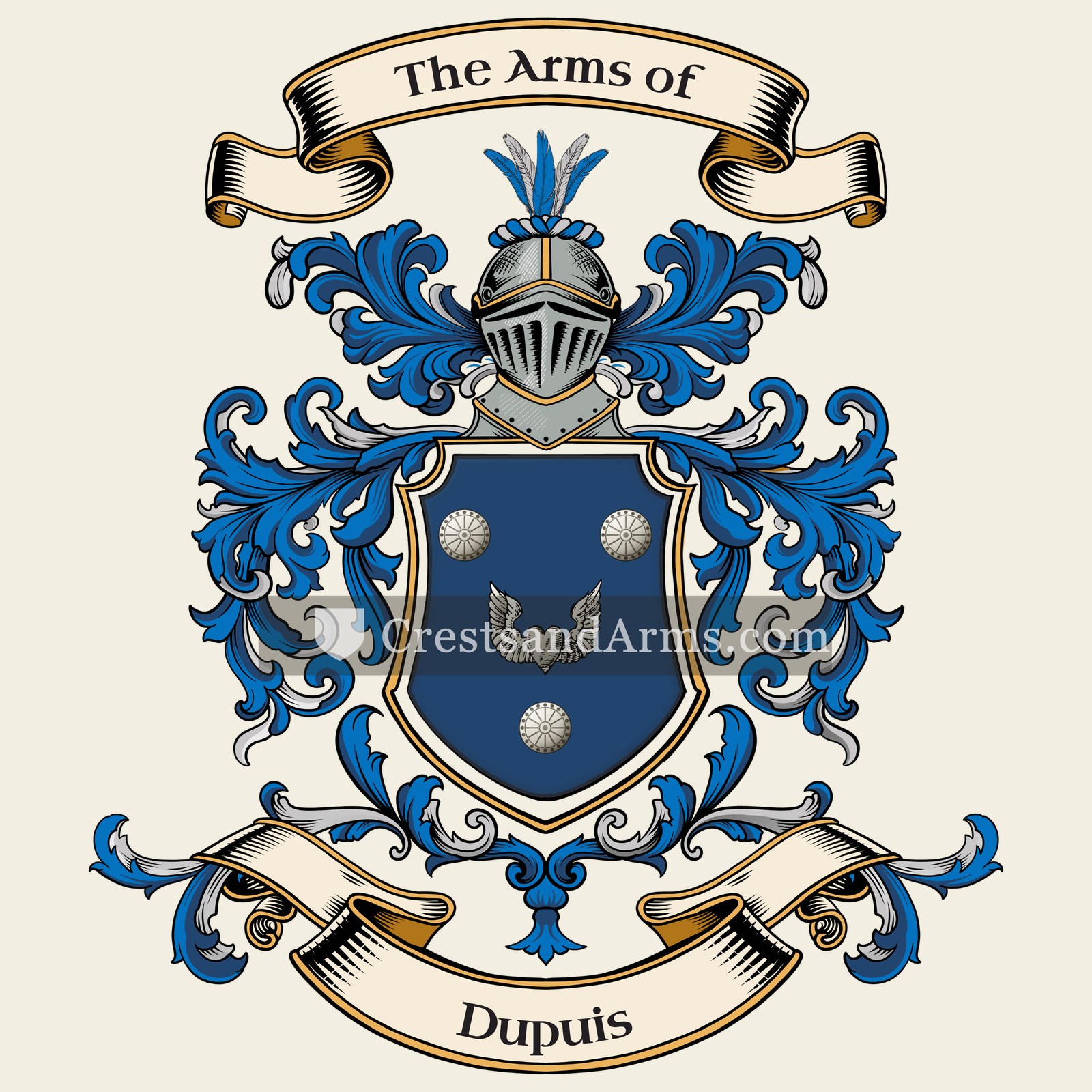
Symbols on this shield
heartSincerity, charity and true affection
roundelA coin, and one who has been to the crusades
Colours
Blue (Azure)Means: Loyalty and truth
Silver (Argent)Means: Peace and sincerity
Historical info
Source
J. B. Rietstap, Armorial Général, Gouda: G. B. van Goor Zonen, 1884–87
Blazon (the actual original written record)
“D'azur à un coeur d'arg., cour. d'or, acc. de trois bes. d'arg., rangés en p.”
ForezForez, c. 1663
Where the Dupuis Arms Were Recorded
Forez
Map of France showing where the Dupuis arms are recorded
The Dupuis arms were recorded in Forez, c. 1663.
Forez was a small upland county in central France, thick with minor gentry holding modest estates. Its families were more numerous than wealthy, and even a small holding was enough for a shield of one's own.
This is where the arms were entered in the register. Families often moved to other parts of the country, so the same name can turn up in more than one region.
The body that granted and recorded arms in France in this period.
Louis XIV of France
Sovereign of the period
Louis XIV of France
1643–1715
Reigning in France when the Dupuis arms are first recorded.
How Arms Worked in France
In France, a coat of arms was a mark of honor that passed down through the male line to all legitimate descendants. Families often used the same shield without changes to show their shared heritage. If a branch wanted to stand out, they could add a small mark to their shield to show their specific place in the family tree.
Granting authority
The Juge d'armes de France acted as the official authority that regulated and verified coats of arms across the country.
How they got arms
Families typically inherited their arms from ancestors, though they could also receive them through royal grants or by proving their noble status.
Where arms were recorded
Coats of arms were officially recorded in the Armorial Général de France, which began its main collection in the year 1696.
The family's standing
Recorded among the armigerous families of Forez.
Origin & History of the Dupuis Family in France
The surname Dupuis is a classic example of a topographic name, which means it was originally used to identify people based on where they lived. In French, the name translates literally to "of the well" or "from the well," suggesting that the earliest ancestors bearing this name likely resided near a prominent village well or a deep water source. By the mid-seventeenth century, records confirm that the family had established a strong presence in the Forez region of central France. During this era, life in Forez was deeply tied to the land, and families often adopted names that reflected the geography of their specific farmsteads or hamlets. Because wells were essential gathering points for rural communities, the name became a practical way to distinguish one family from another in a growing population. As these individuals moved through the local parishes and kept records of their births and marriages, the name became a permanent marker of their history in the French countryside.
Coat of Arms & Family Crest Details
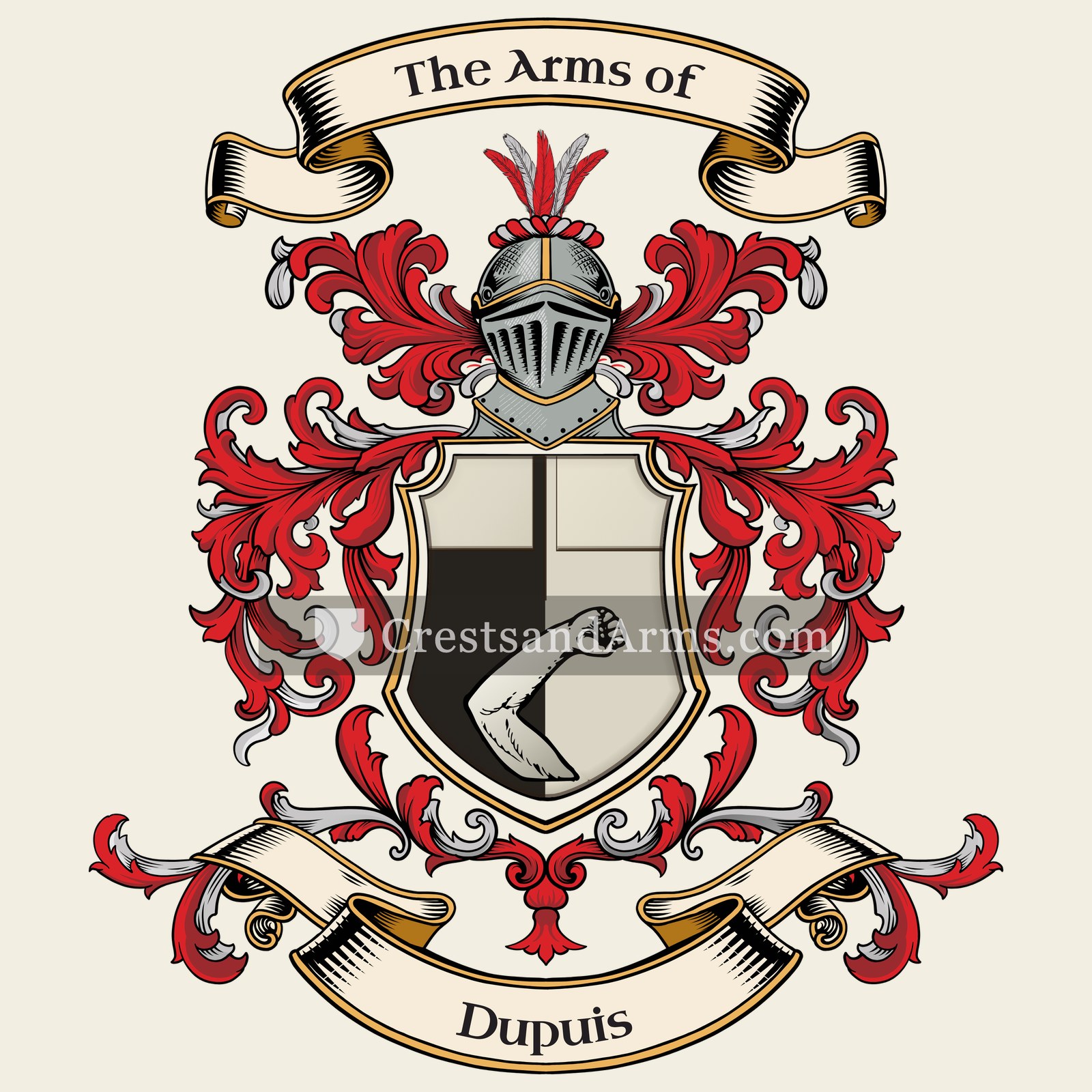
Symbols on this shield
chiefAuthority, wisdom and dominion
cross symbolChristian faith and service
armA person of action, industrious and laborious
eagleNobility, strength and a keen mind
Colours
Black (Sable)Means: Constancy
Silver (Argent)Means: Peace and sincerity
Red (Gules)Means: Military strength
Historical info
Source
J. B. Rietstap, Armorial Général, Gouda: G. B. van Goor Zonen, 1884–87
Blazon (the actual original written record)
“De sa. à un senestrochère arm., tenant une épée d'arg., garnie d'or; au chef parti, à dextre d'arg. à cinq croisettes pattées de gu. 2, 1 et 2, à sen. d'or à l'aigle de sa. C.: le senestrochère.”
BrabantBrabant, c. 1737
Where the Dupuis Arms Were Recorded
Brabant
Map of Belgium showing where the Dupuis arms are recorded
The Dupuis arms were recorded in Brabant, c. 1737.
Brabant lay at the heart of the Low Countries, where the trade routes met. Its towns were wealthy and its landowners many, and both kinds of family kept arms, which is why the region is so heavily represented.
This is where the arms were entered in the register. Families often moved to other parts of the country, so the same name can turn up in more than one region.
The body that granted and recorded arms in Belgium in this period.
Charles VI, Holy Roman Emperor
Sovereign of the period
Charles VI, Holy Roman Emperor
1711–1740
Reigning in France when the Dupuis arms are first recorded.
How Arms Worked in Belgium
In Belgium, a coat of arms is considered personal property that is passed down through the male line to legitimate descendants. Families often use the same shield design across generations to show their shared heritage. If a branch of the family wants to change the design, they must apply for an official update to their specific version of the arms.
Granting authority
The Conseil héraldique is the official body that regulates and approves all coats of arms in Belgium.
How they got arms
Families obtain their coats of arms through formal royal grants or by confirming their historical right to use existing designs.
Where arms were recorded
All approved coats of arms are officially recorded in the public registers of the Conseil héraldique since 1844.
The family's standing
Recorded among the armigerous families of Brabant.
Origin & History of the Dupuis Family in Belgium
The family name Dupuis is a classic example of a topographic surname, which means it was originally used to identify people based on where they lived. In French, the name translates to "from the well" or "from the bridge," indicating that the earliest ancestors likely resided near a prominent landmark or a specific water source. By the year 1737, records confirm that members of the Dupuis family were well-established in the Brabant region of present-day Belgium. During this period, Brabant was a bustling center of trade and agriculture, and families like the Dupuis were often integrated into the local community as farmers, tradespeople, or skilled laborers. Because the name was descriptive rather than tied to a single noble lineage, it emerged independently in various villages across the region. This allowed the family to put down deep roots in the local landscape, contributing to the social and economic fabric of the Belgian countryside for generations.
Coat of Arms & Family Crest Details
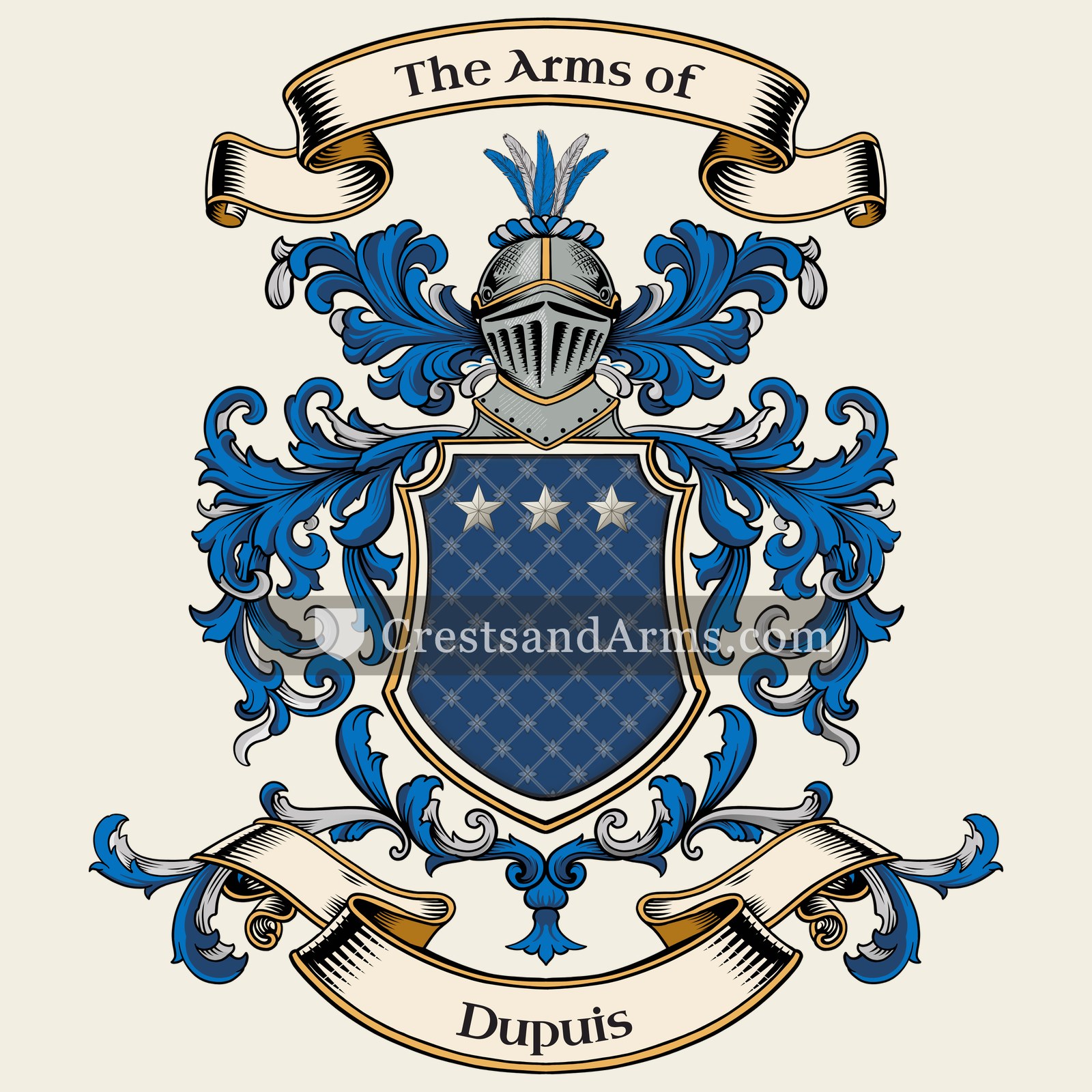
Symbols on this shield
mulletThe third son, and a divine quality from above
Colours
Blue (Azure)Means: Loyalty and truth
Silver (Argent)Means: Peace and sincerity
Historical info
Source
J. B. Rietstap, Armorial Général, Gouda: G. B. van Goor Zonen, 1884–87
Blazon (the actual original written record)
“D'azur à un puits d'arg. en p., acc. de trois étoiles (5) du même, rangées en chef.”
GenevoisGenevois, c. 1745
Where the Dupuis Arms Were Recorded
Map of Switzerland showing where the Dupuis arms are recorded
The Dupuis arms were recorded in Genevois, c. 1745.
Genevois was Alpine country south of Geneva, held in small estates by families who stayed put. Land there passed down the same line for centuries, and long tenure counted for more than wealth.
This is where the arms were entered in the register. Families often moved to other parts of the country, so the same name can turn up in more than one region.
The body that granted and recorded arms in Switzerland in this period.
How Arms Worked in Switzerland
In Switzerland, coats of arms were not restricted to the nobility and were often adopted by common citizens and families. These symbols were passed down through generations to show family identity. When branches of a family grew, they often changed small details of the design to distinguish their own line from the original group.
Granting authority
Cantonal and civic authorities managed the use of coats of arms within their specific regions and local jurisdictions.
How they got arms
Families typically assumed their own coats of arms based on local custom rather than receiving them from a central monarch.
Where arms were recorded
Arms were recorded in various cantonal and civic registers starting from the fourteenth century throughout the Swiss region.
The family's standing
Recorded among the armigerous families of Genevois.
Origin & History of the Dupuis Family in Switzerland
The surname Dupuis is a topographical name that originated in France, meaning "from the well" or "from the bridge." By the mid-eighteenth century, the name had established a firm presence in the Genevois region of Switzerland. Families bearing this name were often integrated into the local agricultural or artisanal communities that defined the area near Lake Geneva. In 1745, records confirm that members of the Dupuis family were active participants in the social and economic life of this border region. These early settlers were likely drawn to the area by the unique political stability and trade opportunities offered by the Republic of Geneva. Over time, the family became deeply rooted in the local culture, contributing to the development of the Genevois landscape through their work and community involvement.
Related Branches & Arms
Root word
Puis
Derived from the Latin word puteus meaning a well or pit.
This name
DupuisRefers to someone who lived near a well or a deep water source.
also spelled
Dupuy
Dupwee
Related arms
Bohorquessimilar arms
Hurtado de Mendozasimilar arms
Touarsimilar arms
Dupuyvariant spelling
Documented Sources
J. B. Rietstap, Armorial Général, Gouda: G. B. van Goor Zonen, 1884–87
Dauzat, Albert. Dictionnaire étymologique des noms de famille et prénoms de France. 1951
Morlet, Marie-Thérèse. Dictionnaire étymologique des noms de famille. 1991
Digital archive packCoat of arms PNG, gold border print PDF, vector SVG and the certificate of authenticity. Sent to your email in minutes.


 heartSincerity, charity and true affection
 roundelA coin, and one who has been to the crusades
 heartSincerity, charity and true affection
 roundelA coin, and one who has been to the crusades

 chiefAuthority, wisdom and dominion
 cross symbolChristian faith and service
 armA person of action, industrious and laborious
 eagleNobility, strength and a keen mind

 mulletThe third son, and a divine quality from above