Map of France showing where the Durand arms are recorded
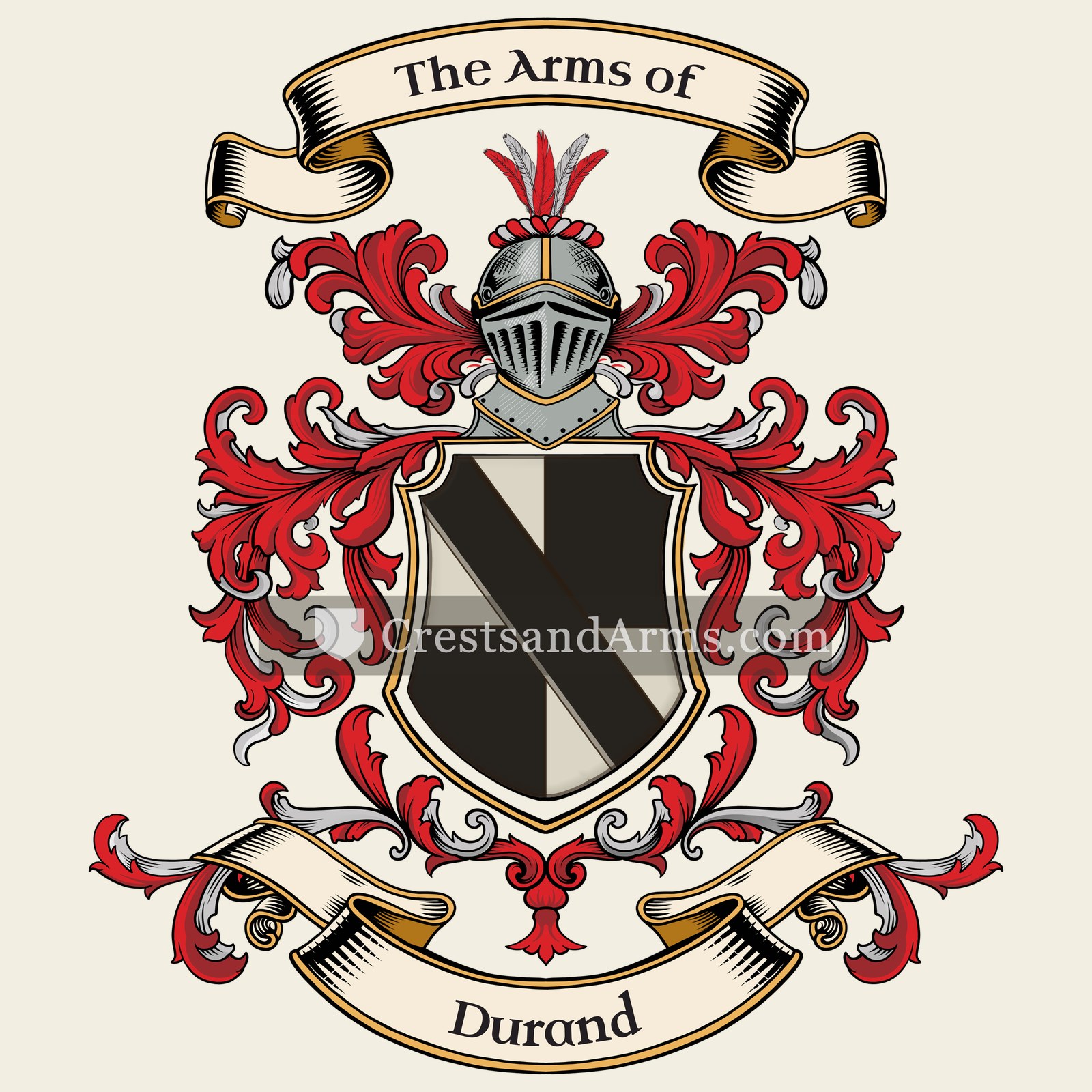
The Durand arms were recorded in Savoy, c. 1569.
Savoy was Alpine country ruled by its own house for eight hundred years. Families there held land and served in arms, and both service and landholding brought recorded shields with them.
This is where the arms were entered in the register. Families often moved to other parts of the country, so the same name can turn up in more than one region.
The body that granted and recorded arms in France in this period.
Charles IX of France
Sovereign of the period
Charles IX of France
1560–1574
Reigning in France when the Durand arms are first recorded.
How Arms Worked in France
In France, a coat of arms was a mark of honor that passed down through the male line to all legitimate descendants. Families often used the same shield without changes to show their shared heritage. If a branch wanted to stand out, they could add a small mark to their shield to show their specific place in the family tree.
Granting authority
The Juge d'armes de France acted as the official authority that regulated and verified coats of arms across the country.
How they got arms
Families typically inherited their arms from ancestors, though they could also receive them through royal grants or by proving their noble status.
Where arms were recorded
Coats of arms were officially recorded in the Armorial Général de France, which began its main collection in the year 1696.
The family's standing
Recorded among the armigerous families of Savoy.
Origin & History of the Durand Family in France
The name Durand has deep roots in the history of France, originating from the Old French word durand, which means enduring or steadfast. This name was often given to people to describe their strong character or their ability to persevere through difficult times. By the sixteenth century, the family had established a notable presence in the region of Savoy. Records from 1569 show that members of the Durand family were active participants in the local community during a time when the area was transitioning between French and Italian cultural influences. Over the generations, the family name spread across various French provinces, often associated with families who held roles in local administration or agriculture. Because the name was based on a common personality trait rather than a specific location, it emerged independently in several different parts of the country, allowing the name to become one of the most widespread surnames in France today.
Coat of Arms & Family Crest Details
Symbols on this shield
bendDefence, and the scarf of a commander
Colours
Silver (Argent)Means: Peace and sincerity
Black (Sable)Means: Constancy
Historical info
Source
J. B. Rietstap, Armorial Général, Gouda: G. B. van Goor Zonen, 1884–87
Blazon (the actual original written record)
“Ec.: aux 1 et 4 d'arg. à la bande de sa.; aux 2 et 3 de sa. à la bande d'arg.”
SwitzerlandGenève, c. 1745
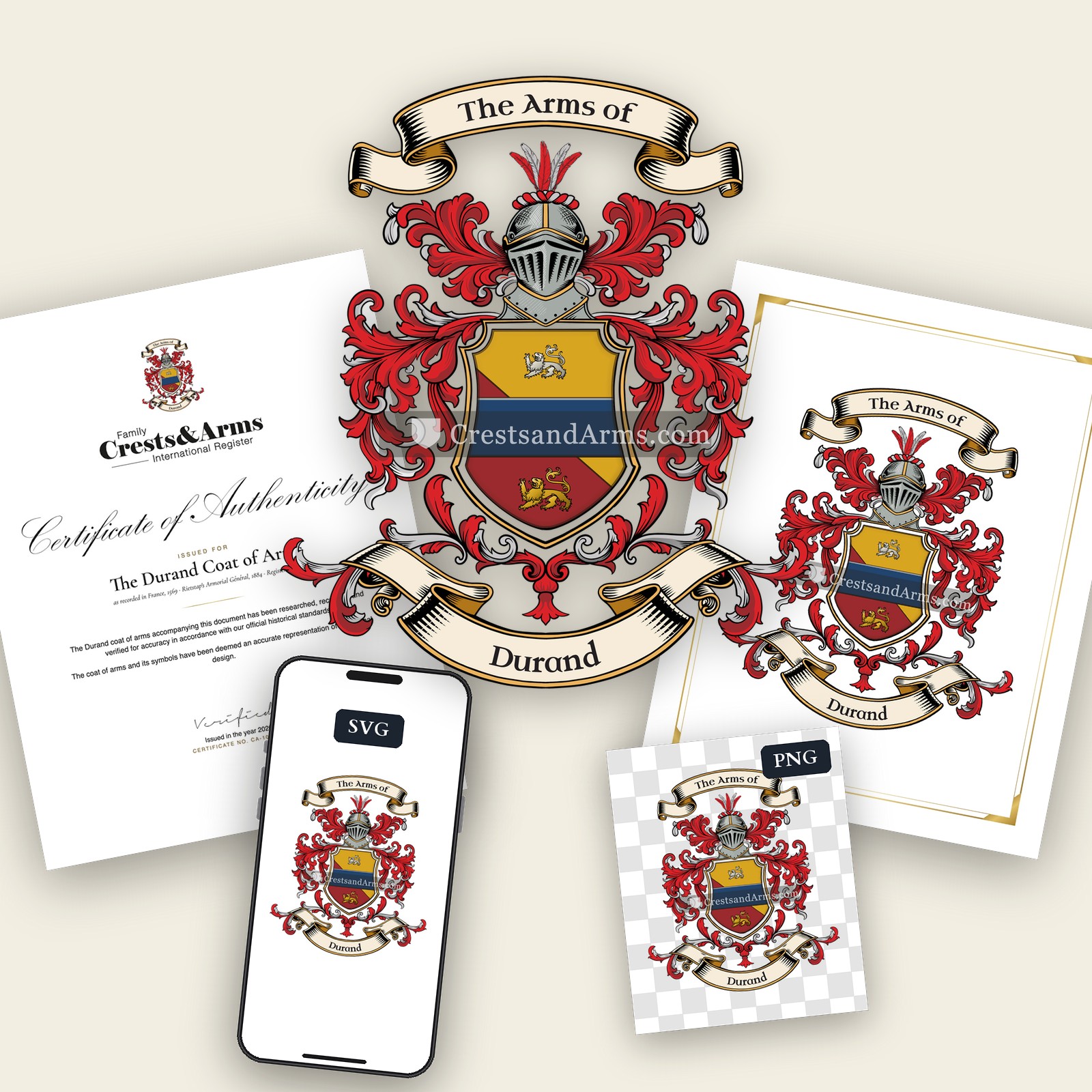
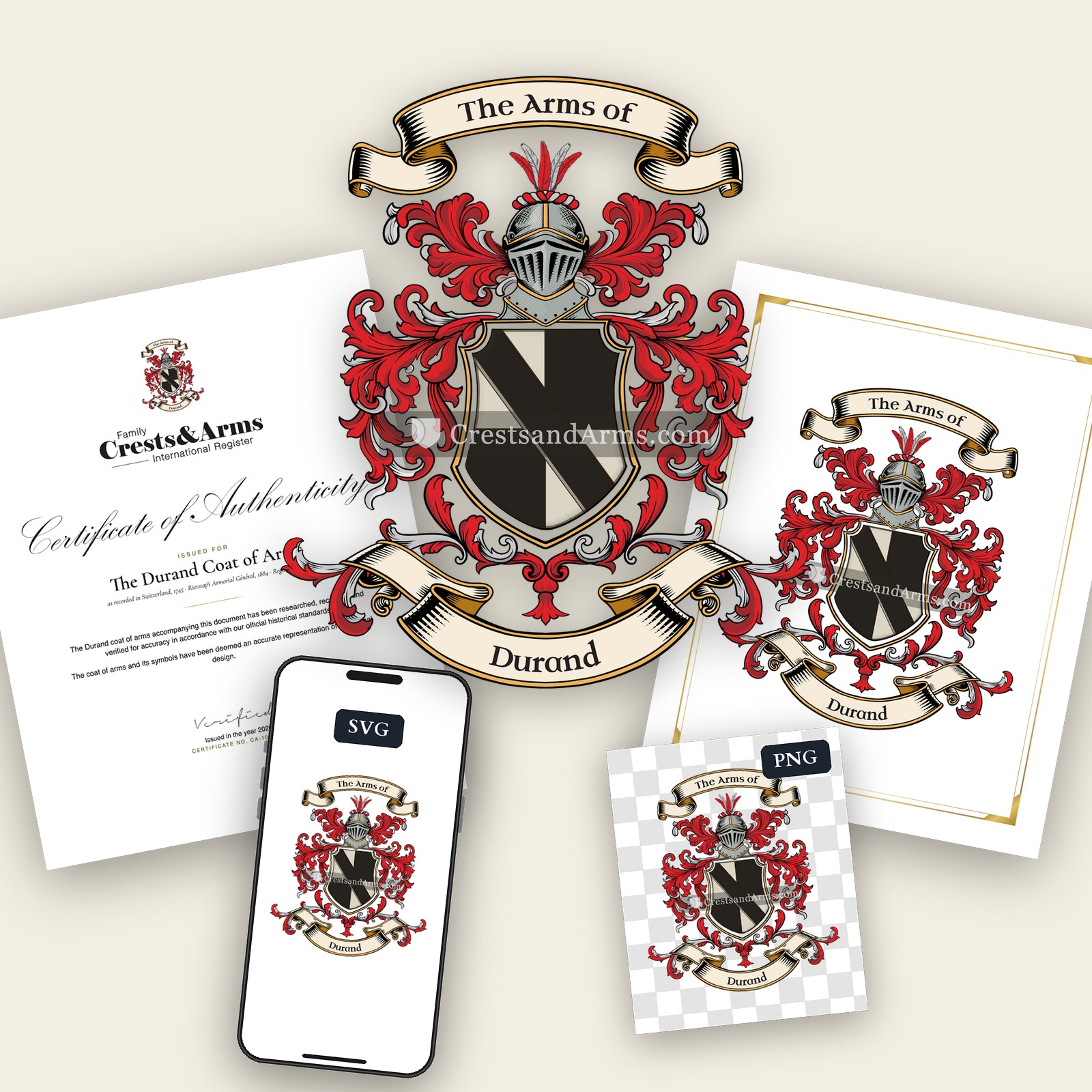
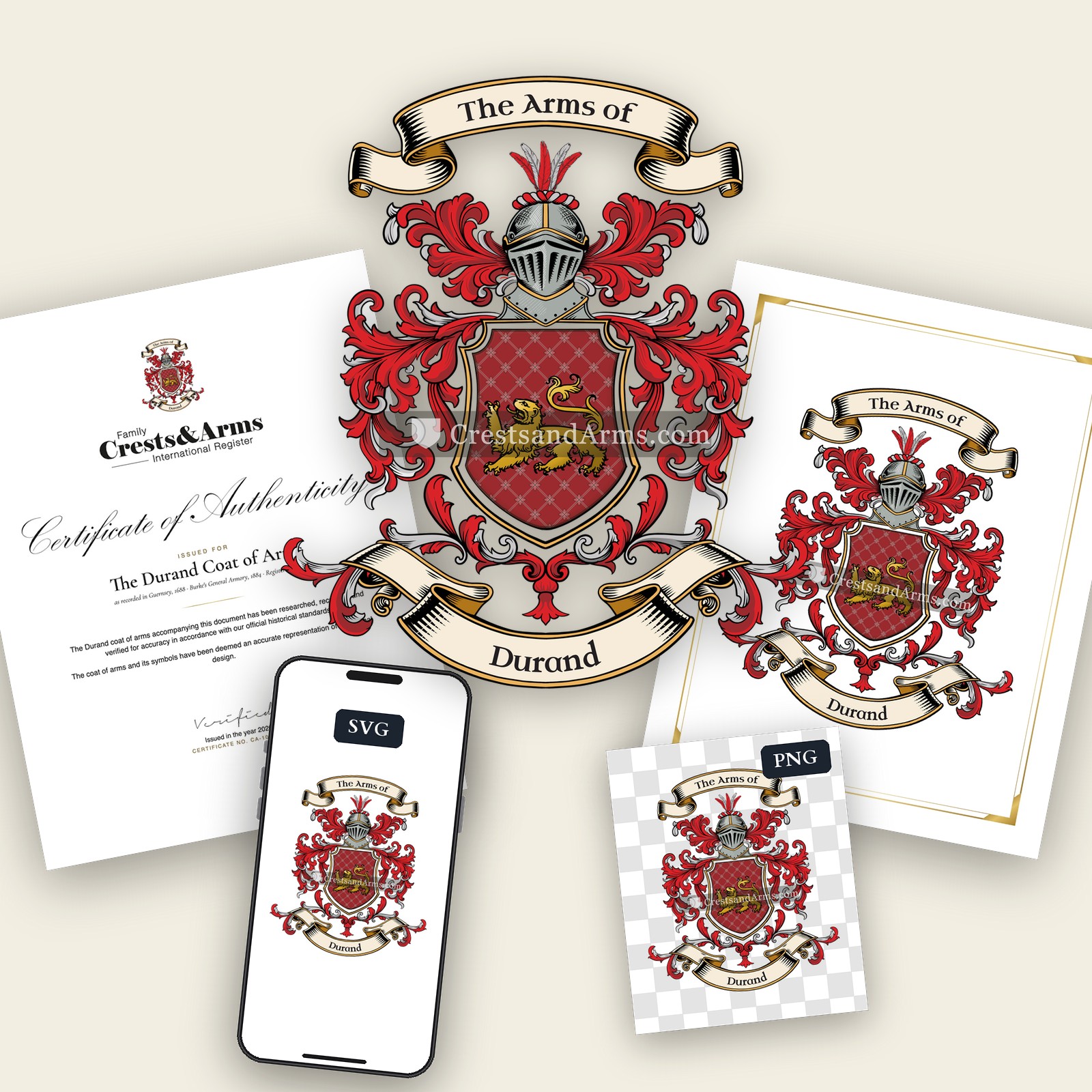
Digital archive packCoat of arms PNG, gold border print PDF, vector SVG and the certificate of authenticity. Sent to your email in minutes.
Map of Switzerland showing where the Durand arms are recorded
The Durand arms were recorded in Genève, c. 1745.
This is where the arms were entered in the register. Families often moved to other parts of the country, so the same name can turn up in more than one region.
The body that granted and recorded arms in Switzerland in this period.
How Arms Worked in Switzerland
In Switzerland, coats of arms were not restricted to the nobility and were often adopted by common citizens and families. These symbols were passed down through generations to show family identity. When branches of a family grew, they often changed small details of the design to distinguish their own line from the original group.
Granting authority
Cantonal and civic authorities managed the use of coats of arms within their specific regions and local jurisdictions.
How they got arms
Families typically assumed their own coats of arms based on local custom rather than receiving them from a central monarch.
Where arms were recorded
Arms were recorded in various cantonal and civic registers starting from the fourteenth century throughout the Swiss region.
The family's standing
Recorded among the armigerous families of Switzerland.
Origin & History of the Durand Family in Switzerland
The surname Durand has deep roots in the French-speaking regions of Europe, and its presence in Geneva by 1745 reflects the city’s long history as a hub for trade and intellectual exchange. The name itself is derived from the Old French word durer, which means to endure or to last, suggesting that early ancestors were likely known for their strength or perseverance. In the context of Switzerland, families bearing this name often integrated into the local burgher classes, contributing to the professional and civic life of the republic during the eighteenth century. As Geneva grew into a center for clockmaking and banking, individuals named Durand frequently worked as skilled artisans or merchants who helped shape the city’s reputation for precision and commerce. By settling in this region, these early family members became part of a unique cultural landscape where French linguistic traditions blended with Swiss political independence.
Coat of Arms & Family Crest Details
Symbols on this shield
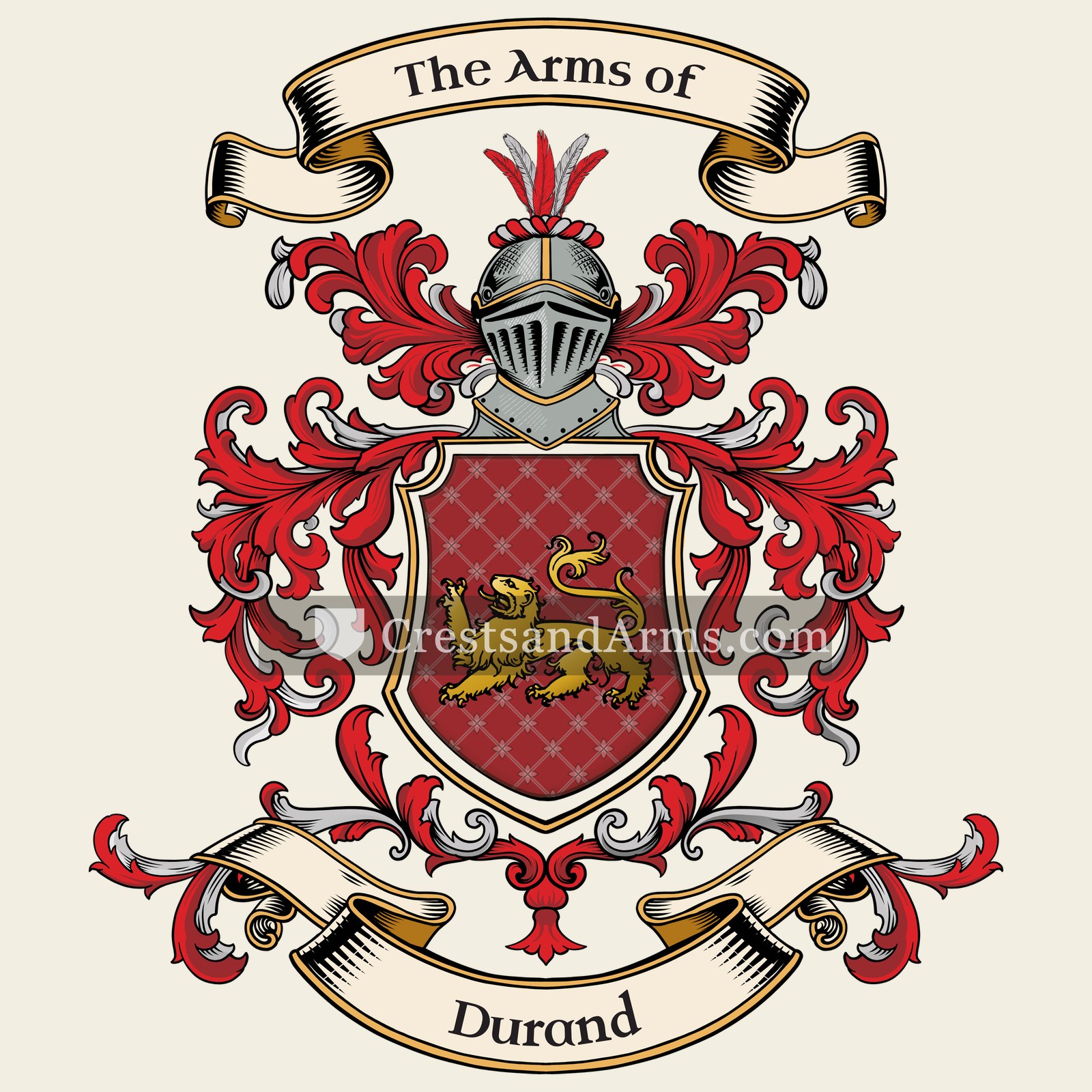
lionCourage, strength and royalty
Colours
Red (Gules)Means: Military strength
Gold (Or)Means: Generosity
Historical info
Source
Sir Bernard Burke, The General Armory of England, Scotland, Ireland and Wales, London: Harrison & Sons, 1884
Blazon (the actual original written record)
“Gu. a lion ramp. or, in the dexter paw a cutlass ar. hilted of the second”
Guernseyc. 1688
Digital archive packCoat of arms PNG, gold border print PDF, vector SVG and the certificate of authenticity. Sent to your email in minutes.
The body that granted and recorded arms in Guernsey in this period.
James II of England
Sovereign of the period
James II of England
1685–1688
Reigning in France when the Durand arms are first recorded.
How Arms Worked in Guernsey
Arms in the Channel Islands were granted and recorded by the College of Arms in London, under the same law of arms as England. They could be used by all legitimate descendants of the original owner: the eldest son kept the original design, and other family members used the same shield without registering a version of their own.
Granting authority
The College of Arms in London has regulated the use of coats of arms for Guernsey and the other Channel Islands since 1484.
How they got arms
Families typically obtained their coats of arms through a formal grant from the Crown or by proving their ancient right to them.
Where arms were recorded
All official coats of arms are recorded in the registers kept at the College of Arms, which date back to the fifteenth century.
The family's standing
Recorded among the armigerous families of Guernsey.
Origin & History of the Durand Family in Guernsey
The Durand family established a firm presence in Guernsey by 1688, marking the beginning of a long history on the island. The name itself is of French origin and is derived from the Old French word durand, which means enduring or steadfast. This meaning likely reflected the resilient nature of the families who held the name during the medieval period. When the Durands arrived in Guernsey, they integrated into a society shaped by a unique blend of Norman traditions and British influence. Over the following generations, members of the family became deeply involved in the local maritime and agricultural life of the island. Their ability to adapt to the changing political landscape of the Channel Islands allowed the family to maintain a consistent presence in Guernsey for centuries. By settling in this strategic location, the early Durands helped shape the social fabric of the community while preserving their distinct ancestral identity.
Durand Meaning & Related Branches
Root word
durus
Latin adjective meaning hard, tough, or enduring.
This name
DurandA surname denoting a person who is steadfast, hardy, or resilient in character.
also spelled
Duran
Durant
Related arms
Buckinghamsimilar arms
Duranvariant spelling
Durantvariant spelling
Durrantvariant spelling
Documented Sources
J. B. Rietstap, Armorial Général, Gouda: G. B. van Goor Zonen, 1884–87
Dauzat, Albert. Dictionnaire étymologique des noms et prénoms de France. 1951
Morlet, Marie-Thérèse. Dictionnaire étymologique des noms de famille. 1991
Archives départementales de la Savoie, Série B: Cours et juridictions
Digital archive packCoat of arms PNG, gold border print PDF, vector SVG and the certificate of authenticity. Sent to your email in minutes.


 fessThe military belt, and readiness to serve
 lionCourage, strength and royalty
 fessThe military belt, and readiness to serve
 lionCourage, strength and royalty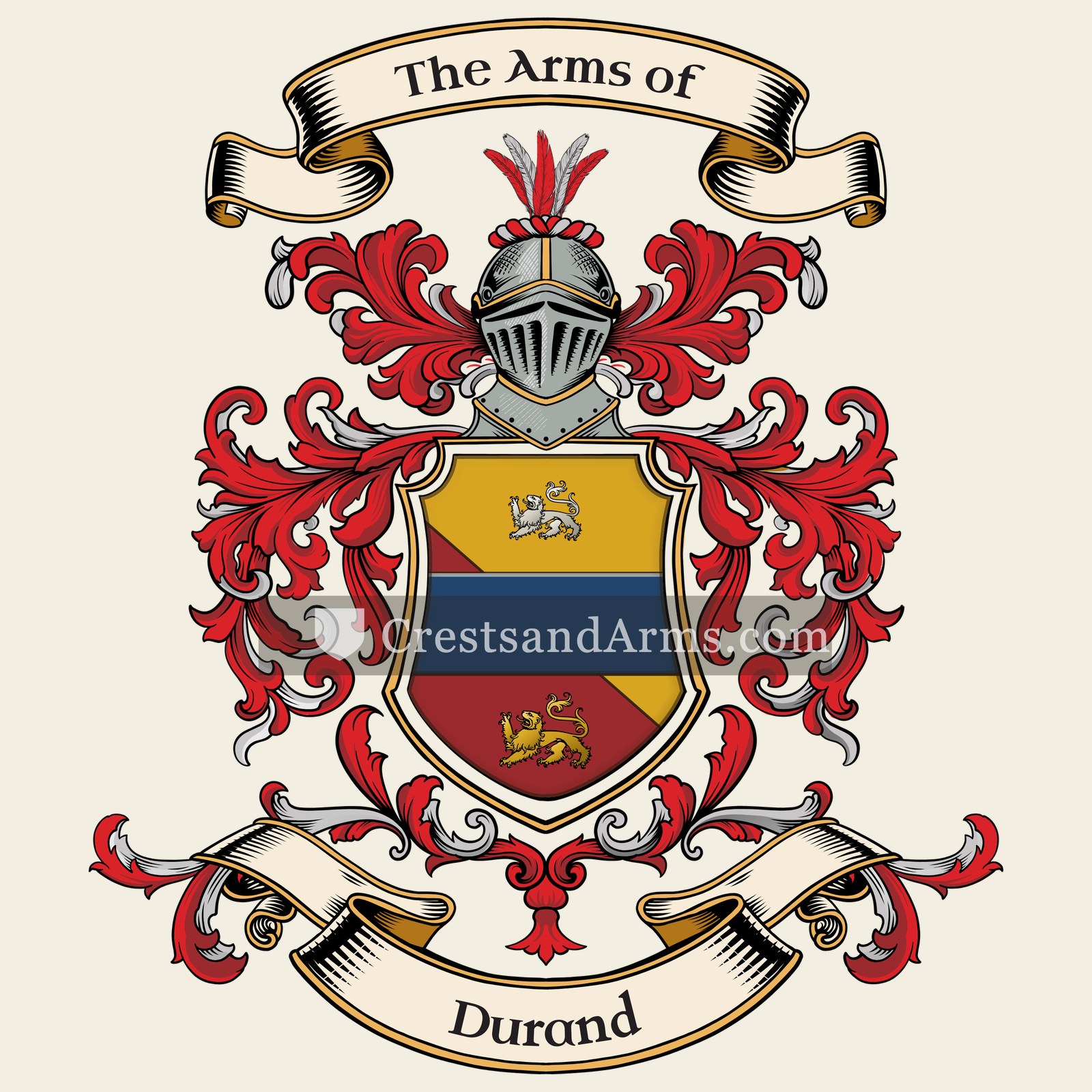


 bendDefence, and the scarf of a commander