A record of documented arms, meaning and origin, researched for the Durell family lines. Documented in 3 countries.
Reg. 1721 · Swedish, D–F
Coat of Arms & Family Crest Details
Symbols on this shield
lionCourage, strength and royalty
Colours
Gold (Or)Means: Generosity
Red (Gules)Means: Military strength
Silver (Argent)Means: Peace and sincerity
Historical info
Source
J. B. Rietstap, Armorial Général, Gouda: G. B. van Goor Zonen, 1884–87
Blazon (the actual original written record)
“Taillé d'or sur gu.; au lion d'arg., hr. sur le taillé. C.: un lion iss. d'arg., entre six pl. d'aut., les trois à dextre de gu., de sa. et d'or, les trois à sen. d'or, de sa. et de gu. L. d'arg., de gu., de sa. et d'or.”
Swedenc. 1648
Digital archive packCoat of arms PNG, gold border print PDF, vector SVG and the certificate of authenticity. Sent to your email in minutes.
Map of Sweden showing where the Durell arms are recorded
The Durell arms were recorded in Sweden, c. 1648.
Arms such as these were typically recorded in Stockholm.
Stockholm held the Swedish court and the House of Nobility, where every noble family's arms were entered and kept. Families ennobled for service registered there, which is why so many are recorded around the city.
This is where the arms were entered in the register. Families often moved to other parts of the country, so the same name can turn up in more than one region.
The body that granted and recorded arms in Sweden in this period.
Christina of Sweden
Sovereign of the period
Christina of Sweden
1632–1654
Reigning in Sweden when the Durell arms are first recorded.
How Arms Worked in Sweden
In Sweden, a coat of arms belonged to a noble family as a whole rather than just one individual. These arms were passed down through the generations to all legitimate descendants. Younger branches of the family used the same shield without needing to change it. This system ensured that the entire lineage shared the same identity and status under the law.
Granting authority
The Riddarhuset, or House of Nobility, regulated all noble coats of arms in Sweden under royal authority.
How they got arms
Families received their coats of arms through royal grants of nobility which were then officially registered with the House.
Where arms were recorded
Coats of arms were officially recorded in the Swedish House of Nobility register starting in the year 1626.
The family's standing
Recorded among the armigerous families of Sweden.
Origin & History of the Durell Family in Sweden
The Durell family name first appeared in the official records of Stockholm in 1648, marking the beginning of their documented influence in Sweden. The family originally migrated from the Netherlands, bringing with them professional expertise that allowed them to integrate quickly into the Swedish administrative and merchant classes. During the seventeenth century, members of the family became deeply involved in the economic life of the capital city. They worked closely with the Swedish state to manage trade and financial affairs during a period when the country was expanding its reach across the Baltic region. By settling in Stockholm, the Durells established a legacy of public service and commercial activity that helped them secure a stable place in Swedish society for generations to come.
Coat of Arms & Family Crest Details
Symbols on this shield
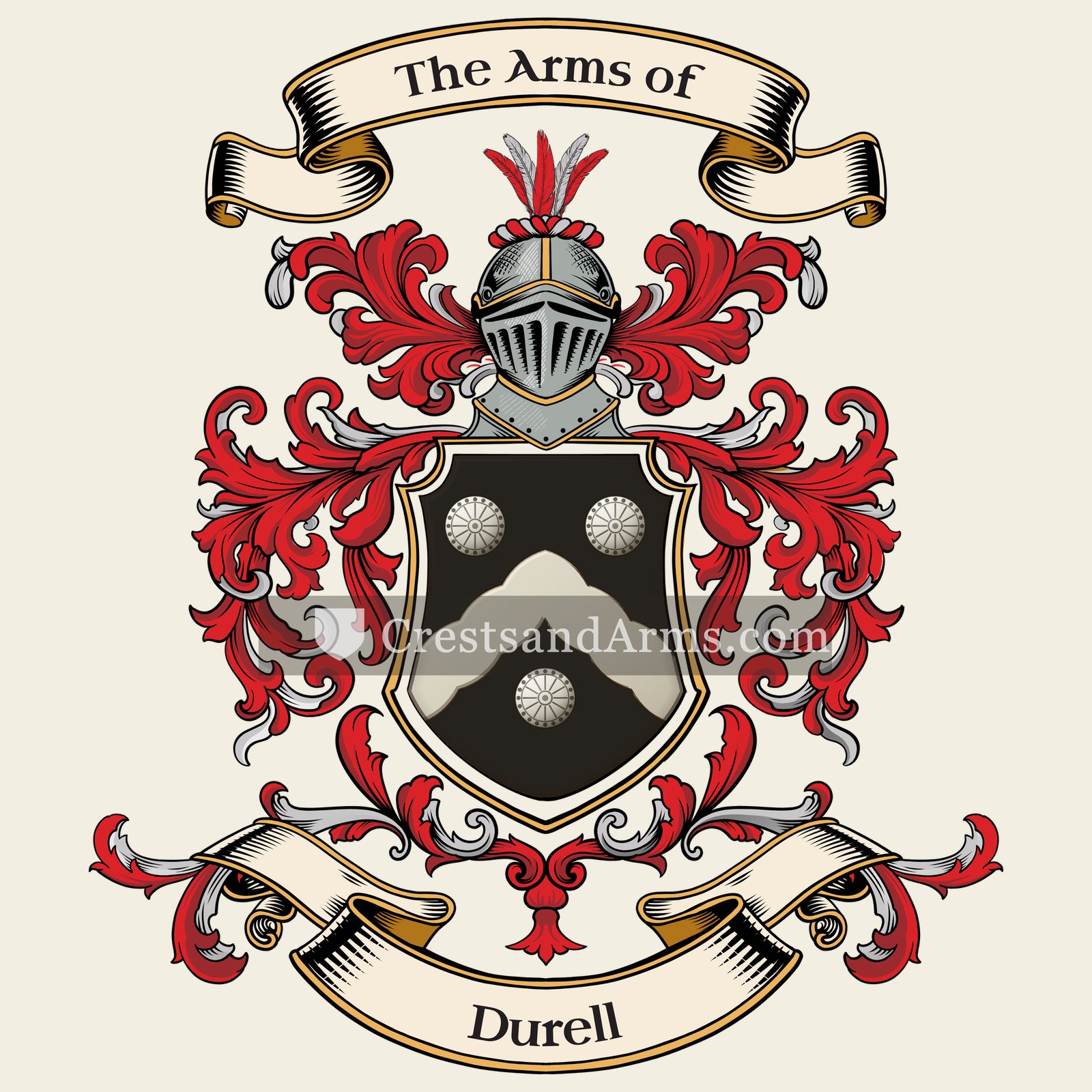
chevronProtection, and faithful service completed
roundelA coin, and one who has been to the crusades
Colours
Black (Sable)Means: Constancy
Silver (Argent)Means: Peace and sincerity
Historical info
Source
Sir Bernard Burke, The General Armory of England, Scotland, Ireland and Wales, London: Harrison & Sons, 1884
Blazon (the actual original written record)
“Sa. a chev. engr. ar. betw. three plates”
Irelandc. 1645
Digital archive packCoat of arms PNG, gold border print PDF, vector SVG and the certificate of authenticity. Sent to your email in minutes.
Map of Ireland showing where the Durell arms are recorded
The Durell arms were recorded in Ireland, c. 1645.
Arms such as these were typically recorded in Dublin.
Dublin was the seat of government in Ireland and the place where grants were sought and recorded. Families with business at the castle or the courts settled nearby, and settling there put their arms on record.
This is where the arms were entered in the register. Families often moved to other parts of the country, so the same name can turn up in more than one region.
The body that granted and recorded arms in Ireland in this period.
Charles I of England
Sovereign of the period
Charles I of England
1625–1649
Reigning in Sweden when the Durell arms are first recorded.
How Arms Worked in Ireland
The Ulster King of Arms granted coats of arms to individuals who proved their social standing and good character. These symbols were typically inherited by all legitimate descendants of the original holder. If a family branch wanted a unique look, they could apply for a specific change to their design through the office to ensure their identity remained distinct.
Granting authority
The Ulster King of Arms acted as the official body that regulated and issued all coats of arms throughout Ireland.
How they got arms
Families obtained their arms through formal grants issued by the office after proving their eligibility and paying the required fees.
Where arms were recorded
All official grants were recorded in the registers held by the Ulster King of Arms starting from the year 1552.
The family's standing
Recorded among the armigerous families of Ireland.
Origin & History of the Durell Family in Ireland
The Durell family name has a distinct history in Ireland that centers on its establishment in the city of Dublin during the mid-seventeenth century. By 1645, records indicate that members of the family were already active participants in the social and civic life of the capital. During this era, Dublin was a bustling center of trade and political transition, and the Durells integrated themselves into this urban environment as the city expanded. While the name likely arrived in Ireland through migration from across the Irish Sea, the family quickly became part of the local fabric of Dublin. Their presence in the city during the 1640s suggests they were among the families navigating the complex religious and social shifts that defined Ireland at the time. Over the following generations, the name remained associated with the administrative and professional circles of the city, marking the Durells as a family that helped shape the early modern history of Dublin.
Coat of Arms & Family Crest Details
Symbols on this shield
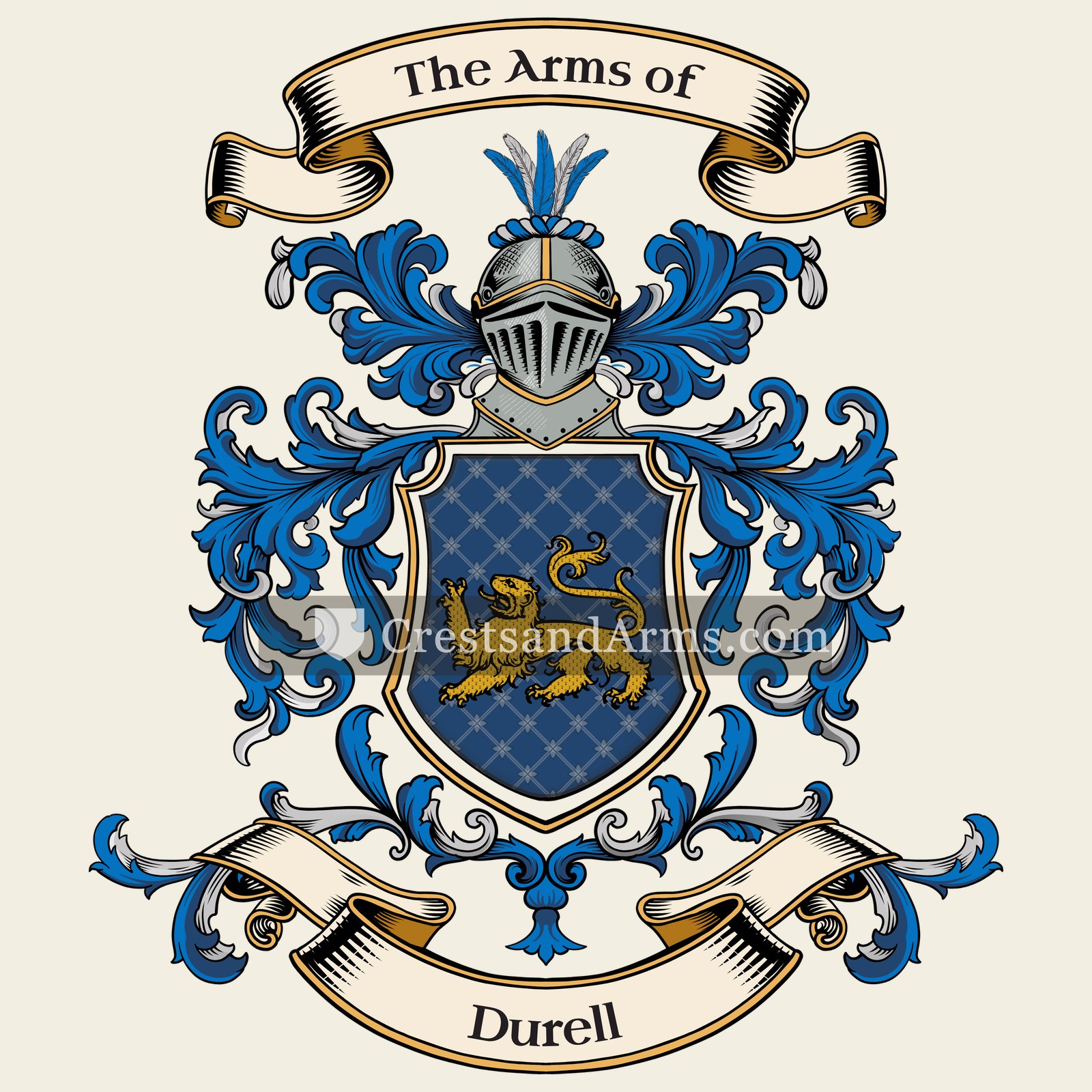
lionCourage, strength and royalty
Colours
Blue (Azure)Means: Loyalty and truth
ErmineMeans: Dignity
Historical info
Source
Sir Bernard Burke, The General Armory of England, Scotland, Ireland and Wales, London: Harrison & Sons, 1884
Blazon (the actual original written record)
“Az. a lion ramp. erminois ducally crowned or”
EnglandWestminster, c. 1771
Digital archive packCoat of arms PNG, gold border print PDF, vector SVG and the certificate of authenticity. Sent to your email in minutes.
Map of England showing where the Durell arms are recorded
The Durell arms were recorded in Westminster, c. 1771.
This is where the arms were entered in the register. Families often moved to other parts of the country, so the same name can turn up in more than one region.
The body that granted and recorded arms in England in this period.
George III of Great Britain
Sovereign of the period
George III of Great Britain
1760–1801
Reigning in Sweden when the Durell arms are first recorded.
How Arms Worked in England
English heraldry allowed arms to be shared by all legitimate descendants of the original owner. These symbols were treated as personal property that moved through the generations to all children. While the eldest son kept the original design, other family members could use the same shield without needing to change it or register their own unique versions.
Granting authority
The College of Arms in London has regulated the use of coats of arms throughout England and Wales since 1484.
How they got arms
Families typically obtained their coats of arms through a formal grant from the Crown or by proving their ancient right to them.
Where arms were recorded
All official coats of arms are recorded in the registers kept at the College of Arms, which date back to the fifteenth century.
The family's standing
Recorded among the armigerous families of England.
Origin & History of the Durell Family in England
The Durell family name has deep roots in the historical landscape of England, with records confirming their presence in the bustling center of Westminster by 1771. The name itself is thought to be of Norman-French origin, likely arriving in Britain following the events of the eleventh century. Over the generations, families bearing this name integrated into the social and professional fabric of London, often appearing in local parish registers and government census documents. By the late eighteenth century, the Durells were well-established as part of the urban population, participating in the daily commerce and civic life of the capital. Their transition from early settlers to documented residents of Westminster highlights the broader movement of families who helped shape the administrative and cultural identity of England during the Georgian era.
Durell Meaning & Related Branches
Root word
durus
Latin term meaning hard, durable, or stern.
This name
DurellDerived from a nickname describing a person who is tough, resilient, or steadfast in character.
also spelled
Durel
Related arms
Dürelsvariant spelling
Documented Sources
J. B. Rietstap, Armorial Général, Gouda: G. B. van Goor Zonen, 1884–87
Elgenstierna, Gustaf. Den introducerade svenska adelns ättartavlor med tillägg och rättelser. 1925–1936
Riksarkivet (National Archives of Sweden). Riksregistraturet (The Royal Chancery's Register). 1648
Stockholms stadsarkiv (Stockholm City Archives). Stockholms magistrats och rådhusrätts arkiv. 1648
Digital archive packCoat of arms PNG, gold border print PDF, vector SVG and the certificate of authenticity. Sent to your email in minutes.


 lionCourage, strength and royalty
 lionCourage, strength and royalty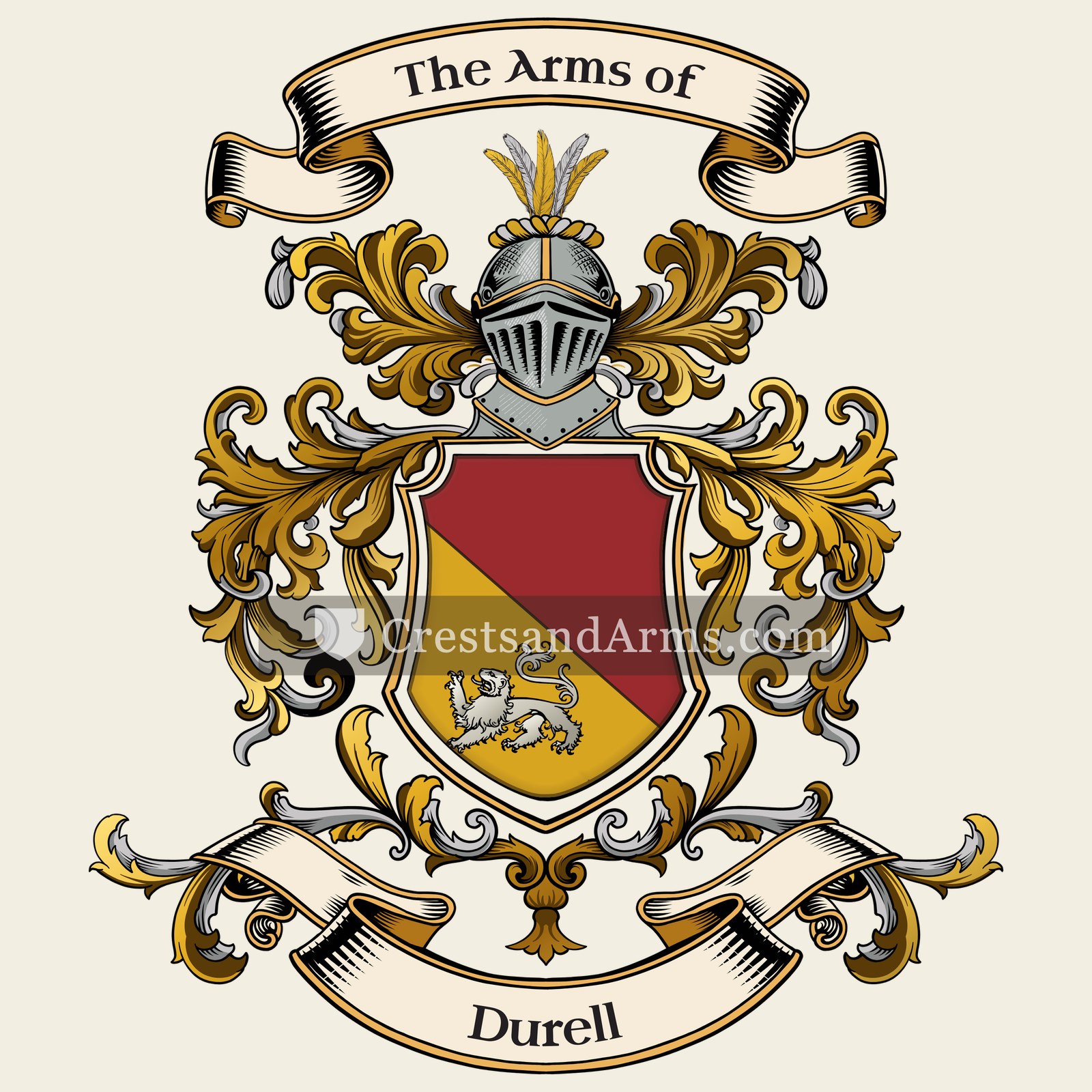


 chevronProtection, and faithful service completed
 roundelA coin, and one who has been to the crusades