A record of documented arms, meaning and origin, researched for the Dury family lines. Documented in 2 countries.
Reg. 9890 · French, D–F
Coat of Arms & Family Crest Details
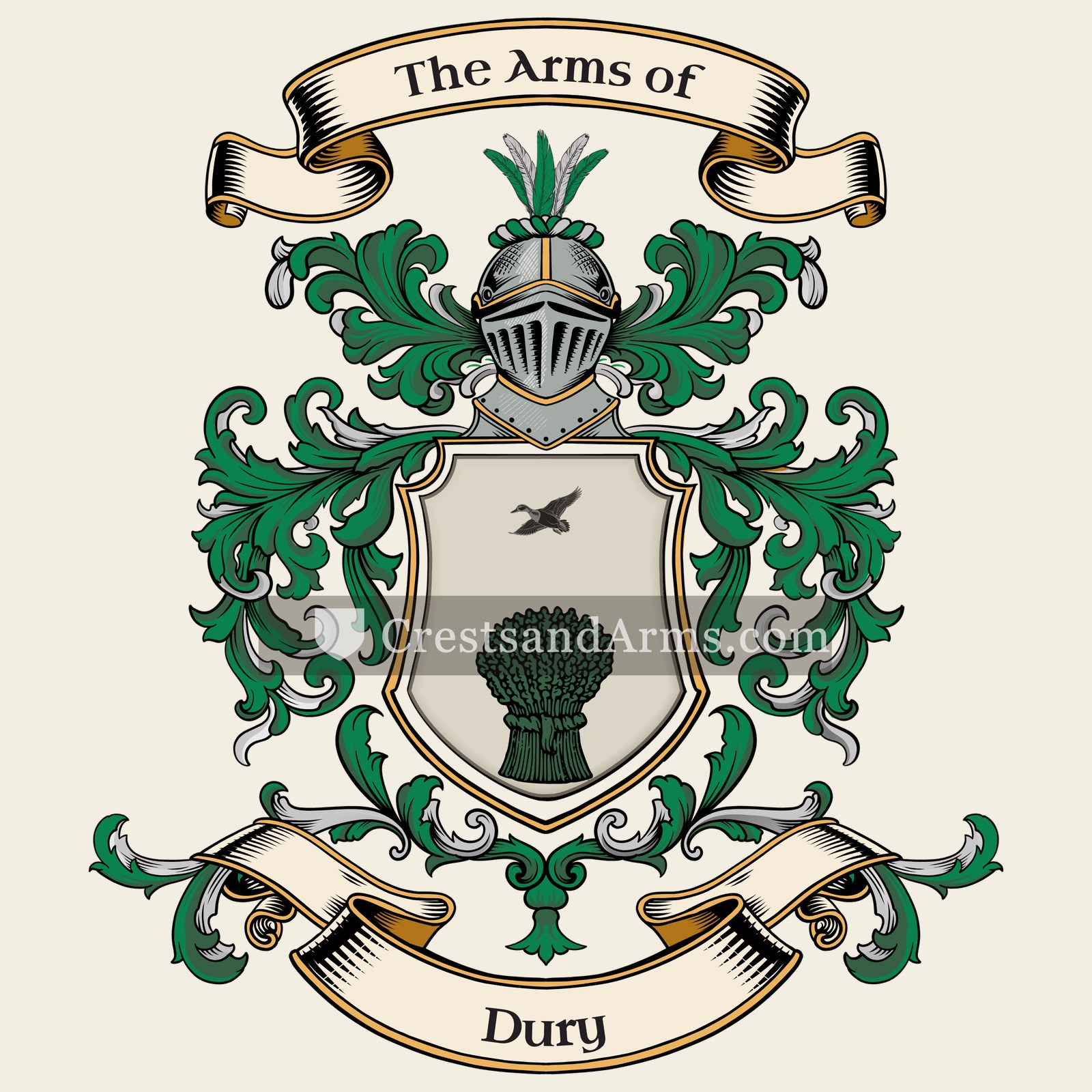
Symbols on this shield
wheatsheafPlenty, and the harvest of one's own labour
duckResourcefulness on land and water
Colours
Silver (Argent)Means: Peace and sincerity
Green (Vert)Means: Hope
Black (Sable)Means: Constancy
Historical info
Source
J. B. Rietstap, Armorial Général, Gouda: G. B. van Goor Zonen, 1884–87
Blazon (the actual original written record)
“D'arg. à une gerbe de sin., acc. en chef d'un duc (oiseau) de sa., bq. et m. d'or.”
ForezForez, c. 1663
Where the Dury Arms Were Recorded
Forez
Map of France showing where the Dury arms are recorded
The Dury arms were recorded in Forez, c. 1663.
Forez was a small upland county in central France, thick with minor gentry holding modest estates. Its families were more numerous than wealthy, and even a small holding was enough for a shield of one's own.
This is where the arms were entered in the register. Families often moved to other parts of the country, so the same name can turn up in more than one region.
The body that granted and recorded arms in France in this period.
Louis XIV of France
Sovereign of the period
Louis XIV of France
1643–1715
Reigning in France when the Dury arms are first recorded.
How Arms Worked in France
In France, a coat of arms was a mark of honor that passed down through the male line to all legitimate descendants. Families often used the same shield without changes to show their shared heritage. If a branch wanted to stand out, they could add a small mark to their shield to show their specific place in the family tree.
Granting authority
The Juge d'armes de France acted as the official authority that regulated and verified coats of arms across the country.
How they got arms
Families typically inherited their arms from ancestors, though they could also receive them through royal grants or by proving their noble status.
Where arms were recorded
Coats of arms were officially recorded in the Armorial Général de France, which began its main collection in the year 1696.
The family's standing
Recorded among the armigerous families of Forez.
Origin & History of the Dury Family in France
The family name Dury finds its historical roots in the rugged landscape of the Forez region in central France. By the year 1663, records confirm that members of the family were firmly established in this area, which was known for its dense forests and traditional agricultural life. The name itself is thought to be topographical, likely derived from the Old French word *dure*, which referred to hard or unyielding land. This suggests that the earliest ancestors were likely farmers or laborers who worked the difficult soil of the Massif Central. Over time, the family became integrated into the local social structure of the province, living through the transition from the feudal era to the more centralized rule of the French monarchy. Their presence in Forez highlights a long history of resilience and deep ties to the rural communities that defined the heart of France during the seventeenth century.
Coat of Arms & Family Crest Details
Symbols on this shield
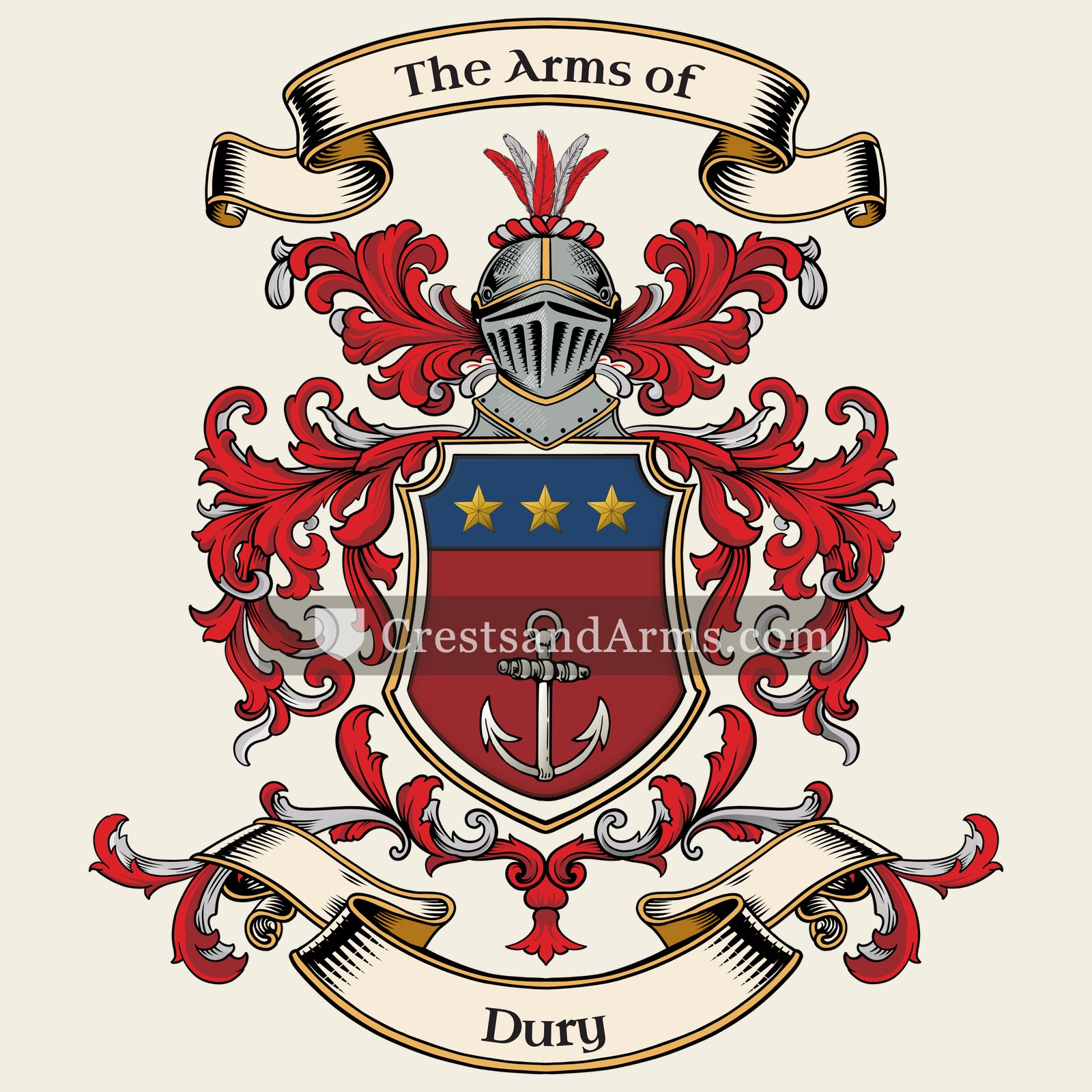
chiefAuthority, wisdom and dominion
anchorHope, and steadfastness in trouble
mulletThe third son, and a divine quality from above
Colours
Red (Gules)Means: Military strength
Blue (Azure)Means: Loyalty and truth
Gold (Or)Means: Generosity
Historical info
Source
J. B. Rietstap, Armorial Général, Gouda: G. B. van Goor Zonen, 1884–87
Blazon (the actual original written record)
“De gu. à une ancre au nat.; au chef d'azur, ch. de trois étoiles d'or. Cq. cour. C.: trois étoiles mal-ordonnées d'or; entre deux prob. coupées, à dextre d'arg. sur azur, à sen. d'arg. sur gu. L. conformes aux émaux des prob.”
BavariaBavaria, c. 1736
Where the Dury Arms Were Recorded
Bavaria
Map of Germany showing where the Dury arms are recorded
The Dury arms were recorded in Bavaria, c. 1736.
Bavaria was a country of old landed families and walled market towns. Estates passed down the same line for centuries, and both the landowners and the leading townsmen kept arms, which is why so many Bavarian names sit in the registers.
This is where the arms were entered in the register. Families often moved to other parts of the country, so the same name can turn up in more than one region.
The body that granted and recorded arms in Germany in this period.
Charles VI, Holy Roman Emperor
Sovereign of the period
Charles VI, Holy Roman Emperor
1711–1740
Reigning in France when the Dury arms are first recorded.
How Arms Worked in Germany
In the Holy Roman Empire, coats of arms were often granted to individuals by the Emperor or his representatives. These arms were then passed down through the generations to all legitimate descendants of the original holder. Younger branches of a family usually kept the same shield design without needing to change it, as the arms belonged to the entire lineage.
Granting authority
The Holy Roman Emperor held the sole power to grant new coats of arms throughout his vast imperial territories.
How they got arms
Families typically obtained their coats of arms through a formal imperial grant or by proving their noble status to the authorities.
Where arms were recorded
These grants were officially recorded in the Imperial Chancery registers, which began keeping formal records of such honors during the Middle Ages.
The family's standing
Recorded among the armigerous families of Bavaria.
Origin & History of the Dury Family in Germany
The family name Dury has deep roots in the German-speaking regions of Europe, with documented evidence placing members of the family in Bavaria by the year 1736. During the eighteenth century, Bavaria was a place of significant social and religious change, which often influenced how families moved and settled. The name likely originated as a descriptive term or a locational identifier, as was common for surnames developing in the Holy Roman Empire during this era. Families like the Durys were often part of the agrarian or artisan classes, contributing to the local economy through farming or skilled trade work. By establishing themselves in the Bavarian landscape, these early ancestors helped build the foundations for the family lineage that would eventually spread across different regions. Their presence in official records from this time provides a clear link to the historical development of the area and the persistent nature of the family name throughout the generations.
Related Branches & Arms
Root word
dure
Derived from the Latin durus meaning hard or enduring.
This name
DuryRefers to someone who lived near a hard or stony piece of land.
also spelled
Durie
Duree
Related arms
Durievariant spelling
Documented Sources
J. B. Rietstap, Armorial Général, Gouda: G. B. van Goor Zonen, 1884–87
Archives départementales de la Loire, Série E, État civil et registres paroissiaux de la province du Forez
Gonon, Marguerite, La vie quotidienne en Forez au XVIIe siècle, 1960
Perroy, Édouard, Les familles du Forez et du Lyonnais, 1975
Digital archive packCoat of arms PNG, gold border print PDF, vector SVG and the certificate of authenticity. Sent to your email in minutes.


 wheatsheafPlenty, and the harvest of one's own labour
 duckResourcefulness on land and water
 wheatsheafPlenty, and the harvest of one's own labour
 duckResourcefulness on land and water

 chiefAuthority, wisdom and dominion
 anchorHope, and steadfastness in trouble
 mulletThe third son, and a divine quality from above