Map of Germany showing where the Dusch arms are recorded
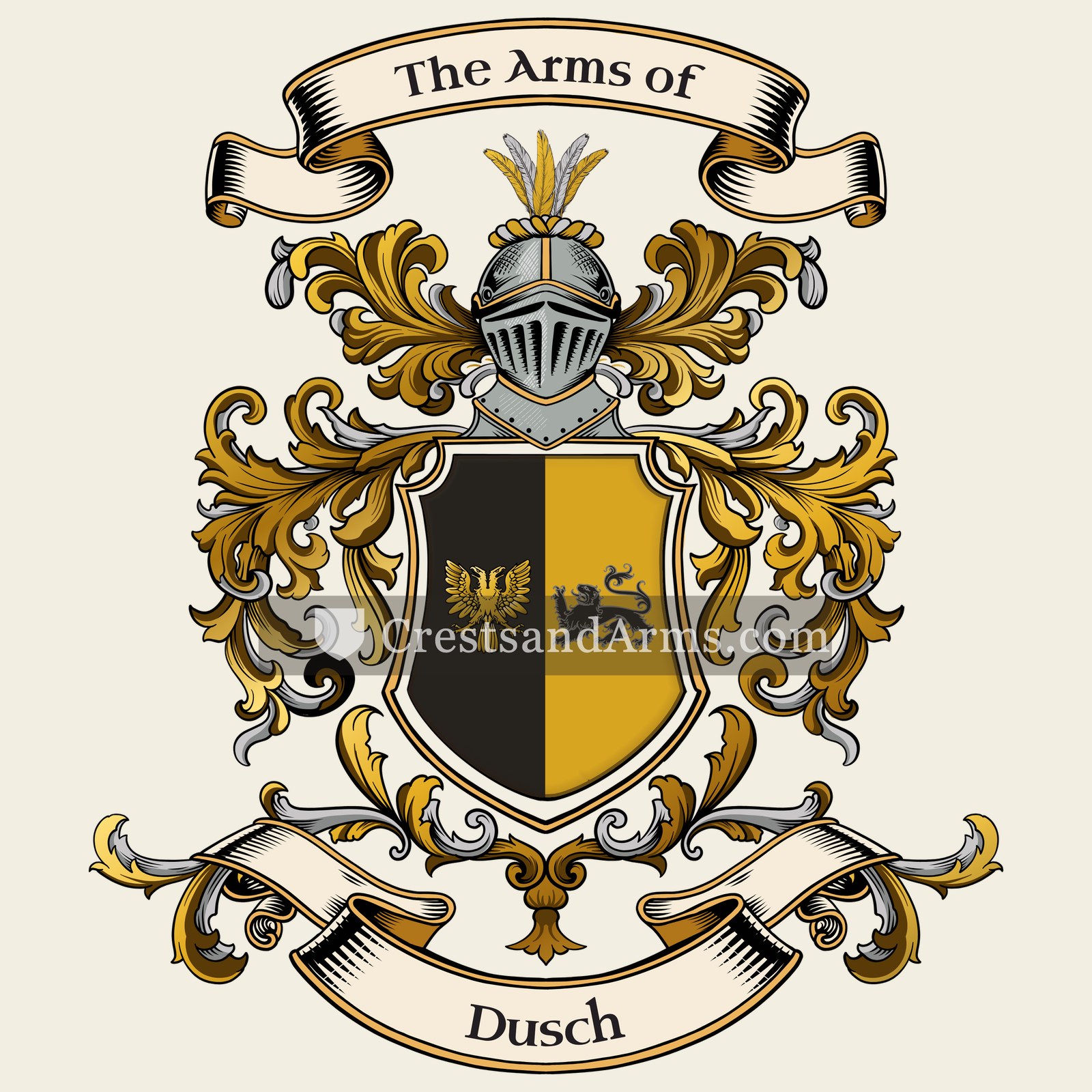
The Dusch arms were recorded in Bade, c. 1790.
This is where the arms were entered in the register. Families often moved to other parts of the country, so the same name can turn up in more than one region.
The body that granted and recorded arms in Germany in this period.
Joseph II, Holy Roman Emperor
Sovereign of the period
Joseph II, Holy Roman Emperor
1765–1790
Reigning in Germany when the Dusch arms are first recorded.
How Arms Worked in Germany
In the Holy Roman Empire, coats of arms were often granted to individuals by the Emperor or his representatives. These arms were then passed down through the generations to all legitimate descendants of the original holder. Younger branches of a family usually kept the same shield design without needing to change it, as the arms belonged to the entire lineage.
Granting authority
The Holy Roman Emperor held the sole power to grant new coats of arms throughout his vast imperial territories.
How they got arms
Families typically obtained their coats of arms through a formal imperial grant or by proving their noble status to the authorities.
Where arms were recorded
These grants were officially recorded in the Imperial Chancery registers, which began keeping formal records of such honors during the Middle Ages.
The family's standing
Recorded among the armigerous families of Germany.
Origin & History of the Dusch Family in Germany
The surname Dusch is deeply rooted in the historical region of Baden, Germany, where records confirm the family presence by the year 1790. The name likely evolved as a descriptive term or a local identifier within the German-speaking territories of the Holy Roman Empire. During the late 18th century, families in this area were often tied to the land through agriculture or specialized local trades. As the region underwent significant social and political shifts, including the influence of the Napoleonic era shortly after 1790, the Dusch family would have been part of a stable, rural society that relied on parish registers to track births, marriages, and deaths. These early ancestors were part of the foundational population of southwestern Germany, living through a time when surnames were becoming permanently fixed in official government and church documentation.
Dusch Meaning & Related Branches
Root word
Dusch
Derived from the Middle High German word for a shower or splash.
This name
DuschAn occupational name for someone who worked near a waterfall or a splashing stream.
also spelled
Dush
Documented Sources
J. B. Rietstap, Armorial Général, Gouda: G. B. van Goor Zonen, 1884–87
Badisches Generallandesarchiv, Kirchenbücher der evangelischen und katholischen Gemeinden in Baden
Breunig, Charles, The Age of Revolution and Reaction, 1789–1849, 1970
Kunze, Konrad, dtv-Atlas Namenkunde: Vor- und Familiennamen im deutschen Sprachgebiet, 2004
Digital archive packCoat of arms PNG, gold border print PDF, vector SVG and the certificate of authenticity. Sent to your email in minutes.


 eagleNobility, strength and a keen mind
 lionCourage, strength and royalty
 eagleNobility, strength and a keen mind
 lionCourage, strength and royalty