Map of Sweden showing where the Dusse arms are recorded
The Dusse arms were recorded in Sweden, c. 1576.
Arms such as these were typically recorded in Stockholm.
Stockholm held the Swedish court and the House of Nobility, where every noble family's arms were entered and kept. Families ennobled for service registered there, which is why so many are recorded around the city.
This is where the arms were entered in the register. Families often moved to other parts of the country, so the same name can turn up in more than one region.
The body that granted and recorded arms in Sweden in this period.
John III of Sweden
Sovereign of the period
John III of Sweden
1568–1592
Reigning in Sweden when the Dusse arms are first recorded.
How Arms Worked in Sweden
In Sweden, a coat of arms belonged to a noble family as a whole rather than just one individual. These arms were passed down through the generations to all legitimate descendants. Younger branches of the family used the same shield without needing to change it. This system ensured that the entire lineage shared the same identity and status under the law.
Granting authority
The Riddarhuset, or House of Nobility, regulated all noble coats of arms in Sweden under royal authority.
How they got arms
Families received their coats of arms through royal grants of nobility which were then officially registered with the House.
Where arms were recorded
Coats of arms were officially recorded in the Swedish House of Nobility register starting in the year 1626.
The family's standing
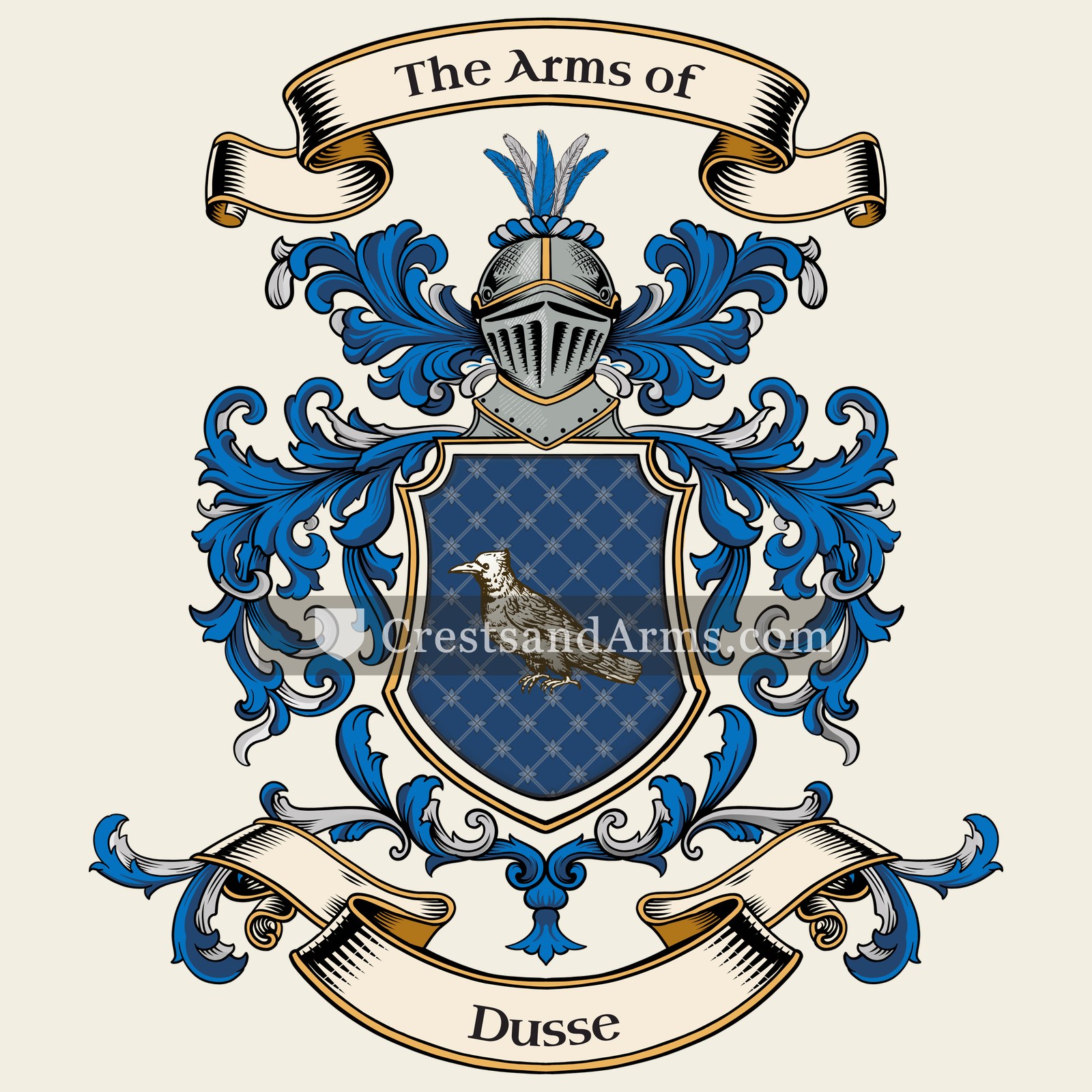
Recorded among the armigerous families of Sweden.
Origin & History of the Dusse Family in Sweden
The history of the Dusse family is deeply rooted in the urban development of sixteenth-century Stockholm. Records confirm that members of the family were active residents of the city as early as 1576, a time when Stockholm was transforming into a vital center of trade and royal administration. During this period, individuals bearing the name were often connected to the professional classes, serving as skilled craftsmen or merchants who helped support the growing capital. Because the name appears in municipal documents from this era, it suggests that the family was well-integrated into the social fabric of the city during the reign of King John III. Over the following generations, the family continued to be associated with the administrative and commercial life of Sweden, leaving a lasting mark on the historical records of the region.
Related Branches & Arms
Root word
Duss
A Middle Low German term referring to a thicket or brushwood.
This name
DusseA topographic name for someone who lived near a dense thicket or wooded area.
also spelled
Dusee
Dooza
Dooz
Documented Sources
J. B. Rietstap, Armorial Général, Gouda: G. B. van Goor Zonen, 1884–87
Stockholm City Archives (Stockholms stadsarkiv), Tänkeböcker från Stockholms rådhusrätt 1576
Bolin, Sture, Stockholms historia, 1930
Forsstrand, Carl, Stad och stadsbor i gamla Stockholm, 1926
Digital archive packCoat of arms PNG, gold border print PDF, vector SVG and the certificate of authenticity. Sent to your email in minutes.


 dovePeace, love and the Holy Spirit
 dovePeace, love and the Holy Spirit