Map of France showing where the du Teil arms are recorded
The du Teil arms were recorded in Orleanais, c. 1663.
Orleanais lay on the Loire around Orleans, close enough to Paris for court money to reach it. Officials and lawyers who did well bought estates there, and an estate brought a coat of arms with it.
This is where the arms were entered in the register. Families often moved to other parts of the country, so the same name can turn up in more than one region.
The body that granted and recorded arms in France in this period.
Louis XIV of France
Sovereign of the period
Louis XIV of France
1643–1715
Reigning in France when the du Teil arms are first recorded.
How Arms Worked in France
In France, a coat of arms was a mark of honor that passed down through the male line to all legitimate descendants. Families often used the same shield without changes to show their shared heritage. If a branch wanted to stand out, they could add a small mark to their shield to show their specific place in the family tree.
Granting authority
The Juge d'armes de France acted as the official authority that regulated and verified coats of arms across the country.
How they got arms
Families typically inherited their arms from ancestors, though they could also receive them through royal grants or by proving their noble status.
Where arms were recorded
Coats of arms were officially recorded in the Armorial Général de France, which began its main collection in the year 1696.
The family's standing
Recorded among the armigerous families of Orleanais.
Origin & History of the du Teil Family in France
The family name du Teil traces its roots to the historical province of Orléanais, where members of the family were firmly established by the year 1663. In the French language, the name is a topographical descriptor, derived from the word *tilleul*, which refers to the linden or lime tree. During the seventeenth century, such names were often adopted by families living near a prominent landmark or a specific grove of trees that served as a local point of reference. As the family grew, they became integrated into the social and administrative fabric of the region, often serving in roles that required literacy and local standing. By settling in the heart of France, the du Teil family participated in the steady development of rural and provincial life, moving through the generations as part of the evolving landscape of the French countryside.
Meaning of the du Teil family crest colors & symbols
Symbols on this shield
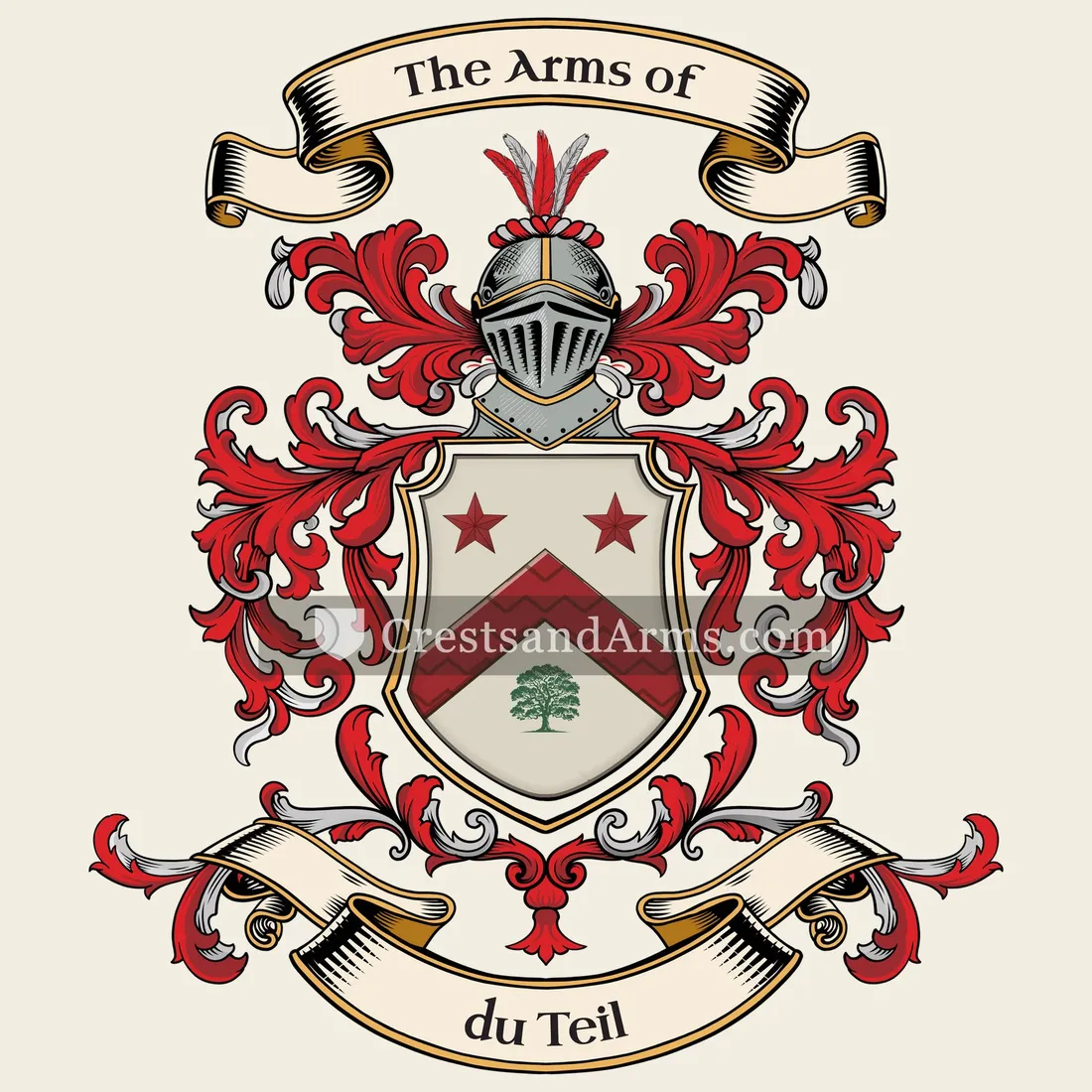
chevronProtection, and faithful service completed
mulletThe third son, and a divine quality from above
treeLife, endurance and deep roots
Colours
Silver (Argent)Means: Peace and sincerity
Red (Gules)Means: Military strength
Green (Vert)Means: Hope
Historical info
Source
J. B. Rietstap, Armorial Général, Gouda: G. B. van Goor Zonen, 1884–87
Blazon (the actual original written record)
“D'arg. au chev. de gu., acc. en chef de deux étoiles (5) du même et en p. d'un tilleul de sin.”
SwitzerlandLausanne, c. 1745
Digital archive packCoat of arms PNG, gold border print PDF, vector SVG and the certificate of authenticity. Sent to your email in minutes.
Map of Switzerland showing where the du Teil arms are recorded
The du Teil arms were recorded in Lausanne, c. 1745.
This is where the arms were entered in the register. Families often moved to other parts of the country, so the same name can turn up in more than one region.
The body that granted and recorded arms in Switzerland in this period.
How Arms Worked in Switzerland
In Switzerland, coats of arms were not restricted to the nobility and were often adopted by common citizens and families. These symbols were passed down through generations to show family identity. When branches of a family grew, they often changed small details of the design to distinguish their own line from the original group.
Granting authority
Cantonal and civic authorities managed the use of coats of arms within their specific regions and local jurisdictions.
How they got arms
Families typically assumed their own coats of arms based on local custom rather than receiving them from a central monarch.
Where arms were recorded
Arms were recorded in various cantonal and civic registers starting from the fourteenth century throughout the Swiss region.
The family's standing
Recorded among the armigerous families of Switzerland.
Origin & History of the du Teil Family in Switzerland
The family name du Teil has deep roots in the history of the Vaud region of Switzerland, where members of the family were established in the city of Lausanne by 1745. During this period, Lausanne was a center of intellectual and social life under the influence of the Bernese authorities. Families like the du Teils often integrated into the local bourgeoisie, participating in the civic and professional life of the city. As the name suggests a French origin, it is likely that the family arrived in Switzerland as part of the broader movement of Huguenots or other skilled migrants seeking stability and religious freedom. By the mid-eighteenth century, the family had become well-integrated into the local community, contributing to the administrative and commercial growth of the region as it transitioned toward the modern era. Their presence in the city records from this time highlights their role as active residents who helped shape the local culture of Lausanne.
du Teil Meaning & Related Branches
Root word
Tegula
Latin term referring to a roof tile or earthen material.
This name
du TeilRefers to someone who lived near a tiled roof or worked as a tiler.
also spelled
Duteille
Du Tay
Related arms
Barriensimilar arms
Bernet (du) de Mazèressimilar arms
du Theilsimilar arms
Documented Sources
J. B. Rietstap, Armorial Général, Gouda: G. B. van Goor Zonen, 1884–87
Albert Dauzat, Dictionnaire étymologique des noms de famille et prénoms de France, 1951
Marie-Thérèse Morlet, Dictionnaire étymologique des noms de famille, 1991
Archives départementales du Loiret, Série E (Familles et notaires)
Digital archive packCoat of arms PNG, gold border print PDF, vector SVG and the certificate of authenticity. Sent to your email in minutes.


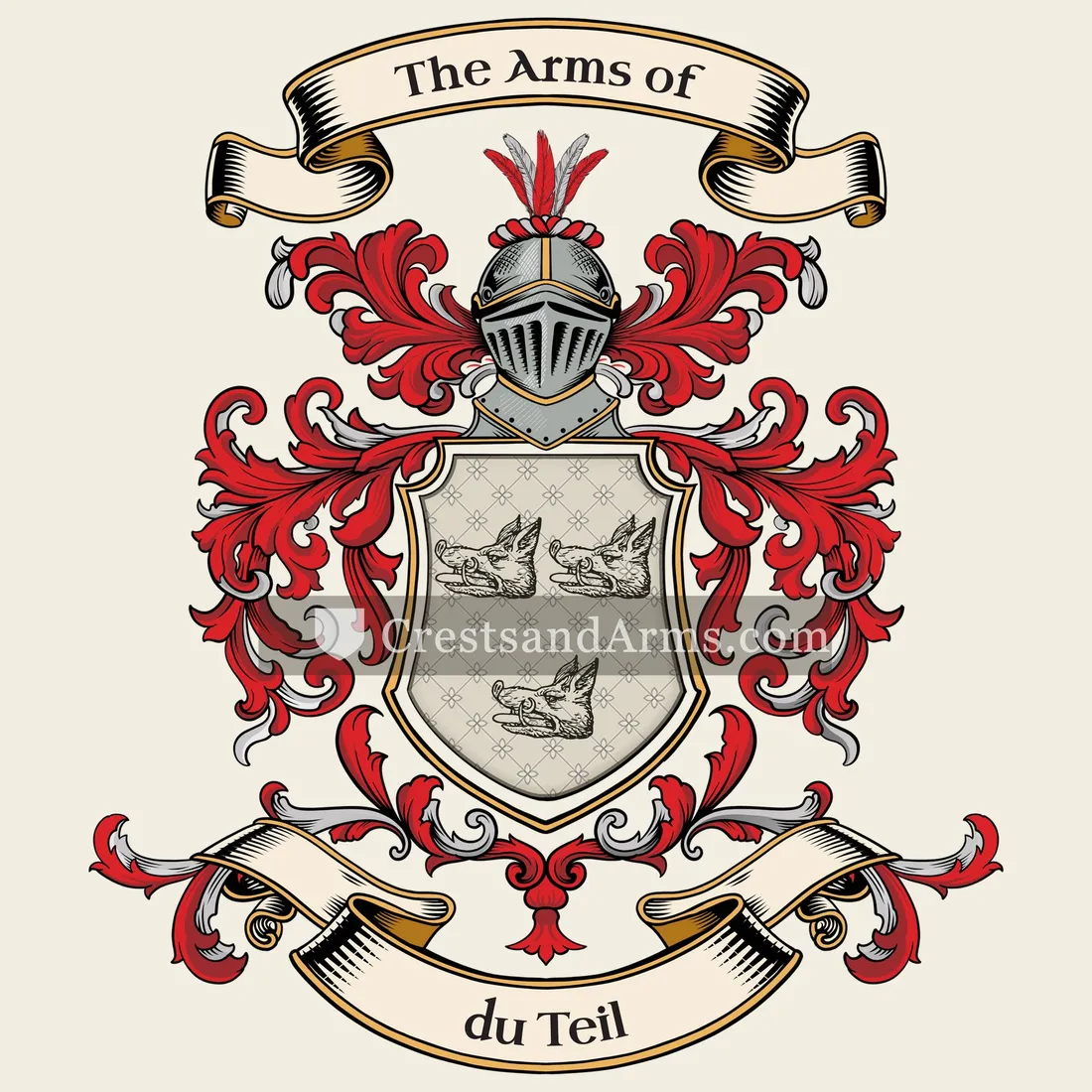
 boars headA fierce fighter who battles to the end
 boars headA fierce fighter who battles to the end


 chevronProtection, and faithful service completed
 mulletThe third son, and a divine quality from above
 treeLife, endurance and deep roots