Map of Britain showing where the Dutro arms are recorded
The Dutro arms were recorded in Londres, c. 1700.
Arms such as these were typically recorded in Kent.
Kent sits between London and the short crossing to Europe, and the trade passing through made it wealthy. Merchant families bought land with that money, and it was landowners who took coats of arms.
This is where the arms were entered in the register. Families often moved to other parts of the country, so the same name can turn up in more than one region.
The body that granted and recorded arms in Britain in this period.
William III of England
Sovereign of the period
William III of England
1694–1702
Reigning in Britain when the Dutro arms are first recorded.
How Arms Worked in Britain
English heraldry allowed arms to be shared by all legitimate descendants of the original owner. These symbols were treated as personal property that moved through the generations to all children. While the eldest son kept the original design, other family members could use the same shield without needing to change it or register their own unique versions.
Granting authority
The College of Arms in London has regulated the use of coats of arms throughout England and Wales since 1484.
How they got arms
Families typically obtained their coats of arms through a formal grant from the Crown or by proving their ancient right to them.
Where arms were recorded
All official coats of arms are recorded in the registers kept at the College of Arms, which date back to the fifteenth century.
The family's standing
Recorded among the armigerous families of Britain.
Origin & History of the Dutro Family in Britain
The Dutro family name first appears in the historical records of Kent, England, around the turn of the eighteenth century. During this period, Kent was a bustling region shaped by its proximity to the English Channel and its role as a gateway for trade and migration. Families living in this area often worked in agriculture or maritime industries, benefiting from the fertile soil and the busy ports that connected the county to the rest of Europe. While the name itself suggests potential roots in continental Europe, the presence of the Dutro family in Kent by 1700 indicates they were part of a diverse local population that helped define the social fabric of the English countryside. These early generations likely navigated the challenges of rural life in a changing Britain, contributing to the local economy and establishing the foundations for the family’s future. Their history reflects the broader movement of people who settled in the British Isles and integrated into the local community over several centuries.
Dutro Meaning & Related Branches
Root word
D'Outre
Old French phrase meaning from beyond or across.
This name
DutroA locational surname denoting someone who lived across a river, valley, or body of water.
also spelled
Dutrie
Dutrey
Dutri
Dutree
Documented Sources
J. B. Rietstap, Armorial Général, Gouda: G. B. van Goor Zonen, 1884–87
Kent Archives, Quarter Sessions Records: Petitions and Orders, 1700
The National Archives, Parish Register Transcripts for the Diocese of Canterbury, 1700
Digital archive packCoat of arms PNG, gold border print PDF, vector SVG and the certificate of authenticity. Sent to your email in minutes.


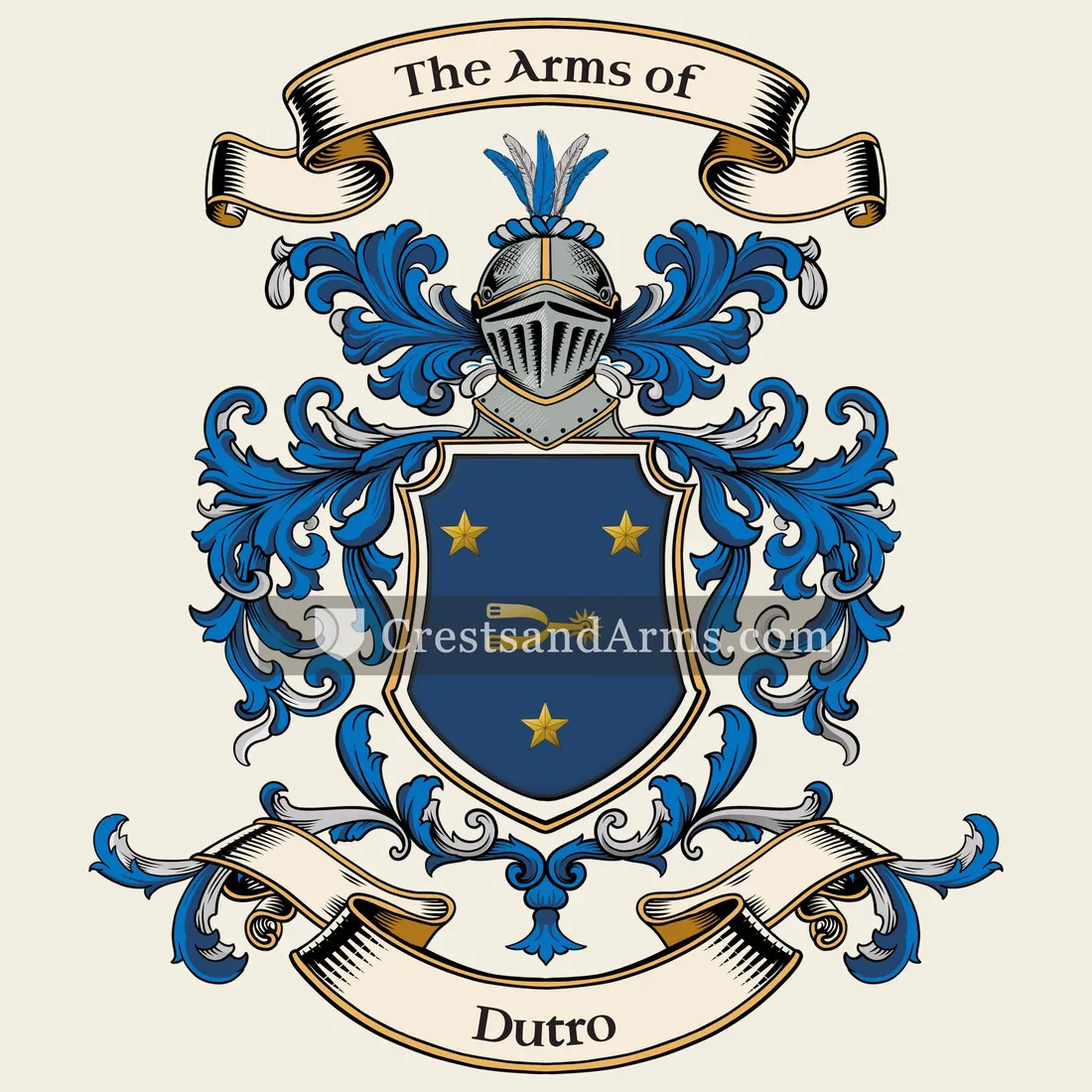
 spurKnighthood, and readiness to spur on
 mulletThe third son, and a divine quality from above
 spurKnighthood, and readiness to spur on
 mulletThe third son, and a divine quality from above