Map of France showing where the Dwyer arms are recorded
The Dwyer arms were recorded in Middlesex, c. 1678.
Middlesex was the county around London, and City money flowed straight into it. Merchants and officials bought estates within reach of the capital, and a new estate brought a coat of arms with it.
This is where the arms were entered in the register. Families often moved to other parts of the country, so the same name can turn up in more than one region.
The body that granted and recorded arms in France in this period.
Louis XIV of France
Sovereign of the period
Louis XIV of France
1643–1715
Reigning in France when the Dwyer arms are first recorded.
How Arms Worked in France
In France, a coat of arms was a mark of honor that passed down through the male line to all legitimate descendants. Families often used the same shield without changes to show their shared heritage. If a branch wanted to stand out, they could add a small mark to their shield to show their specific place in the family tree.
Granting authority
The Juge d'armes de France acted as the official authority that regulated and verified coats of arms across the country.
How they got arms
Families typically inherited their arms from ancestors, though they could also receive them through royal grants or by proving their noble status.
Where arms were recorded
Coats of arms were officially recorded in the Armorial Général de France, which began its main collection in the year 1696.
The family's standing
Recorded among the armigerous families of Middlesex.
Origin & History of the Dwyer Family in France
The roots of the Dwyer name are deeply tied to the historical movement of people across Western Europe, particularly during the turbulent centuries before the family established a presence in Middlesex in 1678. While the name is most famously associated with Irish origins, historical evidence suggests that families bearing similar names were part of the broader migration patterns between France and the British Isles. Many families moved across the English Channel during the medieval and early modern periods due to trade, religious shifts, and political instability. By the time the name appeared in official Middlesex records in the late seventeenth century, it represented a lineage that had likely spent generations adapting to new regions. This transition from continental Europe to the English-speaking world reflects the common experience of families who sought stability and new opportunities during a time of great social change.
Coat of Arms & Family Crest Details
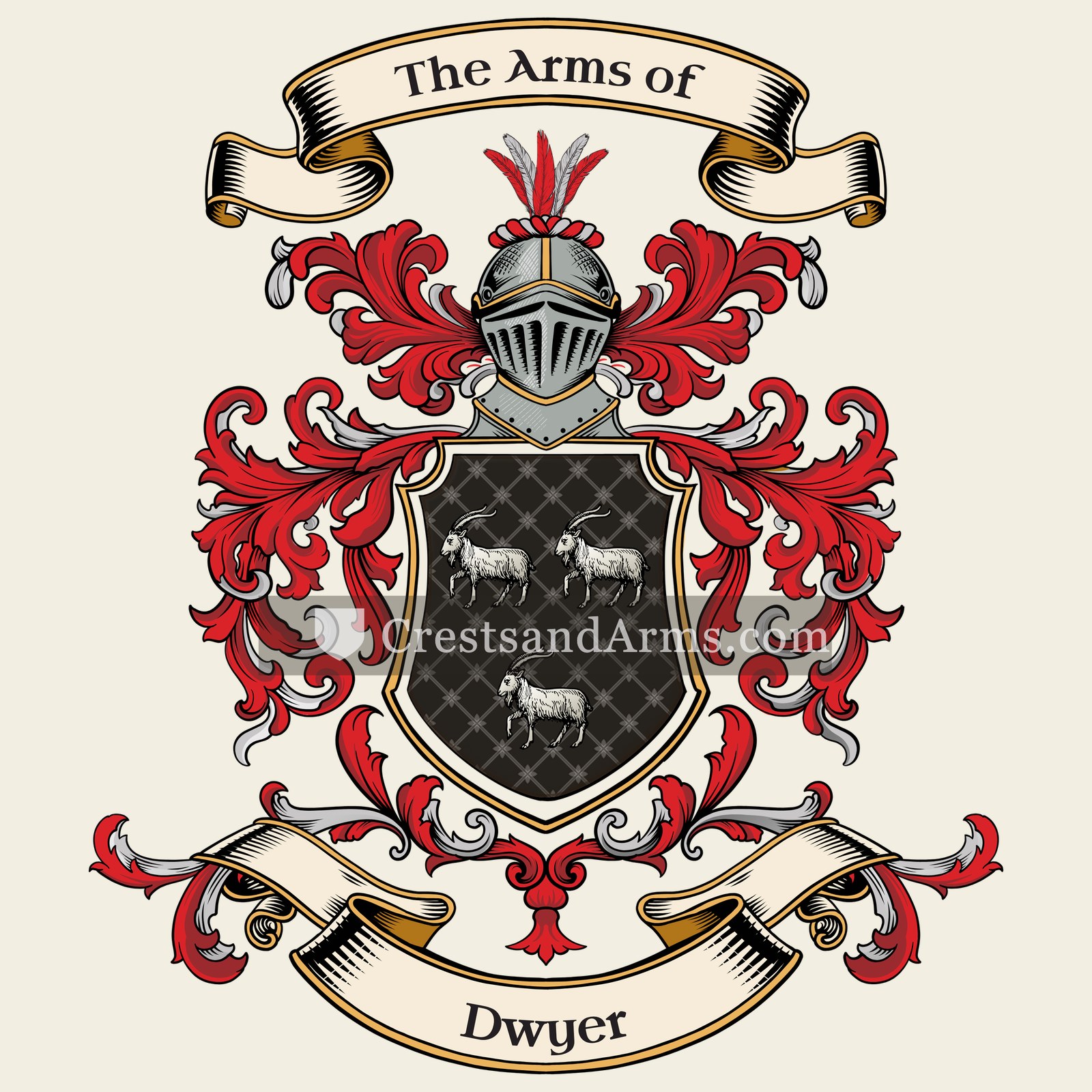
Symbols on this shield
goatOne who wins by diplomacy rather than force
Colours
Black (Sable)Means: Constancy
Silver (Argent)Means: Peace and sincerity
Historical info
Source
Sir Bernard Burke, The General Armory of England, Scotland, Ireland and Wales, London: Harrison & Sons, 1884
Blazon (the actual original written record)
“Sa. three goats pass. ar. attired or”
HertfordAldebury · Hertford, c. 1575
Digital archive packCoat of arms PNG, gold border print PDF, vector SVG and the certificate of authenticity. Sent to your email in minutes.
Map of England showing where the Dwyer arms are recorded
The Dwyer arms were recorded in Hertford, c. 1575.
Hertfordshire lay just north of London and filled with families who had made money in the City. Buying an estate within a day's ride was the usual next step, and an estate brought arms with it.
This is where the arms were entered in the register. Families often moved to other parts of the country, so the same name can turn up in more than one region.
The body that granted and recorded arms in England in this period.
Elizabeth I of England
Sovereign of the period
Elizabeth I of England
1558–1603
Reigning in France when the Dwyer arms are first recorded.
How Arms Worked in England
English heraldry allowed arms to be shared by all legitimate descendants of the original owner. These symbols were treated as personal property that moved through the generations to all children. While the eldest son kept the original design, other family members could use the same shield without needing to change it or register their own unique versions.
Granting authority
The College of Arms in London has regulated the use of coats of arms throughout England and Wales since 1484.
How they got arms
Families typically obtained their coats of arms through a formal grant from the Crown or by proving their ancient right to them.
Where arms were recorded
All official coats of arms are recorded in the registers kept at the College of Arms, which date back to the fifteenth century.
The family's standing
Recorded among the armigerous families of Hertford.
Origin & History of the Dwyer Family in England
The family name Dwyer has deep roots that stretch back to the sixteenth century in the English county of Hertfordshire. Records confirm that members of the family were established in the town of Hertford by 1575. During this period, the name was often spelled in various ways as standardized spelling did not yet exist. Families like the Dwyers were typically part of the local community of tradespeople or farmers who helped shape the growth of the region. By living in a market town like Hertford, these early ancestors were likely involved in the local economy and the daily life of the English countryside. Over time, the family became a settled part of the local population, contributing to the social fabric of the area for generations.
Dwyer Meaning & Related Branches
Root word
Dubhuidhir
Derived from the Gaelic words for black and dark-colored.
This name
DwyerAn anglicized Irish surname signifying a descendant of the dark-haired or swarthy person.
also spelled
Dyar
Dier
Dyerre
Documented Sources
J. B. Rietstap, Armorial Général, Gouda: G. B. van Goor Zonen, 1884–87
Canny, Nicholas, Making Ireland British, 1580–1650, 2001
The National Archives (UK), Middlesex Quarter Sessions Records, 1678
Wigoder, Geoffrey, The Oxford Dictionary of Jewish Names and Their History (for context on surname migration patterns), 2002
Digital archive packCoat of arms PNG, gold border print PDF, vector SVG and the certificate of authenticity. Sent to your email in minutes.


 chiefAuthority, wisdom and dominion
 chiefAuthority, wisdom and dominion
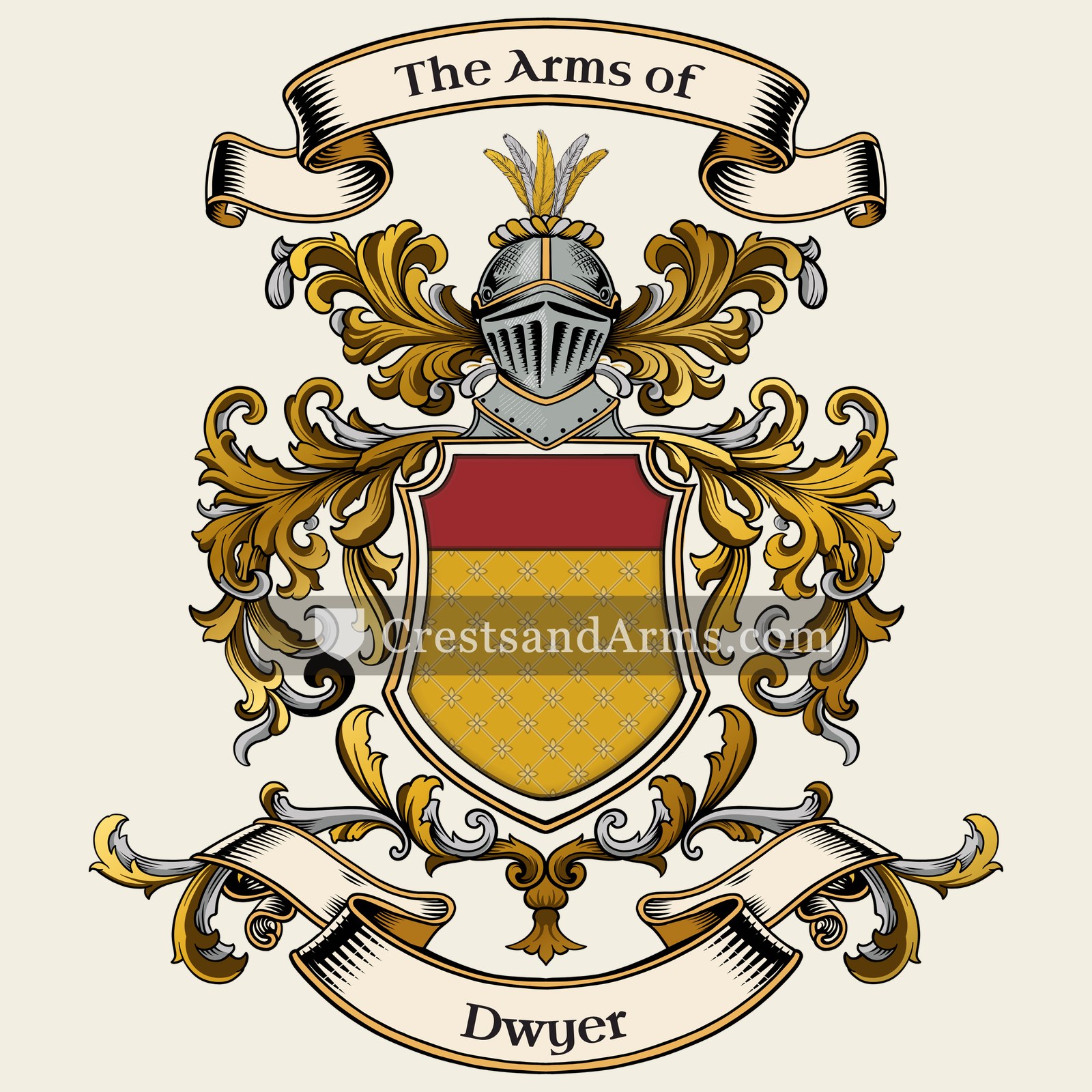


 goatOne who wins by diplomacy rather than force