Map of France showing where the Dyer arms are recorded
The Dyer arms were recorded in Middlesex, c. 1678.
Middlesex was the county around London, and City money flowed straight into it. Merchants and officials bought estates within reach of the capital, and a new estate brought a coat of arms with it.
This is where the arms were entered in the register. Families often moved to other parts of the country, so the same name can turn up in more than one region.
The body that granted and recorded arms in France in this period.
Louis XIV of France
Sovereign of the period
Louis XIV of France
1643–1715
Reigning in France when the Dyer arms are first recorded.
How Arms Worked in France
In France, a coat of arms was a mark of honor that passed down through the male line to all legitimate descendants. Families often used the same shield without changes to show their shared heritage. If a branch wanted to stand out, they could add a small mark to their shield to show their specific place in the family tree.
Granting authority
The Juge d'armes de France acted as the official authority that regulated and verified coats of arms across the country.
How they got arms
Families typically inherited their arms from ancestors, though they could also receive them through royal grants or by proving their noble status.
Where arms were recorded
Coats of arms were officially recorded in the Armorial Général de France, which began its main collection in the year 1696.
The family's standing
Recorded among the armigerous families of Middlesex.
Origin & History of the Dyer Family in France
The family name Dyer has roots that reach back to the medieval period in France, where it often functioned as an occupational surname. In the French language, the name was historically linked to the word *teinturier*, which identified a person who worked in the trade of dyeing fabrics. As the textile industry grew in importance across European trade centers, individuals who mastered the complex chemistry of pigments and color fixation became essential members of their communities. By the time members of the family were recorded in Middlesex in 1678, they were part of a broader movement of people who carried their professional skills and ancestral identities across borders. This transition from a French trade title to a stable family name reflects how common labor and craftsmanship helped shape the surnames we recognize today.
Meaning of the Dyer family crest colors & symbols
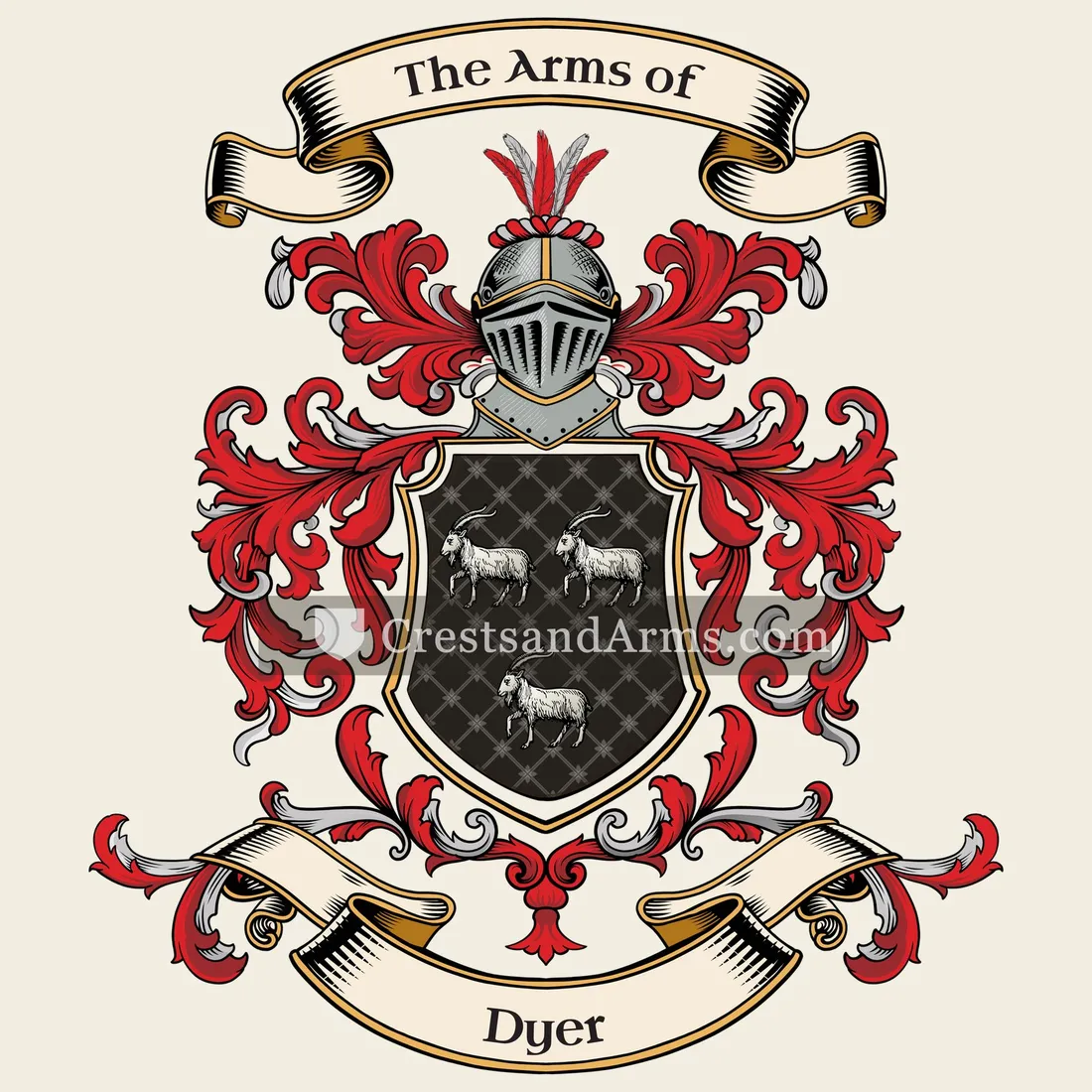
Symbols on this shield
goatOne who wins by diplomacy rather than force
Colours
Black (Sable)Means: Constancy
Silver (Argent)Means: Peace and sincerity
Historical info
Source
Sir Bernard Burke, The General Armory of England, Scotland, Ireland and Wales, London: Harrison & Sons, 1884
Blazon (the actual original written record)
“Sa. three goats pass. ar. attired or”
HertfordAldebury · Hertford, c. 1575
Digital archive packCoat of arms PNG, gold border print PDF, vector SVG and the certificate of authenticity. Sent to your email in minutes.
Map of England showing where the Dyer arms are recorded
The Dyer arms were recorded in Hertford, c. 1575.
Hertfordshire lay just north of London and filled with families who had made money in the City. Buying an estate within a day's ride was the usual next step, and an estate brought arms with it.
This is where the arms were entered in the register. Families often moved to other parts of the country, so the same name can turn up in more than one region.
The body that granted and recorded arms in England in this period.
Elizabeth I of England
Sovereign of the period
Elizabeth I of England
1558–1603
Reigning in France when the Dyer arms are first recorded.
How Arms Worked in England
English heraldry allowed arms to be shared by all legitimate descendants of the original owner. These symbols were treated as personal property that moved through the generations to all children. While the eldest son kept the original design, other family members could use the same shield without needing to change it or register their own unique versions.
Granting authority
The College of Arms in London has regulated the use of coats of arms throughout England and Wales since 1484.
How they got arms
Families typically obtained their coats of arms through a formal grant from the Crown or by proving their ancient right to them.
Where arms were recorded
All official coats of arms are recorded in the registers kept at the College of Arms, which date back to the fifteenth century.
The family's standing
Recorded among the armigerous families of Hertford.
Origin & History of the Dyer Family in England
The surname Dyer is an occupational name that emerged in medieval England to identify individuals who worked in the textile industry. During this era, a dyer was a skilled craftsman responsible for coloring fabrics using natural pigments derived from plants, minerals, and insects. Because vibrant cloth was a sign of status and wealth, these workers were essential to the local economy of English market towns. By the time the family was firmly established in Hertford in 1575, the name had become a permanent fixture of the community. Records from this period show that families with this name were often integrated into the social and economic life of their parishes, frequently appearing in local tax rolls and church registers as the town grew into a center for trade and governance.
Dyer Meaning & Related Branches
Root word
tingere
Latin verb meaning to dye, stain, or color.
This name
DyerAn occupational surname for a person who worked as a dyer of cloth.
also spelled
Dyar
Dier
Dyerre
Related arms
Dyrevariant spelling
Hobsonrecorded with Dyer, same area
Phesantrecorded with Dyer, same area
Smythsonrecorded with Dyer, same area
Documented Sources
J. B. Rietstap, Armorial Général, Gouda: G. B. van Goor Zonen, 1884–87
Dauzat, Albert, Dictionnaire étymologique des noms de famille et prénoms de France, 1951
Middlesex County Archives, Middlesex County Court Records, 1678
Morlet, Marie-Thérèse, Dictionnaire étymologique des noms de famille, 1991
Digital archive packCoat of arms PNG, gold border print PDF, vector SVG and the certificate of authenticity. Sent to your email in minutes.


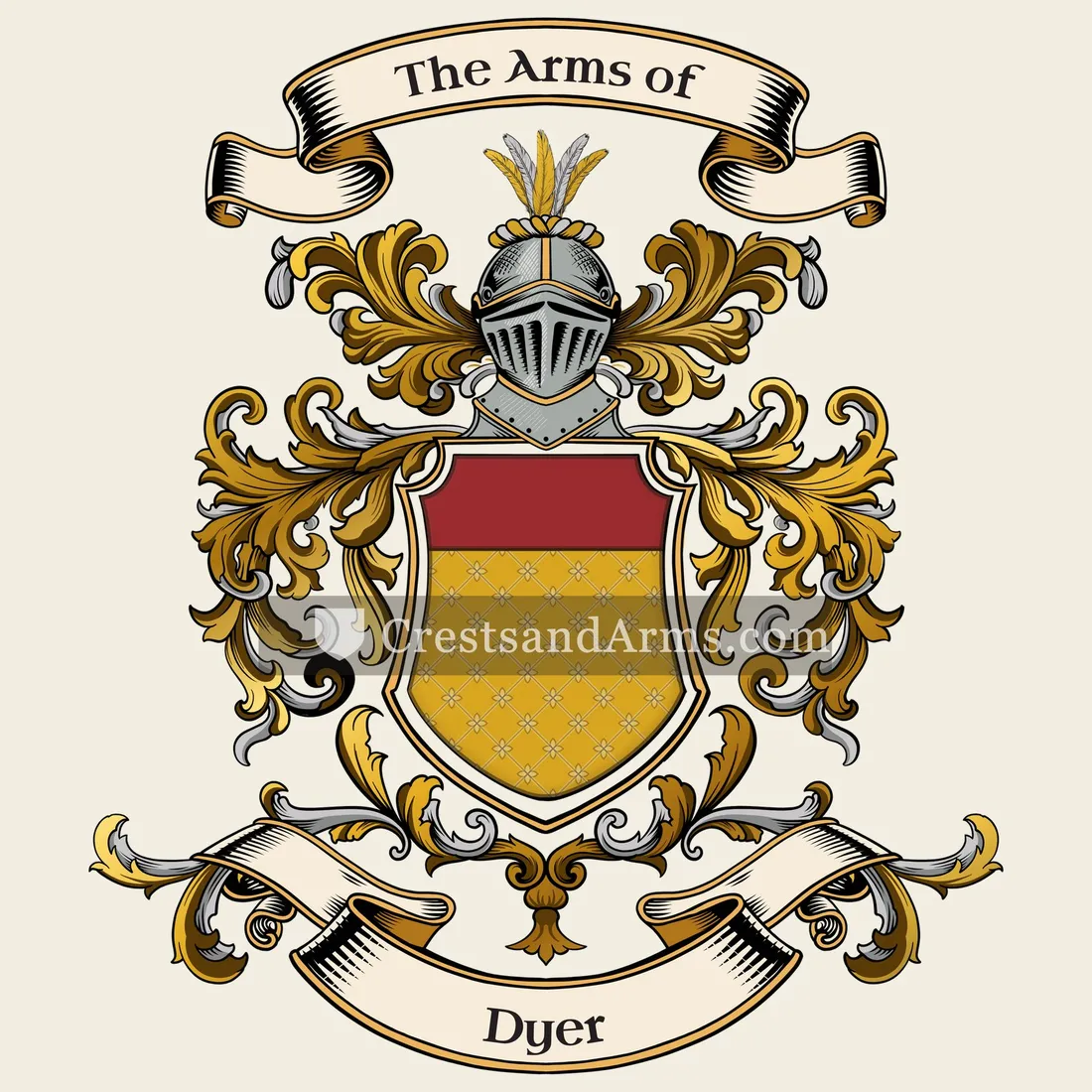
 chiefAuthority, wisdom and dominion
 chiefAuthority, wisdom and dominion


 goatOne who wins by diplomacy rather than force