A record of documented arms, meaning and origin, researched for the Dyk family lines. Documented in 3 countries.
Reg. 9568 · German, D–F
Coat of Arms & Family Crest Details
Symbols on this shield
lionCourage, strength and royalty
griffinValour and vigilance, guarding great treasure
Colours
Gold (Or)Means: Generosity
Black (Sable)Means: Constancy
Historical info
Source
J. B. Rietstap, Armorial Général, Gouda: G. B. van Goor Zonen, 1884–87
Blazon (the actual original written record)
“D'or au lion de sa., ayant deux têtes de griffon adossées du même, bq. et languées de gu., coll. d'une couronne renv. d'or. C.: le lion de l'écu, iss. (d'or.”
GermanySpire, c. 1532
Digital archive packCoat of arms PNG, gold border print PDF, vector SVG and the certificate of authenticity. Sent to your email in minutes.
Map of Germany showing where the Dyk arms are recorded
The Dyk arms were recorded in Spire, c. 1532.
This is where the arms were entered in the register. Families often moved to other parts of the country, so the same name can turn up in more than one region.
The body that granted and recorded arms in Germany in this period.
Charles V
Sovereign of the period
Charles V
1519–1556
Reigning in Germany when the Dyk arms are first recorded.
How Arms Worked in Germany
In the Holy Roman Empire, coats of arms were often granted to individuals by the Emperor or his representatives. These arms were then passed down through the generations to all legitimate descendants of the original holder. Younger branches of a family usually kept the same shield design without needing to change it, as the arms belonged to the entire lineage.
Granting authority
The Holy Roman Emperor held the sole power to grant new coats of arms throughout his vast imperial territories.
How they got arms
Families typically obtained their coats of arms through a formal imperial grant or by proving their noble status to the authorities.
Where arms were recorded
These grants were officially recorded in the Imperial Chancery registers, which began keeping formal records of such honors during the Middle Ages.
The family's standing
Recorded among the armigerous families of Germany.
Origin & History of the Dyk Family in Germany
The family name Dyk finds its roots in the linguistic landscape of medieval Germany, where it functioned as a topographic surname. In the German language, the term *Dyk* or *Deich* refers to a dike or an embankment built to hold back water. This suggests that the earliest ancestors bearing this name likely lived near or worked on the construction and maintenance of these vital flood-control structures in low-lying regions. By 1532, historical records confirm the presence of the family in the city of Speyer. During this period, Speyer was a prominent center of the Holy Roman Empire, serving as a frequent meeting place for the Imperial Diet. Living in such a significant urban hub indicates that the family was likely integrated into the professional or civic life of the city during the transformative era of the Reformation. As the name spread, it evolved alongside the German language, reflecting both the geographical surroundings and the practical occupations of those who first adopted it as their family identifier.
Coat of Arms & Family Crest Details
Symbols on this shield
mulletThe third son, and a divine quality from above
stagPeace and harmony, and one who will not fight unprovoked
Colours
ErmineMeans: Dignity
Red (Gules)Means: Military strength
Historical info
Source
Sir Bernard Burke, The General Armory of England, Scotland, Ireland and Wales, London: Harrison & Sons, 1884
Blazon (the actual original written record)
“Erm. a fesse az. betw. two mullets in chief and a hart's head erased with ten tynes in base gu”
EdinburghPrestonfield · Edinburgh, c. 1677
Digital archive packCoat of arms PNG, gold border print PDF, vector SVG and the certificate of authenticity. Sent to your email in minutes.
Map of Scotland showing where the Dyk arms are recorded
The Dyk arms were recorded in Edinburgh, c. 1677.
Edinburgh was the seat of Scotland's government, its courts and its heralds. Families with business there settled nearby, and being close to where arms were recorded is exactly why so many of them appear.
This is where the arms were entered in the register. Families often moved to other parts of the country, so the same name can turn up in more than one region.
The body that granted and recorded arms in Scotland in this period.
Charles II of England
Sovereign of the period
Charles II of England
1660–1685
Reigning in Germany when the Dyk arms are first recorded.
How Arms Worked in Scotland
Scottish heraldry is unique because it treats a coat of arms as a piece of personal property protected by law. Only one person can own a specific design at any given time. When a family grows, the head keeps the original shield while other relatives must apply for their own distinct version with slight changes to prove their specific identity.
Granting authority
The Court of the Lord Lyon acts as the official body that regulates and controls all heraldic matters throughout Scotland.
How they got arms
Individuals obtain a legal right to their arms through a formal petition process that confirms their identity and family connection.
Where arms were recorded
All valid coats of arms are officially entered into the Public Register of All Arms and Bearings starting from 1672.
The family's standing
Recorded among the armigerous families of Edinburgh.
Origin & History of the Dyk Family in Scotland
The family name Dyk has deep roots in the urban landscape of seventeenth-century Scotland. By the year 1677, records confirm that members of the family were established residents of Edinburgh. During this period, Edinburgh was a bustling center of trade and legal activity, and families with this name were likely integrated into the city’s growing professional and merchant classes. The name itself is thought to be topographical, originating from the Middle Dutch or Middle Low German word for a dike or embankment. This suggests that the family’s ancestors may have been skilled in land management or lived near significant water barriers before migrating to the Scottish capital. As they settled into the social fabric of Edinburgh, these early individuals contributed to the city's development during a time of significant political and cultural transition in Scotland.
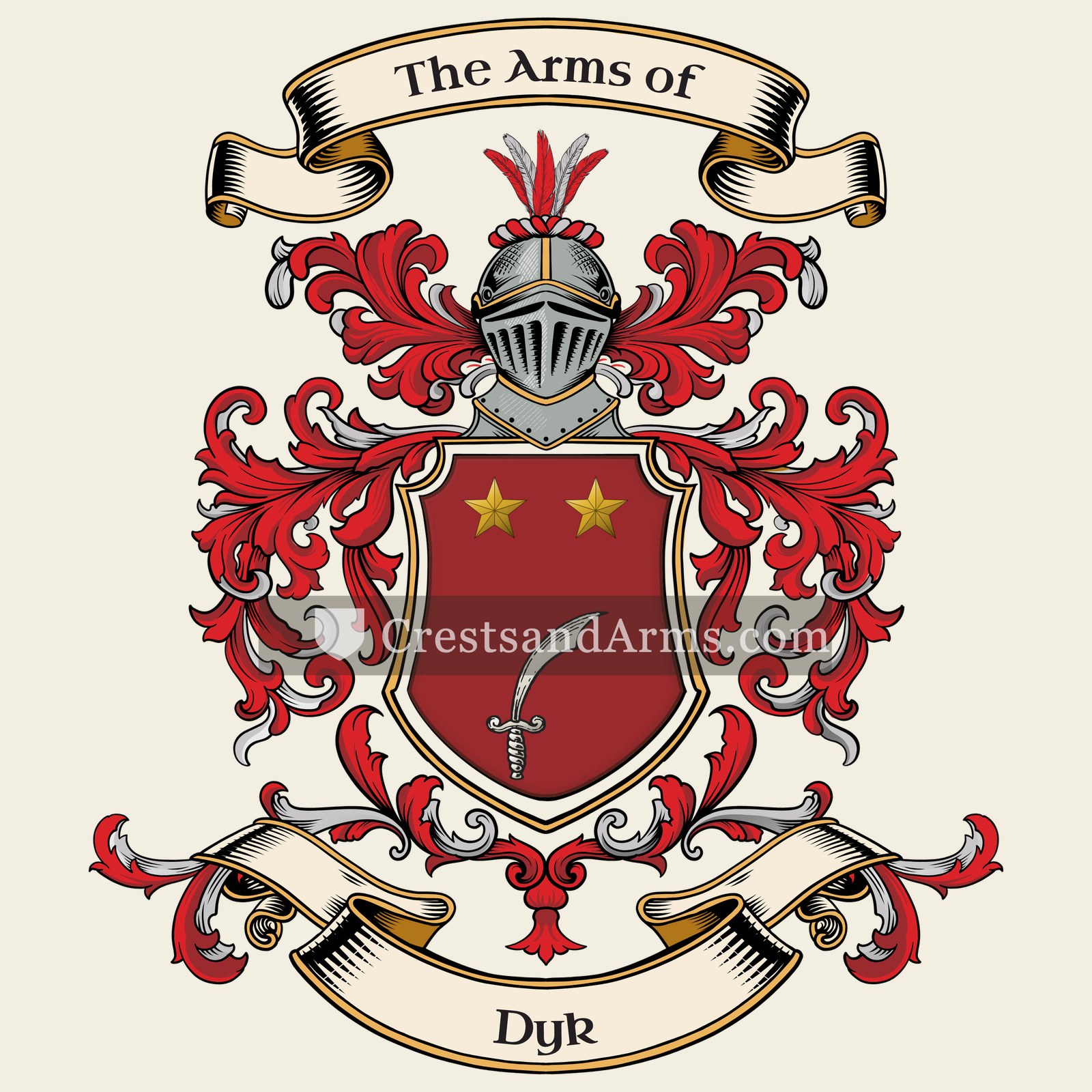
Coat of Arms & Family Crest Details
Symbols on this shield
swordJustice, and military honour
mulletThe third son, and a divine quality from above
Colours
Red (Gules)Means: Military strength
Silver (Argent)Means: Peace and sincerity
Gold (Or)Means: Generosity
Historical info
Source
Sir Bernard Burke, The General Armory of England, Scotland, Ireland and Wales, London: Harrison & Sons, 1884
Blazon (the actual original written record)
“Gu. a sword in pale ar. pommel and hilt or, in chief two mullets of the last”
DerryDerry, c. 1812
Digital archive packCoat of arms PNG, gold border print PDF, vector SVG and the certificate of authenticity. Sent to your email in minutes.
Map of Ireland showing where the Dyk arms are recorded
The Dyk arms were recorded in Derry, c. 1812.
This is where the arms were entered in the register. Families often moved to other parts of the country, so the same name can turn up in more than one region.
The body that granted and recorded arms in Ireland in this period.
George III of Great Britain
Sovereign of the period
George III of Great Britain
1801–1820
Reigning in Germany when the Dyk arms are first recorded.
How Arms Worked in Ireland
The Ulster King of Arms granted coats of arms to individuals who proved their social standing and good character. These symbols were typically inherited by all legitimate descendants of the original holder. If a family branch wanted a unique look, they could apply for a specific change to their design through the office to ensure their identity remained distinct.
Granting authority
The Ulster King of Arms acted as the official body that regulated and issued all coats of arms throughout Ireland.
How they got arms
Families obtained their arms through formal grants issued by the office after proving their eligibility and paying the required fees.
Where arms were recorded
All official grants were recorded in the registers held by the Ulster King of Arms starting from the year 1552.
The family's standing
Recorded among the armigerous families of Derry.
Origin & History of the Dyk Family in Ireland
The history of the Dyk family in Ireland is closely tied to the shifting social landscape of County Derry during the early nineteenth century. By 1812, records confirm that members of the family were already established in this region, which was a hub for trade and agricultural development. The name itself likely arrived in Ireland through migration patterns linked to the movement of people between the British Isles and the Low Countries, where the name originated as a descriptive term for someone living near a dike or embankment. As these families settled in the north of Ireland, they often integrated into the local community by participating in the linen industry or tenant farming, which were the primary economic drivers of the time. Over the decades, the family name adapted to the local dialect and spelling conventions, eventually becoming a distinct part of the regional history of Derry. Their presence in the area during this period reflects the broader trend of families seeking new opportunities in the growing urban and rural centers of Ulster.
Dyk Meaning & Related Branches
Root word
dijk
A barrier or embankment constructed to prevent flooding.
This name
DykA topographic name for someone who lived near a dike or embankment.
also spelled
Dyk
Dik
Dyke
Documented Sources
J. B. Rietstap, Armorial Général, Gouda: G. B. van Goor Zonen, 1884–87
Bader, Karl S., Der deutsche Südwesten in seiner territorialstaatlichen Entwicklung, 1950
Stadtarchiv Speyer, Ratsprotokolle der Stadt Speyer, 1532
Heintze, Albert, Die deutschen Familiennamen: geschichtlich, geographisch, sprachlich, 1903
Digital archive packCoat of arms PNG, gold border print PDF, vector SVG and the certificate of authenticity. Sent to your email in minutes.


 lionCourage, strength and royalty
 griffinValour and vigilance, guarding great treasure
 lionCourage, strength and royalty
 griffinValour and vigilance, guarding great treasure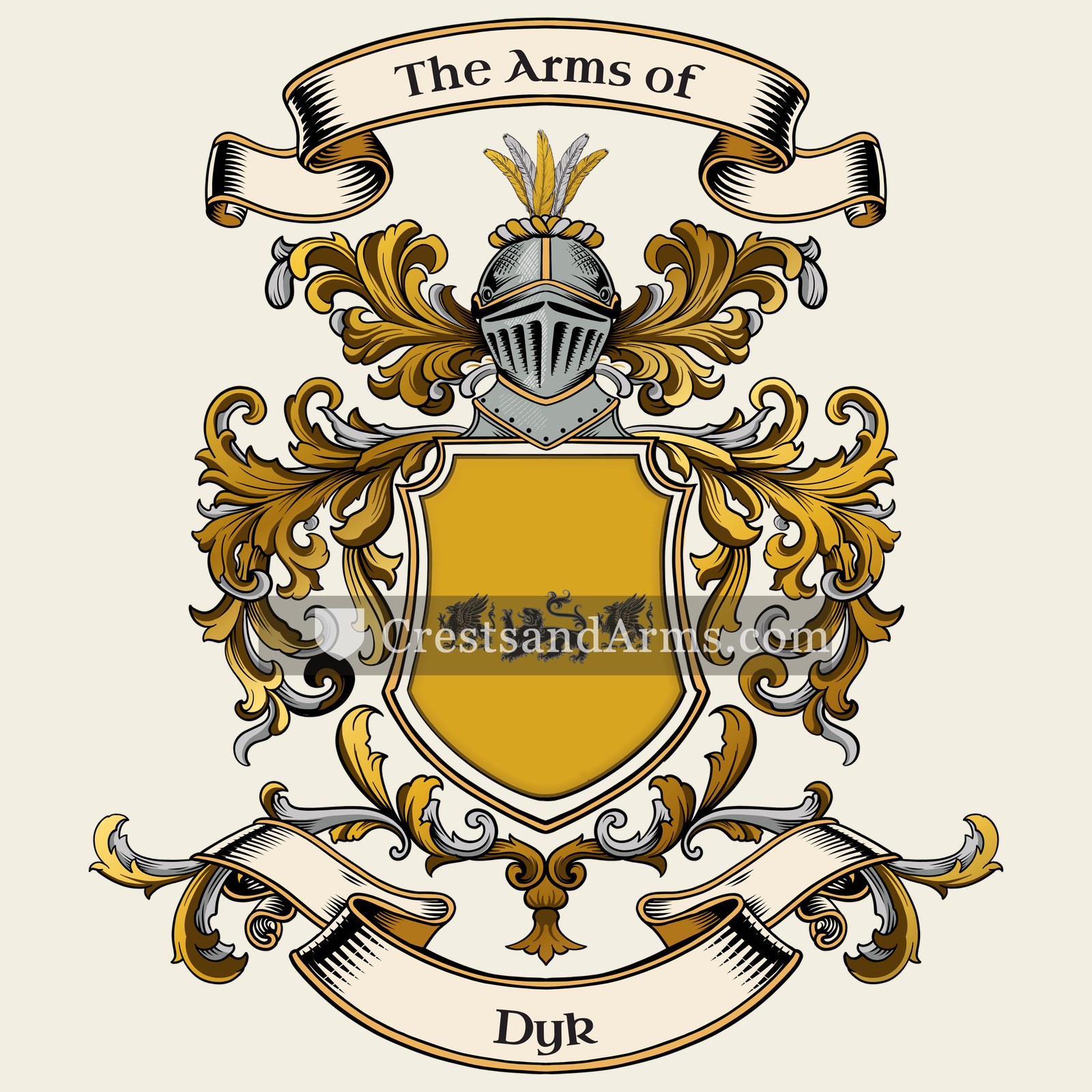


 mulletThe third son, and a divine quality from above
 stagPeace and harmony, and one who will not fight unprovoked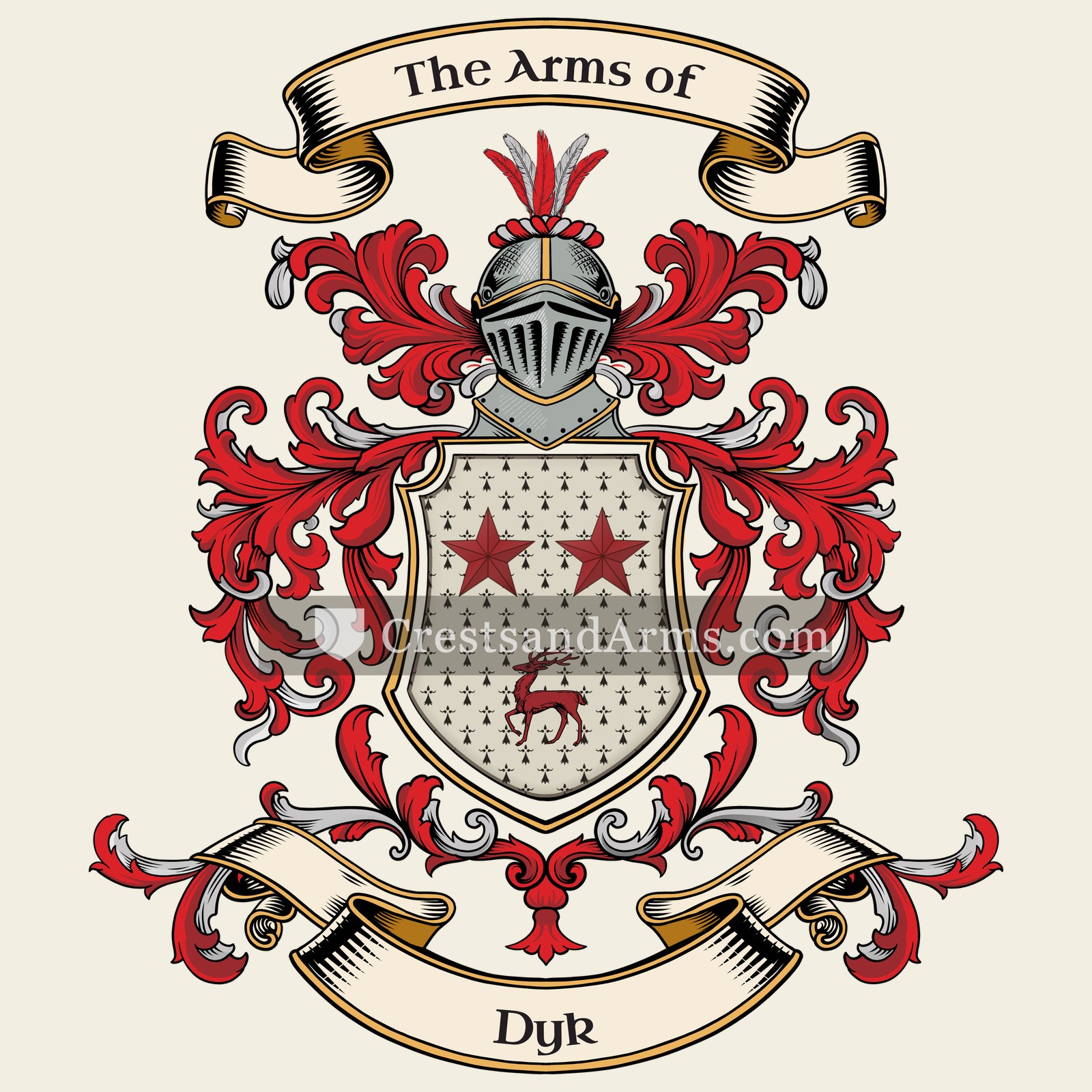


 swordJustice, and military honour