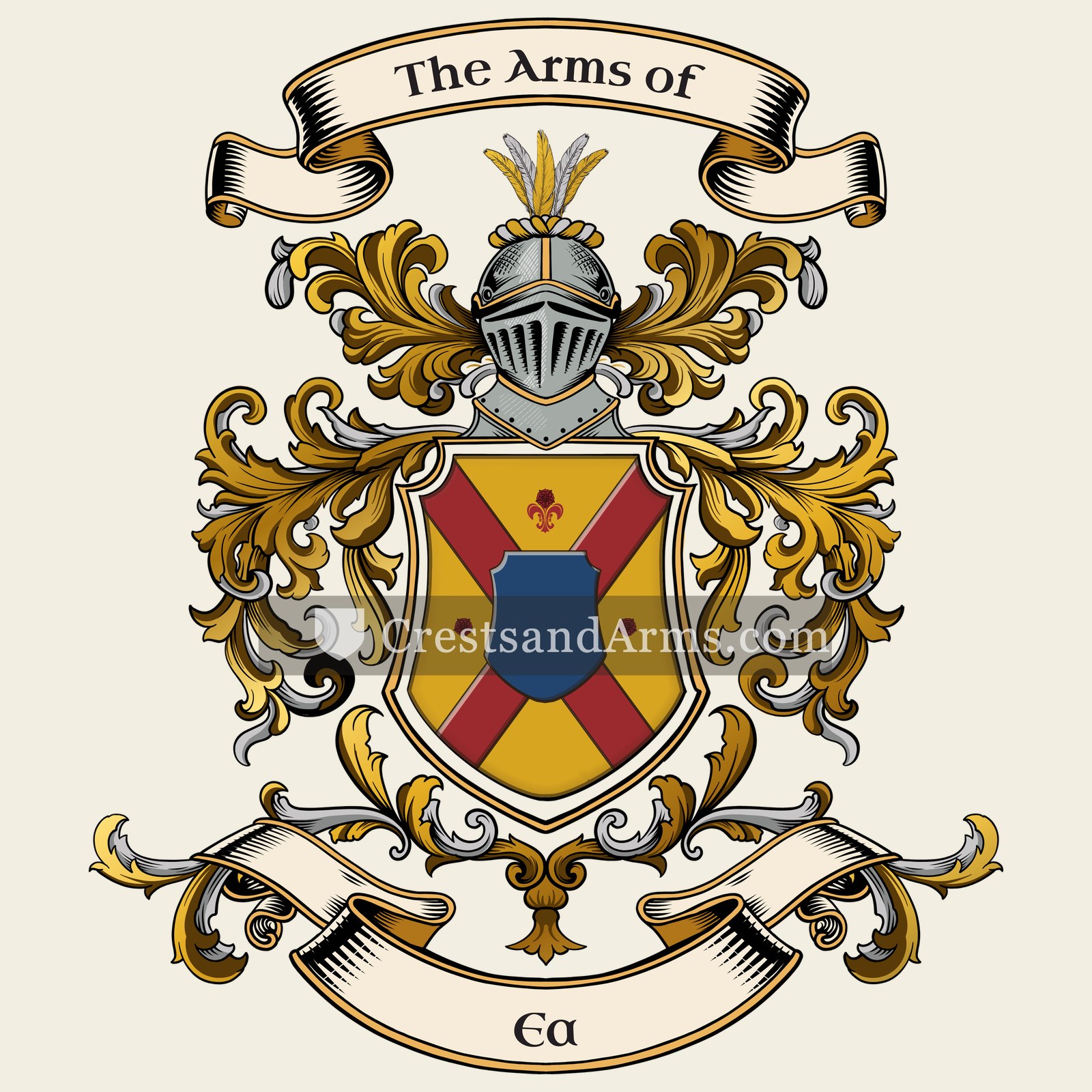
A record of documented arms, meaning and origin, researched for the Ea family of Germany.
Reg. 0222 · German, D–F
Coat of Arms & Family Crest Details
Symbols on this shield
saltireResolution, and St Andrew's cross
fleur de lisPurity, light, and the sixth son
roseThe seventh son, and beauty with grace
Colours
Gold (Or)Means: Generosity
Red (Gules)Means: Military strength
Blue (Azure)Means: Loyalty and truth
Historical info
Source
J. B. Rietstap, Armorial Général, Gouda: G. B. van Goor Zonen, 1884–87
Blazon (the actual original written record)
“D'or au saut., acc. d'une fleur-de-lis en chef et de trois roses, 2 en flancs et 1 en p., le tout de gu. Sur le tout d'azur à un palmier au nat., iss. d'une eau d'arg. Deux cq. cour. C.: 1° trois pl. d'aut., une d'arg. entre deux d'azur: 1. d'arg. et d'azur; 2° une rose de gu., entre un vol du même; l. d'or et de gu.”
HesseHesse, c. 1765
Digital archive packCoat of arms PNG, gold border print PDF, vector SVG and the certificate of authenticity. Sent to your email in minutes.
Map of Germany showing where the Ea arms are recorded
The Ea arms were recorded in Hesse, c. 1765.
Hesse was central German country, divided among a large number of small landowners and prosperous towns. So many separate households held ground there that the region produced an unusual number of coats of arms.
This is where the arms were entered in the register. Families often moved to other parts of the country, so the same name can turn up in more than one region.
The body that granted and recorded arms in Germany in this period.
Francis I, Holy Roman Emperor
Sovereign of the period
Francis I, Holy Roman Emperor
1745–1765
Reigning in Germany when the Ea arms are first recorded.
How Arms Worked in Germany
In the Holy Roman Empire, coats of arms were often granted to individuals by the Emperor or his representatives. These arms were then passed down through the generations to all legitimate descendants of the original holder. Younger branches of a family usually kept the same shield design without needing to change it, as the arms belonged to the entire lineage.
Granting authority
The Holy Roman Emperor held the sole power to grant new coats of arms throughout his vast imperial territories.
How they got arms
Families typically obtained their coats of arms through a formal imperial grant or by proving their noble status to the authorities.
Where arms were recorded
These grants were officially recorded in the Imperial Chancery registers, which began keeping formal records of such honors during the Middle Ages.
The family's standing
Recorded among the armigerous families of Hesse.
Origin & History of the Ea Family in Germany
The family name Ea traces its historical roots to the region of Hesse, Germany, where records confirm the presence of family members as early as 1765. During the eighteenth century, Hesse was a collection of territories defined by agricultural traditions and small village communities. Families with short, distinct names like Ea often lived in rural areas where they were deeply connected to the local landscape and the rhythms of seasonal farming. Because the name is quite brief, it likely evolved from a specific local dialect or served as a shorthand for a longer regional name that was common in the Hessian countryside. As these early ancestors moved through the German states, they participated in the social and economic shifts of the era, eventually establishing a legacy that persisted through generations of regional change.
Ea Meaning & Related Branches
Root word
Aue
A meadow or land situated near a body of water.
This name
EaA topographic name for someone who lived near a river or wetland area.
also spelled
Eaux
Deau
Ea
O
Documented Sources
J. B. Rietstap, Armorial Général, Gouda: G. B. van Goor Zonen, 1884–87
Hessisches Staatsarchiv Marburg, Kirchenbücher der Pfarrei (Parish registers of the parish), 1765
Knetsch, Carl, Die hessische Landesgeschichte (The regional history of Hesse), 1929
Digital archive packCoat of arms PNG, gold border print PDF, vector SVG and the certificate of authenticity. Sent to your email in minutes.


 saltireResolution, and St Andrew's cross
 fleur de lisPurity, light, and the sixth son
 roseThe seventh son, and beauty with grace
 saltireResolution, and St Andrew's cross
 fleur de lisPurity, light, and the sixth son
 roseThe seventh son, and beauty with grace