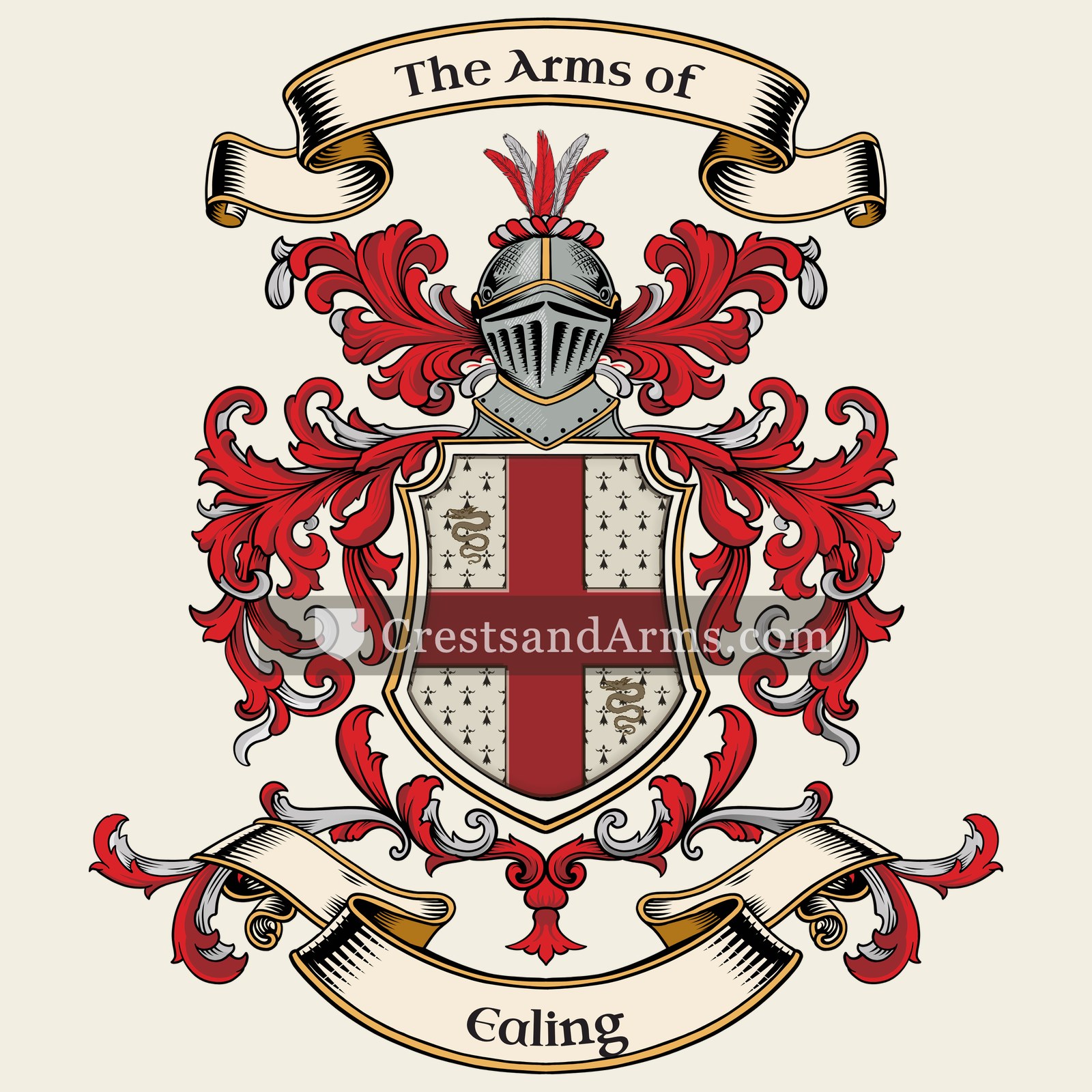
A record of documented arms, meaning and origin, researched for the Ealing family of France.
Reg. 2261 · French, D–F
Coat of Arms & Family Crest Details
Symbols on this shield
cross symbolChristian faith and service
serpentWisdom, healing and prudence
Colours
ErmineMeans: Dignity
Red (Gules)Means: Military strength
Historical info
Source
J. B. Rietstap, Armorial Général, Gouda: G. B. van Goor Zonen, 1884–87
Blazon (the actual original written record)
“D'herm. à la croix écotée de gu., acc. aux 1 et 4 d'un serpent couché au nat., noué en double saut. C.: l'un des serpents de l'écu, devant une tête de griffon d'arg. D.: MENTE ET LABORE.”
MiddlesexMiddlesex, c. 1867
Digital archive packCoat of arms PNG, gold border print PDF, vector SVG and the certificate of authenticity. Sent to your email in minutes.
Map of France showing where the Ealing arms are recorded
The Ealing arms were recorded in Middlesex, c. 1867.
Middlesex was the county around London, and City money flowed straight into it. Merchants and officials bought estates within reach of the capital, and a new estate brought a coat of arms with it.
This is where the arms were entered in the register. Families often moved to other parts of the country, so the same name can turn up in more than one region.
The body that granted and recorded arms in France in this period.
Napoleon III
Sovereign of the period
Napoleon III
1852–1870
Reigning in France when the Ealing arms are first recorded.
How Arms Worked in France
In France, a coat of arms was a mark of honor that passed down through the male line to all legitimate descendants. Families often used the same shield without changes to show their shared heritage. If a branch wanted to stand out, they could add a small mark to their shield to show their specific place in the family tree.
Granting authority
The Juge d'armes de France acted as the official authority that regulated and verified coats of arms across the country.
How they got arms
Families typically inherited their arms from ancestors, though they could also receive them through royal grants or by proving their noble status.
Where arms were recorded
Coats of arms were officially recorded in the Armorial Général de France, which began its main collection in the year 1696.
The family's standing
Recorded among the armigerous families of Middlesex.
Origin & History of the Ealing Family in France
The family name Ealing is deeply rooted in the geography of Middlesex, England. The name itself is derived from the Old English term Gillingas, which refers to the followers or people of a man named Gilla. Over many centuries, this local designation evolved through various spellings such as Illing and Ealling before settling into its modern form. By the mid-19th century, records confirm that families bearing this name were well-established residents of the Middlesex area. These early members of the family were part of a community experiencing rapid industrial and social change as London expanded outward. Their presence in the region during the 1860s reflects a long history of families who lived and worked within the historic boundaries of this county, contributing to the local development of the landscape long before the area became a major suburban center.
Ealing Meaning & Related Branches
Root word
Aegil
An ancient Germanic name element meaning edge or sword point.
This name
EalingDerived from a topographic reference to a place associated with the people of Aegil.
also spelled
Lawrence
Ealing
Lorens Eeling
Documented Sources
J. B. Rietstap, Armorial Général, Gouda: G. B. van Goor Zonen, 1884–87
Gover, J.E.B., Mawer, A., and Stenton, F.M., The Place-Names of Middlesex, apart from the City of London, 1942
Mills, A.D., A Dictionary of London Place Names, 2001
The National Archives, Census Returns of England and Wales, 1861 and 1871, HO 107 and RG 10
Digital archive packCoat of arms PNG, gold border print PDF, vector SVG and the certificate of authenticity. Sent to your email in minutes.


 cross symbolChristian faith and service
 serpentWisdom, healing and prudence
 cross symbolChristian faith and service
 serpentWisdom, healing and prudence