Map of France showing where the Eberlin arms are recorded
The Eberlin arms were recorded in Franche-Comte, c. 1663.
Franche-Comte sat between France and the Empire and changed hands more than once. Border families held their land under arms and expected to defend it, so a shield was a practical thing rather than an ornament.
This is where the arms were entered in the register. Families often moved to other parts of the country, so the same name can turn up in more than one region.
The body that granted and recorded arms in France in this period.
Louis XIV of France
Sovereign of the period
Louis XIV of France
1643–1715
Reigning in France when the Eberlin arms are first recorded.
How Arms Worked in France
In France, a coat of arms was a mark of honor that passed down through the male line to all legitimate descendants. Families often used the same shield without changes to show their shared heritage. If a branch wanted to stand out, they could add a small mark to their shield to show their specific place in the family tree.
Granting authority
The Juge d'armes de France acted as the official authority that regulated and verified coats of arms across the country.
How they got arms
Families typically inherited their arms from ancestors, though they could also receive them through royal grants or by proving their noble status.
Where arms were recorded
Coats of arms were officially recorded in the Armorial Général de France, which began its main collection in the year 1696.
The family's standing
Recorded among the armigerous families of Franche-Comte.
Origin & History of the Eberlin Family in France
The surname Eberlin is deeply rooted in the Germanic linguistic tradition, derived from the Old High German name Eberhard, which combines the words for wild boar and brave or strong. While the name originated in Germanic regions, the family established a notable presence in the Franche-Comté region of eastern France by 1663. During this period, the area was a complex borderland that had recently transitioned from Spanish Habsburg control to French rule. Families like the Eberlins often served as local administrators, craftsmen, or landholders who navigated the cultural shifts between the German-speaking territories and the French kingdom. Their migration into this specific region suggests a history of movement across European borders, likely driven by the search for economic stability or professional opportunities in the wake of the regional conflicts that defined the seventeenth century.
Eberlin Meaning & Related Branches
Root word
Eberhard
Derived from the Germanic elements for wild boar and brave or strong.
This name
EberlinA diminutive form indicating a descendant of one who is as brave as a wild boar.
also spelled
Eberline
Eberlinn
Eberlinh
Documented Sources
J. B. Rietstap, Armorial Général, Gouda: G. B. van Goor Zonen, 1884–87
Bauer, Richard. Etymologisches Wörterbuch der deutschen Familiennamen. 1994
Gutton, Jean-Pierre. La Franche-Comté au XVIIe siècle. 1973
Archives départementales du Doubs, Série B: Cours et juridictions
Digital archive packCoat of arms PNG, gold border print PDF, vector SVG and the certificate of authenticity. Sent to your email in minutes.


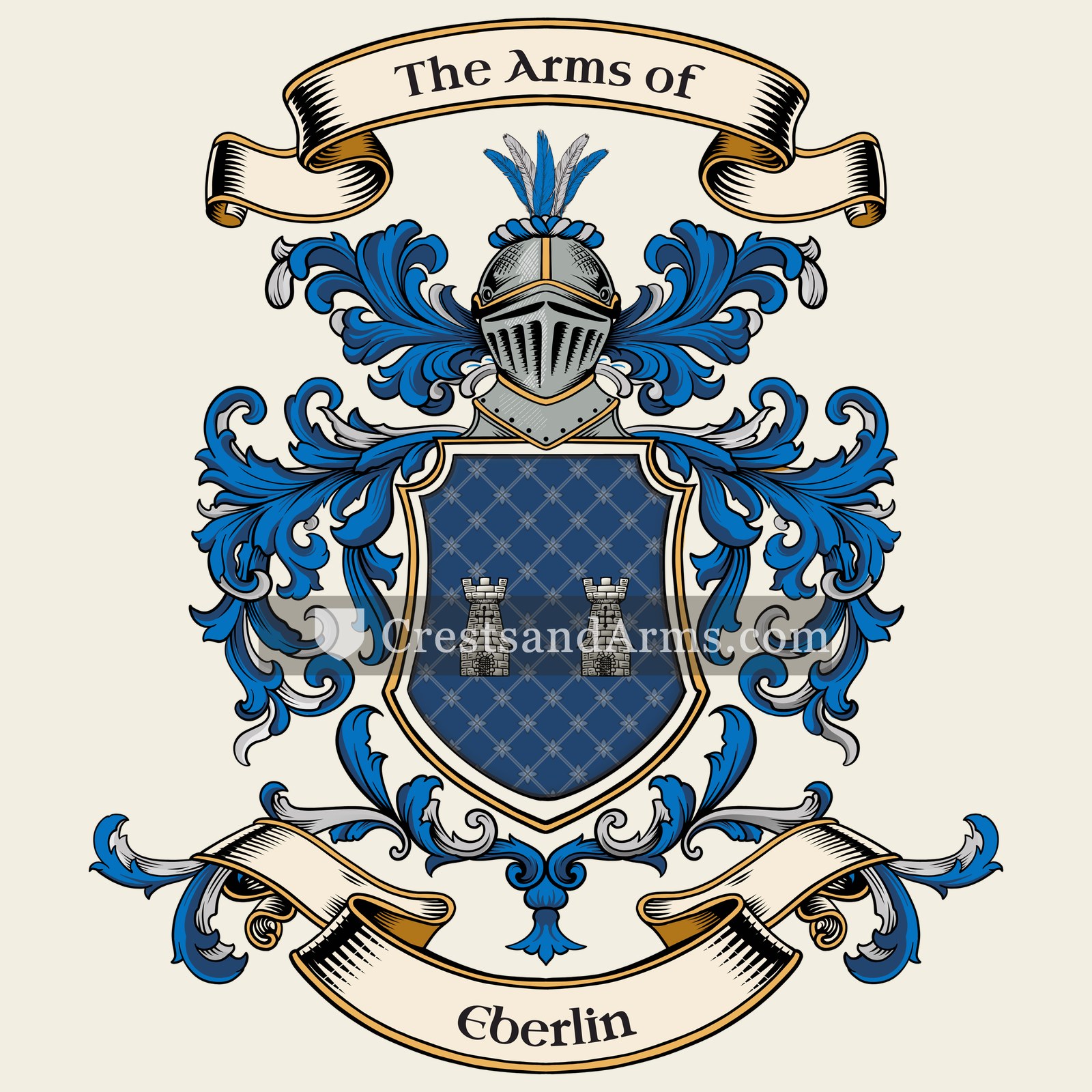
 towerGrandeur and solidity, and a stronghold defended
 towerGrandeur and solidity, and a stronghold defended